Canada's political and business leadership did not anticipate — and how could they have? — that USA leaders would act against their own interest. It was obvious all along that USA doesn't have the smelters to meet aluminum demand.
This shouldn’t be a philosophical debate. It’s a misunderstanding of how infectious disease works.
Vaccines aren’t perfect. The measles vaccine is 97% effective with two doses, not 100%, so some vaccinated people remain vulnerable. More importantly, some people can’t be vaccinated at all: infants under 12 months, immunocompromised patients, people with anaphylactic reactions to vaccine components. They depend on the rest of us not spreading a highly contagious virus to them.
Measles has an R0 of 12-18, meaning each infected person spreads it to 12-18 others in an unvaccinated population. The virus can linger in the air for two hours after an infected person leaves a room. At that level of contagion, you need 92-95% vaccine coverage to stop community transmission. When coverage drops, outbreaks happen, and the people who pay the price are often those who had no choice in the matter.
“My body, my choice” makes sense for decisions that affect only your body. Transmissible disease isn’t that. Your choice not to vaccinate can put a 6-month-old in the hospital or kill an immunocompromised kid who couldn’t get the shot.
The question isn’t “why does it matter if I take it.” The question is whether your comfort with risk should override someone else’s right not to get infected by you.
To the 11th inning.
For as turbulent as it’s been at times with Hoffman pitching, he did his job this evening.
Jays up to bat. I’m still pacing. And thinking about all of the coffee I’m chugging in the morning.
South Korea gender divide update 😲
Young men lean right by 50 points
(74% conservative vs 24% centre-left)
Young women lean left by 22 points
(58% centre-left vs 36% cons)
The Democratic National Convention held its first-ever panel on Palestinian rights Monday, including harrowing testimony from Dr. Tanya Haj-Hassan, who volunteered at a hospital in Gaza earlier this year. "We have witnessed civilian massacre after civilian massacre," she said.
Poilievre's vendetta against carbon pricing serves to shift attention from the larger role of corporations (incl. oil & gas companies, supermarkets, and others) in driving higher prices and the cost of living crisis. For more: https://t.co/iiwf63aPHR..
This is cultural genocide. The Canadian government has removed being born in the state of Palestine as an option on passport renewal process - and people are expected to accept being born stateless moving forward. This is anti-Palestinian racism.
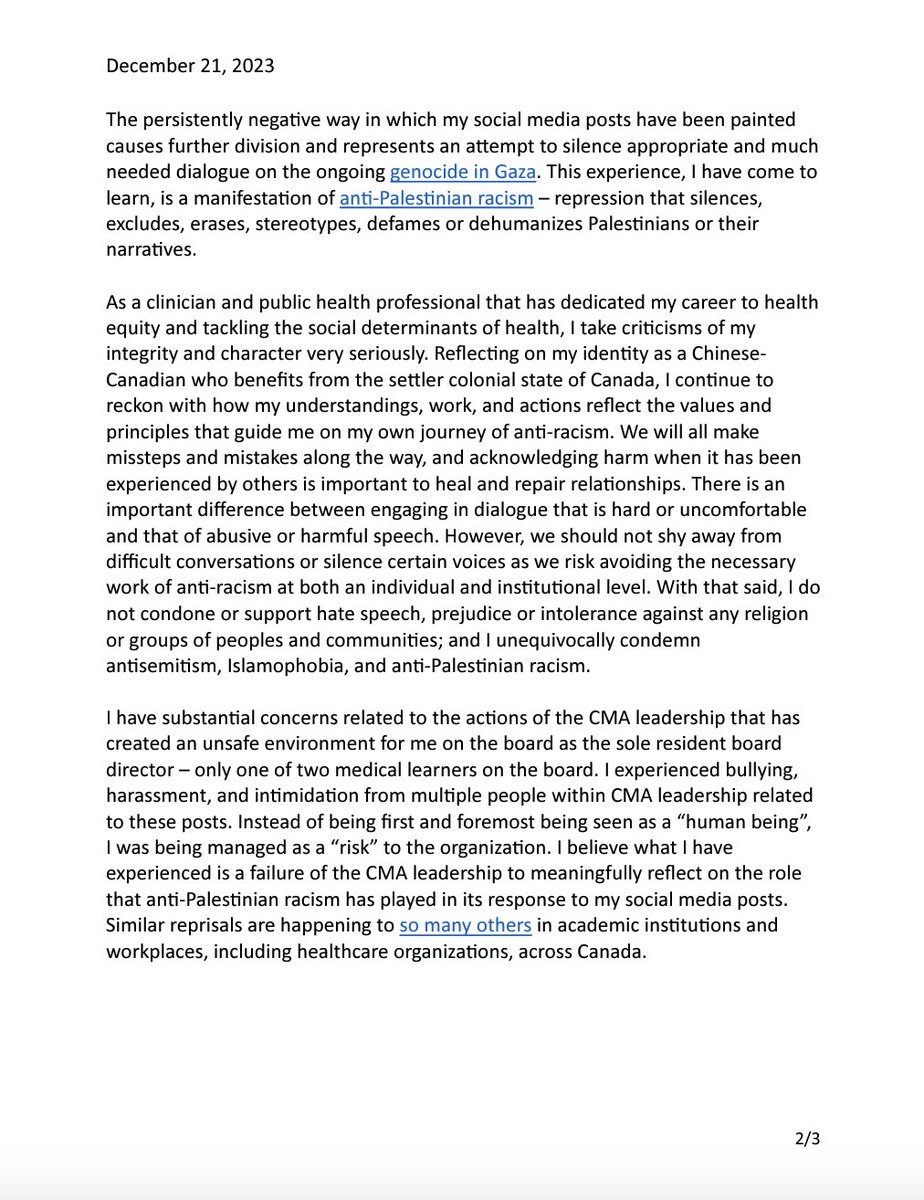
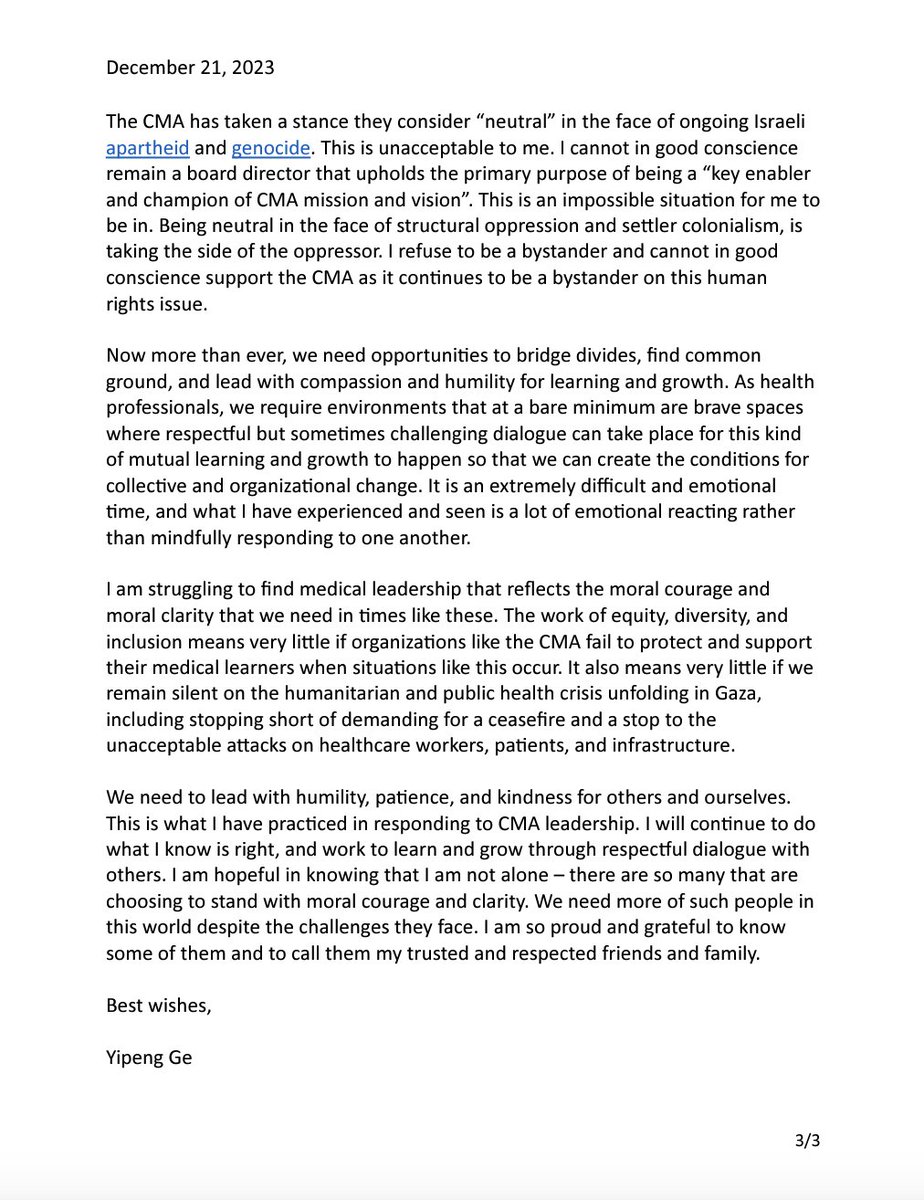
Yesterday, I sent my letter of resignation as a board director to @CMA_Docs. As the national organization that represents physicians and medical learners in Canada, I am profoundly disappointed and appalled by their actions and behaviour.
Link to letter: https://t.co/5JpXUZjDuq
For people who’ve followed Israel-Palestine with eyes wide open for the last 25 yrs, this is just head-nodding stuff from @krystalball.
But for the vast majority of folks traumatized by the horror show in Gaza, this is GAME CHANGING historical context.
Canadians need to ask our government, the rationale behind this devastating decision for Canada’s standing in the world.
From my experience, the 🇺🇸 did not ask us to side w/them.
We did this on our own. But why? Because the cost is enormous, we should be told the reason.
Absolutely masterful interview on Gaza of Dominique De Villepin, former Prime Minister of France, who famously led France's opposition to the Iraq war and who, IMHO is the best diplomat the West has produced in decades.
This is so important, so incredibly well argued, that I decided to translate it in full:
"Hamas has set a trap for us, and this trap is one of maximum horror, of maximum cruelty. And so there's a risk of an escalation in militarism, of more military interventions, as if we could with armies solve a problem as serious as the Palestinian question.
There's also a second major trap, which is that of Occidentalism. We find ourselves trapped, with Israel, in this western bloc which today is being challenged by most of the international community.
[Presenter: What is Occidentalism?]
Occidentalism is the idea that the West, which for 5 centuries managed the world's affairs, will be able to quietly continue to do so. And we can clearly see, even in the debates of the French political class, that there is the idea that, faced with what is currently happening in the Middle East, we must continue the fight even more, towards what might resemble a religious or a civilizational war. That is to say, to isolate ourselves even more on the international stage.
This is not the way, especially since there's a third trap, which is that of moralism. And here we have in a way the proof, through what is happening in Ukraine and what is happening in the Middle East, of this double standard that is denounced everywhere in the world, including in recent weeks when I travel to Africa, the Middle East, or Latin America. The criticism is always the same: look at how civilian populations are treated in Gaza, you denounce what happened in Ukraine, and you are very timid in the face of the tragedy unfolding in Gaza.
Consider international law, the second criticism that is made by the global south. We sanction Russia when it aggresses Ukraine, we sanction Russia when it doesn't respect the resolutions of the United Nations, and it's been 70 years that the resolutions of the United Nations have been voted in vain and that Israel doesn't respect them.
[Presenter: Do you believe that the Westerners are currently guilty of hubris?]
Westerners must open their eyes to the extent of the historical drama unfolding before us to find the right answers.
[Presenter: What is the historical drama? I mean, we're talking about the tragedy of October 7th first and foremost, right?]
Of course, there are these horrors happening, but the way to respond to them is crucial. Are we going to kill the future by finding the wrong answers...
[Presenter: Kill the future?]
Kill the future, yes! Why?
[Presenter: But who is killing whom?]
You are in a game of causes and effects. Faced with the tragedy of history, one cannot take this 'chain of causality' analytical grid, simply because if you do you can't escape from it. Once we understand that there is a trap, once we realize that behind this trap there has also been a change in the Middle East regarding the Palestinian issue... The situation today is profoundly different [from what it was in the past]. The Palestinian cause was a political and secular cause. Today we are faced with an Islamist cause, led by Hamas. Obviously, this kind of cause is absolute and allows no form of negotiation. On the Israeli side, there has also been a development. Zionism was secular and political, championed by Theodor Herzl in the late 19th century. It has largely become messianic, biblical today. This means that they too do not want to compromise, and everything that the far-right Israeli government does, continuing to encourage colonization, obviously makes things worse, including since October 7th. So in this context, understand that we are already in this region facing a problem that seems profoundly insoluble.
Added to this is the hardening of states. Diplomatically, look at the statements of the King of Jordan, they are not the same as six months ago. Look at the statements of Erdogan in Turkey.
[Presenter: Precisely, these are extremely harsh statements...]
Extremely worrying. Why? Because if the Palestinian cause, the Palestinian issue, hasn't been brought to the forefront, hasn't been put on stage [for a while], and if most of the youth today in Europe have often never even heard of it, it remains for the Arab peoples the mother of all battles. All the progress made towards an attempt to stabilize the Middle East, where one could believe...
[Presenter: Yes, but whose fault is it? I have a hard time following you, is it Hamas's fault?]
But Ms. Malherbe, I am trained as a diplomat. The question of fault will be addressed by historians and philosophers.
[Presenter: But you can't remain neutral, it's difficult, it's complicated, isn't it?]
I am not neutral, I am in action. I am simply telling you that every day that passes, we can ensure that this horrific cycle stops... that's why I speak of a trap and that's why it's so important to know what response we are going to give. We stand alone before history today. And we do not treat this new world the way we currently do, knowing that today we are no longer in a position of strength, we are not able to manage on our own, as the world's policemen.
[Presenter: So what do we do?]
Exactly, what should we do? This is where it is essential not to cut off anyone on the international stage.
[Presenter: Including the Russians?]
Everyone.
[Presenter: Everyone? Should we ask the Russians for help?]
I'm not saying we should ask the Russians for help. I'm saying: if the Russians can contribute by calming some factions in this region, then it will be a step in the right direction.
[Presenter: How can we proportionally respond to barbarism? It's no longer army against army.]
But listen, Appolline de Malherbe, the civilian populations that are dying in Gaza, don't they exist? So because horror was committed on one side, horror must be committed on the other?
[Presenter: Do we indeed need to equate the two?]
No, it's you who are doing that. I'm not saying I equate the faults. I try to take into account what a large part of humanity thinks. There is certainly a realistic objective to pursue, which is to eradicate the Hamas leaders who committed this horror. And not to confuse the Palestinians with Hamas, that's a realistic goal.
The second thing is a targeted response. Let's define realistic political objectives. And the third thing is a combined response. Because there is no effective use of force without a political strategy. We are not in 1973 or in 1967. There are things no army in the world knows how to do, which is to win in an asymmetrical battle against terrorists. The war on terror has never been won anywhere. And it instead triggers extremely dramatic misdeeds, cycles, and escalations. If America lost in Afghanistan, if America lost in Iraq, if we lost in the Sahel, it's because it's a battle that can't be won simply, it's not like you have a hammer that strikes a nail and the problem is solved. So we need to mobilize the international community, get out of this Western entrapment in which we are.
[Presenter: But when Emmanuel Macron talks about an international coalition…]
Yes, and what was the response?
[Presenter: None.]
Exactly. We need a political perspective, and this is challenging because the two-state solution has been removed from the Israeli political and diplomatic program. Israel needs to understand that for a country with a territory of 20,000 square kilometers, a population of 9 million inhabitants, facing 1.5 billion people... Peoples have never forgotten that the Palestinian cause and the injustice done to the Palestinians was a significant source of mobilization. We must consider this situation, and I believe it is essential to help Israel, to guide... some say impose, but I think it's better to convince, to move in this direction. The challenge is that there is no interlocutor today, neither on the Israeli side nor the Palestinian side. We need to bring out interlocutors.
[Presenter: It's not for us to choose who will be the leaders of Palestine.]
The Israeli policy over recent years did not necessarily want to cultivate a Palestinian leadership... Many are in prison, and Israel's interest - because I repeat: it was not in their program or in Israel's interest at the time, or so they thought - was instead to divide the Palestinians and ensure that the Palestinian question fades. This Palestinian question will not fade. And so we must address it and find an answer. This is where we need courage. The use of force is a dead end. The moral condemnation of what Hamas did - and there's no "but" in my words regarding the moral condemnation of this horror - must not prevent us from moving forward politically and diplomatically in an enlightened manner. The law of retaliation is a never-ending cycle.
[Presenter: The "eye for an eye, tooth for tooth".]
Yes. That's why the political response must be defended by us. Israel has a right to self-defense, but this right cannot be indiscriminate vengeance. And there cannot be collective responsibility of the Palestinian people for the actions of a terrorist minority from Hamas.
When you get into this cycle of finding faults, one side's memories clash with the other's. Some will juxtapose Israel's memories with the memories of the Nakba, the 1948 catastrophe, which is a disaster that the Palestinians still experience every day. So you can't break these cycles. We must have the strength, of course, to understand and denounce what happened, and from this standpoint, there's no doubt about our position. But we must also have the courage, and that's what diplomacy is... diplomacy is about being able to believe that there is light at the end of the tunnel. And that's the cunning of history; when you're at the bottom, something can happen that gives hope. After the 1973 war, who would have thought that before the end of the decade, Egypt would sign a peace treaty with Israel?
The debate shouldn't be about rhetoric or word choice. The debate today is about action; we must act. And when you think about action, there are two options. Either it's war, war, war. Or it's about trying to move towards peace, and I'll say it again, it's in Israel's interest. It's in Israel's interest!"
The fog of war lies thick all around. It’s so hard to sort out pebbles of fact from mountains of propaganda.
But here’s one thing I know: I’m just appalled.
Appalled by what Hamas unleashed: the slaughter of civilians, homes drenched in terror and raw vengeance. 1/8
An informed public is the foundation of a functioning democracy.
My tweets have gotten longer as the #Greenbelt scandal has come to light, mostly because there is so much to talk about.
But also because I have always seen this platform, even in its changing form, as a mechanism to provide a window into good urbanism, municipal policy and governance, and the foundations of a liveable future (yes all of that usually leads to a lot of tweeting about bikes and affordable housing).
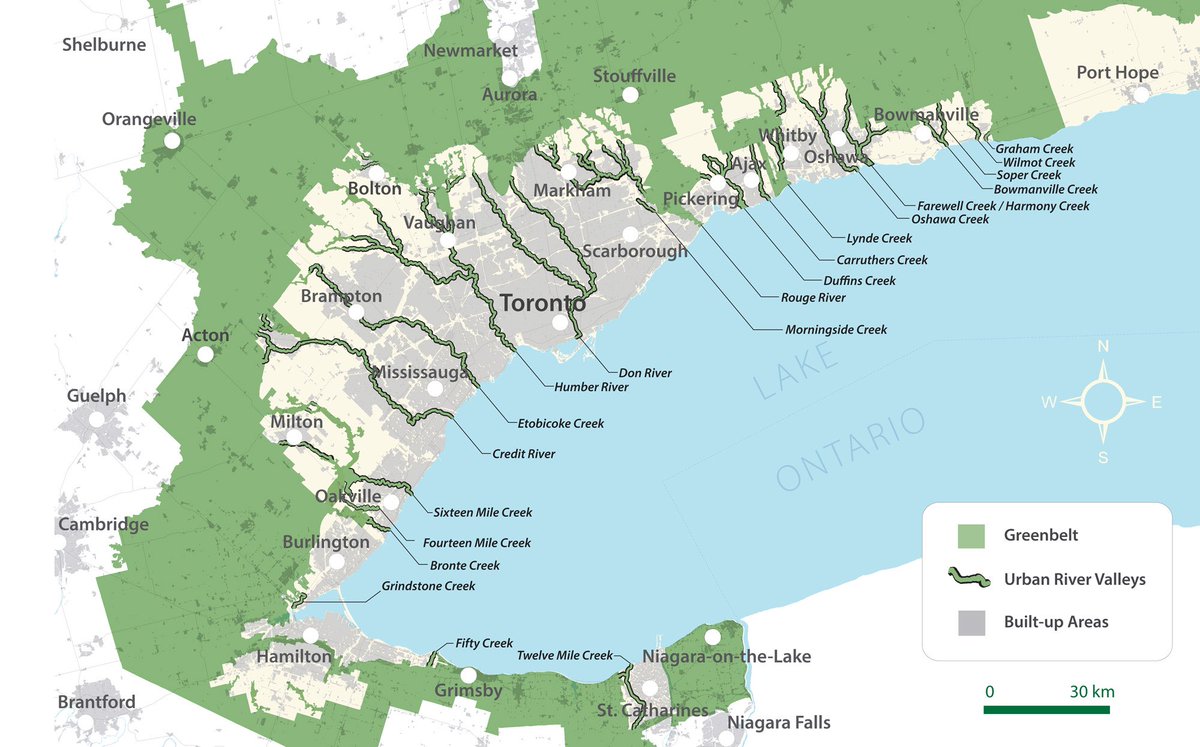
I’ve spent over 25 years advocating for the greenbelt, involved in research and policy development, and touting it on the world stage as foundational to our sustainable future. As Chief Planner I played a role in expanding it significantly through the inclusion of Urban River Valleys. The Greenbelt has made us the envy of the world. It’s something we’ve gotten right. We’ve linked it to policies focused on building housing in existing built up areas, intensification, transit expansion, access to nature, a safe and sustainable food and water supply, and creating complete communities.
The idea that a reckless, self-interested government can destroy it in a term or two is beyond comprehension to me. That they have done this using “deception” - the Integrity Commissioners words, is beyond the pale. That they have hid behind our truly devastating housing crisis, despite the Auditor General making it clear that “a shortage of land is not driving the housing crisis” is also beyond the pale.
But this is happening. And we need to get real about the fact that it is happening. Because the damage to our farmland, our regional centres, the impact on our commutes as a result of another layer of regional sprawl, and the distraction from building housing that we desperately need - it might just take us to our breaking point.