A breathtaking drone show lights up the skies in devotion to Lord Jagannath!
Jai Jagannath🙏
May His blessings bring peace, happiness, and prosperity to everyone.
An Indian scientist at Harvard discovered ATP (Adenosine Triphosphate). Then he helped create the first chemotherapy drug and the first tetracycline antibiotic. Harvard still refused him tenure. A bowling alley would not let him bowl. He died at 53, without an obituary.
His medicines save tens of millions of lives every year. Most American doctors who prescribe them have no idea what his name was. His name was Yellapragada Subbarow (Subba Rao).
He was born in 1895 in Bhimavaram, India. His father was a Sanskrit scholar who died from tropical sprue. Tropical sprue is an acquired malabsorptive disorder found in tropical regions, characterized by chronic diarrhea, weight loss, and severe nutritional deficiencies. It is most commonly associated with deficiencies in vitamin B12 and folic acid, resulting in anemia, fatigue, and glossitis. The same disease killed two of his brothers. As a child, Subbarow watched them fade away and decided he would spend his life fighting disease.
He failed his school exams twice. Passed on the third attempt. His future father-in-law paid for his medical school books. Subbarow married his daughter and repaid the debt. In October 1922, he arrived in Boston with borrowed money and broken English. He was 27. He entered Harvard Medical School and joined the biochemistry PhD program.
He began working under a senior researcher named Cyrus Fiske. Long hours. Little pay. But he was at Harvard, and he did not care. In 1925, they developed the Fiske-SubbaRow assay, a method for measuring phosphorus in body fluids. It is still used today in kidney failure testing, vitamin D testing, and prostate cancer work. It became one of the most cited methods in biochemistry history.
Then they found something even bigger in 1926 - ATP - Adenosine triphosphate. The energy molecule that powers every cell in every living thing on Earth. That discovery changed biochemistry. It also proved that the 1922 Nobel laureate had been wrong about how muscles worked. Muscles did not run on glycogen. They ran on ATP.
Subbarow earned his PhD in 1930. He stayed at Harvard for another decade. Paper after paper. Discovery after discovery. And every year, Harvard refused to promote him. The biochemistry department had never given tenure to a foreigner. They were not going to begin with an Indian.
His colleagues took him fishing. Played tennis with him. Came to dinner at his home. Then voted against him year after year. Outside the laboratory, he met the same wall. He bought an airplane and learned to fly because he loved flying. Once, he tried to go bowling. The local alley refused him entry. The sign said it was “open only to the Caucasian race.”
Then Fiske turned against him. The senior researcher began blocking Subbarow’s discoveries out of jealousy. Some of Subbarow’s work had to be rediscovered years later by other scientists because Fiske kept his findings hidden.
May 1940. Harvard denied him tenure for the last time. After 17 years of groundbreaking work, he walked away. Lederle Laboratories in New York hired him as Associate Director of Research. By the end of the year, he was Director. In the next eight years, he changed medicine. He developed diethylcarbamazine, an oral medicine that killed the tropical worms crippling American soldiers in the Pacific. The World Health Organization still uses it.
He isolated folic acid from liver and worked out how to produce it on a large scale. Today, folic acid in pregnancy prevents birth defects in tens of millions of pregnancies every year. The same family of diseases that killed his father and brothers became preventable because of him.
Then Dr. Sidney Farber called from Boston with an idea: maybe a drug that blocked folic acid in cancer cells could kill childhood leukemia. Subbarow’s team created the drug. They called it Aminopterin. In December 1947, Farber gave it to an eight-year-old boy dying from leukemia. Within weeks, the cancer cells began to disappear.
It was the first chemotherapy drug in history. The first time anyone had put cancer into remission using a pill. Subbarow’s team later refined it into Amethopterin, now known as methotrexate. It became a gold standard treatment for leukemia, lymphoma, breast cancer, and lung cancer. Then rheumatoid arthritis, psoriasis, and Crohn’s disease. The World Health Organization lists it as an essential medicine. Tens of millions of people use it every year.
In 1948, his lab produced Aureomycin. The first tetracycline antibiotic - a broad-spectrum one that killed typhus, cholera, pneumonia, and many bacteria that penicillin could not touch. It opened the door to the whole tetracycline family: doxycycline, minocycline, and drugs still used today against plague, malaria, anthrax, and drug-resistant infections.
He was 53 years old. He had created medicines that would save tens of millions of lives. August 8, 1948. Yellapragada Subbarow suffered a heart attack at his home in New York and died. No American newspaper gave him a front-page obituary. No university held a memorial. The Nobel Committee never honoured him. His own colleague George Hitchings later won a 1988 Nobel Prize for work built directly on Subbarow’s foundation. Subbarow was not even nominated.
In 1950, Argosy magazine published a feature about him titled “Miracle Man of the Miracle Drugs.” It began with a line that still hits hard. “You’ve probably never heard of Dr. Yellapragada Subbarow. Yet because he lived, you may be alive and are well today. Because he lived, you may live longer.”
Most Americans had not heard of him in 1950. Most still have not. Harvard has never officially honoured him. American medical schools mostly do not teach his name. The Nobel Committee that honoured Hitchings for work built on his foundation never corrected the record. Every methotrexate prescription written today remains silent about the man behind it.
India remembers. The government issued a postage stamp for his 100th birthday. His childhood home became a museum. Indian medical schools teach his name. But the country that denied him tenure, refused to let him bowl, and allowed him to die unknown - the same country that uses his drugs every day - still mostly does not know him.
Here is the truth. If someone you know has ever taken methotrexate for cancer or an autoimmune disease. If someone you love has taken folic acid during pregnancy. If you have ever been prescribed doxycycline for an infection. That was him. Yellapragada Subbarow. Born 1895. Died 1948. Saved tens of millions of lives, while a country he loved barely knows what it owes him.
Please remember his name and let your near and dear know about this little-known scientific legend born on this soil but never got the true recognition that he deserved. A story you need to know. A story all of us need to know. #Medicine #Unknownlegends @centerofright@KiranKS
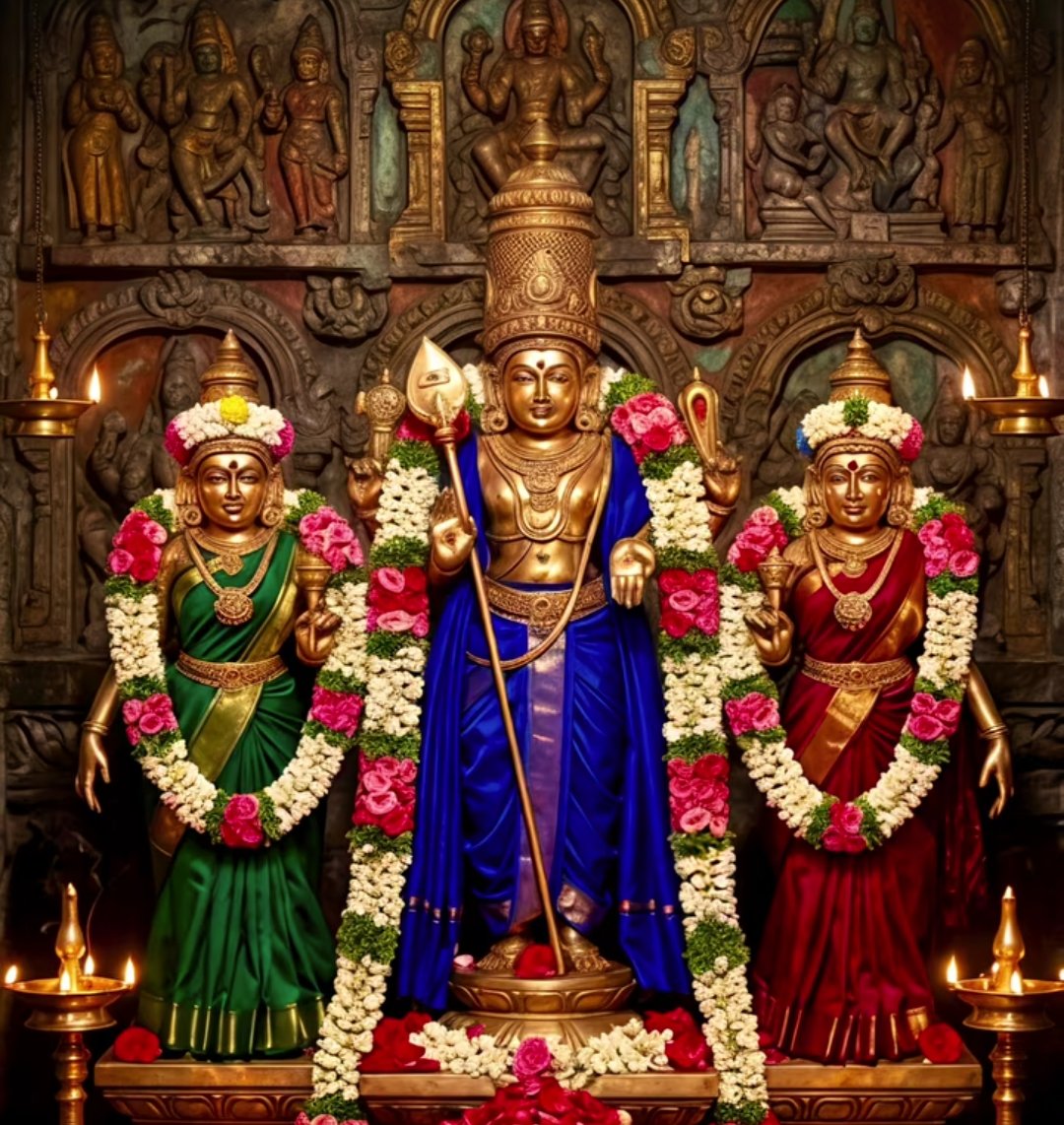
Maragatha Natarajar darshan
Ravi Pradosh— today🔆
6-foot tall idol carved from a single piece of emerald, in the Uthirakosamangai Mangalanatha Swamy Temple (TN)
It is usually kept covered in sandalwood paste—with the paste removed only once a year during the Arudhra Darshan festival in the Tamil month of Margazhi
It's a shame no major film has been made about Biju Patnaik. He lived a life that sounds almost fictional:
In 1938, he flew his entire wedding procession by aircraft to Rawalpindi for his marriage to Gyanwati Sethi (who became the first Indian woman to hold a commercial pilot’s license, and the couple later flew daring missions together.)
While serving in the Royal Indian Air Force (including as head of Air Transport Command), he secretly ferried freedom fighters like Jayaprakash Narayan, Ram Manohar Lohia, and Aruna Asaf Ali to their hideouts. He also airdropped 'Quit India' leaflets to Indian troops while evacuating British families.
The British once jailed him for transporting nationalist leaders and distributing anti-British literature but also honored him for bravery in evacuating civilians from Japanese-occupied Burma.
During WWII, he flew daring missions delivering arms and supplies to Soviet forces in Stalingrad, and over the treacherous 'Hump' route to China in
support of Chinese Nationalist forces against the Japanese.
In July 1947, he and his wife flew a Dakota into Indonesia, landed on an improvised airstrip while evading Dutch anti-aircraft fire, rescued Prime Minister Sutan Sjahrir, refuelled using abandoned Japanese fuel, and flew him safely to India via Singapore.
A couple of months later, during the Pakistani invasion of Kashmir, he airlifted one of the first Indian troops into Srinagar.
The same year he founded Kalinga Airlines, one of India's earliest private airlines.
As Odisha CM post-1962 India-China war, he secretly visited CIA headquarters at Langley to forge a covert India-US partnership against China, which led to the Aviation Research Centre (ARC) at Charbatia, which supported U-2 recon missions over Tibet.
He was also a legendary administrator and statesman, laying much of the foundation of Odisha's industrial empire (mines, ports, heavy industries etc).
When he passed away, Indonesia observed 7 days of state mourning. Russia observed 1 day. He remains the only person in Indian history whose body was draped in the national flags of 3 nations - India, Indonesia, and Russia.
Few public figures have left such a footprint.
His extraordinary life needs to be brought to the big screen.
His name was Brigadier Mohammad Usman.
At Partition, Pakistan wanted him. He was one of the finest Muslim officers in the army, and he was offered seniority and a future in the new Pakistan he could not have dreamed of in India.
He said no.
Twelve days short of his 36th birthday, he died fighting for India instead.
He was born on 15 July 1912 in Azamgarh, the son of a police officer. When he was twelve, a child fell into a well in his village. Usman jumped in and pulled him out. The rope tore his hands open. He carried those scars for the rest of his life.
He trained at Sandhurst, one of the few Indians the British allowed to become officers.
Then came Partition. His regiment, the Baluch, was sent to Pakistan. Almost every Muslim officer went with it. Usman was urged to go too, and offered rank and promotion in the new army.
His answer was simple. He was born in India. He would die in India.
Late 1947. Pakistani raiders poured into Kashmir and took Jhangar, planning to hand it over as a prize. Usman was sent to hold Nowshera.
His own men, raw from Partition, doubted whether a Muslim commander would be loyal. He made "Jai Hind" the greeting of his brigade and swore he would not sleep on a bed until Jhangar was retaken.
6 February 1948. Eleven thousand attackers hit Nowshera from every side. His outnumbered men did not break.
Nearly a thousand of the enemy lay dead by the end. Thirty-three Indians fell. They began calling him the Lion of Nowshera. Pakistan put a bounty of fifty thousand rupees on his head.
3 July 1948. Evening at Jhangar. He had just finished his prayers and was meeting his officers when a shell landed near his post. He died within minutes.
He was the highest-ranking Indian officer killed in that war.
Nehru and his cabinet came to the funeral. Maulana Azad led the prayers. He was given the Maha Vir Chakra. He lies buried at Jamia Millia Islamia in Delhi.
A man who was offered a future in one country, and chose to die for another.
My my my… this @ARanganathan72 stripping of @BBCWorld is classic. Will go down as one of his best that #BBC should frame & present to its trainees. 🤓
On Wednesday morning Sinoj, who runs a lottery shop at Kochi developed severe chest pain while driving himself to a hospital. As traffic came to a standstill, he collapsed inside the car.
Two nurses - Anjali Baiju and Ardra Raj, who were travelling in a bus, noticed the commotion on the roadside. They immediately got off the bus, rushed to the car and began cardiopulmonary resuscitation (CPR).
A passer by Ranjith, took over the car and drove Sinoj to the hospital. The two nurses continued CPR inside the vehicle until Sinoj reached a hospital.
Doctors said he had regained signs of recovery by the time he arrived.
Respect to the two sisters. God bless
This truly made my day
Fish in Utrecht had a problem. They were piling up against a 400-year-old canal lock every spring with nowhere to go. Predators found them. Many didn't make it.
Two ecologists fixed this with the Visdeurbe, or "fish doorbell."
They mounted an underwater camera on the Weerdsluis lock and built a website where anyone on Earth can watch the livestream and press a button when they see fish waiting at the gate. The lock keeper gets notified and opens it when enough people have rung in.
In 2024, over 20 million people tuned in. The doorbell was pressed 150,000 times by viewers in the Netherlands, Germany, the US, the UK, and dozens of other countries. Perch, bream, pike, rudd, catfish, and eels made it through to their spawning grounds upstream.
A centuries-old infrastructure problem was solved by a camera, a website, and strangers on the internet who wanted to help a fish get where it was going.
The site is visdeurbel dot nl. Migration season runs through spring. The fish doorbell season has come to an end for 2026, but they'll be back online March 1, 2027. See you next season!
At the summit of Girnar stands a shrine of Dattatreya. Dattatreya is worshipped in Karnataka too.
Swami Samarth is revered in Bengaluru.
Samartha Ramdas has a Matha in Thanjavur.
Rishi Agastya is deeply worshipped across Tamil Nadu.
Adi Shankaracharya attained Mahasamadhi at Kedarnath.
Sharadamba, whose ancient association is with Kashmir, is enshrined in Sringeri.
Vitthala Panduranga Swamy is celebrated in Karnataka and Tamil Nadu.
Ganesha brings joy in several states.
The list goes on.
Can any of them be confined to a single geography? Sanātana Dharma has never recognized such boundaries.
Our sages, saints, and deities belong to the entire civilization, not to one region, one language, or one community.
The ethereal beauty of the Snapana Thirumanjanam during Vasanthotsavam at Sri Padmavathi Ammavari Temple, Tiruchanur. A breathtaking display of devotion and tradition. 🙏✨
#Tiruchanur#PadmavathiDevi
ANI news teams in Arunachal to highlight the disruption caused by cloud bursts and flash floods in the region.
Unfortunately not a lot of interest in some mainstream news orgs. One day biases will break.