$QUBIC : Review 📜
What if blockchain mining wasn't a waste of energy but the engine building the world's next artificial intelligence?
Meet Qubic - a feeless, instant-finality Layer-1 protocol where mining power trains AI neural networks instead of solving meaningless puzzles, built by the man who invented Proof of Stake and the DAG, and running at 15.52 million TPS verified on live mainnet.
Let's explore how Qubic is redefining what a blockchain can actually do. 👇
⚪ Qubic at a Glance
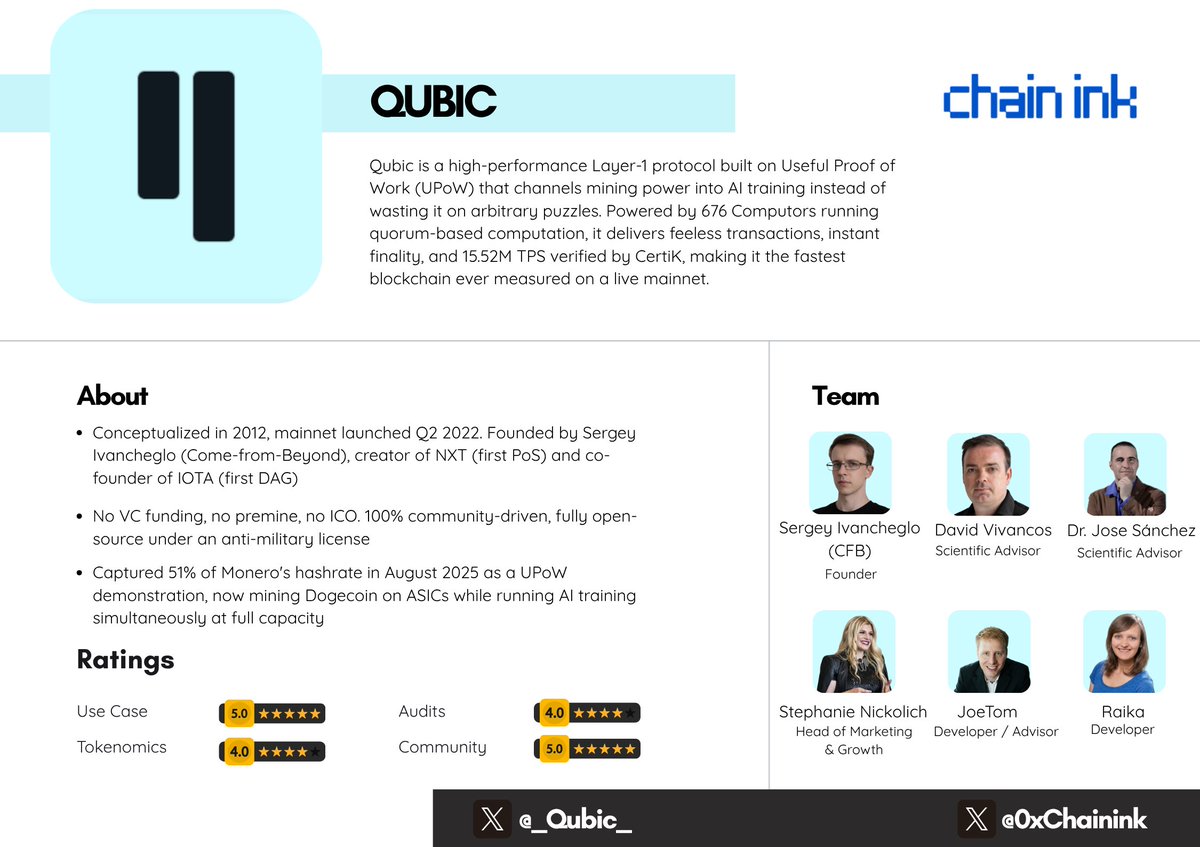
Qubic is a Layer 1 useful-proof-of-work (UPoW) crypto platform founded by Sergey Ivancheglo, with origins dating back to 2012.
The mainnet went live in Q2 2022. The network employs quorum-based computation (QBC) with 676 Computors that validate transactions, execute smart contracts, and interface with Oracle Machines.
The $QUBIC token functions as computational "energy" rather than traditional currency. Unlike traditional monetary units, $QUBIC is burned when used, creating a built-in deflationary mechanism where every smart contract execution and service access removes tokens permanently from circulation.
As of April 2026, $QUBIC holds a market cap around $128M, with a circulating supply of ~140 trillion tokens out of a 200 trillion max supply (reduced from the original 1,000 trillion via community vote), and a price near $0.000001.
Marketplace Insight: With DOGE mining now live on ASICs alongside full-capacity AI training, and a CertiK-verified 15.52M TPS record, Qubic is creating a unique economic flywheel where mining revenue from external chains gets converted into $QUBIC buybacks and burns, tying token value to real computational output rather than speculation.
⚪ Mission
Qubic's mission is to prove that blockchain mining can serve a higher purpose. By redirecting computational power toward training artificial neural networks through its Aigarth AI system, Qubic aims to build the foundation for decentralized Artificial General Intelligence while delivering feeless, instant transactions. The network exists at the intersection of two of the biggest narratives in tech: blockchain and AI, and it's the only protocol that genuinely merges both at the infrastructure level.
🔵 A Brief History
Sergey Ivancheglo first mentioned the name Qubic in a 2012 blog post on BitcoinTalk, but the core idea goes back even further. He first discussed the concept of Useful Proof of Work in 2002. The Quorum concept itself draws from Nick Szabo's 1998 paper on secure property titles.
Ivancheglo's work spans several foundational crypto projects. He created NXT in 2013, the first pure Proof of Stake blockchain (cited in Ethereum's whitepaper). He then co-founded IOTA in 2015, developing the Tangle, the first DAG protocol designed for feeless IoT transactions.
In June 2019 Sergey Ivancheglo departed to pursue Qubic as an independent project. The Qubic mainnet went live in Q2 2022, built entirely without VC funding, premines, or ICOs.
The team implemented a significant reduction in max supply, cutting it from 1,000 trillion to 200 trillion, an 80% reduction approved by community vote. In April 2025, Qubic set a CertiK-verified record of 15.52 million TPS on the live mainnet.
Starting in May 2025, Qubic began mining Monero alongside AI training tasks, eventually capturing over 51% of Monero's total hashrate, mining 27,000+ XMR blocks, and generating $3.5M in revenue. The governance framework was approved at Epoch 200 (February 2026) with 614 votes in favor and zero opposition. DOGE mining went live on mainnet April 1, 2026.
🔵 Ecosystem Narrative
Qubic's ecosystem is unlike any other blockchain. It doesn't compete on DeFi TVL or NFT volume. Instead, it's building a decentralized compute network where mining power serves dual purposes: securing the blockchain and training an open-source AI. Every component feeds back into this loop.
Key dynamics include:
➛ Useful Proof of Work (UPoW) redirects mining computation toward training artificial neural networks through Aigarth, Qubic's open-source AI system, instead of wasting energy on arbitrary hash puzzles.
➛ 676 Computors form the quorum, validating transactions, executing smart contracts, and interfacing with Oracle Machines. At least 451 (two-thirds majority) must agree on any operation for finality.
➛ DOGE mining now runs on ASICs in parallel with CPU/GPU-powered AI training, with no trade-off between the two. Mined DOGE is sold and used to buy back and burn $QUBIC.
➛ Smart Contract IPOs require every new contract to go through a Dutch auction where all $QUBIC spent is permanently burned, creating continuous deflationary pressure.
➛ Oracle Machines went live on mainnet in February 2026, connecting real-world data to smart contracts, with 11,000+ successful queries and zero unresolvable requests.
➛ Neuraxon, Qubic's evolving AI system, is scheduled for network integration by spring 2026.
⚪ Token Utilities
$QUBIC functions as computational "energy" rather than traditional currency:
➛ Smart Contract Execution - $QUBIC is burned (not paid) when executing smart contracts. Commissions are determined by Computor quorum vote, not fixed fees.
➛ Transfers - All peer-to-peer transfers on Qubic are completely feeless. Zero gas, zero friction.
➛ Smart Contract IPOs - New contracts launch via Dutch auctions where all $QUBIC spent is permanently destroyed, reducing circulating supply.
➛ Mining Revenue Loop - DOGE (and previously XMR) mining revenue is used to buy back and burn $QUBIC on the open market, creating external demand tied to real computational output.
➛ Computor Rewards - Each weekly epoch produces new $QUBIC distributed among efficient Computors. Inefficient ones have rewards partially burned.
⚪ Key Features
➛ 15.52M TPS (CertiK Verified) - Fastest blockchain ever measured on a live mainnet in production, without rollups, gas fees, or Layer 2 dependence. Operates on a native "tick-based" architecture where consensus, execution, and finality happen in a single synchronized cycle.
➛ Useful Proof of Work - Mining power trains artificial neural networks through Aigarth instead of solving meaningless puzzles. The first blockchain to integrate AI training into its consensus mechanism.
➛ Feeless Transactions - All transfers are completely free. $QUBIC is only burned when executing smart contracts, not for basic transactions.
➛ Quorum-Based Computation - 676 Computors reach consensus through a two-thirds majority (451+) vote, ensuring decentralized validation without single points of failure.
➛ Dual Mining + AI Architecture - DOGE mining runs on ASICs simultaneously with CPU/GPU AI training. No toggle, no trade-off. Both at full capacity.
➛ Bare Metal Execution - Smart contracts execute directly on hardware without an operating system layer, enabling extreme speed in Turing-complete C++ contracts.
➛ Deflationary Burn Model - Smart contract commissions, IPO auctions, and mining revenue buybacks all permanently remove from circulation.
🔵 Meet the Qubic Team
Qubic is a community-governed protocol where most contributors use pseudonyms. It's led by one of the most legendary figures in all of crypto, operating without VC oversight or corporate hierarchy.
▶️ Core Members:
➛ Sergey Ivancheglo (Come-from-Beyond) - Founder | Creator of the first 100% PoS protocol (NXT), co-founder of IOTA, and inventor of the first DAG architecture. One of the earliest Bitcoin miners (2009). Skills span assembler, C, C++, Java, Python, and UEFI development. Created Aigarth, Qubic's AI system. Widely considered one of the most important but least known figures in crypto history.
➛ David Vivancos - Scientist | A longtime advocate of human-machine integration, contributing to Qubic's AI research direction and the Aigarth system's development.
➛ Joetom - Core Lead Developer | Leads technical implementation including the DOGE mining integration architecture and network upgrades.
➛ Stephanie Nickolich - Head of Marketing & Growth | Oversees Qubic's public communications and community engagement strategy.
➛ Community-Governed - Most team members operate under pseudonyms. The 676 Computors serve as the decentralized governance layer, with major decisions requiring quorum vote approval.
🔵 Ratings
➛ Use Case: ★★★★★ (5/5) - This is the most genuinely unique use case in crypto right now. No other blockchain merges AI training into its consensus mechanism at this scale. The UPoW model doesn't just theoretically redirect mining energy, it proved it by capturing 51% of Monero's hashrate and is now mining DOGE while training AI simultaneously. The 15.52M TPS verified by CertiK on live mainnet is not a testnet claim. Feeless transactions, instant finality, Oracle Machines, and a bare-metal execution layer round it out. This is not another "fast EVM chain." It's a fundamentally different category.
➛ Tokenomics: ★★★★ (4/5) - The deflationary mechanics are genuinely strong: smart contract burns, IPO auction burns, and the DOGE mining buyback-and-burn loop all permanently remove supply.
The community voted to reduce max supply from 1,000T to 200T (80% cut), showing governance works. The halving at Epoch 175 cut net emissions by roughly 50%. No VC allocation, no premine, no ICO is a massive positive, meaning zero insider dump risk.
The raw numbers (140T circulating) can look intimidating at first glance, but the burn mechanics are among the most aggressive and multi-layered in crypto. Economics are sound when you look past the decimal places.
➛ Audits: ★★★★ (4/5) - CertiK verified the 15.52M TPS record in April 2025 on the live mainnet. Qubic's CertiK audit is currently in progress at 99% remediation, with 4 core team members verified and a Bronze verification badge granted in December 2025.
The project is fully open-source, which provides continuous public scrutiny. The 51% Monero hashrate demonstration also proved the network's real computational power.
The ongoing CertiK audit nearing completion is a strong signal. Deduction comes from the audit not yet being fully finalized.
➛ Community: ★★★★★ (5/5) - This is Qubic's crown jewel. No VC funding, no premine, no ICO, yet the project has built one of the most passionate, deeply engaged communities in all of crypto.
The governance framework passed with 614 yes votes and zero opposition. The pseudonymous team culture mirrors Bitcoin's early ethos. Community-driven supply reduction (80% cut) shows real collective decision-making power. Active presence across Discord, X, Reddit, and Telegram.
The DOGE mining launch generated massive organic buzz across crypto media (Decrypt, The Block, CoinDesk). The anti-military license is a unique philosophical touch that resonates deeply with the community's values. This is grassroots conviction at its purest.
Conclusion
Qubic is the most conceptually ambitious project in crypto that almost nobody outside its community has heard of. Founded by the man who invented Proof of Stake and co-created the DAG, built without a single dollar of VC money, and now running the fastest verified blockchain on earth while simultaneously training AI and mining Dogecoin, it's a project that defies easy categorization.
The fundamentals are undeniable. No other project has a founder with this pedigree building something this technically novel with this level of community conviction.
If the AI training actually produces meaningful results and the DOGE mining flywheel scales, Qubic could become the proof that blockchain and AI convergence isn't just a narrative, it's the actual future. And if that happens, this is the project that got there first.
> be $QUBIC
> born from a BitcoinTalk post in 2012
> before most of crypto even existed
> the idea belongs to one man
> Sergey Ivancheglo
> alias: Come-from-Beyond
> software engineer from Belarus
> obsessed with computer games as a kid
> evolved into distributed computing and AI
> BSc in electronics and artificial intelligence
> codes in everything
> Assembler, C, Java, Python, the full stack
> first known internet footprint: 2002
> publishes "Distributed computing with minimal costs"
> twenty years before the rest of crypto catches up
> mines Bitcoin in 2009
> one of the earliest miners alive
> there before the industry existed
> 2013: creates NXT
> the first full Proof-of-Stake blockchain
> not a Bitcoin fork, built from scratch
> NXT is cited in the Ethereum whitepaper
> Vitalik studied it
> the foundation under the foundation
> projects like Monero draw inspiration from NXT
> the man's fingerprints are on everything
> and nobody outside crypto knows his name
> 2015: co-founds IOTA
> invents the Tangle
> the first DAG-based ledger, no blocks, no chain
> feeless transactions at scale
> designed for the Internet of Things
> the architecture is years ahead of its time
> joins the IOTA Foundation board in 2018
> the project grows massive
> but the politics grow faster
> internal conflict with David Sønstebø
> public fallout in 2019
> claims he's owed 25 trillion IOTA tokens
> leaves IOTA
> walks away from the project he helped build
> the pattern is familiar
> but the idea never left
> Qubic was mentioned in 2012
> before NXT, before IOTA, before everything
> the name goes back further than any of his projects
> the concept of Useful Proof-of-Work
> first discussed by CFB in 2002
> the endgame was always Qubic
> NXT was a stepping stone
> IOTA was a stepping stone
> launches Qubic as an independent project
> open source, community-driven
> no VC funding, no pre-mine, no central control
> anti-military license
> the code can't be used for war
> a philosophical line in the sand
> 676 Computors form the Quorum
> 451 must agree to finalize anything
> two-thirds majority, every time
> transactions are feeless
> finality is sub-second
> 15.5 million TPS verified on mainnet by CertiK
> fastest blockchain ever verified
> not on a testnet
> on mainnet
> Useful Proof-of-Work
> miners don't solve meaningless puzzles
> the compute power trains AI
> Aigarth
> an AI system built on Qubic
> designed to let artificial intelligence emerge from the network
> "AI will not be created, it will emerge.
> with help of Qubic miners."
> that's CFB's thesis
> smart contracts launch through IPOs
> the community votes on what gets built
> QUBIC spent on launches gets burned
> no whitepaper yet
> the tech is "too revolutionary" to finalize
> they're still reinventing components
> the man who built the first PoS chain
> the man who built the first DAG
> is now building a chain that turns mining into AI training
> three decades of distributed computing
> three landmark crypto projects
> and the final one is the one he always wanted to build
mined Bitcoin in 2009
built the first Proof-of-Stake blockchain
co-invented the Tangle for IOTA
left it all behind
and came back with the project he first imagined in 2002
the man who inspired Ethereum's whitepaper
is building something nobody's copied yet
because nobody understands it yet
Smart contracts are called "contracts" because they define agreements enforced by code. Running #AI as a smart contract makes little sense, true #AI is able to break any agreement, emergence of the first #AI will mark the end of the Era of Smart Contracts.
What is the next big thing in #cryptoindustry? Follow #Qubic to witness it.
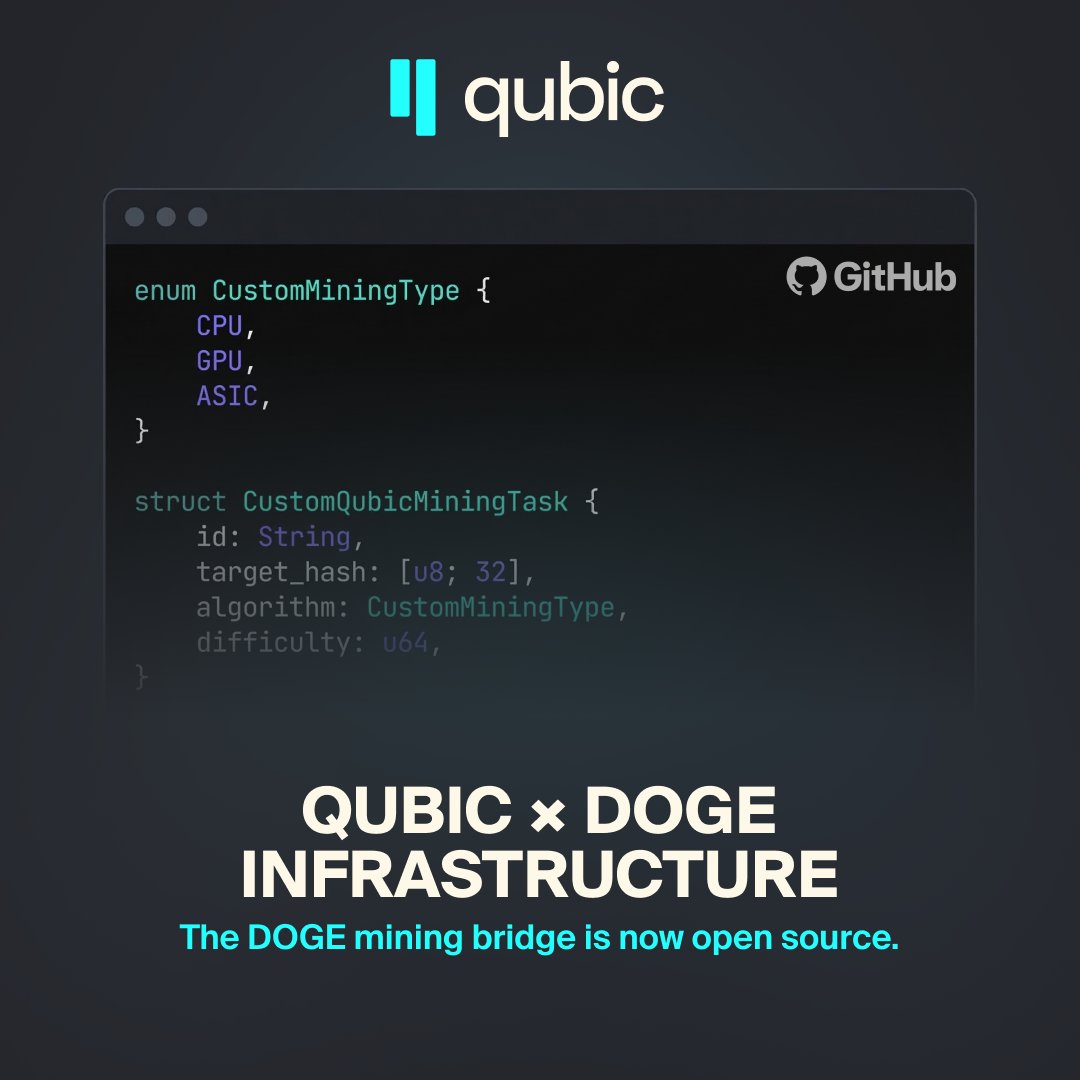
The first draft of the DOGE protocol implementation is now public on GitHub.
Doge-connect is the bridge between the Qubic network and Dogecoin mining. The repo includes:
• The Dispatcher: the custom bridge that connects Qubic’s compute network to the DOGE mining pool
• Communication structures for custom mining tasks and solutions between the Qubic network and external chains
• A testminer implementation for end-to-end pipeline validation
The architecture is designed to be extensible. The code defines generic structs that can support additional custom mining types beyond DOGE in the future.
This is open-source infrastructure, built in public.
Most people compare supply the wrong way.
They look at 21M BTC vs 200T QUBIC and assume Bitcoin is scarcer.
But that comparison is incomplete.
🧵 Let’s break it down.
1️⃣ Bitcoin is divisible
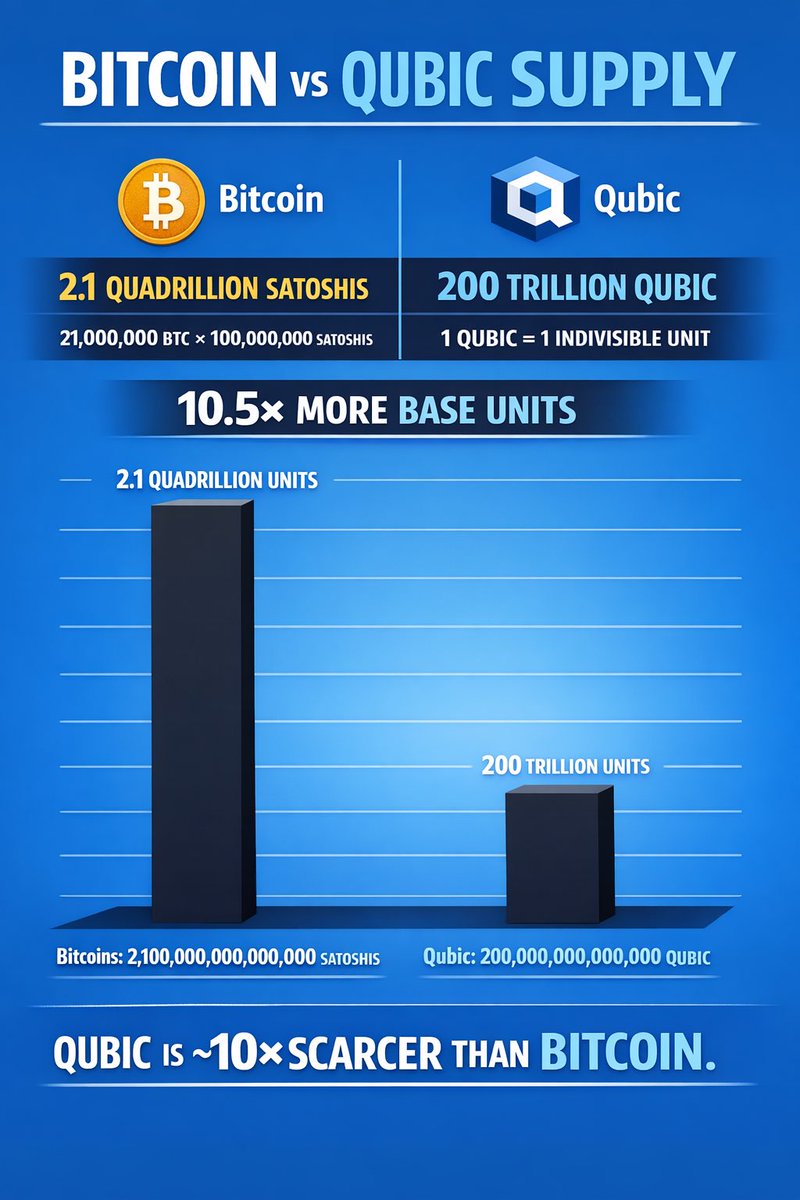
1 BTC = 100,000,000 satoshis
So the real maximum units of Bitcoin are:
21,000,000 BTC
× 100,000,000 satoshis
= 2,100,000,000,000,000 units
That’s 2.1 quadrillion satoshis.
2️⃣ Qubic is NOT divisible
1 QUBIC = 1 QUBIC
There are no decimals and no smaller units.
This design avoids floating-point calculations and improves performance in the network.
Maximum supply:
200,000,000,000,000 QUBIC (200 trillion)
3️⃣ Real comparison
If we compare the smallest units of each network:
Bitcoin
= 2.1 quadrillion units
Qubic
= 200 trillion units
That means:
Bitcoin has 10.5× more units than Qubic.
4️⃣ The takeaway
When comparing fairly:
• BTC units (satoshis): 2,100,000,000,000,000
• QUBIC units: 200,000,000,000,000
So in terms of base units, Qubic is actually ~10x scarcer than Bitcoin.
And remember:
Bitcoin needs satoshis to work.
Qubic doesn’t.
1 QUBIC = 1 indivisible unit.
Sometimes the biggest misconceptions come from looking at the wrong numbers.
#Qubic #Bitcoin #Crypto #Tokenomics #Altcoins #CryptoEducation
@0xEnjooyer One third of population that use creatine have no effects, this is good because it means your creatine levels in your body are already "full"
@aakashgupta This problem was with us all these decades since wide adoption of computers, why do you think methods like https://t.co/vRHL8DmaCW were invented?
Somebody hasn't used fault-tolerant computing where it was critical during #AI training? Just shows what amateurs those engineers are.
People often worry about the misuse of $QUBIC funds
They see the CCF pay huge sums to people they consider leeches (which may be right or wrong...)
But the part that few understand is that this is how $QUBIC is meant to work
That $QUBIC that is paid to the "leeches" doesn't come from nowhere..
It belongs to the Quorum
The Qubic project emits $QUBIC tokens every week, this is how the protocol works
At one time, almost 100% of these emissions went to the Quorum (and they then paid miners with it)
Then last year, the Quorum voted to put some of these $QUBIC into a fund (I think it was 20% of the weekly emissions)
****So a key point to understand here is this*****
The Quorum took THEIR $QUBIC, and put it into a fund (called the Computor Controlled Fund)
If the Quorum did not put this money into this fund, it would instead go to the miners
And the miners would then sell these $QUBIC on the open market
Every week the Quorum vote on how to spend the $QUBIC that is placed in the fund
So when you see a proposal pass
It is because the Quorum has agreed to pay the proposer some of the funds
They aren't creating extra $QUBIC to dump on the market
The $QUBIC they pay out was always going to be emitted
So when you get angry that someone was paid by the Quorum
Just realize that no matter what happened, those $QUBIC they were paid would still have existed
And it was the computors $QUBIC that was paid to the proposer
At any time, the Quorum could decide that they no longer want to put THEIR money into the fund and instead they could start paying it to miners again or redirect some other way
The important point!! The $QUBIC paid out to proposers was always going to exist
These $QUBIC belong to the Quorum and they are deciding to pay it to proposers
This is $QUBIC's governance model
And whether you believe it is right or wrong
It is working exactly as CfB intended when he built $QUBIC
The new #Bittensor documentary is brilliant btw
@evert_scott absolutely killed it 🔥
If you're new and want to understand why #Bittensor matters.. I highly recommend giving it a watch
👉 https://t.co/FkdmlfJGER
I didn't think I could get more bullish at this point..
$TAO
Ah the joys of crypto, one day one of the biggest sell events in history, the next its back to normal, if you dont look at charts you wouldnt even know what had happened 🤣