@redtachyon In France, PhDs are frequently targeted in startup R&D roles because of "Crédit d’Impôt Recherche", a major R&D tax credit. Clumsy wording, but maybe structural rather than ideological. ¯\_(ツ)_/¯
So what is this graph ⬆️? It's a visualization of all SGA 4 1/2 artefacts (lemmas, propositions, theorems,...) and their dependencies. You can explore it here: https://t.co/1VyjMG9by3
-- Built with an LLM, so to be taken with a pinch of salt.
Etale Cohomology was introduced in the infamous SGA 4 1/2, which is more magical than Platform 9 3/4.
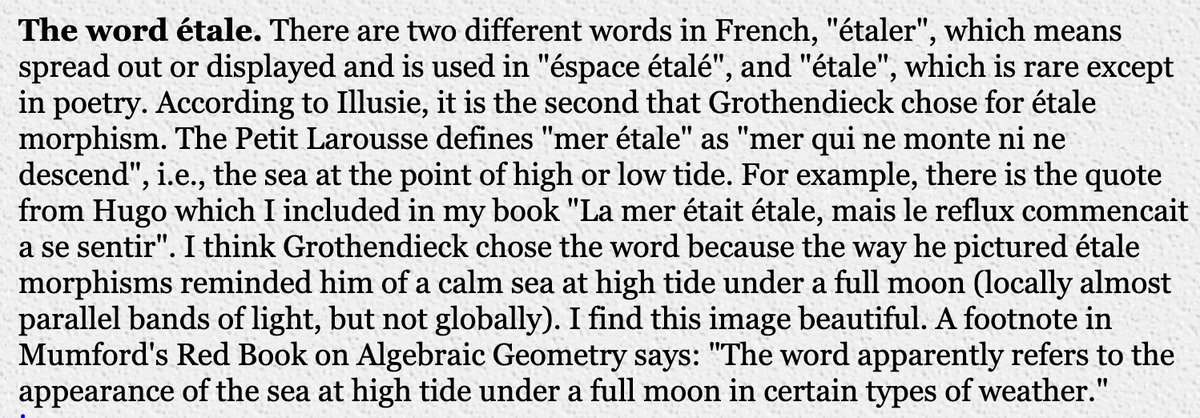
According to J.S. Milne, Grothendieck "chose the word because the way he pictured étale morphisms reminded him of a calm sea at high tide under a full moon".
@jasondeanlee If the current state of the art is still "copy-pasting into Cursor," the interface for scientific research is broken.
The Adjoint explores what an environment that actually understands the structural logic of mathematical research looks like...
https://t.co/giMoOAFzAc
@damekdavis Totally fair concern. That’s why The Adjoint, an open-source AI workspace for mathematicians, is model-agnostic. Users can choose or extend it to whatever models they trust.
https://t.co/dDHsoxqwhz
@kevinweil Very nice ! I’ve been working on something similar but purpose-built for mathematicians rather than general scientific workflows.
It’s called The Adjoint: https://t.co/dDHsoxqwhz
Curious how Prism is thinking about formal domains like pure math.
@davidbessis Beyond his mathematical legacy, there is this rather bizarre documentary about trying to find Grothendieck after he went into reclusion: https://t.co/G9NXtJzUv1
@DmitryRybin1 Completely agree, the tooling for math is lagging far behind the models. Our vision is to democratize and standardize access to all technologies for mathematicians. We’ve built a first working prototype toward this: https://t.co/dDHsoxqwhz
This keeps resurfacing in discussions about AI and mathematics — especially the gap between how math is practiced and how it’s often framed in AI narratives.
And it echoes my recent conversations with @Thom_Wolf and @davidbessis.
AI is often hyped as a ‘math-proving superpower,’ but real mathematical practice is evolving quietly and socially. I asked mathematicians what they see happening. What’s changing isn’t mathematicians’ relevance, it’s how they work.
https://t.co/eTcFw0xK46