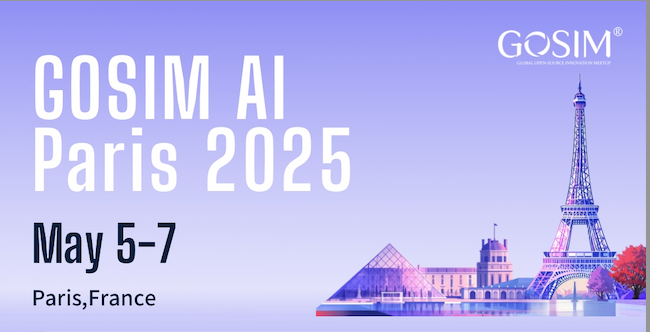
🎟️ Enter @gosimfoundation's Lucky Draw for a chance to get 70–90% off registration for PyTorch Day France 2025, co-located with GOSIM AI Paris 2025. Full schedule now available 🔽
👉 Look for the Lucky Draw banner atop https://t.co/slDucFmGbt to learn how to enter. Or, use code PYTORCHFRIEND to receive 25% off traditional registration.
🗓️ Explore the full lineup of speakers and sessions: https://t.co/1V5PpO2xRJ
Join us for insightful technical talks, interactive discussions, and engaging poster sessions designed to foster knowledge exchange and collaboration. Learn more: https://t.co/5SwSejoH7R
#PyTorch #PyTorchDayFrance #OpenSourceAI #GOSIMAIParis
The GOSIM conference in Paris on May 6-7 will be packed with speakers from @LeRobotHF and @huggingface training and post-training teams! Super exciting!
Join here: https://t.co/LGsMutLYhw
Just take a look:
- @gui_penedo talking about Open R1: the fully open reproduction of DeepSeek-R1-https://t.co/c69uwOThLh
- @antoinepirrone presenting Open Duck: An Open Source Bipedal as a stand - https://t.co/EJp0FEJHt1
- @eliebakouch talking about Pre-training of Smol and Large LLM
- @Reachy 2 Emotional Intelligence - https://t.co/s9s3uKD15X
- @NepYope showing progress on @Lerobot Open Source Reachy hand - https://t.co/e8a1E24iab
- @centralesupelec showing human shadowing on top of Reachy 1 as a stand - https://t.co/YZFqmB0Yez
- @seeedstudio demonstraing the Seeed Embodied Workshop with the SO-ARM 100 from @lerobot - https://t.co/B0RRd4hXE6
PSA: I help organizing the GOSIM AI Conference next month (May 5-7) in Paris. It is co-located with PyTorch Day France. 🇫🇷
If you are an open-source AI enthusiast in France, you might be eligible for a deeply discounted tickets that are good for both events! Just
🐥 Follow GOSIM Foundation @gosimfoundation
✉️ DM them with your ticket request
That's it!
In a divided world, it is the only conference that brings together major European 🇪🇺, Chinese 🇨🇳, and American 🇺🇸 labs, researchers, and open-source projects! Do not miss it!
🎉 Feeling lucky? Win exclusive discounts for Europe’s premier open-source AI event 🇫🇷✨
GOSIM AI Paris 2025 is all about open-source passion—let’s share the love! Join our Lucky Draw for a chance to unlock MASSIVE DISCOUNTS on your conference ticket! 🎟✨
🔸 How to enter: Simply Follow, Re-Tweet & tag your AI enthusiast friends and DM us
🎁 Winners receive: Huge savings & exclusive perks to Europe’s most vibrant AI gathering!
💌 Let's spread the AI magic—join the fun today!
#OpenSource #Paris #GOSIM #TechEvents #DiscountTickets #LLM #DeepSeek #AICommunity #AIConference #AIModels #EmbodiedAI #QWen #AIinfra #RAG #agentic #PyTorch #HuggingFace #GOSIMAI2025 #LuckyDraw #AI #AGI #OpenSource #Paris #GOSIM #TechEvents #DiscountTickets #LLM #DeepSeek #AICommunity #AIConference #AI2025 #AIModels #EmbodiedAI #QWen #AIinfra #RAG #agentic #OpenManus #autogen #camelai #PyTorch #SGLang #zenoh #dora #HuggingFace #StationF #AIApps
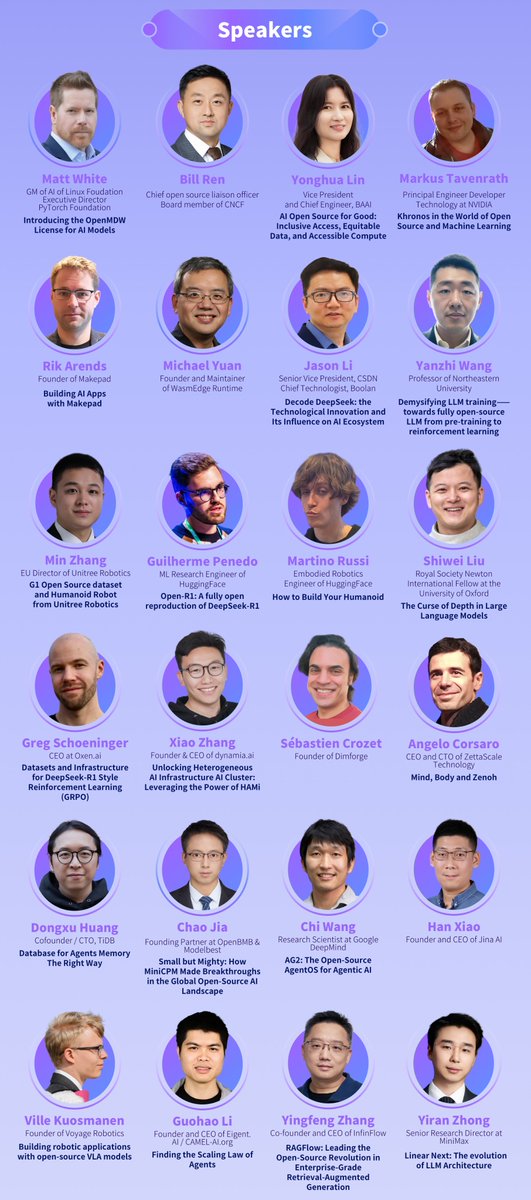
GOSIM AI Paris 2025 will have the most impactful speakers we can currently imagine within the Open Source Community including: Hugging Face, Alibaba Cloud, NVIDIA, Huawei, Unitree Robotics, Google DeepMind, ... And many more, that you hopefully find inspiring!
Early bird tickets are available until April 8!
https://t.co/5KxtGOTeSx
#conference #ai #robotics #embodiedai #aimodels #qwen #openr1 #deepseek #unitree #deepmind #nvidia #huawei #huggingface #alibaba #dify #zhipuai #openmanus #docker
Unveiling the Core Drivers of AI Infrastructure Efficiency Revolution! GOSIM AI Paris 【AI Infra】Forum Agenda Officially Revealed!
From redefining GPU scheduling as the "Kubernetes of AI" to building ultra-efficient, cross-device inference engines—GOSIM AI Paris 2025 is where the next wave of AI infrastructure breakthroughs is taking shape.
At the 【AI Infra】Forum, global leaders from NVIDIA, Docker, LMSYS Org, BAAI, Huawei, and more will unveil how hardware-software co-design is transforming the economics and scalability of AI—from hyperscale data centers to edge devices. Whether it's resurrecting legacy GPUs, streamlining model deployment, or democratizing compute access through open-source innovation—this is where AI efficiency becomes real.
�� May 5–7, 2025 @ Station F, Paris
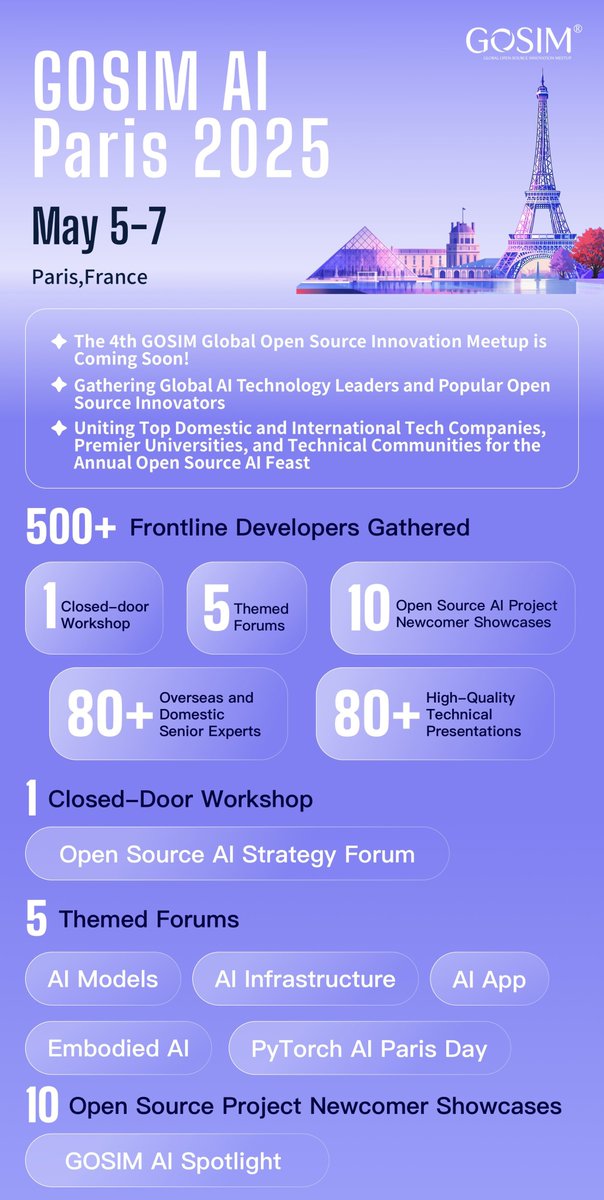
Join 80+ global experts across 5 Conference Tracks and 10+ finalist from GOSIM AI Spotlights.
Discover the infrastructure behind tomorrow’s AI.
https://t.co/wNq3b5C2Q1…
📷
Topic Details Revealed
Yonghua Lin
Role: Vice President
Organization: BAAI
Bio:The Vice President and Chief Engineer of Beijing Academy of Artificial Intelligence, responsible for AI System, and Large Model Foundation Technology research, industry and open-source ecosystem cooperation. She is formerly the Director of IBM China Research Lab and Distinguished Engineer at IBM, she led global AI system innovation within IBM. She has been engaged in research on system architecture, cloud computing, AI systems, computer vision, and other fields for more than 20 years. She holds over 50 global patents and has won the ACM/IEEE Best Paper awards. She was named one of the "50 Leading Female Tech Leaders in China" by Forbes in 2019. She is member of IEEE Women in Engineering Asia Pacific Leadership Team and the founder of IEEE Women in Engineering Beijing affinity.
Title:AI Open Source for Good: Inclusive Access, Equitable Data, and Accessible Compute.
Abstract:This talk unveils how open source technologies act as catalysts for equitable AI across three pillars. First, inclusive access: We open-source voice datasets tailored for underrepresented groups—such as children and the elderly—to ensure Multimodal AI Systems understand diverse linguistic patterns and bridge generational divides. Second, equitable data: we have released nearly 100 globally accessible datasets, amassing over 680,000 downloads, empowering developers from any countries to innovate freely. Third, accessible compute: We present FlagOS, an open-source system software that facilitates AI development and deployment across diverse hardware ecosystems—including legacy GPUs and emerging accelerators—while significantly lowering the cost barrier to AI innovation. Collectively, these open-source efforts transform 'AI for Good' into a shared mission—breaking barriers of age, location, and resources to empower anyone to create and benefit from AI.
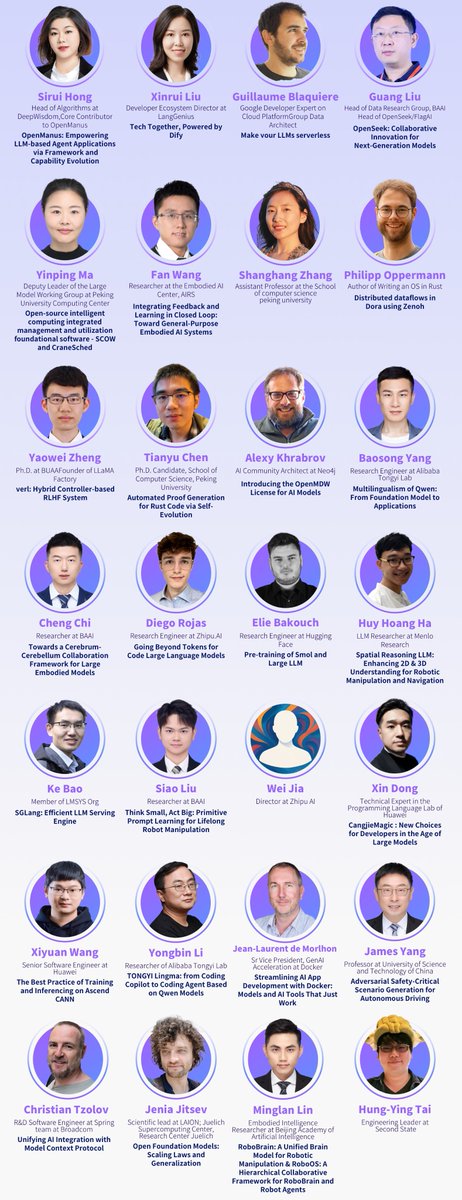
Xiyuan Wang
Role: Senior software engineer
Organization: Huawei
Bio: I have worked on OpenSource for over ten years. I was Openstack Keystone project maintainer previously. And now I'm focus on opensource AI software. I'm the maintainer of vllm-project/vllm-ascend currently.
Title: The best practice of training and inferencing on Ascend CANN.
Abstract: The AI-oriented, heterogeneous Compute Architecture for Neural Networks (CANN) is a key platform for improving the computing efficiency of Ascend AI processors. It serves as a bridge between upper-layer AI frameworks and lower-layer AI processors and programming. This topic will focus on OpenSource ecosystem about CANN, shows how CANN helps AI sofeware, such as pytorch, vllm and so on, efficiently running on Ascend.Building on this, we’ll examine the vibrant AI open-source software ecosystem that CANN supports, highlighting how it fosters collaboration, scalability, and accessibility for developers and researchers globally. Next, we’ll dive into best practices for leveraging very large language models (vLLM) with CANN to achieve high-performance inferencing, ensuring maximum computational efficiency and model accuracy. Finally, we’ll introduce cutting-edge techniques for Reinforcement Learning from Human Feedback (RLHF) training and inferencing on CANN, showcasing how these innovations can enhance model alignment with human preferences while maintaining robust performance. By the end of this talk, you’ll have a clear understanding of how CANN is shaping the future of AI, empowering both research and industry applications through its powerful and flexible infrastructure.
Ke Bao
Role: Member
Organization: LMSYS Org
Bio: Member of LMSYS Org, Core Contributor to SGLang.
Title: SGLang: Efficient LLM Serving Engine.
Abstract: SGLang is a fast serving engine for LLMs and VLMs. It's fully open-source, incubated by LMSYS Org, with 300+ contributors worldwide. In this talk, we will introduce the key features and performance optimizations in SGLang.
Yinping Ma
Role: Engineer
Organization: Peking University
Bio: Deputy Leader of the Large Model Working Group at Peking University Computing Center, and Adjunct Associate Researcher at the PKU-Changsha Institute for Computing and Digital Economy. My primary research areas include high-performance computing(HPC), intelligent computing, and computing power networks. I have been involved in the construction and management of multiple HPC clusters and has published over ten papers and dozens of patents in fields such as HPC scheduling, application optimization, high-performance operator optimization, and artificial intelligence. I led the development of the open source computing power scheduling system CraneSched and participated in the development of the computing center portal and management platform OpenSCOW. I have contributed to several major projects, including the National Key R&D Program of China under the "New Generation Artificial Intelligence" initiative, the Top Ten Technological Breakthrough Projects of Hunan Province, the Key R&D Program of Guangdong Province, and various Huawei university-industry collaboration projects.
Title: Open-source intelligent computing integrated management and utilization foundational software - SCOW and CraneSched.
Abstract: The Peking University Computing Center is dedicated to developing general foundational software for both supercomputing (HPC) and intelligent computing (AI computing). In the field of HPC and AI computing, it has developed several flagship foundational software systems, including SCOW and CraneSched. OpenSCOW provides a graphical user interface (GUI) that allows developers to flexibly manage supercomputing and AI computing resources for AI model training and inference. It has already been deployed across 56 computing centers, including 34 universities and 12 enterprises in China. CraneSched is a high-performance scheduling and orchestration system for HPC and AI computing tasks. It supports large-scale model training with exceptional performance and has been adopted by 8 universities and 1 enterprise in China.
Yaowei Zheng
Role: Ph.D. Student
Organization: Beihang University
Bio: Yaowei Zheng is currently a 4-th year Ph.D. student at Beihang University. He is the founder of LLaMA Factory, one of the most popular libraries for fine-tuning LLMs. As the first author, he has published several conference papers in ACL, CVPR, and WWW. He serves as a reviewer for AAAI and EMNLP. He was awarded the Outstanding Open-Source Contributor for the Ascend Ecosystem. He has been invited to deliver keynote speech at GOSIM China 2024.
Title: verl: Hybrid Controller-based RLHF System.
Abstract: verl is a flexible, efficient and production-ready RL training library for LLMs. This talk will share the ideas in designing a hybrid-controller system and the benefits of this system in efficient large-scale RL training.
Greg Schoeninger
Role: CEO
Organization: https://t.co/SWcrUOhEnf
Bio: Founder and CEO of https://t.co/SWcrUOhEnf, former IBM Watson. Have been training language models for over a decade.
Title: Datasets and Infrastructure for DeepSeek-R1 Style Reinforcement Learning (GRPO).
Abstract: We will walk through everything you need to know about the latest in reinforcement learning for LLMs, datasets and infrastructure, down to training your own small reasoning LLM that can write code locally.
Jean-Laurent de Morlhon
Role: Sr Vice President, GenAI Acceleration
Organization: Docker
Bio: An Executive & SVP of Engineering at Docker, leading Generative AI initiatives to enhance the developer experience across the Docker ecosystem. With over nine years at Docker, he has played a key role in shaping its engineering culture, scaling teams, and driving innovation in cloud-native development. A seasoned engineering leader with deep expertise in developer tools, infrastructure, and software delivery, Jean-Laurent is passionate about automation, security, and AI-powered developer experiences. As an executive at Docker, he focuses on fostering high-performing teams, delivering impactful products, and pushing the boundaries of developer productivity. Beyond Docker, he actively engages with the tech community and shares his insights on Bluesky.
Title:Streamlining AI App Development with Docker: Models and AI Tools That Just Work.
Abstract: Discover how Docker’s Model Runner enables fast, local AI inference with GPU support, and how the Docker makes it easy to integrate LLMs and agents using MCP —no complex setup required.
Yajing Wang
Role: Director
Organization: Olares
Bio:Focusing on empowering developers through meaningful content, inclusive community engagement, and scalable solutions. With a passion for bridging the gap between technology and its users, Yajing brings technical expertise and creativity to foster thriving developer ecosystems.
Title:Olares: An Open-Source Sovereign Cloud OS for Local AI.
Abstract:Olares provides a straightforward, open-source solution for Local AI. This talk highlights its design philosophy, focusing on how it empowers users to securely manage data and run AI applications with minimal overhead.
Markus Tavenrath
Role: Principal Engineer Developer Technology
Organization: NVIDIA
Bio: Markus Tavenrath studied computer science with a focus on computer graphics at RWTH Aachen University. This academic background provided a solid foundation for his career in the technology industry. In 2008, Markus joined NVIDIA, where he began working on real-time ray tracing on GPUs. Over the years, he has contributed to performance optimization for ray tracing, scene graphs, OpenGL, WebGL, Vulkan, and AI. His work has played a role in advancing these technologies. Markus is also a co-founder of the Vulkan-Hpp project, which has been beneficial to the Vulkan community. His efforts have helped improve the use and implementation of Vulkan. Recently, Markus was elected as the Chair of the ML Council at Khronos. In this role, he helps coordinate and support AI and machine learning initiatives within the Khronos group. His election to this position reflects his expertise and leadership qualities. Markus Tavenrath is a dedicated professional whose contributions have positively impacted the technological landscape at NVIDIA and beyond.
Title: Khronos in the World of Open Source and Machine Learning.
Abstract: In my role as Chair of the Khronos Machine Learning Council, I will introduce the Khronos Group's work in the field of machine learning and how Khronos embraces open source within its software stack.
Sébastien Crozet
Role: CEO
Organization: Dimforge
Bio: Sébastien Crozet has been in love with the Rust programming language since its earliest days. He is the creator and maintainer of popular open-source libraries, including nalgebra and Rapier, for the Rust ecosystem that specialize in linear algebra, geometry, physics, and AI. He is the founder of Dimforge where he focuses on developing the future of AI, geometry and physics for engineering, games, and the metaverse.
Title:WGML: the story of building a new high-performance, cross-platform, on-device inference framework.
Abstract: Ever dreamed of writing a new low-level LLM inference library? Check out the making of WGML, an open-source high-performance cross-platform GPU inference framework using Rust and WebGPU. We will cover tips for discovering and implementing LLM inference.This talk retraces the story of the writing of the WGML library for cross-platform GPU-based inference leveraging the WebGPU standard. The presentation assumes basic knowledge about linear algebra (matrix multiplication). Some knowledge of the Transformer architecture is helpful too, but resources for learning about it will be provided.
Scan the code to sign up!
80+ senior experts from around the world
5 Conference Tracks with 80+ high-quality sessions
10+ finalist from open-source AI projects Spotlight…
We welcome you to register and join us on-site to engage face-to-face with senior experts in the open-source field!
Where is the future of superhuman-level AI applications headed? The GOSIM AI Paris 【AI Apps】Track reveals the answer!
When AG2's open-source AgentOS redefines AI development paradigms, when MetaGPT automates complex reasoning with multi-agent collaboration, when RAGFlow cracks enterprise RAG challenges with OSS solutions—can you envision the future of superhuman AI applications?
The GOSIM AI Paris 2025【AI Apps】Track convenes pioneers from Google DeepMind, Alibaba Tongyi, and Huawei Cangjie to unveil the first complete stack: from agent frameworks , AI-native toolchains to knowledge graph integration .
This global open-source AI event will be held from May 5–7, 2025, at Station F, the global innovation industry incubation hub in Paris, France.
https://t.co/5KxtGOTeSx
📷
Topic Details Revealed
Chi Wang
Role: Research Scientist
Organization: Google DeepMind
Bio: Created AG2 (formerly known as AutoGen), the open-source AgentOS to support agentic AI, and its parent open-source project FLAML, a fast library for AutoML & tuning. He has received multiple awards such as best paper of ICLR’ 24 LLM Agents Workshop, Open100, and SIGKDD Data Science/Data Mining PhD Dissertation Award. Chi runs the AG2 community with 20K+ members.
Title: AG2: The Open-Source AgentOS for Agentic AI.
Abstract: This presentation will examine the trend of agentic AI and the fundamental design considerations for agentic AI programming frameworks. It will introduce a pioneering initiative, AG2. It will explain the primary concepts and its application across a diverse range of tasks and industries.
Xin Dong
Role: Technical expert in the programming language lab of HUAWEI
Organization: HUAWEI
Bio: Served as Chief Technical Expert and Project Manager, working on Huawei’s mobile AI development tools, the company-wide AI R&D platform, the Ascend AI chip toolchain, and the HarmonyOS toolchain.Since 2021, responsible for programming language and IDE foundational software R&D as Program Director, driving the development of self-controlled programming languages and IDE core technologies. Played a key role in the technical planning, productization, and industrial adoption of domestic application programming languages, making significant contributions to their advancement.
Title: CangjieMagic : New Choices for Developers in the Age of Large Models.
Abstract: With the surge in popularity of various AI large models, the trend of agent-oriented development in large model applications has become increasingly evident. Agents are gradually becoming a core element in the development of large model applications. This topic shares an AI large model Agent development framework based on the Cangjie programming language. This framework supports Agent-oriented programming, providing developers with an efficient Agent DSL for Agent programming. Its main features include: support for the MCP protocol to facilitate mutual invocation between Agents and tools, support for modular invocation, and support for intelligent task planning. It enhances the efficiency of developers in creating smart HarmonyOS applications, delivers an exceptional development experience, and explores new paradigms for future large model application development.
Yongbin Li
Role: Senior Algorithm Expert
Organization: Tongyi Lab, Alibaba Group
Bio: Graduated from Tsinghua University and is a senior algorithm expert at Alibaba's TONGYI Lab. Focusing on LLMs, including code models, character models, post-training and agents. He has developed the Tongyi Lingma coding copilot and AI programmer (coding agent), which is currently the largest and most popular coding product in China, and has recently launched the international version of Tongyi Lingma. Additionally, he is responsible for the LLM technologies such as Tongyi Xingchen (Character Model/Role-playing Agent), Tongyi Xiaomi (Intelligent Customer Service), and Tongyi Tingwu (Audio and Video Assistant).
Title: TONGYI Lingma: from Coding Copilot to Coding Agent based on Qwen Models.
Abstract: This presentation will take the perspective of intelligent development in the software engineering to outline and introduce the latest technological advancements and product applications of Code LLMs, Coding Copilot, and Coding Agents, as well as analyze and forecast future development trends.
Christian Tzolov
Role: R&D Software Engineer
Organization: Spring team at Broadcom
Bio: R&D Software Engineer at Broadcom's Spring team, leads the Spring AI and MCP Java SDK projects. He specializes in connecting enterprise systems with AI capabilities, helping Java developers build intelligent applications. Christian brings hands-on experience and a pragmatic approach to making advanced AI concepts accessible and useful for real-world applications.
Title: Unifying AI integration with Model Context Protocol
Abstract: The talk delves into MCP's core capabilities and how the MCP Java SDK combined with Spring AI MCP can integrate AI with your existing resources and https://t.co/yUF40K6vS5's intelligent agents can understand context, guide decisions, and integrate seamlessly with external services. Through live coding and practical examples, we will illustrate how to implement both client and server components. By attending this session, you will gain a practical understanding of MCP's standardized interfaces and architectural best practices, empowering you to build and extend AI-powered applications with agent-like capabilities.
Rik Arends
Role: Founder
Organization: Makepad
Bio: With 20+ years’ experience as a C/C++, JavaScript and more recently Rust developer, Rik Arends have always been excited by using computation for visuals and audio. For this to work you need performance, and a smooth workflow enabled by the right tooling. After having everything he wanted with C except stable code he moved to JavaScript and web technologies. However, this never got to the point of being able to make fast applications that use modern CPU and GPU power. Now with Rust we have a new chance. Rik Arends have been an entrepreneur his entire life building VJ software in the 00's, then web UI technology and web IDEs with Cloud9, and him now reimagining the developer workflow in Rust with Makepad. And lately how to leverage AI to write Rust and UI code.
Title: Using AI to vibe code Rust UI's and shaders.
Abstract: In the talk he will show vibecoding makepad UIs and UI shaders with Makepad Studio and an LLM. Makepad Studio is our visual design / code environment and the vision is to bring back Visual Basic, but now for a modern language: Rust.
Xinrui Liu
Role: Developer Ecosystem Director
Organization: LangGenius, Inc.
Bio: Developer Ecosystem Director at DIFY, is responsible for building DIFY's global open-source ecosystem partnership network and driving the deep integration of developer tools with commercial https://t.co/6rnMiykFuw a next-generation AI-native application development platform, DIFY upholds the philosophy of open-source-driven innovation. Through technological empowerment, resource connectivity, and ecosystem incubation, DIFY aims to help developers and enterprises worldwide bridge the gap between code and commercial value.
Title: Tech together, Powered by Dify
Abstract: Dify is a next-generation AI-native application development platform that bridges cutting-edge technology with real-world business value. Built on a robust open-source foundation, Dify integrates modern tech stacks—including LLM orchestration, RAG (Retrieval-Augmented Generation), fine-tuning tools, and multi-agent workflows—to simplify the creation, deployment, and scaling of AI applications.This talk will highlight:Dify’s open-source ecosystem and its role in accelerating AI adoption;Key technologies powering the platform and how they solve real-world challenges;Success stories from developers and enterprises.
Guohao Li
Role: Founder and CEO
Organization: https://t.co/SQjReNNgGE / https://t.co/eYnn5gsrDw
BIo: The founder and CEO of https://t.co/SQjReNNgGE. An artificial intelligence researcher and an open-source contributor working on building intelligent agents that can perceive, learn, communicate, reason, and act. He is the core lead of the open source projects https://t.co/eYnn5gsrDw and https://t.co/TGI5fNzGzk.He has published related papers in top-tier conferences and journals such as ICCV, CVPR, ICML, NeurIPS, RSS, 3DV, and TPAMI.
Title: Finding the Scaling Law of Agents
Abstract: This talk explores the potential of building scalable techniques to facilitate autonomous cooperation among communicative agents. To address the challenges of achieving autonomous cooperation, we propose a novel communicative agent framework named CAMEL. We showcase how role-playing can be used to generate conversational data for studying the behaviors and capabilities of a society of agents. In particular, we conduct comprehensive studies on cooperation in multi-agent settings. Our contributions include introducing a novel communicative agent framework, offering a scalable approach for studying the cooperative behaviors and capabilities of multi-agent systems, and open-sourcing our library to support research on communicative agents and beyond.
Sirui Hong
Role: Technical Leader
Organization: DeepWisdom
Bio: Sirui Hong is currently the technical leader of NLP/AIGC Algorithms at DeepWisdom (MetaGPT), responsible for algorithm research and development. She has experience in NLP, automated complex data analysis, and intelligent multi-agent system design. She won the NeurIPS 2019 AutoDL Competition (NLP track), authored the MetaGPT paper (ICLR 2024 Oral) and Data Interpreter paper, and co-authored the AFLOW paper (ICLR 2025 Oral). She is a core contributor to OpenManus. Her research has been published in TPAMI and ICLR, with current interests in enhancing large language models, advanced code generation, and multi-agent performance optimization.
Title: OpenManus: Empowering LLM-based Agent Applications via Framework and Capability Evolution.
Abstract:Introducing OpenManus, a lightweight and versatile LLM-based multi-agent framework evolved from MetaGPT, designed to enhance adaptability, autonomy, and scalability through advanced reasoning, planning, and effective cross-environment operation.
Yingfeng Zhang
Role: CEO
Organization: InfiniFlow
BIo: Co-founder of InfinFlow and a seasoned entrepreneur, has for years spearheaded Infrastructure R&D across search engines, database engines, cloud infrastructure, and big data architecture. With extensive AI expertise in advertising, recommender systems, and computer vision (notably developing InsightFace, a top facial recognition algorithm), he has successfully led the digital transformation of multiple large enterprises and robustly supported internet services boasting over 10 million daily active users and 200 million daily dynamic search requests.
Title: RAGFlow: Leading the Open-Source Revolution in Enterprise-Grade Retrieval-Augmented Generation.
Abstract: RAGFlow tackles core RAG challenges—data quality, semantic gaps, low hit rates—with open-source solutions. This talk demonstrates enhanced retrieval, reasoning, and multimodal capabilities for robust enterprise AI applications.
Alexy Khrabrov
Role: AI Community Architect
Organization: Neo4j
BIo: Alexy Khrabrov is the AI Community Architect at Neo4j, the category-defining Graph database company. The founding Chair of Open-Source Science at NumFOCUS, and a cofounder of the AI Alliance. Alexy was the founding Chair of the Generative AI Commons at the Linux Foundation for AI and Data (LFAI) and now represents Neo4j at LFAI. The founder and organizer of Bay Area AI and AI Agent SF meetups, as well as the Scale/Data/AI By the Bay conferences, the independent OSS AI conference running since 2013.
Title: OAKS: The Open Agentic AI Knowledge Stack.
Abstract: Presenting an OSS AI architecture for Agentic AI+Knowledge. Encapsulating business knowledge is key for agents, and focusing on AI memory and scalable frameworks around Knowledge Graphs is a good foundation to build an OSS AI ecosystem for agents.
Scan the code to sign up!
80+ senior experts from around the world
5 Conference Tracks with 80+ high-quality sessions
10+ finalist from open-source AI projects Spotlight…
We welcome you to register and join us on-site to engage face-to-face with senior experts in the open-source field!