Greg Abbott has imitated a hostile takeover of the local school district in Houston, TX — taking control away from the local school board so that it’s now run by the state.
Parent and activist Lauren Ashley read the superintendent for FILTH
It makes no sense to me that the people who want to disqualify Fulton County DA Fani Willis for a consensual relationship won't disqualify a rapist and adulterer from running for President.
Make it make sense.
Democrats to:
Ukraine - “you get $44 billion”
Afghanistan - “you get $2 billion”
Israel - “you get $14.5 billion and weapons”
Ukraine, Israel, and Taiwan - “you get
$95 billion”
Heirs of Holocaust Survivors - “ you get $183 million in reparations”
Migrant Families - “ you get a $53 million prepaid card”
Black Americans - “you get to vote for us in November”
Chicago Public Schools revealed that 77,505 devices were lost or stolen during the 2021-2022 school year. This staggering amount of lost technology was worth an estimated $23 million. In 36 schools, every single device was unaccounted for.
We need more like Matthew going to school board meetings and calling out their hypocrisy. He always shows up with important things to say. Thankfully he is fighting for those who are afraid to speak out.
This is an American hero.
#LiveBlue#Fresh#DemVoice1
Are you familiar with the song “Blackbird” by The Beatles? Most of us are, but few know the REAL meaning behind it…
Paul McCartney was visiting America. He was sitting, resting, when he heard a woman screaming. He looked up to see a Black woman being surrounded by the police. The police had her handcuffed, and were beating her.
He thought the woman had committed a terrible crime, only to find out that "the crime" she committed was to sit in a section reserved for whites.
Paul was shocked. There was no segregation in England. But, here in America, the land of freedom, this is how Blacks were being treated.
McCartney and the Beatles went back home to England, but he would remember what he saw, how he felt, the unfairness of it all.
He also remembered watching television and following the news in America, the race riots and what was happening in Little Rock, Arkansas, what was going on in the Civil Rights movement.
He saw the picture of 15-year-old Elizabeth Eckford attempt to attend classes at Little Rock Central High School as an angry mob followed her, yelling, "Drag her over this tree! Let's take care of that n**ger!'" and “Lynch her! Lynch her!” “No n**ger b*tch is going to get in our school!”
McCartney couldn't believe this was happening in America.
He thought of these women being mistreated, simply because of the color of her skin. He sat down and started writing.
Last year at a concert, he would meet two of the women who inspired him to write one of his most memorable songs, Thelma Mothershed Wair and Elizabeth Eckford, members of the Little Rock Nine (pictured here).
McCartney would tell the audience he was inspired by the courage of these women: "Way back in the Sixties, there was a lot of trouble going on over civil rights, particularly in Little Rock. We would notice this on the news back in England, so it's a really important place for us, because to me, this is where civil rights started. We would see what was going on and sympathize with the people going through those troubles, and it made me want to write a song that, if it ever got back to the people going through those troubles, it might just help them a little bit, and that's this next one."
He explained that when he started writing the song, he had in mind a Black woman, but in England, "girls" were referred to as "birds." And, so the song started:
"Blackbird singing in the dead of night
Take these broken wings and learn to fly
All your life
You were only waiting
for this moment to arise."
McCartney added that he and the Beatles cared passionately about the Civil Rights movement, "so this was really a song from me to a Black woman, experiencing these problems in the States: ‘Let me encourage you to keep trying, to keep your faith, there is hope.’
"Blackbird singing in the dead of night
Take these sunken eyes and learn to see
All your life
You were only waiting
for this moment to be free."
Today is that day where Republican members of Congress put up videos and graphics thanking veterans for our service after repeatedly voting against our health, housing, and families. The shamelessness is unbearable.
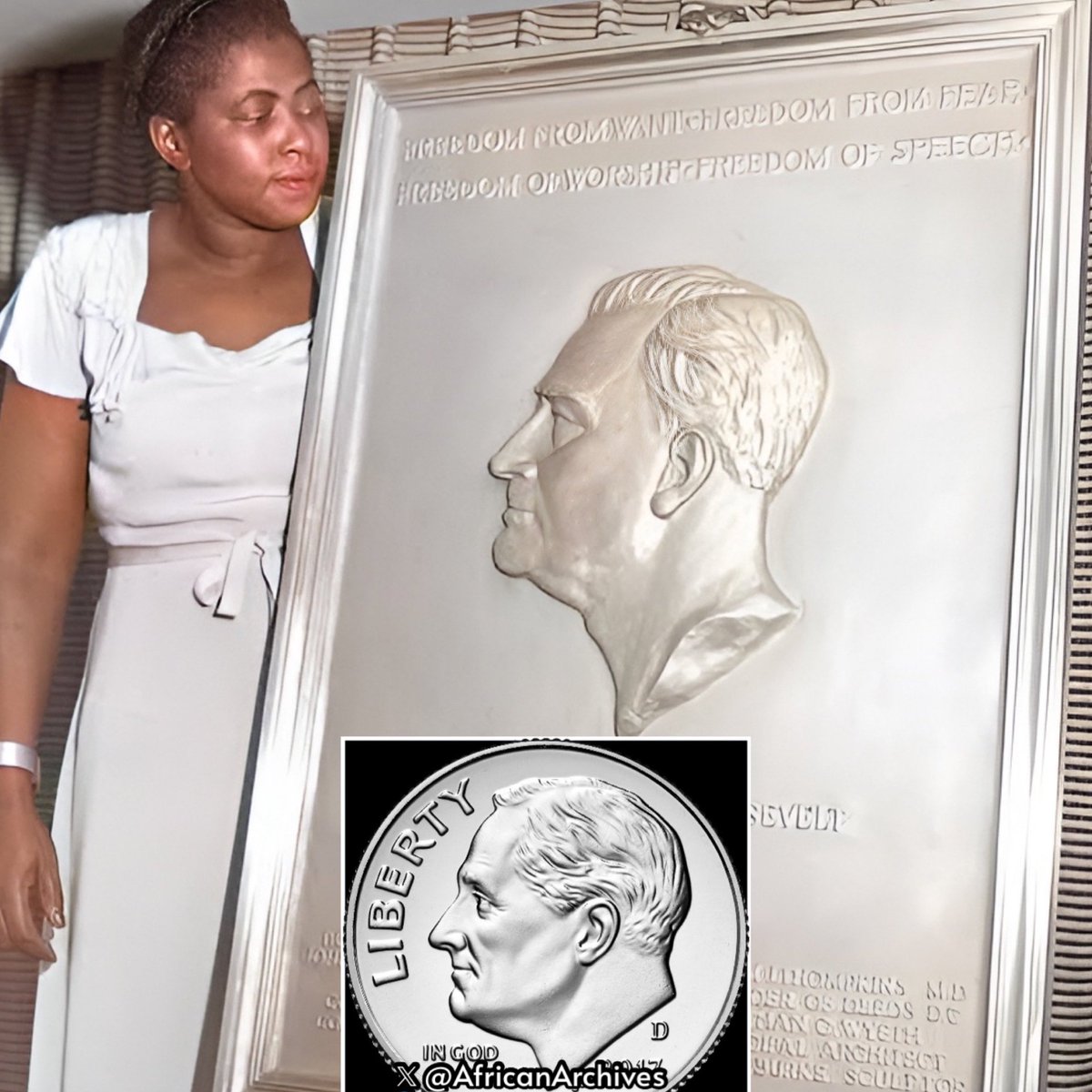
Selma Burke was a sculptor and a member of the Harlem Renaissance movement, best known for a bas relief portrait of President Franklin D. Roosevelt
She never received credit for her portrait of President Franklin D. Roosevelt which was later featured on the US dime.
—In 1943, Franklin D. Roosevelt sat for a portrait by a young African-American artist from Mooresville. That artist was Selma Burke.
However, John R. Sinnock’s signature is on the dime, and he receives credit for the work while Burke’s portrait, which she spent two years working on, is only recognized as an inspiration and model for the final image used on the coin. According to Lisa E. Farrington, author of “Creating Their Own Image, The History of African-American Women Artists,” Sinnock made “barely perceptible alterations.”
HONORS
As well as a sculptor, Burke was also a lifelong student and educator, winning numerous awards and fellowships. She earned her first degree from Winston-Salem State University in North Carolina and eventually graduated with a Master of Fine Arts from Columbia.
She started her first art school in 1940, eventually starting her second in 1946, and opened the Selma Burke Art Center in Pittsburgh, which operated from 1968 to 1981.
Burke is an honorary member of Delta Sigma Theta sorority. She received several honorary doctorate degrees during her lifetime, including one awarded by Livingston College in 1970 and one from Spelman College in 1988.
Milton Shapp, then-governor of Pennsylvania, declared July 29, 1975, Selma Burke Day in recognition of the artist's contributions to art and education. Her papers and archive are in the collection of Spelman College.
Burke was a member of the first group of women – along with Louise Nevelson, Alice Neel, Georgia O'Keefe, and Isabel Bishop – to receive lifetime achievement awards from the Women's Caucus for Art, in 1979. She received the award from President Jimmy Carter in a private ceremony in the Oval Office.
She received a Candace Award from the National Coalition of 100 Black Women in 1983 and the Pearl S. Buck Foundation Women's Award in 1987.
She died in 1995 at the age of 94.