Actor Gary Sinise leads the annual Snowball Express event, taking over 1,700 family members of fallen service members to Walt Disney World for free....
The trip was organized through Snowball Express, a program operated by the Gary Sinise Foundation for the children and surviving spouses of fallen military service members.
In December 2019, approximately 1,000 Gold Star children traveled to Orlando for several days at Walt Disney World.
The experience included airfare, lodging, meals, entertainment and activities designed to help families build new memories during an emotionally difficult time of year. American Airlines provided flights from cities across the country, with employees and volunteers decorating terminals and aircraft for the children.
The purpose extended far beyond a free vacation. Children who had lost a parent through military service were able to meet others who understood their grief without needing it explained.
The program combined celebration with remembrance, giving families opportunities to honor the people they had lost while forming lasting friendships.
Sinise became widely associated with supporting military families after playing wounded Vietnam veteran Lieutenant Dan Taylor in Forrest Gump. He later created the Gary Sinise Foundation and formed the Lt. Dan Band, performing for service members and raising money for veterans, first responders and their families.
Snowball Express began in 2006 and was inspired partly by a letter written by Army Pfc. Jesse Givens, who was killed in Iraq in 2003. In the letter, he told his wife to take their children to Disneyland if he did not return home.
#archaeohistories
At sixteen, Srinivasa Ramanujan encountered G. S. Carr’s A Synopsis of Elementary Results in Pure and Applied Mathematics, a compact collection of roughly 5,000 formulas and theorems.
This book gave results with little or no proof. For Ramanujan, that was almost an invitation: each theorem became a problem to reconstruct for himself, helping him develop methods that were largely his own.
“Obvious” in mathematics can be dangerous.
Shizuo Kakutani once wrote a lemma on the board and told his Yale class that its proof was obvious.
A student asked for the proof. Kakutani tried, but could not produce one.
After class he searched for the original paper and finally found it. The lemma was there, followed by the words: “Exercise for the reader.” The author of that 1941 paper was Kakutani himself.
Source: Steven G. Krantz, Mathematical Apocrypha, Chapter “Great Foolishness,”.
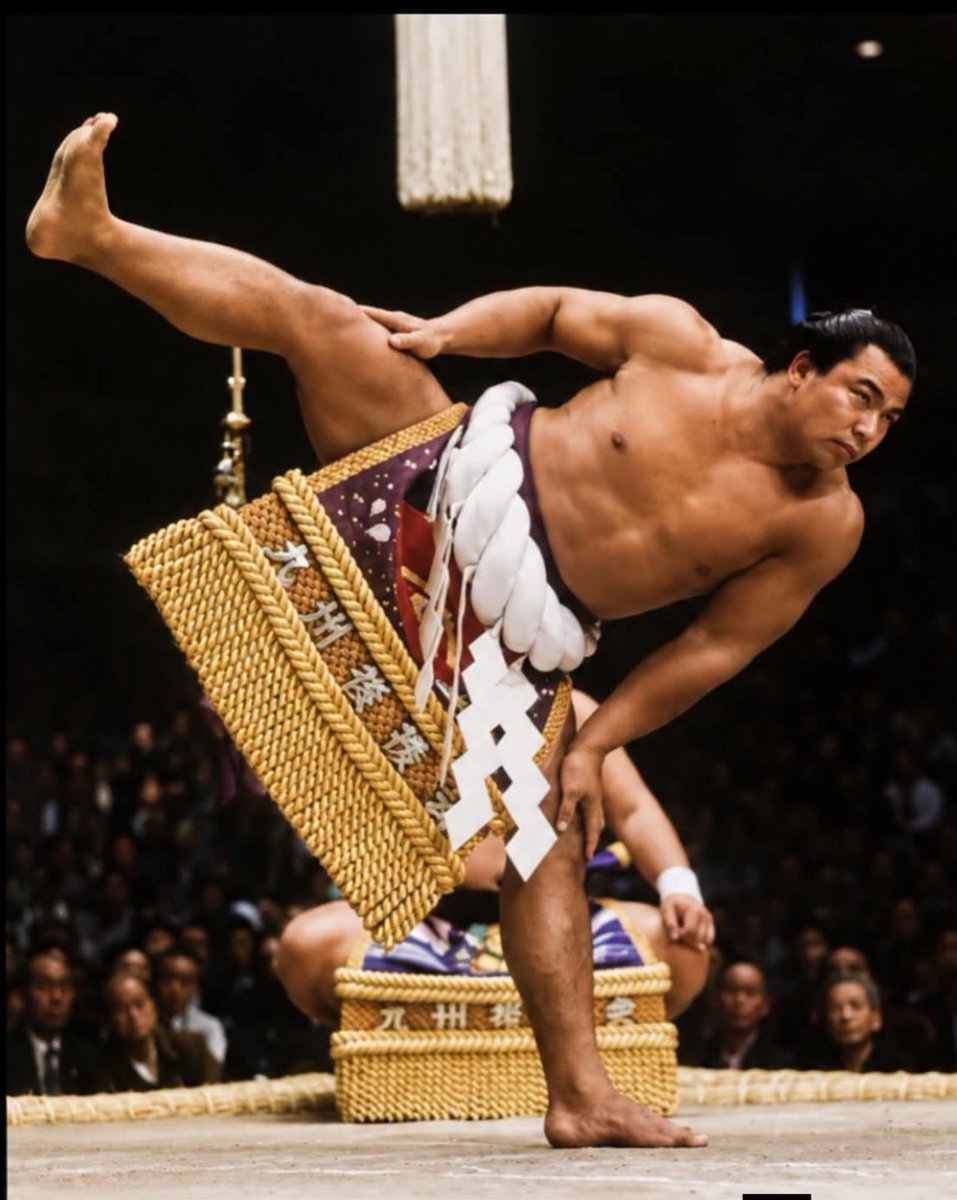
The 58th Yokozuna, Chiyonofuji Mitsugu, performing the dohyō-iri (ceremonial ring entrance) in 1983. Nicknamed "The Wolf," he is widely regarded as one of the greatest sumo wrestlers in modern history due to his exceptional strength, technical skill, and remarkably lean, muscular build...
A yokozuna is the highest rank in professional sumo, reserved for wrestlers who combine outstanding results with exceptional dignity. Unlike lower-ranked wrestlers, a yokozuna cannot be demoted; when he can no longer meet the rank’s demands, retirement is expected.
Chiyonofuji was promoted to the rank in 1981, becoming sumo’s 58th yokozuna. Known as “The Wolf,” he was more muscular and athletic-looking than many of his larger opponents. Rather than relying on bulk alone, he used speed, balance and precise technique to throw or force them from the ring. His compact build made every victory over a heavier rival part of his signature.
He remained yokozuna for a decade and won 31 top-division championships, establishing himself as one of the sport’s defining champions. His strength and longevity made him a household name in Japan, while his dramatic style helped bring new attention to sumo. He retired in 1991, but his image—muscular, focused and wearing the braided rope of a yokozuna—remains one of the most recognizable in the sport’s modern history.
In 1989, Chiyonofuji became the first sumo wrestler to receive Japan’s People’s Honour Award, after reaching 965 career wins.
#archaeohistories


![NARUTO_info_en's tweet photo. [#BORUTO: Two Blue Vortex Character File]
Delta
・A cyborg
・Former Kara member https://t.co/BTIHox2e0h](https://pbs.twimg.com/media/HTMM365a8AAICyv.png)
![NARUTO_info_en's tweet photo. [#BORUTO: Two Blue Vortex Character File]
Delta
・A cyborg
・Former Kara member https://t.co/BTIHox2e0h](https://pbs.twimg.com/media/HTMM363bIAAP2LC.png)









![NARUTO_info_en's tweet photo. [#BORUTO: Two Blue Vortex Character File]
Delta
・A cyborg
・Former Kara member https://t.co/BTIHox2e0h](https://pbs.twimg.com/media/HTMM366bEAAsKMc.png)