There is no science that shows vaccines cause Autism ...except in these published studies which show vaccines cause Autism:
▪️ https://t.co/9PBis1NeN0
▪️ https://t.co/BnGp3LHpNY
▪️ https://t.co/GZg2u91uyH
▪️ https://t.co/HxyJhJ9eTU
▪️ https://t.co/UxGxKAQhcJ
▪️ https://t.co/pMF2i9yH4L
▪️ https://t.co/0gN0fSNtKK
▪️ https://t.co/d3fELVQ3bO
▪️ https://t.co/nerRN2PiFm
▪️ https://t.co/z3Jr3j1L4T
▪️ https://t.co/dfXwUj6L37
▪️ https://t.co/rsAb6yiTp6
▪️ https://t.co/T7FGd5W39O
▪️ https://t.co/WB7eA9gfwb
▪️ https://t.co/CIApYvYcxV
▪️ https://t.co/gVt803ebzu
▪️ https://t.co/8aif6nRsWz
▪️ https://t.co/g8R2I7z9Rb
▪️ https://t.co/Ou4Op0TVgP
Causal relationship between vaccine induced immunity and autism
▪️ https://t.co/cm2GtMLmYG
... and autism being listed in the inserts....
J.R.R. Tolkien explains why he spent years building Middle-earth before writing The Lord of the Rings.
In a rare interview, Tolkien is asked why he devoted more than a decade to creating the world behind his stories before writing them.
He rejects the idea that Middle-earth emerged purely from his unconscious, describing himself instead as “a meticulous sort of bloke” who spent years working out timelines, languages, histories, customs, and genealogies until everything fit together.
For Tolkien, the world existed before the story.
He even says The Hobbit began almost by accident, explaining that the larger mythology was already in place and that the novel simply became absorbed into it.
When asked why anyone would build an entire fictional world before telling a story, Tolkien points to what he calls “subcreation.”
As creations of a Creator, he argues, humans naturally desire to create. Since we cannot create something from nothing, we instead reshape existing reality into new forms that are both imaginative and aesthetically satisfying.
Tolkien also rejects the idea that art should be driven solely by moral purpose, insisting that beauty and aesthetics are just as fundamental to human creativity.
Discussing good and evil, he explains that Sauron was not evil from the beginning but fell from grace, much like Lucifer. The One Ring, he says, symbolizes a power so absolute that even someone with good intentions would inevitably be corrupted by wielding it.
He adds that this idea long predates the atomic age, noting that the foundations of his mythology were developed while he was still an undergraduate, not as an allegory for modern events.
At the end of the interview, Tolkien is asked whether he would rather be remembered for what he said or for what he made. He dismisses the distinction, arguing that lasting creations endure precisely because they have something meaningful to say.
Source: The Tolkien Professor interview with J.R.R. Tolkien (BBC, 1968), “J.R.R. Tolkien Interview (1968).
Richard Feynman stood at a Cornell blackboard in 1964 and explained the problem every AI lab is fighting in 2026. The BBC filmed it. Almost nobody watches it.
The lecture is about why nature only answers in mathematics. Every team forcing language models to reason is hitting the wall he mapped 62 years ago.
He was 46. The Nobel Prize came 11 months later. The footage survived on film reels and now sits free on YouTube with fewer views than a keyboard unboxing.
Watch the blackboard section near the middle. He takes 1 of Kepler's laws and rebuilds it from nothing, with notation a 12-year-old can follow.
No slides. No jargon. 1 piece of chalk.
An ML engineer I know paused it 4 times and made his whole team watch it before standup.
You're 62 years late. The lecture is still free.
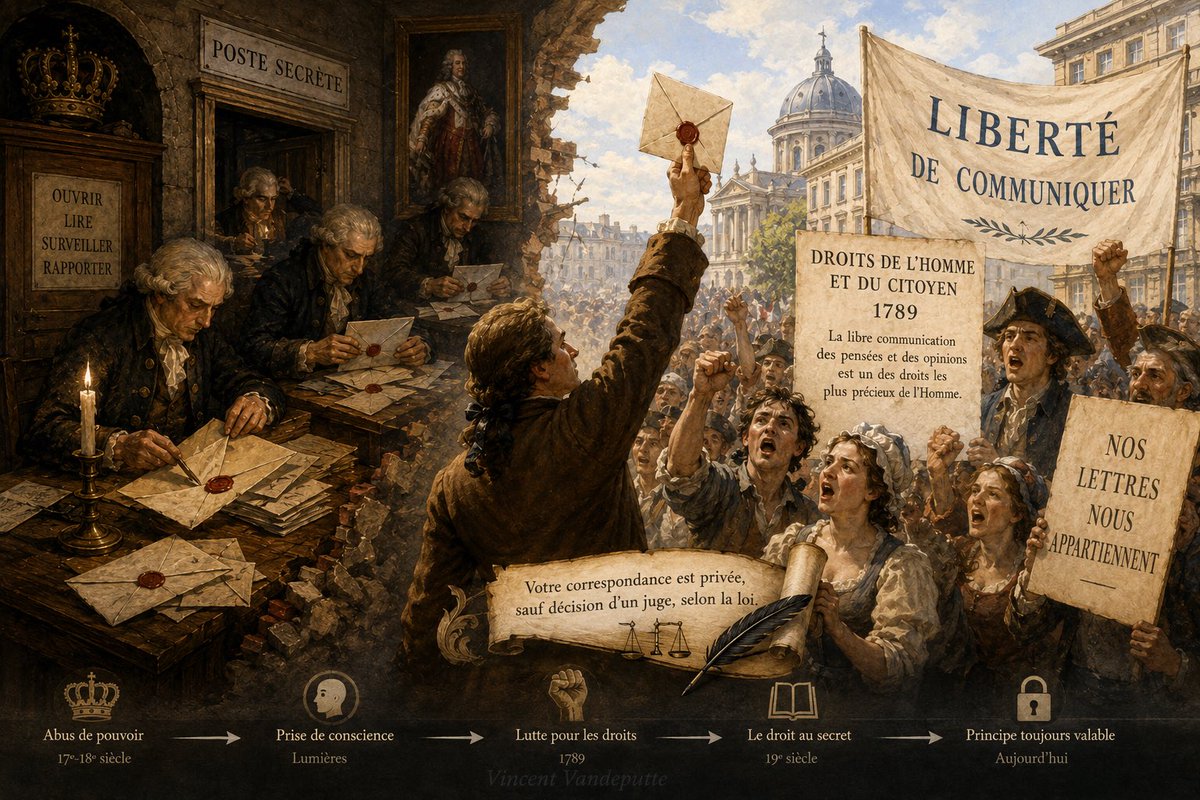
Misschien toch even een opfrissing over het briefgeheim en waar het vandaan komt.
Want dat briefgeheim is geen toevallig regeltje dat juristen ooit hebben bedacht. Het is een grondrecht dat is ontstaan uit harde historische lessen.
In de 17e en 18e eeuw was het in grote delen van Europa doodnormaal dat koningen, vorsten en regeringen privébrieven lieten onderscheppen.
Er waren zelfs officiële “zwarte kamers” waar ambtenaren post in geheim openden, overschreven, analyseerden en daarna opnieuw verzegelden, zodat de afzender niet eens wist dat zijn brief was gelezen.
Dat deden ze niet omdat ‘iedereen verdacht was’, maar omdat de ‘powers that be’ perfect hadden begrepen dat wie alle communicatie controleert, uiteindelijk ook de controle krijgt over de samenleving.
En juist daarom groeide in de 18e eeuw, tijdens de Verlichting, het besef dat vrije burgers ook volledig vrij met elkaar moesten kunnen communiceren.
—> dat besef en de ermee gepaard gaande onvrede leidde ertoe dat het briefgeheim vanaf het einde van de 18e eeuw en in de loop van de 19e eeuw in steeds meer Europese grondwetten werd opgenomen als een fundamenteel recht.
Absoluut niet om criminelen te beschermen trouwens maar om burgers te beschermen tegen een overheid die veel te veel macht naar zich toe trok.
Want de vraag is gewoon: hoe vrij spreek je nog als je weet dat de overheid elk privégesprek kan meelezen?
Het uitgangspunt werd: “Jouw communicatie is privé, tenzij een onafhankelijke rechter, in uitzonderlijke omstandigheden en volgens de wet, beslist dat daarvan mag worden afgeweken.”
Dat principe geldt vandaag nog altijd. Maar nu zijn brieven grotendeels vervangen door e-mails, WhatsApp-, Signal- en Messenger-berichten enz.
De technologie is veranderd maar de reden waarom het briefgeheim bestaat, is exact dezelfde gebleven.
Het briefgeheim is dus geen bescherming van mensen die “iets te verbergen hebben”.
Het is juist een bescherming van vrije burgers tegen een les die Europa eeuwen geleden al op de harde manier heeft geleerd: een overheid die ongecontroleerd alle communicatie kan lezen, krijgt vroeg of laat meer macht dan een vrije samenleving mag aanvaarden.
En Chat Control is niet meer of minder dan het opheffen van een van onze grondrechten: het briefgeheim. Een basisrecht dat is voortgekomen uit mistoestanden en waarvoor letterlijk is gevochten en waar jarenlang is over nagedacht. Dat omkeren is bijzonder precair en nefast, op zoveel vlakken…
Een mega boomerang ‘in the making’.
@Hanneke1698443@demo_demo_nl@wierdduk Als je als NL’er een buitenlands paspoort aanneemt, raak je direct je NL paspoort kwijt. Andersom geeft NL wel paspoorten aan buitenlanders die binnenkomen en hun eigen paspoort behouden.
In 2012, the people of Ireland were asked to choose their favorite painting in the world.
They did not choose a Caravaggio, a Vermeer, or a Monet. They chose this: two lovers saying goodbye on a staircase...
It is called Hellelil and Hildebrand, the Meeting on the Turret Stairs, painted in 1864 by Frederic William Burton. It is a watercolor, which makes its richness and depth almost impossible to believe, and it hangs today in the National Gallery of Ireland.
The story comes from a medieval Danish ballad. Hellelil, a noblewoman, fell in love with Hildebrand, the prince who had been assigned to be her personal guard. Her father forbade it and ordered her seven brothers to kill him. When they attacked, Hildebrand killed six of them. At Hellelil's desperate cry, he spared the youngest, and that hesitation cost him his life. He died of his wounds. The surviving brother imprisoned her, and she did not live much longer...
Burton could have painted the battle. He could have painted the deaths, the grief, the blood. Instead he chose the one intimate moment before all of it: the lovers passing on a turret staircase, stealing a final embrace, knowing what is coming.
And every detail in the painting carries the weight of that knowledge. He does not seize her in passion. He bows his head and kisses her arm with a tenderness that is almost unbearable, because it is goodbye. She does not collapse into him. She turns to climb the stairs, her face hidden from him and from us, because to look back would make it impossible to leave.
The Victorian novelist George Eliot saw the painting and described it perfectly. The face of the knight, she wrote, is "the face of a man to whom the kiss is a sacrament."
And that is precisely why it has moved people to tears for more than a hundred and sixty years. It shows something that most of us have felt: not love at its beginning, when it is easy, but at the moment it must be given up, which is the moment that reveals everything it was worth.
Burton understood that the most powerful thing he could paint was not the tragedy itself, but the last gentle second before it arrived, held forever in paint, so that the two of them never have to climb those stairs apart.
Eliot, who was a friend of Burton's, captured it best: "It might have been made the most vulgar thing in the world, but the artist has raised it to the highest pitch of refined emotion."
I started this newsletter because our predecessors left us extraordinary things, and almost no one teaches us about them anymore. Every week I try to. If that is something you would like to be part of, you can join here:
https://t.co/hgJUdR0jlx
And if you'd like to support my work, a paid subscription is what makes it possible.
Thanks for reading.
@Lidia1762992586@InkFromAStone @bernsteind @tricrobotics yeah - look at the difference even glycosulphate makes on the ecosystem at my finca and my neighbours
https://t.co/uqs8EzuhR4