Introducing SMERF: a streamable, memory-efficient method for real-time exploration of large, multi-room scenes on everyday devices. Our method brings the realism of Zip-NeRF to your phone or laptop!
Project page: https://t.co/WOzE4ApKAH
ArXiv: https://t.co/lugQXu3mQZ
(1/n)
I had the pleasure last month of giving slightly provocative talk at Bliss AI, a a wonderful student-run organization here in Berlin. The best part: the talk is online for everyOne to enjoy! Behold: "NeRF is dead"
https://t.co/XdGxJ8e9bk
Are you at #SIGGRAPH2024 and want to learn how to reconstruct meshes from multi-view images that contain details like individual strands of grass? Then come today to the "Radiance Field Processing" session at 2 p.m. in Mile High 1.
https://t.co/43Ez7VMQHB
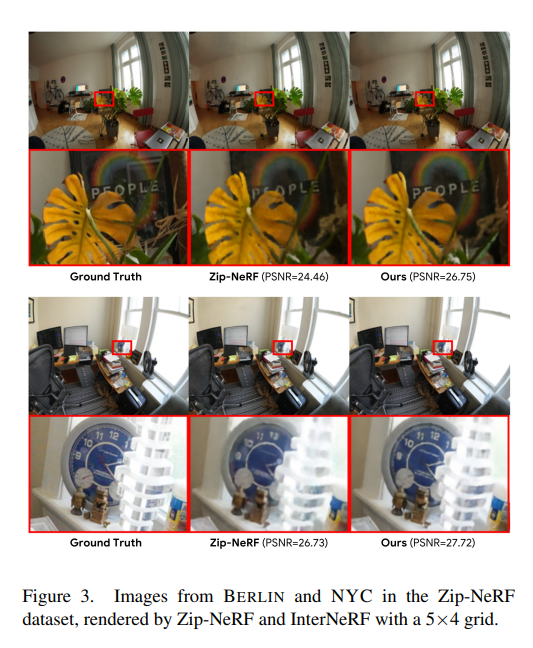
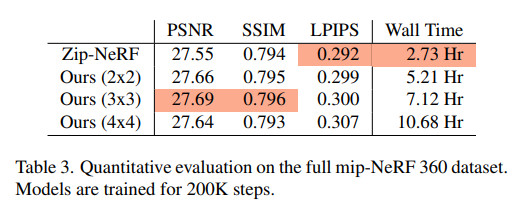
InterNeRF: Scaling Radiance Fields via Parameter Interpolation
@clintonjwang, @PeterHedman3, Polina Golland, @jon_barron, @duck
tl;dr: use camera origin to assign camera region to partitioned parameter grid and compute bilinear interpolation weights
https://t.co/UGwHw1Mqng
@dariel_noel@LinusEkenstam You'll have to read the paper for all of the technical details, but in short: clever use of OpenGL texture lookups + lots of model training magic.
Seeing the amazing new SMERF technology immediately made me imagine a time when we can walk around in environments like this, styled to be anything we can imagine. All happening in realtime, shaped with voice prompts or virtual paint or sculpt marks.
Here's a test of using some of the SMERF demo scenes to drive a generative AI image stream in Krea.. incredible! It's like seeing the world through a new camera lens of imagination.
I'll post a link to the incredible SMERF paper by @duck and his colleagues below.. what a time to be alive!
#ai #art
Introducing SMERF: a streamable, memory-efficient method for real-time exploration of large, multi-room scenes on everyday devices. Our method brings the realism of Zip-NeRF to your phone or laptop!
Project page: https://t.co/WOzE4ApKAH
ArXiv: https://t.co/lugQXu3mQZ
(1/n)
@supremebeme@RadianceFields This and other large scenes are captured with a DSLR camera and a fisheye lens. Approximately ~1500 photos are used. Capture takes 30~60 min.
@Kyrannio Don't forget my amazing collaborators at Google Research, Google Inc, and Tübingen! This was very much a team effort.
More info here: https://t.co/MSfKDuNGdI
Introducing SMERF: a streamable, memory-efficient method for real-time exploration of large, multi-room scenes on everyday devices. Our method brings the realism of Zip-NeRF to your phone or laptop!
Project page: https://t.co/WOzE4ApKAH
ArXiv: https://t.co/lugQXu3mQZ
(1/n)
Introducing SMERF: a streamable, memory-efficient method for real-time exploration of large, multi-room scenes on everyday devices. Our method brings the realism of Zip-NeRF to your phone or laptop!
Project page: https://t.co/WOzE4ApKAH
ArXiv: https://t.co/lugQXu3mQZ
(1/n)
@GKopanas Thanks for the kind words, Georgios! I look forward to the next generation of 3DGS work as well. It's just a matter of time till 3D capture & presentation is accessible as 2D is today.
Thoughts NeRFs were dead? Google DeepMind just dropped SMERF — streamable, multi-room NeRFs with cm-level detail. Oh and it works realtime on mobile 🤯
It’s a sweet spot between the speed of Gaussian Splatting and the quality of Zip-NeRF.
More below ⬇️
SMERF from Google Research (again) achieves Zip-NeRF quality, operating at a remarkable 60fps on everyday devices like smartphones and laptops.
🔗 https://t.co/CaesLtxfPw