Galaxy Digital gets priced like a crypto company.
That might be a mistake.
Its AI data center business could soon generate billions in high-margin revenue. Meanwhile, the market is still valuing it primarily as a crypto stock.
The biggest AI opportunity might be hiding where nobody is looking.
FT @BitcoinJesusETH@m0xt_
Tune in to know more
⏱ TIME POINTS ⏱
00:00 – Intro
01:03 – The SpaceX IPO Trade
05:50 – SpaceX’s Bitcoin Bet
09:40 – Galaxy’s AI Pivot
15:29 – Why Figure Wins
20:01 – The Rise Of Vaults
22:14 – Sponsor: Bitget
22:46 – Sponsor: Cape
23:31 – Vaults vs Traditional Finance
26:06 – The $355M Crypto Raise
31:36 – Canton vs Ethereum
39:53 – Has Bitcoin Bottomed?
🇺🇸 THE U.S. STOCK MARKET IS IGNORING THE MOST IMPORTANT SIGNAL RIGHT NOW.
Every time we have seen a large spike in inflation, the S&P-500 crashed violently.
This is only happening because the AI narrative is acting like a shield.
As soon as that hype fades, the market will realize what's happening.
That will result in a very bad crash.
A man who earned $28 an hour at SpaceX is about to become a millionaire today because of the IPO.
But he is just 1 of 4,400 SpaceX employees becoming millionaires today.
SpaceX begins trading on Nasdaq today under the ticker SPCX, priced at $135 per share and valued at $1.77 trillion.
The offering raised $75 billion and drew more than $250 billion in investor demand, more than three times oversubscribed.
More than 4,400 current and former SpaceX employees are projected to become millionaires today. Around 400 of them will hold stakes worth over $100 million each.
To put that in context, the Google IPO in 2004 created roughly 1,000 millionaires. Facebook's 2012 listing produced a similar number. SpaceX is doing more than four times both of them in a single day.
And the majority of these people are not founders or executives.
They are engineers, welders, machinists, and launch technicians who took equity over cash and held it for years.
Juan Hernandez moved from Mexico and learned to weld for the money.
He joined SpaceX in 2015 earning $28 an hour. When he went full time, the company gave him $10,000 worth of stock. He held it, bought more through payroll deductions, and sold a small portion in 2020 to buy property in Texas.
His remaining shares are worth $880,000 today.
Trevor Hise joined as a launch engineer straight out of college in 2011. He spent 12 years accumulating shares through salary, bonuses, and reinvestment. He is 37 years old and walking away with more than $13.5 million.
Gavin Petit started in 2012 on an $80,000 base salary with a small initial grant priced at $13.80 per share. He took every bonus in stock.
He has already paid off his home in Denver from earlier tender offer windows and now holds a stake worth several million dollars.
J. André Lavoie, an engineer who received grants years ago, is sitting on more than $28 million. He is currently in Italy renovating a hotel.
Tom Mueller was SpaceX's first employee, hired in 2002 to build the engines that made all of this possible. He left in 2020 but kept his equity.
This week he said: "Elon always said that your salary is one thing, but it's the equity that's gonna be worth something. That day is here."
This is what SpaceX's compensation model actually looked like from the beginning. The company paid below market salaries and made up the difference in equity at every level of the organisation, not just at the top.
Stock options vested over four to six years. Workers could buy additional shares at a 15% discount through a company purchase plan.
Early option grants were priced below $2 per share. Even 2025 grants carried exercise prices between $37 and $42. At $135 today, those positions are sitting at 3x returns minimum.
The physical impact is already visible in Brownsville, Texas, one of the poorest cities in the United States, where more than 3,000 SpaceX employees work at Starbase.
Median home prices in the surrounding county have gone from $131,000 in 2014 to over $281,000 today.
More than 100 SpaceX employees pooled their combined holdings, estimated between $1 billion and $5 billion to negotiate institutional level wealth management fees as individual workers.
Today, SPCX opens and 4,400 people find out what years of holding actually pays.
$XLM under $1 is a gift. And I genuinely believe people will look back at this price the way they look back at Amazon in 2001.
Let me show you why with nothing but verified numbers.
Right now, today, $2.8 billion in real-world assets are already tokenized on Stellar.
Not promised. Deployed.
Spiko holds $952.7M in tokenized U.S. and European government debt. Franklin Templeton, managing over a trillion dollars, runs $674.8M through BENJI.
And Stellar was the FIRST blockchain they ever chose.
Ondo Finance, the company controlling 80% of the global tokenized Treasury market, deployed $525.5M.
Circle keeps $269.2M in USDC infrastructure with CCTP now live for native cross-chain transfers.
Four platforms. $2.42 billion.
Then add WisdomTree, Société Générale's FORGE division, Centrifuge, Etherfuse, Nyala, and Paxos with tokenized gold.
That's the present.
Here's the future.
DTCC, custodian of $114 TRILLION, selected Stellar as its first public blockchain for tokenized securities. Russell 1000 stocks. ETFs. Treasuries. Deployment targeted H1 2027.
MoneyGram's stablecoin serving 60 million customers? Live on Stellar.
Bermuda's national payment system? Stellar.
The EU's first regulated DLT securities exchange, 21X? Stellar.
A network already settling billions for trillion-dollar institutions, with the largest securities depository on earth scheduled to connect, priced under a dollar.
The market hands out gifts like this once a cycle.
Most people scroll past them.
These are the top ISO 20022 blockchains you need to study before the institutional wave fully arrives.
$XRP $LINK $QNT $XLM $XDC #HBAR
Six networks. All speaking the language global banking is migrating to.
All collecting institutional partners most chains can only dream of.
$XRP. XRP Ledger.
Ripple is tied to ISO 20022 through official governance membership. The partner list spans SBI Remit, AMINA Bank, Braza Bank, Kraken, OKX, Binance, and Ripple Prime.
Latest move: RLUSD launched in Türkiye while Istanbul Technical University joins UBRI with an XRPL validator on campus.
$LINK. Chainlink
Not a payment chain but embedded in institutional messaging workflows with SWIFT, DTCC, Euroclear, UBS, and Mastercard.
Chainlink Labs just added a Head of Institutional and Market Development specifically to onboard banks and asset managers into tokenized assets.
$QNT. Quant Network
Selected for the UK tokenized sterling deposits project alongside Barclays, HSBC, Lloyds, NatWest, and Santander.
Fusion Rollup just went live connecting 74 blockchain networks in one institutional execution environment.
$XLM. Stellar Network
DTCC selected Stellar as the FIRST public blockchain for DTC-tokenized assets. Franklin Templeton, MoneyGram, Visa, Circle, and PayPal's PYUSD all operate on it.
$XDC. XinFin XDC Network
TradeFinex runs ISO 20022-compliant trade finance. SBI Group, ITFA, Circle, BitGo, and Fireblocks connected. Animoca Brands just joined as institutional masternode validator.
$HBAR. Hedera
Shinhan Bank, Standard Bank, State Street, Lloyds, and Legal & General building tokenization and custody infrastructure on it.
Six chains.
One messaging standard.
Hundreds of institutions.
The financial system is upgrading its language and these networks already speak it fluently.
Are you holding any of these assets?
NEW: Saylor releases an article describing what he sees as the 4 ideologies of Bitcoin:
1Bitcoin Maximalists
2Bitcoin Capitalists
3Bitcoin Technologists
4Bitcoin Fundamentalists
🚨Everyone is selling.🚨
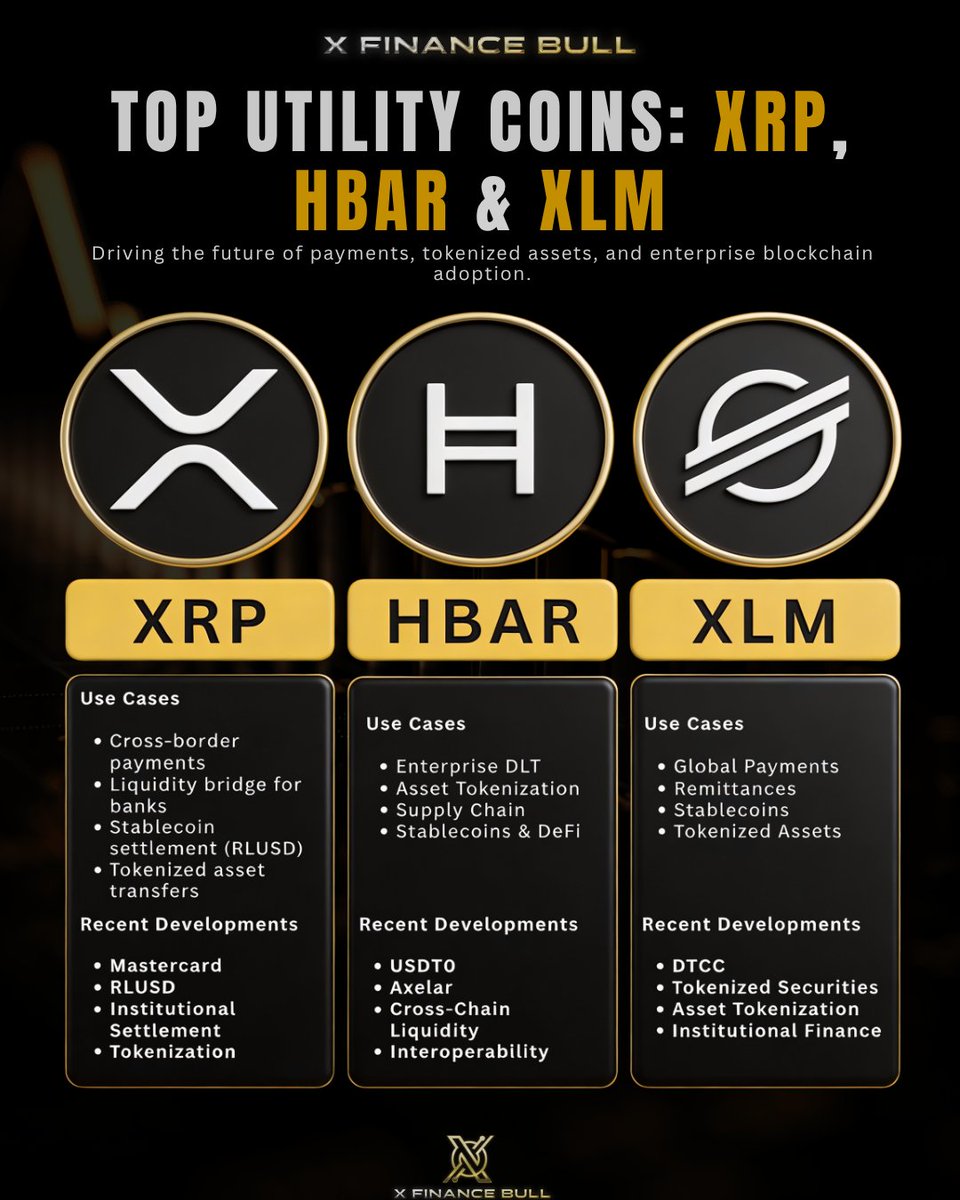
I’m buying $XRP, $XLM, and $HBAR at prices that do not match the institutional development happening behind them.
This discount feels like a gift from a market that has not read its own headlines.
Look at the past 30 days alone.
$XRP
Mastercard expanded settlement options with RLUSD and the XRP Ledger.
That is 3.3 billion cards. 210+ countries. Over $9 trillion in annual transaction volume.
JPMorgan and Ondo settled tokenized Treasuries on XRPL.
DTCC tokenization production starts in July, with Ripple Prime inside the 50-firm working group.
ETF flows stayed green while Bitcoin and Ethereum saw heavy outflow weeks.
A bridge currency connected to massive treasury flows is trading like nothing is happening.
$XLM
DTCC chose Stellar as the first public blockchain for tokenized DTC-custodied securities.
That is not small. DTCC sits at the center of global market plumbing.
MoneyGram launched MGUSD on Stellar for millions of customers.
Figure launched YLDS.
21X went live for regulated securities trading in Europe.
Bermuda is moving national payments on-chain.
Stellar is sitting directly inside the tokenized asset conversation, yet the market is still pricing it like a forgotten payment coin.
$HBAR
USDT0 arrived through Axelar for cross-chain liquidity.
CLPR was announced for bridgeless interoperability.
Animoca Brands, Deutsche Telekom, and SBI are validating the network.
DLA Piper, Lloyds, and the Reserve Bank of Australia have all been connected to real enterprise use cases.
HBAR is not just another chain chasing attention.
It is an enterprise-grade network governed by major global players.
That matters.
$XRP. $XLM. $HBAR.
Three utility assets.
Three infrastructure plays.
Three networks sitting closer to the next financial system than most of the market wants to admit.
The price is down.
The development is not.
I’m not waiting for green candles to confirm what the partnerships are already showing.
Follow along if you want more utility alpha like this.
Financial institutions are embracing Stellar Network and it's massively bullish for $XLM 🤯
MoneyGram just proved it by launching MGUSD, its own stablecoin, directly on Stellar.
Live today.
60 million active customers.
500,000 retail locations.
70%+ digital transactions.
One of the largest payment networks on earth just chose $XLM as the blockchain powering its entire stablecoin infrastructure.
Bridge, a Stripe company, handles regulated issuance. GENIUS Act compliant from day one.
Fireblocks provides institutional custody. M0 runs the smart contracts.
Stellar settles every transaction underneath.Self-custodial wallets embedded in the MoneyGram app. Dollar balances held 24/7.
Convertible to local currency anywhere, anytime. Built for families sending money home and billions without banking access.
Every MGUSD transaction generates native $XLM demand.
60M customers is a distribution channel no other L1 can match through a single partnership.
Locked in!