Solana's read layer 2.0 is now open source: Superbank (history) and Cloudbreak (accounts), marking the end of vendor lock-in for chain access.
Querying @solana should feel like calling a real database, so we built exactly that.
🟣Lightning-fast account reads with dynamic indexes from your query patterns
🟣Your own queryable copy of Solana history, with no indexing logic to write
🟣More performant than Agave, while running on commodity hardware
Fork it, run it, improve it. It's yours 🌊🧵https://t.co/uvnhFjUceE
If you stream Solana data, you're probably using Yellowstone gRPC, Triton's Geyser plugin for real-time access to accounts, transactions, slots, and blocks as the node processes them.
We're constantly making it faster and easier to use, and recently, we've closed two more gaps that teams have been solving in-house.
🟣 Auto-reconnect with a ~1,000-slot replay window
Low-latency streams are stateless, so if a connection drops (network blip, server restart, etc.), you lose your place, have no way to know what data you missed, and can't reconnect automatically.
Yellowstone gRPC client now handles all of it in one config call, delivering:
- Exponential backoff
- Slot-checkpointed resume from the last completed block
- Dedup layer that drops replay duplicates before they reach your handler
Learn more → https://t.co/ASOAKQSzrB
🟣 Compressed account filters for 10x smaller subscribe requests
A subscribe request for 1M accounts weighs ~44 MB on the wire, and every add or remove operation triggers a full filter rebuild, forcing teams to shard across multiple connections.
The new CompressedFilterSet field encodes your tracked accounts as a Cuckoo filter on the wire, providing:
- 10x lighter requests: 1M accounts drop to ~4 MB
- O(1) inserts and removes
- <1% false-positive rate, caught client-side against your exact in-memory set
Learn more → https://t.co/7g54dX5E9A
NEW sendtx endpoint: direct HTTP path for sending Solana transactions, with SWQoS included by default.
Landing fast on Solana comes down to three things: low sending latency, fewer network hops, and stake-weighted QoS.
Yellowstone Jet, our specialised sending engine, already covers all three, but the standard sendTransaction path still leaves some processing overhead on the table.
It wraps your signed transaction in a JSON-RPC envelope that the server has to parse before it even sees it.
New sendtx drops it entirely, letting you POST the raw bytes, or a base58/base64 string, directly to Jet:
🟣No server-side JSON parsing
🟣Smaller request, less bandwidth used
🟣Browsers skip the CORS preflight round-trip
🟣Runs over HTTP/3 and QUIC
🟣SWQoS on by default
Live on every Triton endpoint, and open-sourced in yellowstone-jet.
A must-read for indexers, analytics, compliance, and any pipeline where missing a block isn't an option.
We broke down:
- Why stateless streams fail on completeness
- How the cursor helps you backfill the gaps
- How to get deterministic slot ordering
https://t.co/Unr1LEL9kw
ICYMI, @triton_one recently added support for the `getTransactionsForAddress` (gTFA) RPC method. This worthy method has been requested by the dev community for a long time, and was previously implemented by other RPC providers as extensions to the API. We will propose that gTFA be added to the canonical RPC API specification, along with our soon-to-be open source implementation (currently pending third-party code review). Our updated docs are at https://t.co/oAuX64ZopG.
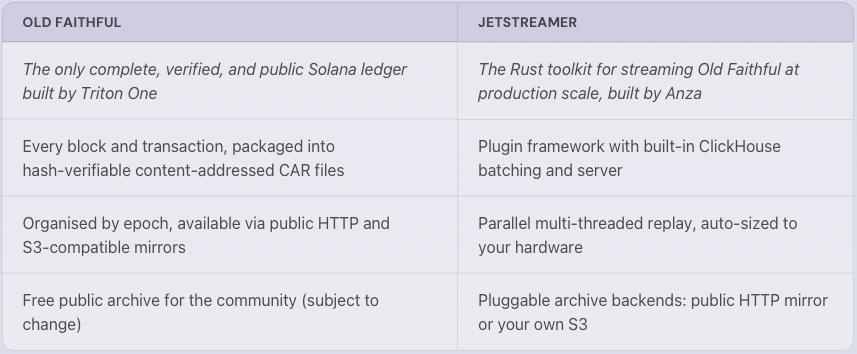
There is no @solana RPC provider who has contributed more to open source software & open data than @triton_one. We're always thrilled to see others, like our good friends at @anza_xyz, build on top of our work. Our latest blog article explains how Anza's JetStreamer works with Triton's Old Faithful to perform supersonic data backfills. Stop paying for RPC calls like `getTransactionsForAddress` when better tools are available for free. See below for the blog link.
We've been working on this for a while, and it's finally here.
A better, faster way to query @solana history.
If your wallet history lags or your explorer spins on lookups, the bottleneck is usually the storage layer. Bigtable is used across most of the industry, but was never designed for how Solana actually gets queried.
It's slow for random access, nearly impossible to adapt, and hasn't meaningfully evolved since its genesis. And the egress costs? Don't get us started.
We couldn't patch it.
So we rebuilt it from scratch.
Hydrant is Triton's new Rust backend running on ClickHouse with:
→ columnar storage physically sorted for each query
→ materialised views created at write time
→ dedicated routing for hot addresses like USDC
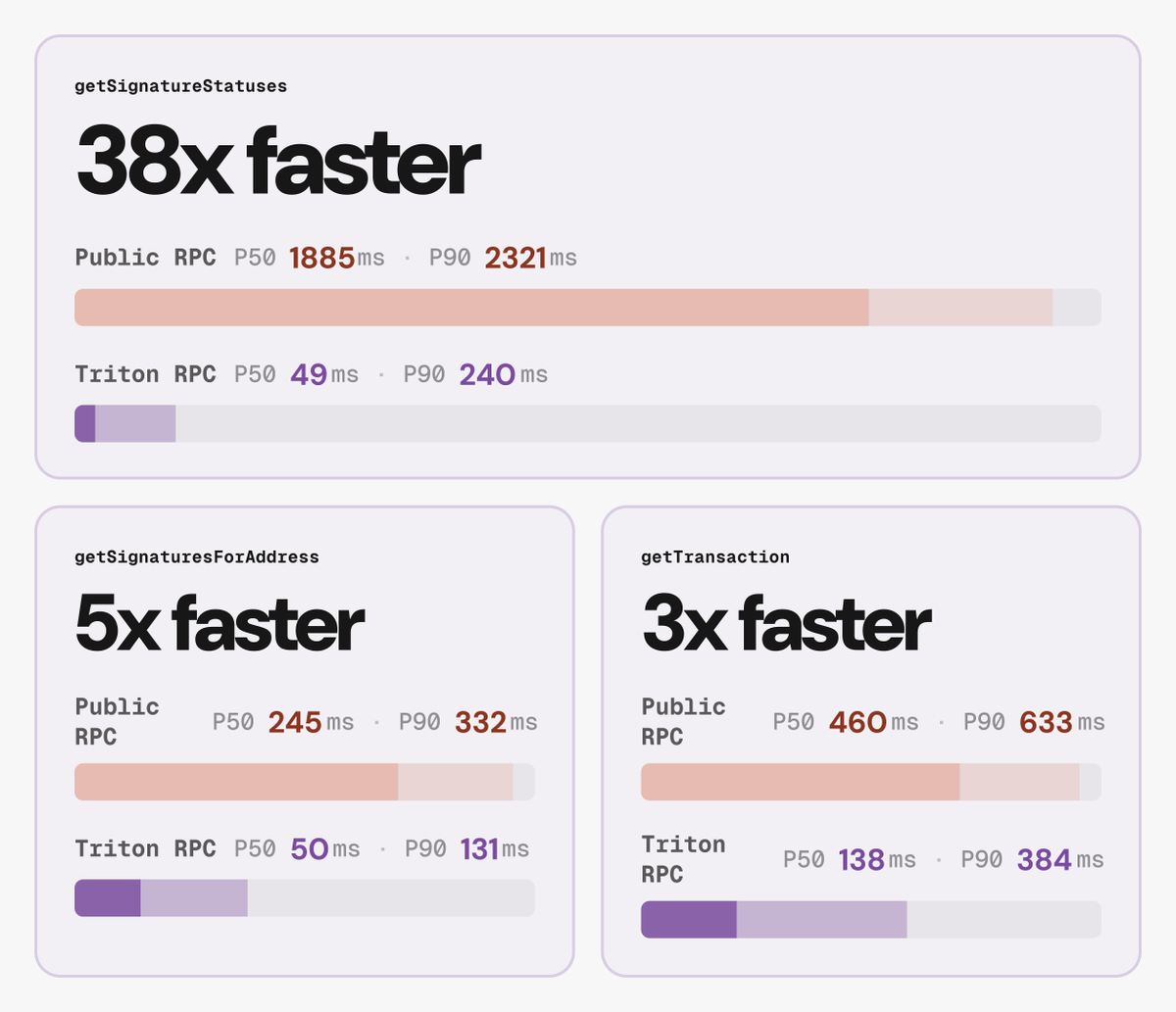
→ head cache that serves recent data at 0.57 ms P50
Three methods live, dramatically faster and more cost efficient.
Pricing is flat across the entire ledger: $0.08/GB + $10/M requests, genesis to tip, same as any standard RPC request.
And as if that wasn't enough, it's soon going open-source under AGPL!
Full breakdown: https://t.co/i0srt9gimJ
BREAKING: We're partnering with @SolanaFndn to rebuild Solana's read layer from the ground up.
@anza_xyz and @jump_firedancer have done incredible work scaling execution and networking, but the read layer has stayed largely unchanged since genesis. It was built alongside the validator and never got its own architecture.
By 2026, that gap shows: slower access, expensive customisation, and growing limitations at scale. The teams closest to the problem built great tools behind closed doors because the read path was too deeply coupled to the validator to improve without massive effort.
It's time Solana's data access layer matched the ecosystem's needs, and we're proud to be the ones building it:
Big news: reads are moving out of Agave into two modular systems, independently scalable, in sync with the network tip, open-source and managed by @SolanaFndn:
- Accounts: an adaptive indexing engine that ingests, stores, and serves the exact account data your app needs at extremely low latency
- Ledger: full architecture to ingest, store, and serve the entire ledger faster and more efficiently in a columnar engine purpose-designed for how builders query data
Every infrastructure provider, builder, dApp, and institution benefits, with the biggest impact coming from what gets built on top.
Full architecture overview: https://t.co/yLMDZIoP9Z
More technical posts coming as we build through 2026, so make sure to follow us on X and subscribe to our blog.
Our CVO (Chief Vibes Officer) @SteveCleanBrook is all in on the current @Colosseum hackathon, it seems.
Yesterday on Pirate's Parley, he announced a week-long $25 offer to self-onboard on Triton. Valid for a year, same infrastructure stack as the biggest protocols on Solana, no feature gates.
Frontier builders, this one's for you: https://t.co/8XDTHVzIWJ
Tomorrow I will be hosting @triton_one's very own @brianlong on Pirates Parley!
We will discuss @solana validators, RPCs, open-source software, the ecosystem, and much more!
We will be live at 4 pm UTC here on X and on YouTube. Join us live and ask us anything in the chat!
RFC: At @ValidatorsApp, we're planning for the @solana Alpenglow release and think this might be a good time to start over with a new website, metrics, scores, etc. Please let me know which features we should keep and what has been missing for the last five years. 🪡🧵 Thanks!
We’ve been building this tool for months to study sub-millisecond behavior on @triton_one.
Now it’s open-source, use it to see how fast your RPC really is and learn things no simple benchmark will show.
Link’s in the comments 👇
The @triton_one team is crushing it with our new gRPC service! This chart shows account update latency in Frankfurt, where we have industry-leading performance. TBH, the great news for @solana is that we're starting to measure latency differences at sub-millisecond levels. #IBRL
Good news!
@solana 's read layer just got a massive upgrade: Introducing Fumarole
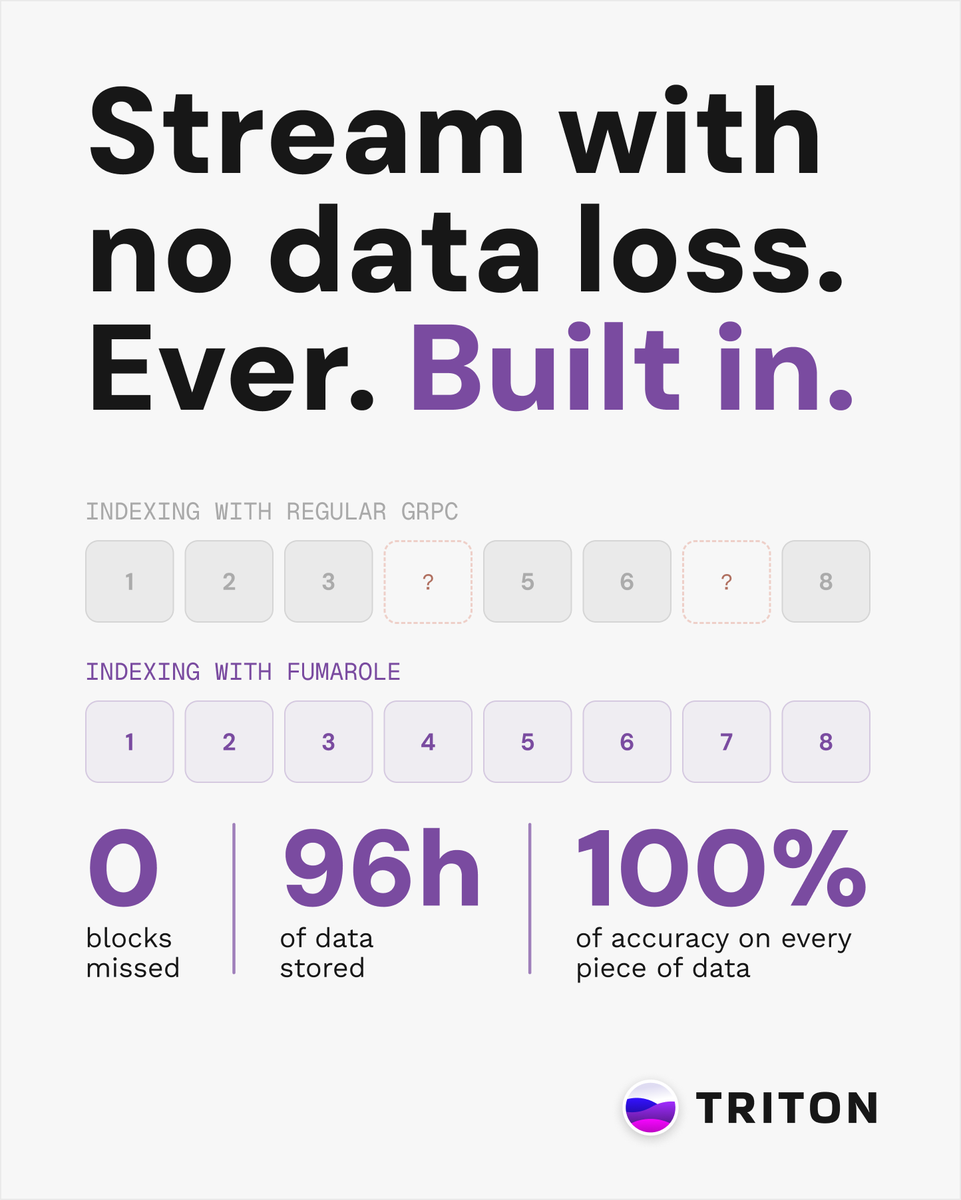
Fumarole is a streaming service explicitly built with data completeness in mind. It pauses the data stream upon disconnection and starts streaming again when you tell it to.
You won't miss updates from unstable gRPC connections anymore. Fumarole stores the last 23 hours; if you start using it today, you can stream yesterday's data, all the way up to the tip of the network!
Please read our blog post, which is linked in the following tweet!