The part worth thinking about is why burn the resource fee 100% instead of splitting it 50/50 with the leader, the way the base signature fee is split today.
Start with who does the work. The leader builds the block, but every other node has to replay and vote on it, which means re-executing every transaction. The resource cost a tx imposes isn't paid by the leader alone, it's paid by the whole network. So if a fee prices that cost, it makes more sense for the whole cluster to benefit through the burn than for the one node that happened to be leader to pocket half.
There's also an incentive problem with splitting it. Leaders already build blocks to maximize their reward, today that's priority fees plus their half of the base fee. Give them a cut of the resource fee too and you add a new dimension to that: they'd earn more from how many CUs get consumed and from any traffic that pays, including wasteful traffic. At the margin you'd be paying block producers to fill blocks with heavy junk. Full burn removes that lever, the leader has no reason to care how many resources a tx burns through if they aren't paid for it.
And this takes nothing from validators. base/2 + priority fees stay exactly as today. The whole debate is just whether this one new fee stream gets burned or captured.
On scale, even rough numbers point the same way. Using the requested-CU data posted in the thread (~16-18T CUs/day) at 0.1 lamport, the burn lands somewhere around 1,500-2,200 SOL/day at current usage. A 50/50 split hands maybe ~750-1,100 SOL/day to the entire validator set combined. Per validator, that's noise.
Now weigh that against the base it's competing with. Very roughly, hundreds of millions of SOL are staked earning mid-single-digit APY, which is on the order of tens of millions of SOL/yr in rewards across validators and delegators. A validator's reward scales with SOL price across that whole base. I'm not claiming this burn moves price by any specific amount, but you don't need much, even a small improvement in tokenomics is worth more across that staked base than splitting a few hundred SOL/day, and it's shared instead of fought over.
That's the trade: capture a tiny per-validator stream now, or burn it and let any value accrue to the whole staked base. The second is bigger in expectation and it's positive sum. Win for Solana.
Supporting @cavemanloverboy's resource-based base fee SIMD.
Charge per cost unit requested, burn 100%.
Ties the burn to the work the cluster does, keeps block producers neutral, upside goes to every SOL holder.
Win for Solana.
https://t.co/hsaBfFroMY
A cool way to watermark network packets is to (very subtly) adjust the timing.
Packet comes in a tiny bit late, maybe that’s a 0. Packet arrives on time? Maybe that’s a 1.
Of course, the neat part is that everything can remain entirely encrypted / the side channel doesn’t “touch” the underlying data flow, so it looks relatively normal.
You can actually get this timing to survive through multiple network hops + switches, because statistically they are (mostly) adding fixed delays. Queueing can mess you up, but as long as your information is above the network jitter noise, you can still decode it.
There’s basically an arm’s race going on. Some networks attempt mixing flows with traffic shapers to preserve anonymity…but you also can’t infinitely pad/delay packets without users getting really annoyed.
So, so many ways to hide a bit when you think about it.
…also a lot of ways to detect it too.
Having a Superteam is a cheat code.
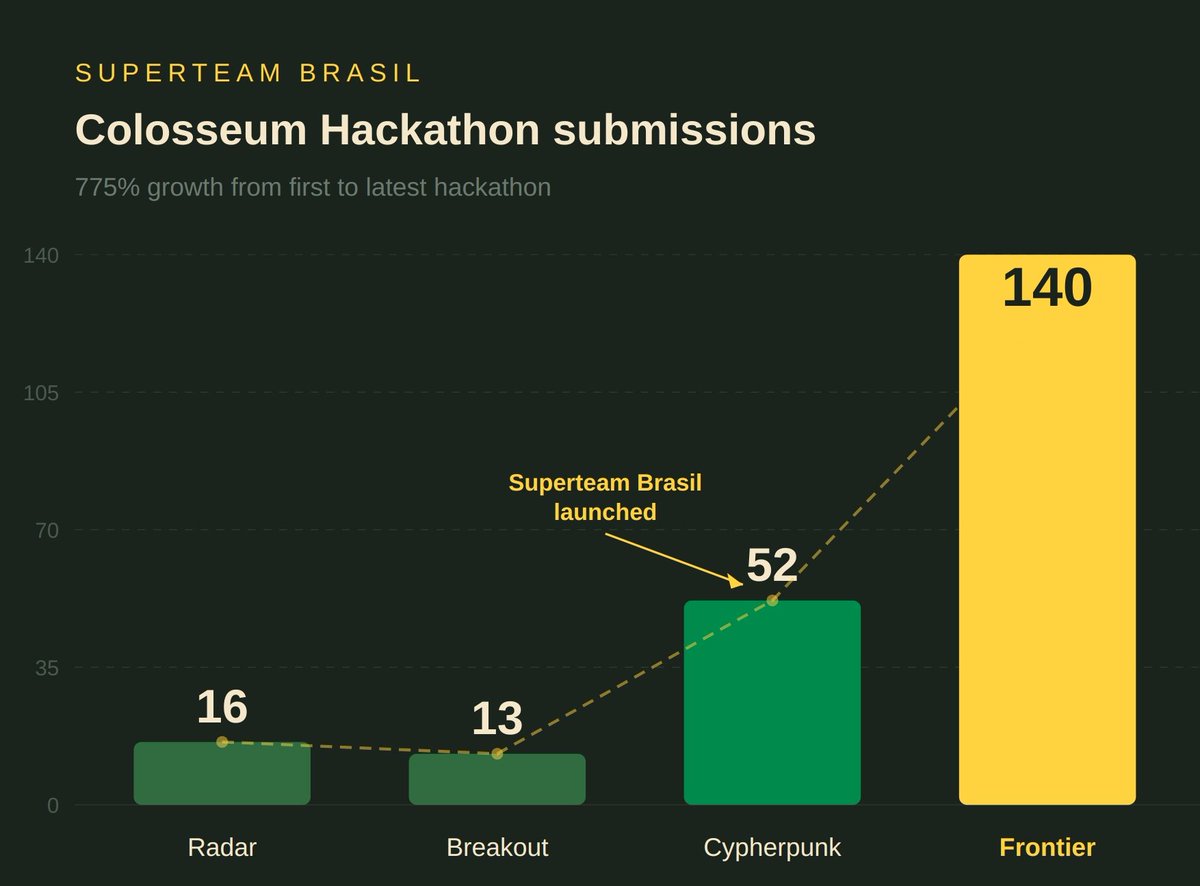
Before Superteam Brasil, Brazil averaged around 10 submissions per Colosseum Hackathon. A country with 200M+ people barely showing up.
Then we launched. First hackathon: 52 submissions, winning teams, and one project accelerated by Colosseum.
Now, Frontier: 1,100+ Brazilians signed up. Brazil ranked 4th globally in registrations, 3x more than last hackathon and over 100x what we saw before Superteam existed.
But signups are easy. What matters is what gets built.
140 teams submitted projects, almost 3x as many as last hackathon. These aren't curious signups that go cold. These are builders who came to the Solana ecosystem to ship and stay.
Across the last 4 Colosseum Hackathons, Brazil went from invisible to undeniable. The quality rises every season.
Brazil is turning into a Solana powerhouse, and this is just the beginning.
Huge thanks to the entire Superteam Brasil crew, our mentors, friends, and every builder who showed up and shipped. 🇧🇷
Accelerate.
Have you ever heard about the inefficiency of AMMs? When you trade on-chain, you lose money.
As a daily Solana user, I make swaps every day.
Simpler, cheaper, faster.
But I have a crazy statistic to share with you: traders on Solana lost $1 billion in 2025 because of the math.
What does math have to do with any of this?
An AMM/liquidity pool operates, for the most part, without an order book but using math (x * y = k).
This mathematical formula is the core concept behind an AMM.
Let's take a simple example:
x = USDC
y = SOL
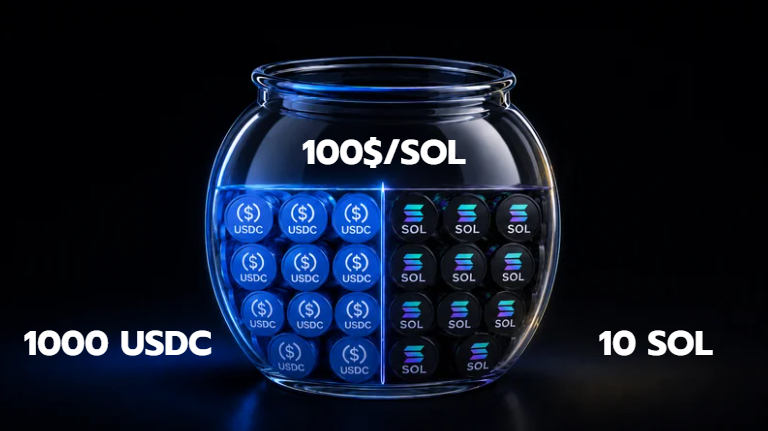
Market price of $SOL is $100.
If I deposit 1,000 USDC, I’ll also deposit 10 SOL so that my liquidity pool has a market price of $100 per SOL (1,000/10 = $100).
Now, let's do the calculation (x * y = k):
1,000 USDC (x)
*
10 SOL (y)
=
10,000 (k).
Great so we know the mathematical value our liquidity pool aims to achieve: 10,000.
Now let's make a trade of 250 USDC to exchange it for SOL… how much do you think you'll get back?
If the price is $100 per SOL, by exchanging 250 USDC you'll get 2.5 SOL, right?
Absolutely not!
Let's do the math again:
1,250 (1,000 initial USDC + 250 deposited by your trade)
*
7.5 (10 initial SOL - 2.5 withdrawn by your trade)
=
9,375.
9,375, not 10,000.
Whereas:
1,250 * 8 = 10,000.
So the liquidity pool will give you 2 SOL instead of 2.5 SOL.
You just lost 0.5 SOL.
This is what's known as AMM inefficiency.
Now the question is: how can you protect yourself from this?
Arbitrage.
You can recover the value you lost by arbitraging liquidity pools.
In this case, if I buy SOL from another liquidity pool and sell it on this one, I’ll rebalance it to 1,000 USDC – 10 SOL and capture the lost value (0.5 SOL).
It was by realizing this that we built @arbmesol for the @colosseum.
It's an extension that lets you recover the SOL you lose during your trades on Solana as cashback directly into your wallet.
Now that you know this and that a solution exists… you're the only one responsible for losing SOL due to the inefficiency of AMMs.
Trade to Earn.
Today I gave a pitch on @Circular_fi and our ambitions with @arbmesol at @theBlocksSummit.
It's always an incredible experience to pitch as a founder.
But pitches are rarely just pitches, we're mingling with other players in the blockchain space.
It doesn't matter if the other founders are from Solana, Ripple or Ethereum… sharing ideas and understanding other ecosystems is always the best part of this kind of event.
Exploring new ideas is the key.
I think I love it… @SolanaEvents, where's your next event?