Introducing our 2024-2025 job market candidates, all seeking employment starting Summer 2025. For more information, visit: https://t.co/8PH87TOAWs… or see 🧵 below.
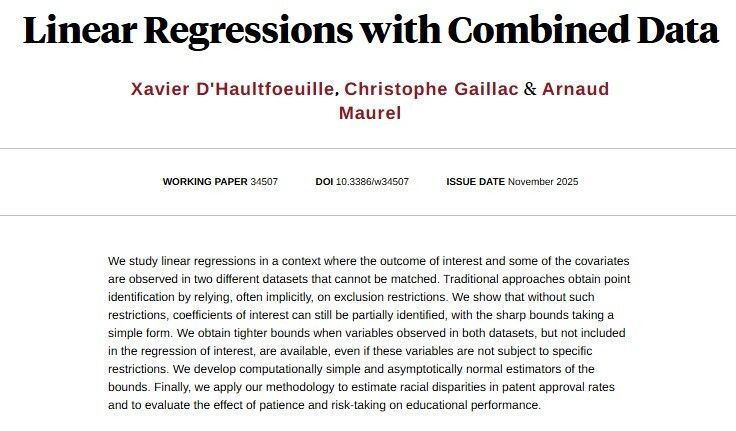
Providing new tools for linear regressions in a data combination environment and providing easy to compute bounds, which do not rely on exclusion restrictions, from Xavier D'Haultfoeuille, Christophe Gaillac, and Arnaud Maurel https://t.co/7d7cJAXoBY
Thank you to Charles Evans, former President of the Chicago Fed, for joining Duke Economics on March 25. He shared insights on the Fed’s current challenges and engaged in a great Q&A with the audience.
https://t.co/psaqiT8WjX
In Indonesia, Prof. Duncan Thomas studies the long-term effects of the 2004 tsunami. His findings from the past 10 years could shape how we approach recovery in future disasters.
Are all electric vehicles beneficial to the planet and society? @DukeEcon associate prof
@FelixTintelnot notes the pros and cons of #EVs. https://t.co/fZXVujgJ4R
In his job market paper, Nurullah Gulec investigates how network knowledge flows with labor mobility, demonstrating that hiring a worker raises the likelihood of acquiring the worker's previous customers.
Website: https://t.co/DNltAvKrLc
Introducing our 2024-2025 job market candidates, all seeking employment starting Summer 2025. For more information, visit: https://t.co/8PH87TOAWs… or see 🧵 below.
.@david_d_shin explores how climate policies affect emissions when capital and labor face mobility frictions across sectors, showing that subsidies on cleaner energy can increase emissions if these frictions remain at current levels.
Website: https://t.co/MpHj1wbuY9
.@DukeU's strength in economics and computation was on display at the ADT-24, where co-chairs David Pennock (@DukePhysics BS’93 and CS MS’94) and Lirong Xia (CS PhD’11 and @DukeEcon MA’10) caught up w/ Mingyu Guo (CS PhD’10) and Kangning Wang (CS PhD’22). https://t.co/aCCFMTkcm8
Jonathan Eaton was a pioneering scholar in international economics.
This column outlines his many contributions to our understanding of the global economy. By Ana Cecilia Fieler (@YaleEconomics) & @FelixTintelnot (@DukeEcon), in @voxeu@cepr_org: https://t.co/eOFfQmHxLQ