Welcome to SPACE!
@DukeTrinity College of Arts & Sciences' new universitywide SPACE Initiative will accelerate interdisciplinary research and education.
Join the kickoff event on Sep 8 and hear a keynote talk by astronaut and Duke alum Anna Menon. https://t.co/V59CsbOhdq
With its 3,200-megapixel camera, the @VRubinObs will transform our understanding of the cosmos. Duke Cosmologists are behind the scenes, keeping everything in focus: https://t.co/vqEmXKv1rb
Do you think you’re smarter than a 5th grader about how the Universe works? You might be, if you read professor @EveVavagiakis children's book, “I’m a Photon," which uses rhymes and illustrations to explain scientific concepts. https://t.co/PyYZTuk2wQ
Congratulations to Divine Kumah @kumahlab, Charles H. Townes Associate Professor of Physics, who was honored with a named professorship in recognition of his leadership and commitment to excellence in scholarship and research. https://t.co/03EHhcp23b
Join us on Monday, May 19 for a research symposium celebrating the late Professor Tom Mehen's career, collaborations and scientific legacy. More information: https://t.co/OJmCFU6InS
“This is the first truly three-dimensional, stereotaxic atlas of the mouse brain,” - G. Allan Johnson, PhD, Charles E. Putman University Distinguished Professor of Radiology @DukeRadiology, and professor @DukePhysics & the Dept of Biomedical Engineering.
https://t.co/4MlRACPS5r
“The hype in the field is just insane right now, but there’s something behind it, I’m convinced. Maybe not today, but I think in the long run, we’re going to see these things.” Professor Chris Monroe weighs in on new quantum results for @sciam.
https://t.co/J4aS8yaaTx
Did you know❓
The Fritz London Memorial Prize commemorates #FritzLondon, a distinguished @DukePhysics member known for his pioneering contributions to theoretical chemistry, physics, and the philosophy of science?
Discover more here: https://t.co/WiYbdsnPof
#LT30#LT302025
The Fritz London Memorial Prize Selection Committee is proud to announce this year's awardees: Congratulations to John Saunders, Robert Hallock & Ali Yazdani for their groundbreaking contributions to low-temperature physics.
@lt30conference@IUPAP_physics
https://t.co/tQC5NRtFs4
Can AI crack the mysteries of nuclear collisions? @DukeU physicist @steffen_bass & Simon Mak @StatSciDuke are using machine learning to reconstruct ultra-fast nuclear interactions — solving problems once thought impossible. https://t.co/myWk9DWSKh
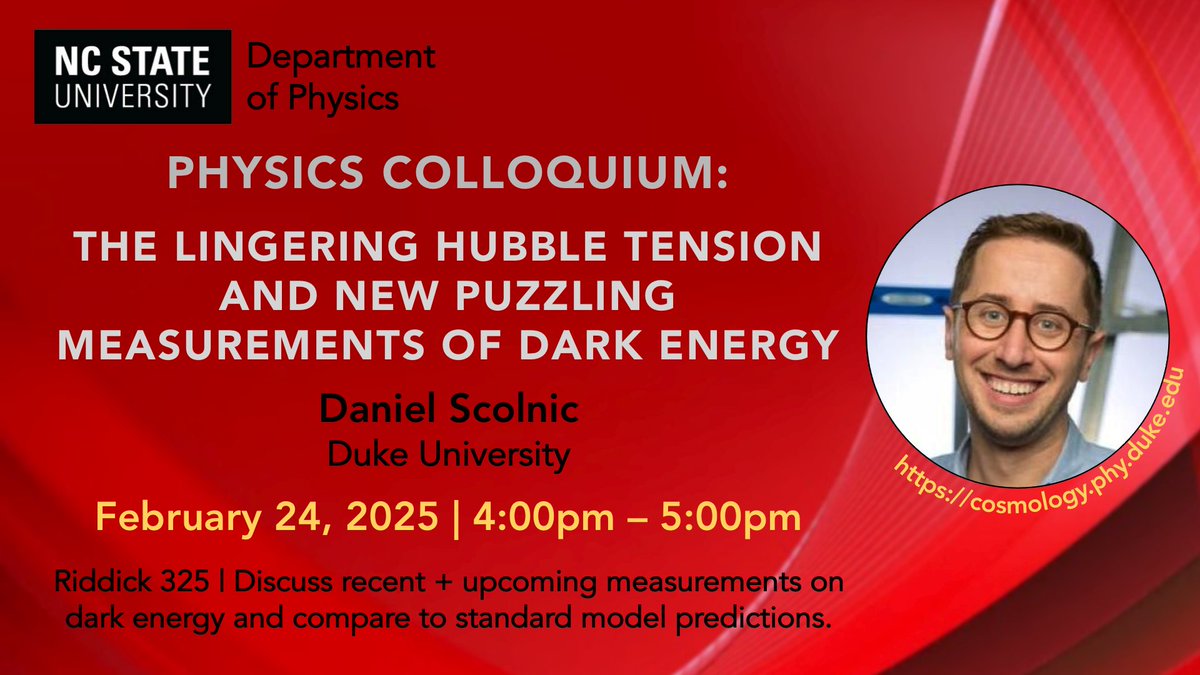
Join us for the colloquium next Monday from 4-5pm in Riddick 325!! Dr. Daniel Scolnic (@DScol) from Duke University (@DukePhysics) will discuss "The Lingering Hubble Tension and New Puzzling Measurements of Dark Energy"! | More info:
https://t.co/WqoSKI16pe
The Universe is expanding—fast. Maybe too fast.
A new measurement from @DScol's team confirms past, hotly debated results: the Universe’s expansion rate doesn’t match our predictions. Could this escalate the Hubble tension into a full-blown crisis? https://t.co/iDk5NqvAH4
Travel across the Universe, or a synthetic version of it, through @michaeltroxel's latest simulations of @NASA's Nancy Grace Roman Space Telescope future findings. https://t.co/lRXyYqJEaF
“It’s actually a very daring thing to even go after it,” @KateScholberg weighs in on the Jiangmen Underground Neutrino Observatory's goal of not simply detecting, but ranking neutrinos. @AP https://t.co/t3I6bIELHG
👋 Say hi to our new lead editor.
Patrick Charbonneau is a professor at @dukechemistry and @dukephysics. His research in soft matter and statistical physics combines theory and simulation to understand the glass problem and microphase formation. He’s also an @apsphysics Fellow.
We mourn the passing of our colleague Tom Mehen, a long-serving @DukeU faculty and passionate teacher known for his research on quantum chromodynamics and the application of effective field theory to problems in hadronic physics. In remembrance: https://t.co/ianaLTRujR