Our new field experiment (w/ @AnujitCh, @hmmlowe, @GarethNellis) shows how brief interactions with multiple outgroup members (broad contact) and longer interactions with a single one (deep contact) shape intergroup relations.
Paper: https://t.co/Q8n3S7VTR5
Prejudice is often rooted in misperceptions: that the outgroup are lazy, unpatriotic, etc. Our new field experiment asks: to reduce misperceptions, is it better to become close with one outgroup member (deep contact), or to have brief encounters with many (broad contact)?
Review of Economic Studies is happy to announce the launch of the new journal, Review of Economic Studies: Insights. This is an open-access, general-interest economics journal that will publish short papers with a fast review process and accept/reject decisions.
1/4
With exposure time fixed, working with one outgroup partner builds stronger ties; working with several reduces the majority’s misperceptions about the outgroup, from Anujit Chakraborty, @arkdevghosh, @hmmlowe, and Gareth Nellis https://t.co/h6gdBe2Xj3
There's only a few more days left to submit a paper for the NBER Economics of Religion conference -> fall 2026 in San Francisco... https://t.co/XIi1fHVJEt
Examining whether algorithmic risk assessments improve child-protection decisions, where supervisors decide which cases need closer scrutiny, from @JasonBaron4, @arkdevghosh, and Richard Lombardo https://t.co/IVHMaocdW2
When states in the US banned cousin marriage, it led to more people immigrating to the cities and changing into higher paying professions. More evidence for how kinship networks hold back development. 1/
Concealment of social-group membership between pairs of workers weakened intergroup relations by making them unsure of each other's identity and less able to interact authentically, from Anujit Chakraborty, @arkdevghosh, @hmmlowe, and Gareth Nellis https://t.co/p9uYuku95D
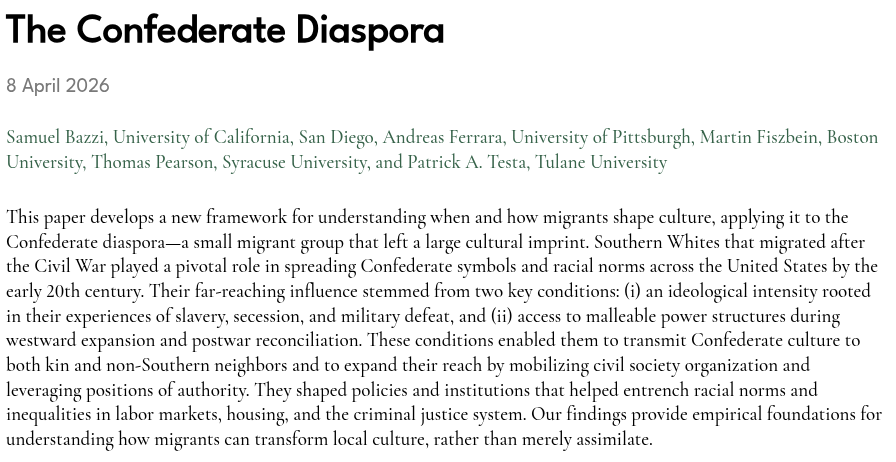
The Confederate diaspora—small but powerful and ideologically intense—reshaped culture across the U.S. through influence, organizational mobilization, and political leverage.
New paper by @SamuelBazzi, @Andreas_Ferrara, Fiszbein, @tpearson_tweets, and Testa:
https://t.co/L2GMjAhKDu
econ job market candidates who work on india, check out this fully-funded 2-year post-doc from gareth nellis, a friend and former colleague and new director of penn's CASI. a wonderful opportunity, esp in a really tough job market year! deadline feb 2.
https://t.co/kYZGhPjGNt
Hi all, please spread the word and we hope everyone can make good use of this new data drop: https://t.co/1DSR2NZ38p
The full surviving establishment-level Census of Manufactures manuscripts from 1850, 1860, 1870, and 1880!
1/
In my JMP, I ask: Why do different kids specialize in different skills?
In the same classroom you have:
– the math whiz
– the leader
– the quiet empath
Is that because they chose different skills to invest in… or because some skills are just harder for them to build?
🧵👇
New @VoxDev piece on our work (with @prerna394, @hmmlowe & Gareth Nellis) on how youth camps in India helped build social cohesion across religious lines.
Paper in @RevEconStudies: https://t.co/ZprSB2xByQ
#EconJobMarket candidate Spreeha Aggarwal’s (@AggarwalSpreeha) job market paper studies how changes in the demand for women’s domestic labour affect their marriage timing and outcomes in rural India. Profile: https://t.co/I3eYVxOaHV
In the latest episode of the @IdeasofIndia@mercatus we kick off the 2025 job market series with Kartik Srivasatva @KSrivastava_ @Kennedy_School. We spoke about his job market paper 'Familiar strangers: Evidence from referral-based hiring experiments in India' and much more.