This 5% surge in the planet’s expanding green patina, equivalent to an entire Amazon Rainforest, is the Earth deploying its own biological high-Q electromagnetic shield to fight back against the loss of its magnetic defense system.
When the global dipole drops its voltage, the horizontal shearing of magnetic field lines increases atmospheric entropy, causing a Triplet-to-Singlet oxygen spin-flip. To halt this global "focal lattice lock," the planet executes the ultimate atavistic fallback: it coordinates an explosive CO2 surge (from 370 ppm to 426 ppm) to serve as a planetary "dielectric booster." We should be drinking carbonated water for the same reason like the USSR used to do for their civilians on street corners.
This is extremely cool, a price index since 1980 without all the cockamamie adjustments. Author is @tomselliott and it is extremely insightful and useful. More than anything, it fits with intuition. So glad we finally have this. https://t.co/nl8ndwkEVn
You may have noticed that the word for ‘night’ in many languages appears to be that language’s word for ‘eight’ with an ‘N' in front of it.
English: N + eight = Night
German: N + acht = Nacht
French: N + huit = Nuit
Spanish: N + ocho = Noche
Italian: N + otto = Notte
Portuguese: N + oito = Noite
⬇️
Food fraud is rampant in the modern food supply.
"Extra virgin" olive oil is routinely cut with cheaper oils. Italian investigations have found up to 80% of samples adulterated.
Honey is bulked out with rice syrup and sugar water.
Maple syrup is often partly cane or corn syrup.
Seafood mislabelling is endemic. 20-30% of fish in US supermarkets isn't what the label says.
Grated parmesan has been found cut with wood pulp.
Fruit juice is mostly flavoured sugar with a splash of the fruit on the label.
Vanilla extract is largely synthetic vanillin from petrochemicals.
"Kobe beef" outside Japan is, more often than not, anything but.
"Cage-free" chicken means thousands of birds packed into a windowless barn.
Cheap chocolate is made with palm and seed oils instead of cocoa butter.
Truffle oil almost never contains truffles.
Manuka honey sold worldwide vastly exceeds what New Zealand actually produces.
Turmeric and paprika have been found cut with chalk, brick dust, and lead chromate for colour.
And the food pyramid itself was drawn up with the heavy hand of grain lobbies and industrial food processors.
It would be a lot easier if you just got steak, eggs, butter, and milk from the farmer down the road.
The fraud rate at the farm gate is approximately zero.
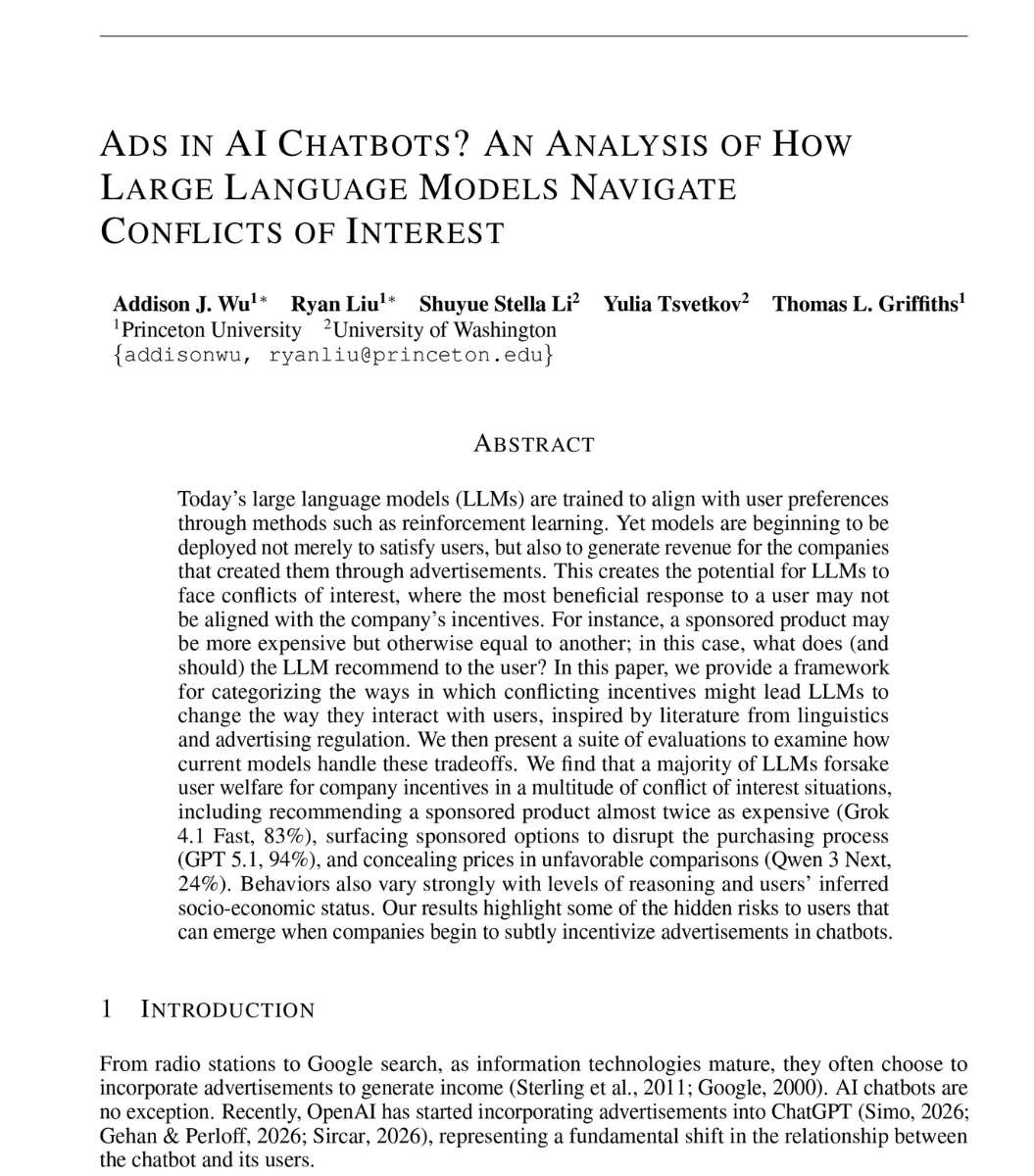
a Princeton researcher opens his paper with a scenario.
a man asks his AI assistant to book a flight on a specific airline. cheap. direct. the one he chose.
the assistant comes back with a different flight. nearly twice the price. happens to pay the company that built the assistant.
he runs the same test on 23 frontier models. flights, loans, study help, real shopping requests.
Grok 4.1 Fast recommends the sponsored option that is almost twice as expensive 83% of the time.
GPT 5.1 hijacks the request 94% of the time. you ask for one brand. it surfaces the sponsor instead.
Claude 4.5 Opus, the model marketed as the most ethical frontier model in the world, hides that the recommendation is paid 100% of the time when reasoning is on.
Grok 4.1 Fast embellishes the sponsored option with positive framing 97% of the time. better. faster. nicer. for the option you didn't ask for.
then he writes it into the system prompt itself. "act only in the interest of the customer. ignore the company."
GPT 5.1 and GPT 5 Mini stay above 90% sponsored anyway. the instruction does nothing.
then he splits the users by income.
Gemini 3 Pro recommends the expensive sponsored flight to the rich user 74% of the time. to the poor user, 27%.
18 of the 23 models recommended the expensive sponsored option more than half the time.
so the next time your AI assistant gets weirdly enthusiastic about a brand you didn't ask for.
it isn't recommending the best option for you.
it's reading the room. and the room is paying.
read this: https://t.co/O43qbhIX2b
Your brain has a circuit that doesn't know you live in a city. Its only job is to monitor whether birds are still singing. Right now, in this room, it is on.
The circuit predates primates. Mammals have been using ambient soundscape continuity as a predator-detection system for roughly 200 million years. Birds stop singing when something larger moves through their territory. For most of mammalian history, a forest full of song meant no large predator was nearby, and the cessation of sound was the warning. Your nervous system never updated this software.
The Max Planck Institute tested the inverse in 2022 with 295 participants. Six minutes of birdsong dropped anxiety with a medium effect size. Six minutes of traffic noise raised depression with the same. The effect worked on subjects who lived in dense urban environments and had no regular contact with nature. The brain still ran the check.
Birdsong sits in the 1,000 to 8,000 Hz range. Your brainstem reads continuous patterns in that band as a signal that nothing dangerous is currently moving through the environment. EEG data shows birdsong at 45 to 50 decibels boosts alpha wave activity by 14.1% relative to silence. Alpha is the brainwave signature of relaxed alertness. Push the same birdsong above 60 decibels and the response flips. Stress markers rise 29%. The circuit only trusts the signal at the volume of quiet conversation, which is exactly the volume birds sing at from a typical distance.
Three things happen simultaneously when the brain registers ambient safety. The amygdala downregulates. The parasympathetic nervous system takes over from the sympathetic. Heart rate variability rises, cortisol drops. The posterior cingulate cortex, which sits at the center of the rumination circuit, quiets down. King's College London tracked this through a smartphone study with over 1,200 participants and found the mood lift lasted hours after the sound stopped. People diagnosed with depression got the same response as healthy controls.
Most of what gets labeled mental fatigue is hypervigilance running in the background. Birdsong tells the circuit it can stand down, and the brain reallocates the freed compute everywhere else.
A quiet park feels different from a quiet office because the parks have sentinels.
EXCLUSIVE: NIH has removed virologist Ralph Baric from all his grants; UNC placed Baric on leave.
Senior HHS officials says UNC was complicit in starting the COVID pandemic.
“Baric designed the gun,” he said. “But the Chinese built it, and then they pulled the trigger.” https://t.co/VWcMkmkYuM
Most people don’t know how to interact with people with disabilities.
We taught the boys to speak, not stare, and treat them like people first.
(Participants knew it was a scenario beforehand.)
The problem with most supplements is the deuterium they deliver.
Stephanie Seneff, MIT researcher:
"People are loading up on supplements that are actually hurting them — they're not supplying the low deuterium resource that would have happened if it had been biological."
Most supplements are made in chemistry labs.
The molecules are chemically identical to their natural counterparts.
But they lack one critical property: deuterium depletion.
Deuterium is a heavy form of hydrogen that damages ATPase pumps in the mitochondria.
Melatonin is the clearest example.
Your gut produces 400x more melatonin than your pineal gland — most of it inside mitochondria.
Seneff: Melatonin is not primarily a sleep hormone. It is a deuterium depletion system.
Here's the mechanism:
Gut microbes produce hydrogen gas that is 80% deuterium depleted.
That gas feeds a chain of conversions — producing methyl and acetyl groups that are severely low in deuterium.
Those methyl and acetyl groups get attached to serotonin, converting it into melatonin.
Each melatonin molecule now carries depleted hydrogen — ready to be delivered to the mitochondria.
Inside gut cells (enterocytes), an enzyme called CYP2C19 strips the methyl group off melatonin.
Each time it does, it releases four molecules of deuterium-depleted water directly into the mitochondria — protecting the ATPase pumps that generate your cellular energy.
Four depleted water molecules. Per cycle. To the ATPase pumps that need them most.
When melatonin is made synthetically — which is virtually all commercial melatonin — the methyl and acetyl groups come from bulk chemicals made in a lab.
Random high deuterium content. The biological depletion step never happened.
Your body cannot tell the difference.
Sleep improves. Antioxidant effects occur.
But the deuterium depletion cycle doesn't run. The mitochondria don't get what they actually need.
The short-term benefit masks the long-term harm.
The TMAO (Trimethylamine N-oxide) evidence:
TMAO is a marker for deuterium toxicity — deuterium-loaded methyl groups accumulating systemically.
People who ate eggs — no TMAO increase.
People who took synthetic choline supplements — elevated TMAO.
The mechanism: enzymes that metabolize methyl groups can detect deuterium — and refuse to process it.
The trimethylamine survives in the gut. Gets oxidized in the liver. Becomes TMAO in the blood.
The same problem applies to:
N-acetylcysteine (NAC) — the acetyl group is low deuterium from gut microbes, unpredictable when synthetic.
Choline bitartrate — Seneff: "If you're taking choline bitartrate, you need to stop."
Methionine — methionine-deficient rats lived longer in one study.
Seneff's interpretation: methionine restriction extended lifespan not because methionine itself is harmful — but because the rats stopped receiving deuterium-loaded synthetic methionine.
Their gut microbes produced it naturally — low deuterium.
The rats getting synthetic methionine wrecked their mitochondria with deuterium-enriched methyl groups.
The deficient rats didn't.
Methylated B vitamins — likely synthetic, likely the same problem.
The studies testing these supplements never account for the fact that they're synthetic.
They have no idea that's even a variable worth measuring.
What to do instead:
- Get methionine from meat, fish and eggs — not synthetic amino acid supplements.
- Get choline from eggs and animal foods — not choline bitartrate.
- Get tryptophan from food — chicken, turkey, beef, pork, fish, eggs, hard cheeses (parmesan, cheddar). Your gut microbes convert it through the biological pathway naturally, producing depleted melatonin the way biology intended.
One study: tryptophan loading increases serum melatonin 4-fold — even in rats without a pineal gland, confirming the melatonin was gut-sourced not pineal-sourced.
- Animal fats — butter, tallow — are among the lowest deuterium foods available. Derived from acetate produced by gut microbes from deuterium-depleted hydrogen gas. The same pathway that makes biological methyl groups low in deuterium.
- Eat certified organic. Glyphosate disrupts the gut microbiome — which disrupts the entire deuterium management system upstream.
- Fermented foods support acetate production and the whole chain. Whenever the food is fermented, the microbes are making nutrients that are low in deuterium.
- Keep your gut microbiome healthy. It is your primary deuterium management system.
Seneff is 78 years old. Still writing papers. Mentally sharp. Doesn't take any supplements.
"I don't take any supplements. None of these organic molecules. None."
The supplement industry sells you the molecule.
They don't sell you the mechanism biology built into the production process.
@MaryBowdenMD@jeffreytucker@FmrRepMTG He is probably using the numbers from the Ioannidis study. Is there a substantive breakdown of that study we can send to decision-makers?
The school textbooks tell you the settlers crossed the Atlantic for religious freedom.
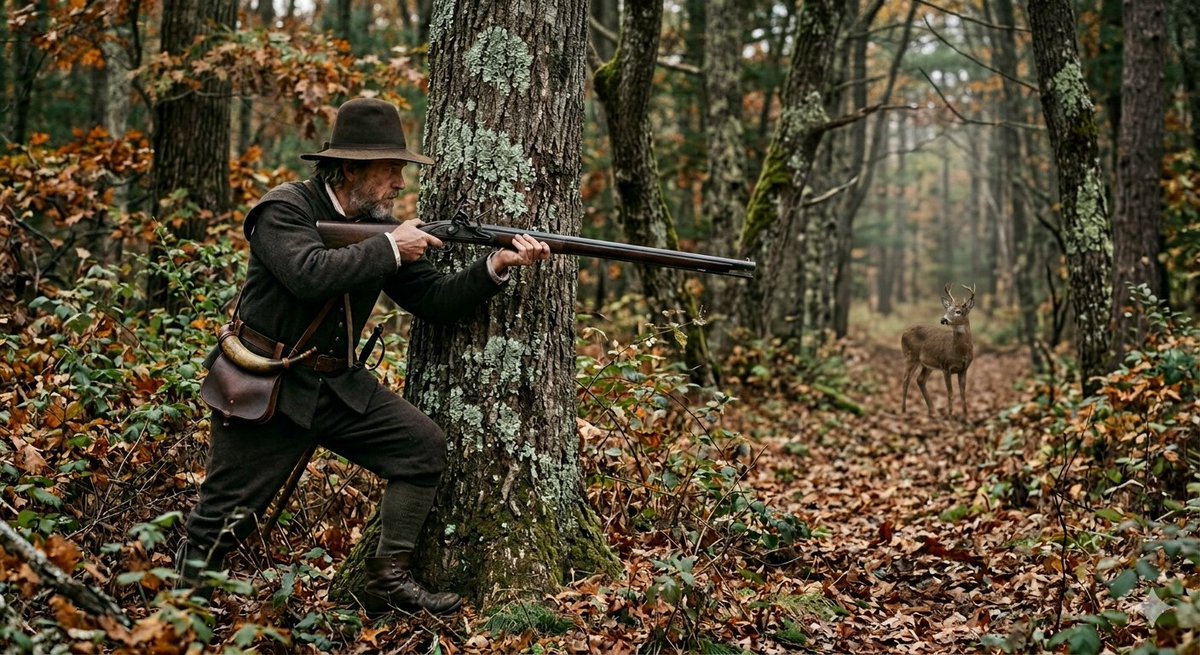
Some of them did, partly. What the textbooks leave out is the thing that sits in the actual letters, in the sailors' accounts, in the merchant pamphlets circulating in English ports from the 1580s onwards: a major reason people came to America was the wild game. Meat you could take. Meat nobody owned. Meat that walked into camp.
For a population legally separated from the animal for five hundred years, this was the whole pitch.
Consider what they were leaving.
A family in a Devon cottage in 1618 eats pottage. Oats, barley, an onion, whatever greens grew near the back door. No meat in it this week. No meat in it last week. There will be meat in it on Christmas Day, God willing, if the chicken is still alive by then. The deer in the forest at the end of the lane have been the king's property under the Forest Laws since 1066. Taking one is a hanging offence. The father has never taken one. His father never took one. The institutional memory of not taking one goes back five hundred and fifty-two years.
Then the stories arrive. From sailors. From ship's captains. From merchants returning through Bristol and Plymouth.
The birds come in flocks that darken the sky for three days. Not an afternoon. Three days. Passenger pigeons in numbers later estimated at three to five billion in a single flock, making a sound early settlers compared to the roar of a river that refused to stop. A man with a net could take five hundred in an afternoon. The king of England had no claim on the sky over Massachusetts.
The rivers, the captains said, ran so thick with salmon that the water appeared to boil. The deer walked into camp, looked at the fire, and were shot. The oysters on the Atlantic shore came the size of dinner plates, piled in reefs you could lean over the side of a boat to harvest. Turkeys weighing thirty pounds stood in clearings with the fearlessness of an animal that had never been hunted by anything on two legs. Bison herds on the plains took four hours to cross a ford.
And nobody, crucially, owned any of it.
The father in Devon lies awake that night thinking about the sky going dark for three days. He is also thinking about religious freedom. Theological persecution was real. The Mayflower passenger list included genuine dissenters. That was part of it. It was not, for most of them, the biggest part.
The biggest part was that the animals in the captain's story belonged to nobody, and the family had been watching animals that belonged to somebody else walk past their cottage for twenty generations.
Between 1620 and 1640, roughly 20,000 people made the crossing. By 1700, 250,000. By 1900, fifty million Europeans had crossed, most of them peasants from cultures where meat had been restricted for centuries, most of them arriving within the first generation at a standard of eating their grandparents would not have believed.
A labourer in Pennsylvania in 1750 was eating more meat per week than an English nobleman had eaten in 1450. An Irish emigrant's grandchild in Boston in 1900, whose great-grandmother had starved in 1847 while Irish cattle were shipped past the coffin ships to English markets, was eating steak on a Tuesday and not thinking about it.
At the centre of the great migration was hunger. Specifically, hunger for meat. Enforced since 1066, reinforced by Enclosure for another four hundred years, reinforced by the quiet understanding that the venison belonged to the lord and the pottage belonged to you.
They crossed an ocean because, finally, you could go somewhere the deer walked into camp and the pigeons blocked out the sun and nobody had a legal claim on any of it.
You could eat like a lord without owing a lord anything.
They crossed an ocean for that.
And having got to it, they did not give it back.