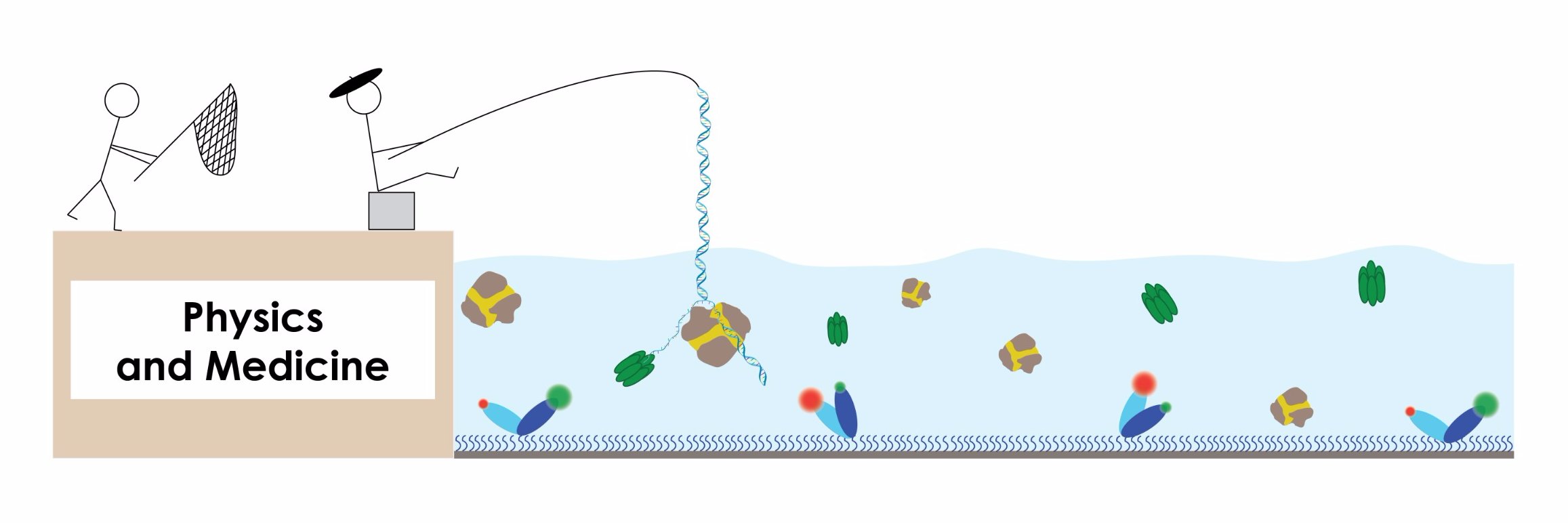
Excited to share a new collaborative study with @Dulin_Lab, out now in Nucleic Acids Research!
We investigated how mitochondrial transcription termination factor 1 (MTERF1) acts as a directional roadblock to transcription. The key to understanding the mechanism was measuring the applied force accurately enough to resolve it.
The @Dulin_Lab approach calibrates the force on each individual bead in high-throughput magnetic tweezers, achieving precision up to 3%. Combined with improved DNA attachments that support measurements for up to 11 hours, this enabled us to characterize the molecular lock formed by MTERF1 and show that its stability depends on the direction of DNA unwinding.
The reach of this work extends well beyond mitochondrial transcription. Accurate force calibration enables researchers to reconstruct energy landscapes and distinguish mechanisms of protein–nucleic acid interactions. We anticipate broad value for the magnetic tweezers and single-molecule force spectroscopy communities.
https://t.co/jMHvsENCTW
#SingleMolecule #Mitochondria #Biophysics
Our study with @xiangylab is out in JVi and was selected as an Editor’s Pick. This study addresses a longstanding question in coronavirus biology: How much proofreading does SARS-CoV-2 actually need?
Coronaviruses rely on nsp14 ExoN to preserve their unusually large RNA genomes, yet catalytic-site mutations were thought to be lethal in SARS-CoV-2. We combined a new continuous fluorescence assay for ExoN activity with an optimized single-bacmid reverse-genetics system to connect enzyme activity directly to viral viability and evolution.
Mutations produced a graded series: K9A retained robust activity and supported efficient recovery; catalytic D90A/E92A substitutions sharply impaired ExoN yet yielded a viable, slow-growing virus; and the more disruptive K9E substitution prevented recovery. Crucially, the D90A/E92A virus maintained its engineered substitutions through serial passage while accumulating genome-wide variation,more than 400 SNPs by passage 14 versus fewer than 40 for wild type, establishing a stable mutator phenotype.
The work replaces a simple “essential or dispensable” view of proofreading with a quantitative threshold model: SARS-CoV-2 can survive substantial loss of ExoN activity, but not below a minimum functional level. That insight provides a framework for understanding coronavirus genome stability, fitness, evolution, attenuation, and vulnerability to fidelity-disrupting antivirals.
https://t.co/5yMvE9qas3
Another step towards assembly of the coronavirus replicase. In this latest report, @Dulin_Lab and collaborators demonstrate a role of the nsp13 helicase in helping the nsp12 polymerase and accessory factors address secondary structures in the RNA template. https://t.co/D6NMN3lpyv
New work from @RKirchdoerfer lab in collaboration with Jamie Arnold and @Dulin_Lab reveal the potent, inhibitory activity of arabinoside incorporation on elongation by both coronavirus and enterovirus RNA polymerases. The major problem with utilization of this class of nucleoside is the poor conversion to the triphosphate in the cell. We are now working on strategies to address that issue.
https://t.co/KwNoGrwpbt
Interested in our recent norovirus NS3 work? 👇
Join us to dig deeper!
I'm recruiting a PhD candidate to investigate NS3's role in viral replication and assembly using #cryoEM, #cryoET, and other complementary techniques.
🔗 https://t.co/OG2Qy7YxuH
Please share! 🙏
The IncaRNAto lab is seeking a motivated #PhD candidate, interested in studying #RNA structural ensemble dynamics in living cells. Here's the link to the vacancy: https://t.co/eaQbAOVBG4. Please share!
@MRHerodDR Does our hex-NS3 construct bind RNA? 🧬
Yes!
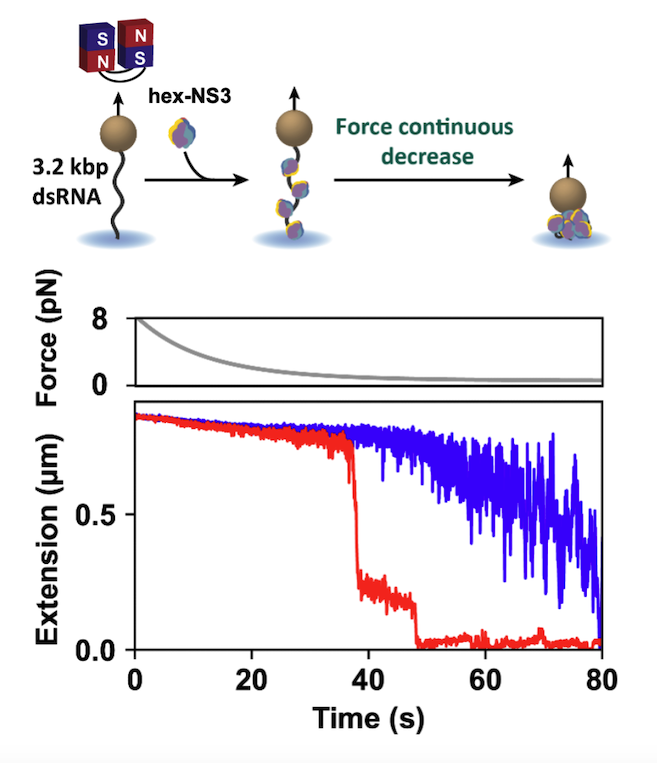
Single-molecule magnetic tweezers experiments with the @Dulin_Lab indicate binding to ssRNA and dsRNA, with compaction of the latter.
No ATP-driven helicase activity detected (thoughts on that in the paper).
A new preprint. We reveal the response of the enterovirus polymerase to a break in the template its copying. Different from homologous recombination. This attribute will facilitate attachment of adapters to RNA for applications like nanopore sequencing. https://t.co/9MuYEv2Ei4
Official pictures and recap from NWO Biophysics 2024 are now available! Thanks to everyone who contributed to the success of this event and hopefully until next year at NWO Biophysics 2024! View the pictures and recap here: https://t.co/U044EFLknR.
Vertaling weergeven