The NUM is taking the South African government to court over the plans to “unbundle” Eskom.
The government won’t say where it learned this “unbundling”stuff from, because if the public were to find out, it could become awkward very quickly.
President Cyril Ramaphosa’s government claims that its unbundling project is just a technical exercise to separate Eskom into different functions and establish an independent transmission company to improve efficiency.
But there is a much bigger ideology hiding underneath the word “unbundling” because South Africa is not inventing this model from scratch.
The South American country of Chile, under one of the most notorious dictatorships of the twentieth century, did the unbundling thing first.
For those who are not up to speed, 53 years ago, a military general named Augusto Pinochet led the 11 September 1973 CIA-sponsored military coup that overthrew Chile’s democratically elected socialist president, Salvador Allende.
Pinochet subsequently ruled Chile as dictator until 1990. The Chilean National Library describes his regime as a dictatorship characterised by human-rights violations and the implementation of a neoliberal economic model.
His regime dissolved Congress, restricted political parties, imposed censorship and used detention, torture and disappearances against political opponents.
Chile’s National Library records the use of political repression, including detention, torture and disappearances of thousands of people under the dictatorship. Amnesty International likewise documents the still unresolved human-rights violations committed under Pinochet's government.
Now, let’s briefly see how what Cyril Ramaphosa is doing and how is straight from the Pinochet manual.
In 1978, Chile established its National Energy Commission. From 1981, the existing state electricity system began to be broken up and generation and distribution activities were separated into different commercial companies.
At the 2019 State of the Nation Address, President Ramaphosa announced that Eskom would be unbundled into three separate entities of generation, transmission and distribution.
Then at this year’s SONA the President again said, “We are restructuring Eskom and establishing a fully independent State-owned transmission entity. This entity will have ownership and control of transmission assets and be responsible for operating the electricity market.
Given the importance of this restructuring for the broader reform of the electricity sector, I have established a dedicated task team under the National Energy Crisis Committee to address various issues relating to the restructuring process, including clear timeframes for its phased implementation. It will report to me within three months”.
Back to Pinochet. It’s crucial to note that Chile, the most rabidly neoliberal government in history did not simply sell the state electricity company.
It first changed the structure of the electricity industry. Only subsequently did large-scale privatisation begin.
In a 2004 paper titled Electricity Reform in Chile Lessons for Developing Countries, Michael Pollitt from the University of Cambridge is explicit that Chile’s large-scale privatisation began several years after the restructuring process had already begun.
Specifically, Pinochet’s sequence was to unbundle → commercialise → establish market rules → and then finally privatise.
The difference is that “privatisation” is politically explosive in South Africa. Even the former CEO of Investec Stephen Koseff cautioned President Ramaphosa against throwing that word around, and to simply call it anything else, but “just do it”.
So government is not about to say:
“We are privatising Eskom”. In fact, it can legitimately say that it isn’t since the transmission company is intended to remain state-owned, at least for now.
Instead, Cyril’s government says it’s just “unbundling” the SOE. Technically, this is correct but it’s also a half-truth because unbundling is not the end of the reform. We know this because that’s how Chile did it with the only difference being that unlike Ramaphosa, Pinochet did not need to deny it. He just tortured and disappeared his critics.
The seriousness of South Africa imitating Pinochet cannot be overstated when you consider how under him, Chile became the testing ground for radical free-market policies that were so extreme that the chief proponent, Milton Friedman had to test them out over there as they were deemed too extreme and too incompatible with democracy for the United States itself.
The point here is that Chile’s unbundling was not an isolated administrative exercise, which is what the SA government is pretending it is, and NUM appears to be opposing this because it sees Eskom being deliberately weakened and placed on a path towards privatisation by stealth.
I have served long enough in leadership to recognise a troubling pattern. Too many among South Africa’s elite - black and white - appear to believe the rules that govern the rest of us do not apply to them.
As chairman of an SOE, I am regularly approached by business leaders asking me to intervene in operational or procurement matters. When I explain that my role is governance and oversight, not management, they say they understand. Yet the requests continue. This reveals a belief that exceptions exist for the connected few.
It was therefore striking to see Business Leadership South Africa and BUSA, organisations that have been vocal against state capture and political interference in state-owned enterprises, actively advocate for political intervention to transfer transmission assets to the Transmission System Operator. These are the same bodies that insist on corporate governance and board independence. Where, then, is the role of the SOE board? What exactly do they believe in?
Equally concerning are recent allegations involving former Democratic Alliance leader Tony Leon. Senior figures within his own party, including John Steenhuisen and Dion George, have raised issues that appear to involve conflicts of interest and undue influence. This from a voice that has long lectured on ethical standards and clean governance. Do these rules apply to everyone, or only when politically convenient? Selective morality is not morality at all.
When those who position themselves as guardians of good governance apply different standards to themselves, public trust erodes. But South Africans are watching. We see the inconsistencies. We now know where people stand.
The path forward requires courage. We must expose wrongdoing wherever it occurs without fear or favour. We must demand that those who preach accountability live it consistently. We must insist that rules bind the powerful as they bind ordinary citizens. And we must model the ethical society we want to build.
South Africa does not lack good people. What we need is the collective will to insist that principle applies to all. Let us find that courage. Let us call out double standards and build a nation where no one is above the law. That is the South Africa worth fighting for. #ProudlySA
So the domkop SARB will hike rates because of the war US Israeli attacks on Iran. They will be shooting blanks against international oil prices. How many times must we point out that rate hikes cannot do anything to address supply side shocks to the economy?
Globeleq is the link to the United Kingdom.
There is someone very powerful who is connected to president’s and to billionaires who can take down top cops in South Africa. The question may arise, how and why could someone have that power?
Globeleq is the answer. But first you need to know about the SIS.
The Secret Intelligence Service (SIS), commonly known as MI6 (Military Intelligence, Section6 is the foreign intelligence service of the United Kingdom.
If someone was an intelligence operative in Africa they would most likely work under the SIS and not M15.
Now let’s talk about Globeleq. I told you that this is the link.
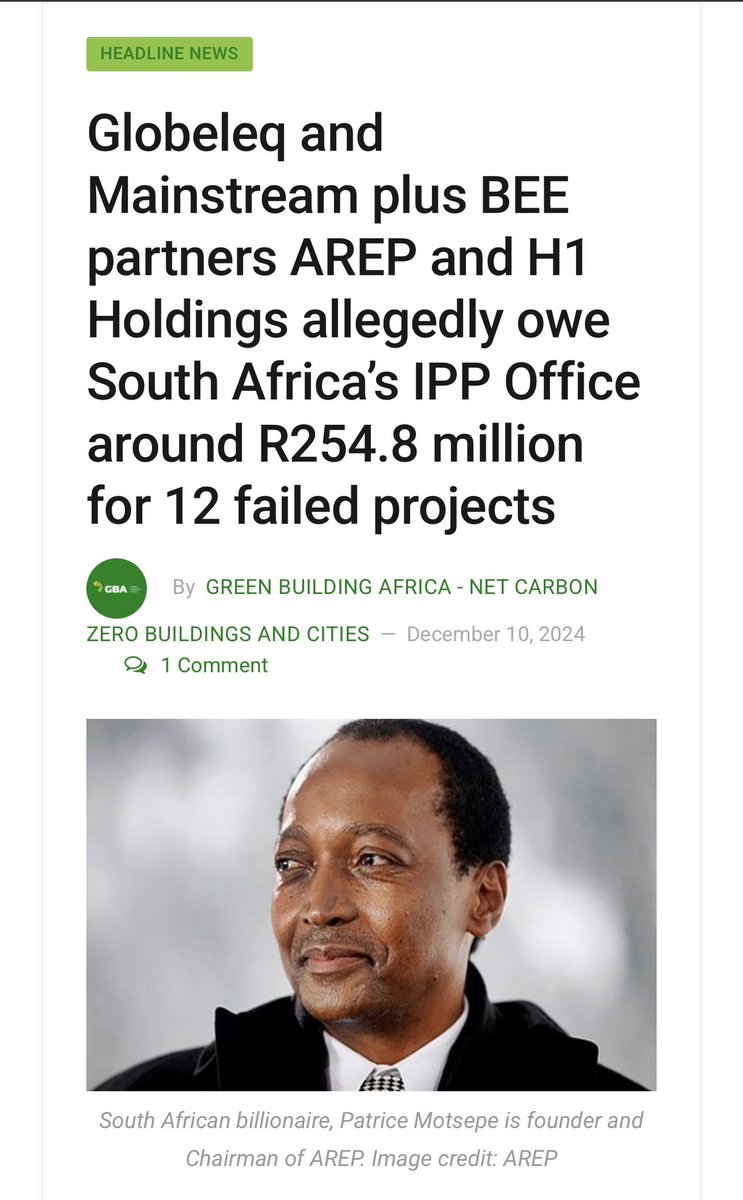
Globeleq is the company that is part of the Patrice Motsepe renewable energy consortium. The consortium is called the IKAMVA consortium.
Every year in the state of the nation address and budget speeches you will hear about the REIPPPP. Renewable Energy Independent Power Producer Procurement Program. You might as well call it the RIP Eskom.
The biggest word in that name is procurement. 20 year deals were signed for the independent power producers to sell energy to Eskom.
The energy is then sold to ordinary people through an exchange owned by Johann Rupert. It’s called the Southern Africa Energy Exchange.
Do you now understand why two billionaires were in the delegation that went to the White House and to Dubai. Patrice Motsepe and Johann Rupert.
To understand fully you need to know that Globeleq comes from an entity known as the CDC.
In 1948 the CDC used to be called the Colonial Development Corporation. It was renamed in 1998 to Commonwealth Development Corporation.
It is the development finance arm of the British Government. It is managed by a ministry in the UK called the “foreign office”.
The CDC is now called British International Investment. But it’s still the same business model.
Instead of helping Africa after they stole from it. The British decided to give African nations loans. Which led to what Dambisa Moyo called Dead Aid. African leaders are micro managed through these loans.
_________________
Link between Globeleq and CDC.
Globeleq was founded in 2002 as part of the CDC Group’s power sector arm, later separated as a standalone entity in 2004.
Globeleq still returns 100% of its net profits
to the UK government and to Norfund (Norway owned fund), and seeks additional capital from CDC as and when needed for expansion purposes.
So the IPPs in Africa are basically UK power stations with lots of layers in between and with local partners. When they take loans from Europe to fund IPPs in Africa, they are taking loans to develop these energy assets.
Please connect the dots further.
* apologies for any typos.
The obvious trap that anti-GMO campaigners keep falling into is to base their argument around science instead of economics. That's a surefire way of losing the debate and making yourself look like some kind of Pastor Chris conspiracy kook.
Look, I come from a family where if you close your eyes and throw a stone, it will hit a doctor. They're like ants. And I can tell you for free that doctors are some of the most arrogant and intransigent professionals you will ever meet, especially where it concerns things that fall within their scope which they don't fully understand - but they will never admit it to you.
A doctor is like a pilot. They are trained to carry out specific tasks using a written set of instructions and parameters. Everything functions off checklists, instructions, and equipment that someone else created, and their job is to demonstrate knowledge of, and compliance with these things. It's not a doctor's job to question the funding, motive, or methodology behind a peer-reviewed research paper. It's not a doctor's job to question why certain research studies have NOT been carried out and why.
A doctor's job, like a pilot's job, is to read what someone put in the book and follow the instructions built on this information. If a study conclusively proving that GMO food has negative health consequences has not been done because nobody will fund it, it's not a doctor's job to ask why. Just like despite Boeing whistleblowers as far back as 2014 having complained about the 737 MAX program, it wasn't the Lion Air pilot's job to determine whether the design of this aircraft posed any hazards. Their job was to follow checklist and do as they were told.
The truth that you will never hear a doctor admit is that most doctors are not especially knowledgeable about things outside their narrow field of specialisation. And even within their field, the knowledge they have is the knowledge that the medical industry allows them to have. Until now as you're reading this, many American doctors and nurses are still taught that there are racial differences in how pain is felt, and that black women feel less pain than white women. As a result of this completely racist, unscientific, 18th century nonsense which nobody has removed from the books, black women in the US are routinely given less anaesthetic during medical procedures, and they are 7-12 times more likely to die during pregnancy and childbirth than white women.
If you point this out to an American doctor, he will find excuses to deny the obvious or take offense at being queried by a layman who hasn't done 100 level Anatomy. Until Bill Gates funds a peer-reviewed study showing that this 18th century anachronism shouldn't be taught in medical school, and then lobbies the Department of Health to change its guidelines, they will keep defending it because that's what the books say.
So as an anti-GMO campaigners, the dumbest thing you can do is start quoting obscure or suppressed studies to 'prove' to a medical professional that GMOs are bad. It's a fight you cannot win and you would be foolish to even try. By the time he whips out a paragraph of 5-syllable words that he learnt from his medical textbook, you'll be left blinking your eyes and looking like a dickhead. Bill Gates is a very smart guy. He has ensured that the entire medical research space cannot produce any research that contradicts the one that supports his financial interests, and typically nobody who wears a white coat dares to stand up to him.
So stick to the economic argument, which is that one man cannot be allowed to privatise and monopolise an entire continent's food supply. Force them to remain on the defensive by using an argument that anyone can understand, and there is no logical comeback for.
Stop losing and looking silly because you want to take on a white coat on their own turf. It doesn't end well. Stick to what you can prove and defend empirically. Leave the Pastor Chris nonsense out.
The American people don’t want a war with Iran.
The Iranian people don’t want a war with America.
The European people don’t want a war with Iran.
The Chinese people don’t want a war with Iran.
So Who wants this war with Iran?
The Jews.
Our foreign policy is dictated by Israel.
Trump will continue to do as he is told by Netanyahu.
If you want to know what America will do, spare yourself the fake White House press briefings and start listening to Bibi.
We are a colony of Israel.
Your politicians are bought and paid for.
This was a moment years in the making.
Three Democrat governors were dragged before Congress—and forced to defend the deadly consequences of their reckless sanctuary state agendas.
Innocent Americans are dead. Violent aliens were protected.
And Kathy Hochul had nowhere left to hide.
🧵 THREAD
The United States has 800 military bases worldwide and would love to have one in South Africa. However, because of South Africa’s political positioning, this is not viable. This is where Starlink comes in.
Proponents of Elon Musk’s satellite internet present it as a solution to rural disconnection, a godsend for farmers, rural clinics and schoolchildren. But Starlink is not just bandwidth in the bundus. It’s a Trojan Horse designed for 21st-century American domination.
If and when South Africa opens its airspace, it will find that “securing our borders” is the least of its problems. South Africans will discover that sovereignty leaks not through borders but through satellites.
Starlink pretends to be a neutral service provider. But neutrality is fiction in geopolitics. While its marketing speaks of farmers and learners, Starlink’s parent company, SpaceX, is neck-deep in the US military-industrial complex.
SpaceX holds Pentagon contracts for missile tracking and battlefield communication. Its satellites are integrated into NATO-linked defence networks. And under the Starshield programme, it is actively developing military-grade space capabilities.
In Ukraine, we saw the real Starlink: coordinating drone strikes, powering real-time battlefield intelligence, and even at Elon Musk’s whim, it dictated the limits of military operations. This isn’t telecoms. It’s geopolitical domination masquerading as broadband.
Now imagine this network quietly embedding itself across South Africa, not as a traditional foreign base with boots on the ground, but as a network of terminals, antennas, and encrypted channels beyond local control. No soldiers, no flag. Just a silent satellite occupation.
Starlink doesn’t need to obey local laws; it bypasses them. Ground stations may be offshore or in neighbouring states. Traffic is routed through US-controlled channels.
When Starlink lands, ICASA will be rendered irrelevant, sidelined by a network that answers not to Pretoria but to Palo Alto and the Pentagon. Forget the BEE requirements. Your honourable members in the Parliamentary committees can discuss them vigourously amongst themselves.
In practice, this means any embassy, NGO or mining company using Starlink would be operating in a digital enclave, communicating independently of the state, shielded from scrutiny, and free from South African jurisdiction. This is the erosion of digital sovereignty, and it’s happening under the radar, literally.
Across Africa right now, NGOs operating in conflict zones or resource-rich regions now rely on Starlink. This creates a parallel communications infrastructure: fast, encrypted, and entirely unaccountable to the host state. These terminals can communicate across borders without touching local networks, making them invisible to regulators, security agencies, and even policymakers.
In practice, this means that foreign-funded NGOs, mining firms, and diplomatic missions can operate within South Africa but outside its digital jurisdiction. South Africa will be digitally Balkanised by infrastructure it neither owns nor controls.
Real-time African data on movement, transactions, agriculture, climate, and demographics will be harvested without oversight and used to train AI models, support predictive policing, or guide strategic investments. All of this happens outside African jurisdictions, enriching US intelligence, tech firms, and defence agencies.
Crucially, the data flowing through these Starlink terminals is not neutral. It’s routed through US-controlled ground stations, governed by American law, and increasingly fed into AI systems, surveillance platforms, and military simulations.
Now, contrast this with how the United States treats foreign technology. Huawei was banned outright because the US believes it could compromise national security. TikTok has faced legislative bans, sanctions, and forced divestments. The justification is that American sovereignty must be protected from Chinese infrastructure.
But in Africa, US tech is welcomed with no questions asked. Starlink is entering countries like Nigeria, Rwanda, Kenya, and Zambia, often outside normal regulatory processes, with no public debate, and in most cases, in defiance of local telecom and regulatory laws.
Where the US sees data infrastructure as a matter of national defence, African governments too often see it as a development opportunity. But digital dependency is still dependency, and when the infrastructure is foreign-owned, so is the power.
The brilliance of Starlink is that it needs no bases. Its dishes are rural clinics. Its antennas are schools. Its forward-operating stations are NGOs. And its justification is always wrapped in the warm glow of “progress.”
But we must learn from history: the railroads of the colonial empires weren’t built for the people, they were built to extract. Today’s satellites do not just connect, they entrench, create dependencies, determine how data flows, how communications are routed and who holds the keys to the cloud.
Already, Starlink is live across much of Africa. In each case, its arrival is celebrated as “leapfrogging traditional telecoms technology.” But Africans should ask themselves what they are leapfrogging into.
South Africa is next in line to be lulled by the illusion of harmless technology, and once this system is embedded, it cannot be dislodged.
The truth is that Starlink is not in it for the money. The commercial model makes no sense in rural South Africa, where the incomes are low and the population is sparse. There’s a reason why network coverage is poor in rural areas. There’s no money to be made there.
Meanwhile, the people who can afford to pay for Starlink are in urban areas and already have relatively affordable high-speed LTE and fibre. So why the interest?
Because, again, this isn’t about profit, it’s about presence and judging by how Starlink is brushing aside the country’s BEE laws, it will almost certainly pressure regulators for exemptions and use NGO-driven deployments to sidestep procurement laws.
The feel-good narrative of “connecting the unconnected” is not philanthropy, it’s a Trojan Horse aimed at the last African state with both the capacity and the inclination to resist American technological dominance.
This isn’t about giving villagers 480p YouTube. It’s about embedding US communications in a BRICS country, dominating infrastructure for NGOs and military contractors, securing exclusive access to real-time African data for AI and intelligence applications, and weakening South Africa’s sovereignty without ever firing a shot.
Starlink is the perfect proxy: a private company doing what governments can’t admit to. For South Africa, accepting Starlink means accepting the expropriation of digital control.
History teaches us that the technologies of empire rarely announce themselves with weapons. They come with promises. They come with progress, and they are here.
Many South Africans believe that “The Law” is made by Parliament—that the people they vote into office are the ultimate lawmakers in a democratic Republic. This is not true.
Yes, Parliament passes laws, the executive signs them, and various institutions give them effect. But “The Law”—the jurisprudential system that governs us—is not under democratic control.
South Africa is a judicial supremacy, a constitutional order where unelected judges have the final say on the laws of the land. This is not rule of law; it is rule by judges. And we should name it for what it is: a judicial dictatorship.
South Africa follows a hybrid common law system, deeply influenced by British traditions. In such systems, case law—not statute—forms the foundation of legal interpretation. Because the courts set legal precedent and interpret the law, they don’t merely “apply” it; they shape, define, and create it.
In South Africa’s context, this role of the judiciary is compounded by the fact that the Constitution is the supreme law, and the Constitutional Court is its priesthood. Parliament may pass legislation, but the judiciary decides whether that legislation lives or dies.
Let’s imagine a majority of voters support a political party that promises to amend the Constitution, say, the property clause in Section 25, in order to redress apartheid-era dispossession. They win two-thirds of the seats in Parliament and push through the amendment through legal and constitutional channels. Everything has followed the will of the people.
But then, a well-resourced interest group that stands to lose property or power challenges the amendment in court. And here’s the kicker: the Constitutional Court may strike down a constitutional amendment—yes, an amendment to the very Constitution it claims to be upholding by declaring it “unconstitutional.”
This is not a hypothetical danger; it is a real one. That’s how a handful of unelected judges can override the will of millions of voters. This is called a “constitutional democracy.” But what does that term really mean?
In an interview, Advocate Muzi Sikhakhane offers a powerful critique of this very phrase. He argues that it’s no accident “constitutional” comes before “democracy.” The adjective modifies the noun, meaning it’s not a democracy in the full sense, but a specific type, a constrained one.
“There’s a reason,” he notes, “why the system is not called ‘democratic constitutionalism.’” According to Adv Sikhakhane, this is because so-called “constitutional democracies” are structured around a deep mistrust of majorities. They are designed to restrict the power of democratically elected governments, limiting what the majority can do, even when acting through legal means.
In his words, “constitutional democracy distrusts majorities.”
But if the terms were reversed to “democratic constitutionalism”, then the priority would be different: democracy would come first, and the Constitution would follow as its expression.
In democratic constitutionalism, “You first accept that the majority is an important component for protection,” Adv Sikhakhane contends. Crucially, he links this formulation to the racial history of postcolonial societies like ours.
“Liberal democracies use ‘constitutional democracy’ because they are not trusting of Black majorities that emerge from the colonial political setup,” he argues. In other words, constitutional supremacy serves as a tool to manage and neutralise the democratic aspirations of the formerly colonised.
This is not unique to South Africa. In Kenya, Zambia and Ghana, attempts to undertake radical land reform or nationalise key industries were routinely shot down by courts citing “constitutional violations”—often under pressure from donor countries or foreign investors.
Courts in these contexts did not stand as shields for the poor, but as guards for elite property rights.
To this end, South Africans are taught to worship this domination by the judiciary as sacred. The media, legal elite and academic class warn us never to “attack the judiciary” or cause a “constitutional crisis.” Criticism of judicial overreach is treated as heresy, especially coming from African political voices.
The public has been indoctrinated to believe that politicians, particularly Black ones, are inherently corrupt, while judges are incorruptible sages beyond political influence.
This is obviously a myth. Judges are not angels. They are people, and they operate within political and class contexts. To imagine they are immune to bias, ideology, or pressure is wilful naiveté.
Let’s take a concrete example. In 2017, under Public Protector Thuli Madonsela, the North Gauteng High Court affirmed that her office had the power to direct other organs of state:
“There is nothing in neither the Public Protector Act nor the Ethics Act that prohibits the Public Protector from instructing another organ of state to conduct a further investigation...” —Judge President Dunstan Mlambo.
In 2020, under Public Protector Busisiwe Mkhwebane, the same court—led again by Judge Mlambo, ruled that: “The Public Protector Act and the NPA Act are clear that she has no power to direct the NDPP to investigate any criminal offence...”
What changed? The law? No. What changed was the Public Protector—from one admired by elites to one relentlessly discredited. So, too, did the court’s tone and conclusions shift. Consistency, it seems, is optional—and legal “reasoning” bends toward political convenience.
Legal apologists will throw sand in our eyes with some Latin, toss around “stare decisis” and hide contradictions behind academic jargon. But the plain truth is clear: judges are not neutral, and the law is not a fixed object—it is a battleground.
So what is the alternative? Parliamentary supremacy.
In a real democracy, elected representatives, not courts, must have the final say. The people must be sovereign, not judges cloaked in legalism.
This does not mean abandoning protections for the vulnerable. But we must distinguish between oppressed minorities (racial, gendered, sexual) who need protections, and elite minorities (Apartheid beneficiaries, corporations, landed interests) who need limits.
Failing to make that distinction allows the privileged to mask their advantages as rights, and courts to act as guardians of inequality.
Elite minorities, cite a concept they call the “tyranny of the majority” to justify why those who could not win elections are somehow a vulnerable minority needing protection.
Except, this American language of minority protection was originally designed to shield elites from redistribution by suppressing majority rule. (See James Madison, in Federalist No. 10).
The US Constitution itself along with its South African counterpart were crafted as counter-majoritarian documents, intended to protect wealth and privilege rather than foster democracy.
As political theorist Sheldon Wolin argued, modern democracies risk becoming “inverted totalitarianisms”—systems where elite minorities dominate marginalised majorities under the disguise of democratic procedure.
This is what is happening in South Africa. The courts are (ab)used to uphold property rights, shielding private interests and disciplining populist challenges to privilege.
The concept of “minority rights” is frequently hijacked to defend the interests of the privileged few, while majority demands are dismissed as populism or mob rule.
Furthermore, South Africa has elevated the judiciary into a priestly caste, above criticism, above democracy, above accountability. This is not a safeguard. This is authoritarianism in legal robes.
As Adv Muzi Sikhakhane’s critique reveals, “constitutional democracy” is not a neutral or innocent term—it is a legal-political mechanism built to protect certain interests against democratic transformation. It is designed to secure stability for the few, not justice for the many.
Unfortunately, the current system has made Parliament a mascot. Ministers continue to pose, MPs pretend to debate, but the real power lies with unelected judges who cannot be voted out and who face no meaningful public scrutiny.
Until the people confront this imbalance and reclaim democratic sovereignty, South Africa will remain a democracy in name only—a Republic ruled not by its people but by its robes.
To claim true democratic sovereignty, South Africans must reject judicial supremacy not in favour of chaos, but in favour of accountable people-driven government, one where no institution, not even the judiciary, stands above the people.
A thread on Burkina Faso's 🇧🇫 President Ibrahim Traore, 37, and his leadership after two years since the coup🧵
1. In 2024, President Traoré launched the Postal Bank of Burkina Faso with a capital of approximately $25 million & the Treasury Deposit Bank.
If, as many still believe, the COVID-19 virus never existed—not as a bioweapon, not as a laboratory accident, not even as a mild flu blown out of proportion—yet, from late 2019 into 2020, nearly every government on Earth participated in a synchronised drama of lockdowns, mandates, and sweeping emergency powers. Borders closed. Streets emptied. Economies stalled. Billions obeyed. Why?
The simplest answer—that there was a real pandemic—is off the table. Instead, there are six cumulative explanations for what really happened.
Explanation One: Global Debt
After the 2008 financial crisis, there was an illusion of recovery in the global economy, but in the years leading up to 2020, cracks began to form again.
Productivity in advanced economies stagnated. Sovereign debt ballooned. Central banks were trapped—interest rates were already near zero, and money printing had become routine. They were running out of financial tricks and time.
In this context, the lockdowns became a controlled demolition of the old economic order. Small businesses were sacrificed. Unemployment spiked, then stabilised through emergency welfare schemes.
Meanwhile, central banks injected trillions into the financial markets, inflating asset prices and consolidating wealth. The Great Reset wasn’t announced—it was enacted.
Explanation Two: A Climate of Consent
Lockdowns, while economically devastating, briefly achieved something no climate summit ever had: a sharp drop in global carbon emissions. Flights halted, cities quieted, and consumption slowed. This was intentional.
The lockdowns served as a dress rehearsal for climate emergency governance. A demonstration that governments could, if pushed hard enough, override market logic and impose drastic behavioural shifts. Not through persuasion—but through narrative, fear, and moral obligation.
Explanation Three: Surveillance
The virus narrative enabled governments to test and expand tools of digital control. Citizens were tracked through contact-tracing apps, assigned QR codes to enter public spaces, and subjected to curfews and restrictions previously unthinkable outside wartime.
This was a soft launch of biometric governance: the infrastructure of a future where identity, mobility, and behaviour are monitored and managed in real time. Under the guise of “flattening the curve,” billions were nudged into accepting the basic architecture of a new social contract—one mediated through screens, algorithms, and compliance scores.
Explanation Four: Psychological Warfare
The media, health authorities, corporations, and international bodies moved together in bizarre synchrony. Dissenting voices were drowned out, censored, or labelled dangerous. The very nature of truth seemed to shift—from empirical uncertainty to robotic consensus.
This was because the real virus was narrative—a contagion of meaning, precision-engineered to study, shape, and segment the mass mind. The lockdowns, in this sense, became a behavioural laboratory: a worldwide experiment in compliance, isolation, and the power of narrative.
Explanation Five: Selling a Phantom Virus
If no real virus existed, how could billions of people come to believe it did? How could hospitals overflow, masks become sacred, and neighbours become vectors of fear? The answer lies not in biology, but in perception management—the combination of science, media, and psychological conditioning.
The first move was to define an illness so broad in symptoms that it could mimic anything—and nothing. Fever, cough, fatigue? Common to hundreds of conditions. Loss of taste? Suggestive, but also triggered by stress or sinus infections. Shortness of breath? Classic anxiety. No symptoms at all? That too became a symptom.
By declaring asymptomatic transmission, the narrative weaponised absence itself. Everyone is a potential carrier. Everyone, even the healthy, became a vector of fear. This created an atmosphere where nothing needed to be proven—because everything was suspect.
Enter the bogus test—a diagnostic tool so sensitive and so poorly contextualised that it created a pandemic on paper. The PCR test detected fragments of irrelevant genetic material, amplified noise into a “positive” result with enough cycles, and was used without clinical context (no symptoms? still positive).
The PCR test was like a gossiping aunt with a microscope—digging up old genetic skeletons, wildly amplifying the drama, and declaring you “infected” even if you felt great, looked great, and hadn’t sneezed in months.
In a world without a real virus, the test became a magic wand—conjuring cases, justifying lockdowns, and creating waves at will. Want to spark fear? Increase testing. Want to declare victory? Reduce testing. The numbers danced to the tune of policy.
However, the real contagion was visual and emotional. Footage of overwhelmed hospitals (even if from different places or years), stories of young, healthy people “suddenly” dying (without context), and daily dashboards of cases and deaths, stripped of cause or nuance, flooded the public consciousness.
Media became the pandemic. And in a hyper-connected world, the fear travelled faster than any pathogen. People began to perform illness—hyperaware of coughs, aches, or fatigue. Psychosomatic symptoms multiplied under stress and scrutiny.
Masks, distancing, sanitising rituals—these weren’t just health measures; they were public performances of belief. And belief, when made visible, became contagious. When every authority figure, peer, employer, and influencer said the same thing, dissent felt dangerous.
Silence and mimicry became the path of least resistance. Even sceptics wore the mask at the store. Even critics stayed home during lockdowns. And so the illusion sustained itself—not through brute force but peer pressure and moral guilt.
The illusion didn’t need tanks or tear gas—just group chats, side-eyes, and a deep, nagging fear of being that guy endangering Grandma.
Finally, science became a religion. Models predicted millions of deaths. Academic papers proliferated faster than they could be vetted. “Experts” spoke with total certainty, even when changing their advice weekly. Questioning any of it became heresy. Social media censored. Colleagues ostracised. Careers vanished.
The virus lived in the shadow of institutional authority, defended not with reason but with ritual and rage.
Explanation Six: Why China and Russia Played Along
A lingering question remains: if the West orchestrated a grand illusion of a pandemic to reset economies, digitise control, and decouple from Chinese dependence—why would China and Russia participate?
Surely, these nations—perennial rivals to Western hegemony—would expose the ruse? Or at least resist its logic? Instead, they doubled down: China locked down Wuhan with stunning theatricality. Russia closed borders, rolled out its own vaccine, and enforced restrictions. What explains their compliance?
Anyone who pays any attention to geopolitics will know that, despite surface rivalries, global elites often operate on parallel tracks, sharing more with each other than with their populations.
China, Russia, and Western powers each saw the crisis as a vehicle for domestic consolidation.
China used the moment to tighten control over its population, push digital surveillance, and test its social credit mechanisms under real stress.
Russia took the opportunity to clamp down on dissent and solidify nationalist narratives. In short, everyone got what they wanted: permission to reorganise domestic issues—under the cover of public health.
For China, playing the victim early on allowed it to frame the virus as a global problem rather than a uniquely Chinese one, portray itself as a model of efficient containment, and also pivot attention away from—and decisively shut down—the annoyance of the 2019 Hong Kong protests.
Russia, too, gained strategic cover. By participating in the pandemic theatre, it cloaked its geopolitical moves in Ukraine and Africa behind a veil of shared global emergency, effectively gaining time to prepare for their subsequent Special Military Operation.
For everyone, the illusion became a smokescreen for real strategy.
So, while the West may have used the pandemic to reduce dependence on Chinese supply chains, China welcomed the excuse to accelerate its own decoupling.
It pushed for technological self-reliance in semiconductors, AI, and battery production; expanded Belt and Road partnerships away from Western scrutiny; and stress-tested domestic consumption as a buffer to global export shocks.
Russia, similarly, exploited the disruption of Western cohesion. With NATO seemingly distracted (They were not—they took the time to arm and train Ukraine) and European economies reeling, Moscow gained space to manoeuvre—economically, militarily, and ideologically.
Ultimately, even if China or Russia suspected the pandemic was exaggerated or fabricated, calling it out would have been risky. Imagine China declaring, “There is no virus”—and then facing global condemnation for dishonesty or negligence. Or Russia refusing to lock down—only to be blamed for spreading death.
By playing along, both superpowers avoided isolation, retained narrative control, and made themselves indispensable to global recovery conversations. In geopolitics, sometimes cooperating in a fiction is more profitable than disrupting it.
In conclusion, the pandemic wasn’t a health crisis, but a test—of obedience, of narrative control, of how reality itself is authored in the digital age. Truth was no longer what is, but what can be enforced, repeated, and believed.
If billions can be convinced to live as though a virus exists—altering every habit, every law, every relationship—the real contagion became the consensus. The real experiment was on the people. And maybe the lockdowns didn’t end. They just changed form.
As it is, Russia barely does any trade with the US and EU, nearly all of it is under sanctions. Yet, our economy is growing 3% now. We’ll take the advice of Lao Tzu and sit by the river, waiting for the body of the enemy to float by. The decaying corpse of the EU economy
Jabulani awoke one morning to find that the world had shifted beneath him. It was not a violent shift, but a slow, insidious one, as though the ground had been replaced by a vast, invisible web of numbers and transactions...🧵🧵
Some of the most profitable banks worldwide are South African. This is one of the biggest reasons unemployment continues to rise while living standards keep falling.
You see, banks, like the rest of the financial services sector, have high profit margins relative to the number of employees, i.e. they don’t have to hire too many people to make a good profit compared to the industrial sector, such as manufacturing.
For example, while a manufacturing entity typically needs up to ten thousand workers to make $1 billion in profit, financial services can do this with as little as three thousand employees.
In some sectors like investment and wealth management (hedge funds, private equity), a billion-dollar profit can be easily reached with just a handful of workers.
Needless to say, if your economy is dominated by “the markets”, like South Africa is, there will simply not be enough jobs.
South Africa has been deindustrialised since the early 1980s and is regarded as being in a “middle-income technology trap”. This means it does not have the structural and institutional frameworks required to advance in industry and technology.
This is a double whammy: On the one hand, unemployment continues to march upward, and the only thing that can reverse this is rapid industrialisation.
However, the country cannot industrialise because it severely lacks the institutions and frameworks to attain the required technological know-how precisely because the economy is dominated by the financial sector.
If you could point to one point where the rot set in, it would be the liberalisation, financialisation and premature industrialisation of the economy between 1984 and 2004.
Today, the financial sector is so entrenched it’s near-impossible to displace. We all know how “the markets” would have a fit if the State attempted to industrialise. They’ve shown us the havoc they can wreak if anyone dares to do anything they disapprove of.
In conclusion, South Africa is fundamentally broken and it simply cannot be fixed. Your favourite politicians are not going to tell you this because their reason for being is to keep you in a permanent state of hopefulness.
Barack Obama will go down in history as the guy who singlehandedly destroyed Libya and killed Gaddafi. The Obama administration revived human slavery in Libya.