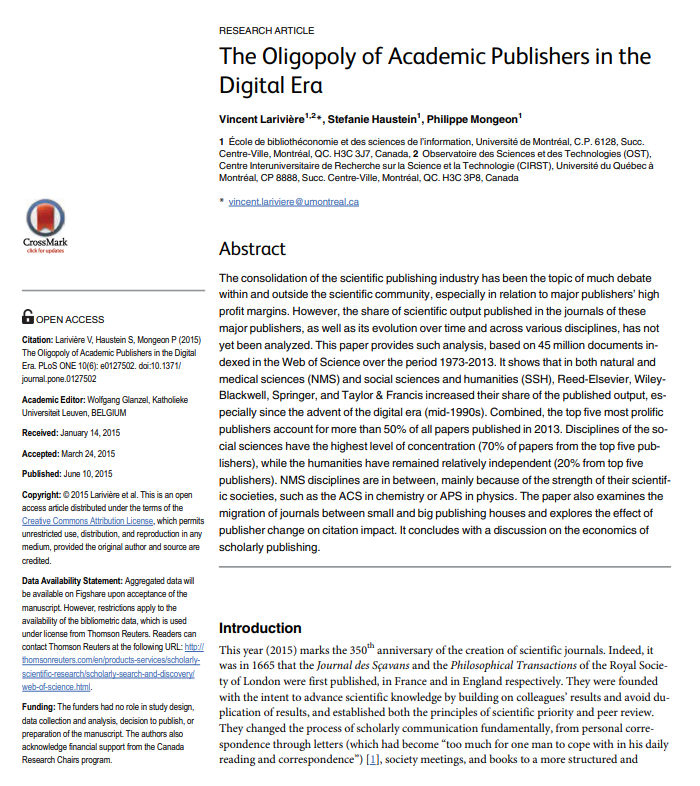
FIVE COMPANIES CONTROL OVER 50% OF SCIENCE
Vincent Lariviere and two colleagues at Universite de Montreal analysed 45 million papers indexed into Web OF Science between 1973 and 2013.
The FIVE companies are Reed-Elsevier, Springer, Wiley-Blackwell, Taylor & Francis, and the American Chemical Society. They have control over:
~ 1/5 OF papers in natural and medical sciences (1973)
~ 1/3 OF papers (1996)
~ 1/2 OF papers (2006)
More THAN HALF (2013).
Chemistry is the worst off, going from ~40% to almost 80% at their peak. Social sciences are at about 70%.
What really made me sad is the money. They make huge profits (almost 40%), increasing the subscription fees to Universities by 5-7%. At his OWN university, HALF the journals they paid for hadn't even been downloaded once in 5 years.
The authors looked at the return on a large publisher. If you move from a small publisher to a large publisher there's no obvious increase in citations.
The important bit: Physics is one OF the subjects that have partially avoided this. Biomedicine and humanities have too. This is because physicists upload their preprint to arXiv. The paywall doesn't matter.
So this whole argument is based on a habit. As long as we continue to do this, it will continue. This blog will give you a paper each time. If you want to get these in your feed then click the link. Share this post as none OF the thirty dollars ever makes it to the author or reviewer.
This paper is freely available. Link in the reply.
THE FERMI PARADOX HAS BEEN DISCONTINUED
for sixty years you have been sold a mystery. the universe is huge, the stars are old, somebody should have called by now, and the silence demands an explanation.
three researchers at the Future of Humanity Institute in Oxford went to check the arithmetic under the product.
what was in the old packaging: one number plugged into each slot of the Drake equation. a single value for the share of planets where life starts, a single value for the share where intelligence appears. point estimates.
the trouble is that our knowledge of those quantities is smeared across orders of magnitude. you cannot be uncertain by a factor of a billion and then write down one number for it.
so Anders Sandberg, Eric Drexler and Toby Ord fed in the whole spread of the uncertainty instead. they ran it twice, once from their own reading of the science, once from the range of published estimates in the astrobiology literature.
the output:
> probability we are alone in the Milky Way: from about half to near certainty
> probability we are alone in the observable universe: from about 40 to 85 percent
at those numbers the silence stops being strange. nothing is missing from the sky. no paradox left to explain, and no Great Filter needed to explain it.
i went in expecting to find the trick, because a paper that deletes a famous problem usually has one. what i came out with is a complaint about method. one number written where a range belongs, repeated for sixty years.
the fine print, and i am the one insisting on it. these are probabilities under the distributions the authors picked, so change the assumptions and the numbers move. the paper measures how little we know and it does not prove that nobody is out there. what it takes away is your right to be surprised that nobody has called.
link in the comments
A PRIZE-WINNING MATH THESIS AND 16 BOMBS HAVE THE SAME AUTHOR
the first half of this story is a cv.
> age 16: starts at harvard on a scholarship
> age 20: degree in mathematics
> 1967: phd at michigan, thesis "boundary functions", on how functions behave at the edge of a region
> same year: the prize for the best math dissertation of the year
> professor piranian: he solved a problem that had stumped me and a colleague, he "picked up the ball and ran like hell"
> committee member reade: maybe 10 or 12 men in the country understood or appreciated it
> age 25: assistant professor of mathematics at berkeley, six papers published between 1965 and 1969
> june 1969: resigns with no explanation
the second half is a police file. his name was ted kaczynski.
> 1978: first bomb, left in a parking lot at the university of illinois at chicago, a campus officer is hurt opening it
> 1979: a bomb in the cargo hold of american airlines flight 444, smoke forces an emergency landing
> 1985: hugh scrutton, 38, owner of a computer store in sacramento, killed
> 1993: charles epstein, a professor at uc san francisco, loses several fingers. david gelernter, a yale computer scientist, loses the sight of one eye and part of his right hand. both opened parcels
> 1994: thomas mosser, an executive at a public relations firm, killed at home by a mail bomb
> 1995: gilbert murray, president of the california forestry association, killed by a mail bomb in sacramento
> total: 16 bombs, 3 killed, about two dozen injured
> duration: 17 years
i will not draw a line between the two lists, because the record does not.
no fingerprints and no dna, and a task force of more than 150 people. what identified him in the end was a manifesto of 35 thousand words and a brother who recognized the phrasing. in 1998 he pleaded guilty and got life without parole.
his own paper from 1969 asks, per its abstract, where on the edge of a disk a continuous function can settle to a value along some path. it shows that the set of such points can be any set of a broad type, and one of its results answers an open problem.
link to the paper in the comments
MATHEMATICIANS SAY DARK ENERGY IS OPTIONAL
dark energy has been the leading explanation for accelerating expansion for almost thirty years. a paper in Proceedings of the Royal Society A says it may not be needed.
the standard model rests on the friedmann solutions of einstein's equations, a smooth universe that looks the same everywhere. blake temple of uc davis and his coauthors say those solutions are unstable. their words: "like einstein's static model, the friedmann spacetimes are all unstable to radial perturbation".
their claim is that once the instability is allowed to play out on large scales, accelerated expansion comes out of einstein's equations by itself. no cosmological constant, no dark energy.
the price:
> the universe needs a center of spherical symmetry
> and the observer ends up in a special place
temple replies that the standard model has the same trouble with the copernican principle.
reservations. this is pure mathematics. the press release gives no acceleration rate, no fit to supernova data and no significance, and says the comparison with observations has not been done. it calls the work a theoretical challenge. until someone runs it against the data, it is an argument about stability.
link to the paper in the comments
THIS GALAXY LOOKED LIKE IT HAD ONE BLACK HOLE AND IT HAS THREE
J0148-4214 sits more than 12.5 billion light-years away. we see it as it was about 1.2 billion years after the big bang.
JWST mapped it with spectroscopy and found three active supermassive black holes. two sit in the center about 620 light-years apart, too close to split in the image, so they were pulled apart by analyzing the light. the third is about 5500 light-years out.
> masses: about 80 million, 2 million and 600 thousand suns
> all the stars in the galaxy together: about 1.3 billion suns
by my arithmetic from those numbers, roughly 6 percent of the stellar mass sits in black holes. nearby galaxies typically carry around a tenth of a percent.
the 80 million one is eating slowly. its neighbor of 600 thousand suns feeds faster than the eddington limit, a ceiling in basic growth models.
the central pair is expected to merge within a few hundred million years. the outer one is either a leftover of an earlier merger kicked out by recoil, or it is slowly drifting in.
reservations: the 620 is a projected distance, the masses and feeding rates are estimates, the merger date is an expectation. the artwork in the press release is AI-generated.
link to the paper in the comments
THE EQUATION OF THE WHOLE UNIVERSE HAS NO TIME IN IT
the wheeler-dewitt equation is supposed to describe the universe as a whole. it dates from 1967 and has no time variable. a universe has nothing outside it to read a clock from, so the equation never got one.
a physicist at the university of birmingham, giovanni barontini, tried to get time to appear on its own.
> about 24 thousand atoms
> a few billionths of a degree above absolute zero
> a laser wall splits them into a watched half and an unwatched half
> the watched half expands and shrinks again and again, a toy big bang and big crunch
he defined time through entropy, by how the atoms are spread between the halves. the spread changes and the clock moves. the spread stays put and the clock stands still, while the lab clock keeps going.
what came out is a time that runs one way, keeps events in order through expansion and shrinking, and speeds up or slows down with entropy. a version of the schrodinger equation written in it still gives predictions.
calling this a universe is generous. it is a cloud of atoms and a laser wall, one author, and "first controlled evidence" is his own wording. it does not show that time is an illusion.
next on his list are more complex systems and black holes.
link to the paper in the comments
a fake gravitational wave fooled LIGO for six months
in september 2010 the detectors picked up a loud signal. a few people in the collaboration had slipped it in on purpose as a test. everyone else knew a fake might show up at some point and had no idea this was it.
so the team treated it as real. they spent months checking it and ended up with a draft paper titled “evidence for the direct detection of gravitational waves from a black hole binary coalescence”. the sealed envelope with the truth in it got opened in march 2011.
that story is a big part of why i believe the numbers, which are hard to believe on their own. the drawing here is the detector in one picture. one laser beam is split and sent down two 4 km tubes at right angles. a 40 kg mirror hangs at each end of each arm, so the light gets trapped and bounces about 300 times, and every arm behaves like it is 1200 km long. the two beams come back and are arranged to cancel at the photodetector. a passing wave stretches one arm and squeezes the other, and in 2015 that was about a thousandth of a proton’s width, which was still enough to let a trace of light through.
look at the coil and magnet next to the end mirror. it holds the mirror still, and in the old detectors the same kind of coil was also how you could fake a wave. when the real signal arrived in september 2015, one of the first jobs was to prove nobody had slipped in another fake, and the announcement came about five months after the signal.
save this one, it covers most of what @LIGO headlines assume you already know.
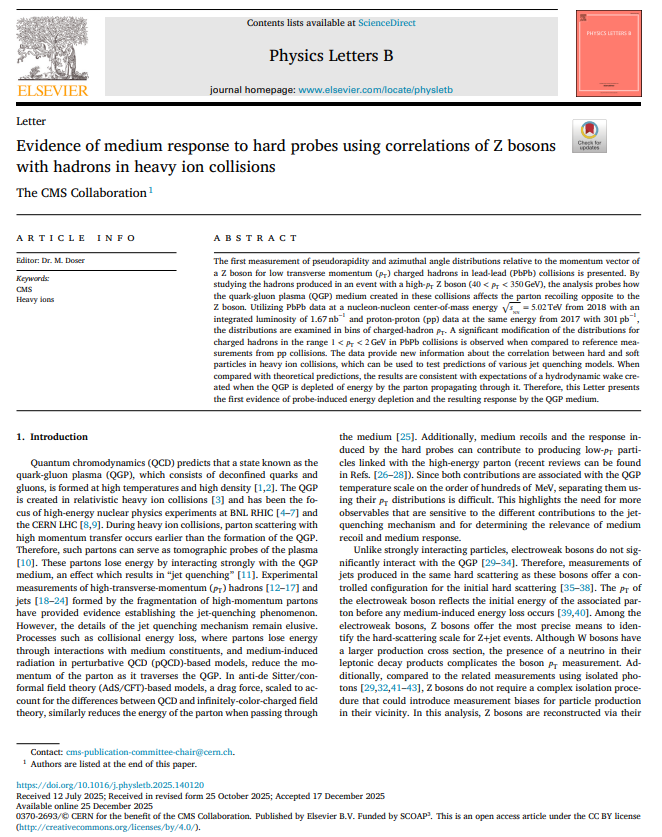
THE UNIVERSE'S FIRST LIQUID SPLASHED BACK AT CERN
for the first few millionths of a second after the big bang, all matter was a liquid. every proton in your body condensed out of it.
a speck of it can be made at the LHC from lead. several trillion degrees, gone in an instant.
@CMSExperiment caught a quark crossing that speck and watched the liquid react. a wake behind the quark. ripples, a splash, a swirl.
the price of one ripple:
> lead collisions recorded: about 13 billion
> usable ones: about 2000
the team calls it the first direct evidence that this plasma moves as one fluid. i trust the word evidence. nobody saw a single splash, the wake is a pattern averaged over those 2000 events.
how big it is, how fast it travels and how long it lasts is still unmeasured. those numbers describe the stuff your protons came from.
link to the paper in the comments
TWO HELIUM ELECTRONS BROKE A TEXTBOOK X-RAY LIMIT
a helium atom has two electrons. when they work together, a laser gets x-rays out of it with more than double the ceiling the textbook sets.
i read "broke a physical limit" as a press release verb by default, so i went to the methods first. i read them twice.
the limit is old. since the 1990s the picture goes like this. the laser field rips one electron off the atom, accelerates it and swings it back. the electron hits, and the collision comes out as a flash of x-ray light. how hard it hits depends on the laser, so the photon energy has a ceiling, and above it the signal collapses. this mechanism sits under the attosecond pulses that got the 2023 physics nobel.
a team from TU Wien and UC San Diego (tenio and dimitar popmintchev) sent ultraviolet pulses, 400 nanometers and under 30 femtoseconds long, into helium gas. above about two quadrillion watts per square centimeter the spectrum grew a second plateau.
> usual ceiling: about 120 eV
> new plateau: about 280 eV
> that is the edge of the water window, the x-ray range used to look inside living cells
the explanation they favor leans on how helium is built. two electrons and no inner shells to screen them from each other. the laser pulls them out one after the other, steers both back at the same moment, and they dump their energy into one photon. a single electron cannot pay for a photon that large.
the checks i wanted to see are there. argon and neon give nothing above the old ceiling, and argon stayed silent after half an hour of exposure while helium lit up within seconds. when the laser polarization was made strongly elliptical, both plateaus vanished, which is what you expect from electrons that get pushed past the atom instead of coming back.
now the part that keeps me from calling it settled. the full quantum simulation gets the photon energies right and the brightness badly wrong. it says the two-electron signal should be about ten billion times fainter than the ordinary one. the lab sees about ten thousand times fainter. the simulation misses by a factor of about a million, and the authors call double-electron recombination the most consistent explanation without claiming the question is closed.
the signal is weak, because correlated pairs are rare and have to meet strict timing, so a bright desktop x-ray source is not coming out of this soon. what you get is a probe. the light carries a record of how two electrons behave next to each other over attoseconds. next they want to look at molecules and solids with strongly correlated electrons, where most of the unsolved materials physics sits.
link to the paper in the comments