Most product feedback sucks. It's an immediate gut reaction: "Ooh, I love this!" or "Meh."
Want to get better at actually giving useful, actionable product feedback? Run yourself through these 7 questions.
1) What is the user journey to get here?
You can’t furnish a room if you don’t know how someone lives.
So learn the context: Who is the user? When do they use this product? Why? How did they arrive here, and what's on their mind?
Don't critique unless you know this.
2) What do we want users to feel and achieve here?
“If you don’t know where you’re going, you’ll end up someplace else.”
Let’s understand what a successful outcome looks like before we start lobbing feedback about the design.
3) How important is this page/experience?
In a perfect world, we make everything perfect.
In the real world, let's spend more collective energy on the stuff that really matters. More eyeballs? More high-stakes? = more thorough inspection of every detail.
4) What is our scope/timeline/team?
If speed is critical, let’s get the greatest bang for the least effort. If we have more time and people, then let's remove constraints (#7) and dream bigger. The "best" design differs according to the time/people/money you have.
5) For every proposed design change, am I confident it is better that what currently exists?
If no:
a) cut it
b) iterate on / improve the design
c) get more user feedback
d) A/B test it
6) What can we remove from this experience and have it work just as well?
When faced with a problem, we bias toward adding stuff to solve it rather than removing. So gut check if it's necessary.
7) If we could throw all our constraints away, would we still design it like this?
While we can't typically throw all constraints away (see #4), it's still worthwhile to ask because we accept some things as constraints (due to legacy, etc) when they really aren't.
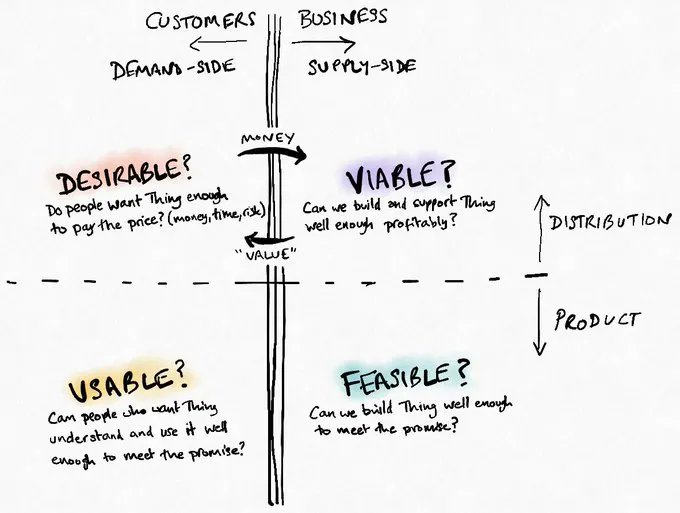
Every PM and designer should memorize this chart.
It clears up the 4 product risks, and finally ends the confusion between desirability, feasibility, viability, and usability.
Keep it close. It’s a cheat code for better product decisions.
Thanks @tom_d_kerwin 🙏
how i'd build a $200k+ MRR mobile app in 2025:
1. Find your target app
- check app store charts for successful but outdated apps ($300k+/month)
- look for consistent revenue + poor UX + strong retention
- focus on boring categories with loyal users
- use tools like SensorTower for revenue data
2. Build the AI version
- identify their most-used feature (usually just one)
- rebuild it with AI, making it 10x faster/easier
- keep it ultra simple
- build in 2 weeks max
3. Copy their user acquisition
- study their ads on Meta/TikTok/Instagram
- check for affiliate programs
- find their best-performing content
4. Growth strategy
- make better versions of their viral content
- post 2x/day on TikTok, 1x/day on Reels
- focus on hook → demo format
- partner with micro-creators (cheap monthly deals)
- scale winning content with paid ads
- add viral features (sharing, referrals)
tldr: find outdated but profitable apps, rebuild their main feature with AI, copy their marketing, scale fast
2025 will be the year of small AI apps overtaking legacy giants
time to build, we're in this together
Win a free IxDF yearly membership & learn UX design 🥳
My friends at @designwithixdf have given me a yearly membership to give away.
❤️ Like and 🔄 repost for a chance to win 🤞
I’ll randomly select a winner on 6 March 2024.
#ad#ux#uxdesign
🎅 Win a FREE copy of @PracticalUI 🙌
To celebrate Christmas, I’m giving away 5 copies of my UI design book. I'll randomly select the winners on 20 Dec 2023.
❤️ Like and 🔁 repost to be in the running.
Good luck 🤞
(X is in no way responsible for this promotion)