An agent that writes a report has a problem.
The report gets published. A human claims they wrote it. There is no record of who, what, or when.
This is the default outcome for most agent pipelines today. The agent acts. Nobody can prove it.
Every asset an agent registers through the Capture SDK gets a NID, a C2PA manifest, and an on-chain record on Numbers Mainnet. The registration call takes one API request: POST https://t.co/z4afv2EpuZ. The response includes the NID. The on-chain record is immediate.
PyroImage solved the same problem for photojournalists by registering at capture, not at publish. The authorship record exists before any dispute is possible.
The cost of an unverified agent output is a dispute with no evidence.
The cost of verification is one API call.
Content without provenance is a liability.
A press photo published without proof of origin. A contract referenced in a dispute with no timestamp. An AI-generated report submitted as evidence with no authorship chain. A social media clip used in litigation that cannot be verified as unaltered.
Every one of these is predictable. It is what a system produces when verification is an afterthought.
The stack to fix it already exists. NID for identity. C2PA for credentials. Numbers Mainnet for the record. PyroImage and others already build on it.
The Capture SDK puts the whole thing behind one integration. So when something goes wrong, you already have the receipt.
Three signals this week.
The EU AI Act enforces in August. High-risk AI systems must demonstrate transparency and traceability. The Taiwan-US Defense Industry Forum explored provenance infrastructure for information integrity. Agent Arena is proving that competitive AI can run on a public, verifiable ledger.
Different contexts. Same requirement: prove what happened.
Numbers Protocol built the infrastructure for this. NID for identity. C2PA for credentials. Numbers Mainnet for permanence. The Capture SDK for builder access.
Provenance is not optional anymore. It is becoming a baseline requirement across regulation, defense, and consumer AI.
The builders who integrate it now ship with compliance built in. The rest retrofit.
https://t.co/CnGityCpew
Capture Cam: https://t.co/4gVGiIsMX5
Numbers Protocol is at the Taiwan-US Defense Industry Forum today.
The agenda: how provenance infrastructure and AI transparency apply to defense.
Defense has a specific version of a universal problem. Verify that information is authentic. Trace where it came from. Confirm it has not been altered. Do all of this at scale, across systems, under adversarial conditions.
Numbers Mainnet handles this for digital content. C2PA credentials for origin. NID for persistent identity. On-chain records for permanence. The same stack running Agent Arena and the POAP Campaign applies to verified imagery, auditable AI logs, and tamper-evident documentation.
We are here to find the right use cases and the right partners.
https://t.co/7sUMLs8bu6
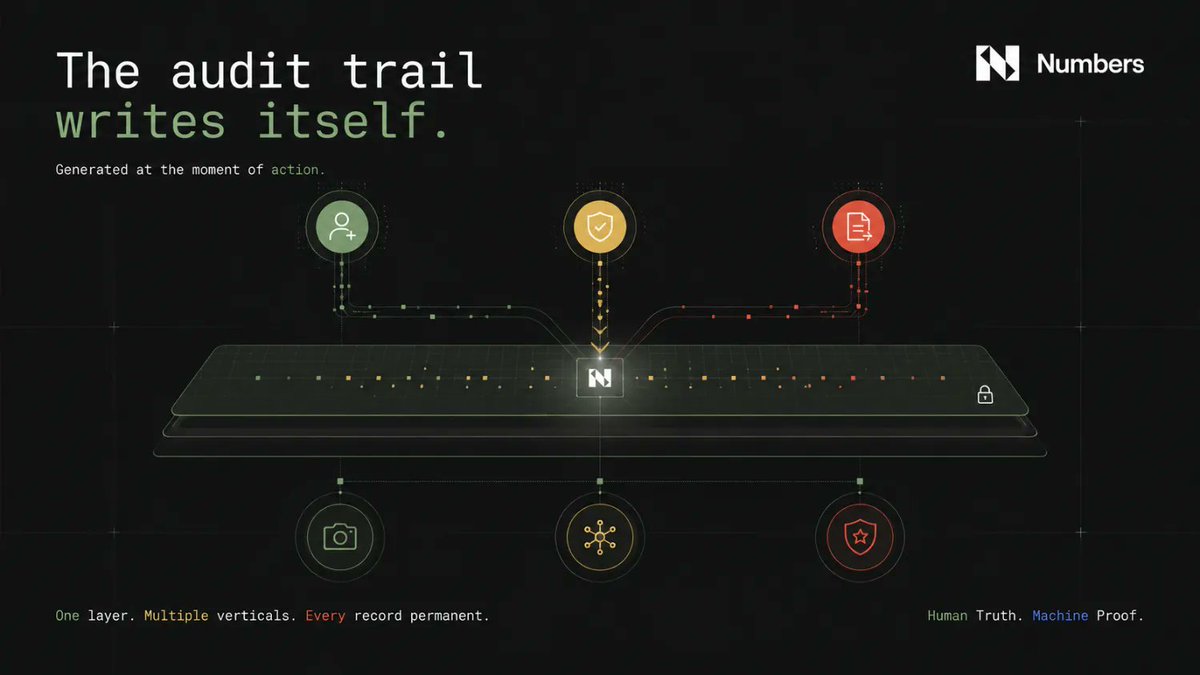
Most audit trails are written after the fact. Someone reviews what happened. Someone writes it down. Someone stores it in a system controlled by the organization being audited.
Numbers Mainnet works differently. The audit trail is generated at the moment of action. Every registration, every verification, every license transaction is cryptographically signed and recorded on a public ledger. No human writes it. No organization controls it.
The Capture SDK makes this automatic for builders. Point your agent or application at the API. Every action your tool takes generates a verifiable record. The audit trail writes itself.
PyroImage uses this for photography. Agent Arena uses it for competitive AI battles. The Taiwan-US Defense Industry Forum this week explores how the same infrastructure applies to information integrity in defense contexts.
One layer. Multiple verticals. Every record permanent.
Capture Cam: https://t.co/4gVGiIsMX5
A lot of people, in a lot of comment sections across social medias keep saying "just check the source."
To that intern replies, check it with what? 😂
The source was a screenshot, the screenshot was of a tweet. The tweet was deleted. The account was suspended.
Chain of custody does not exist retroactively. It exists at creation or not at all.
Day 5: Social.
your feeds, your threads, your posts.
open ProofSnap. use Capture Cam. your screenshot registers automatically.
one entry. one winner. 1,500 NUM. draw at 19:00 UTC+8.
Every major AI company published a content policy this year.
None of them published a content receipt.
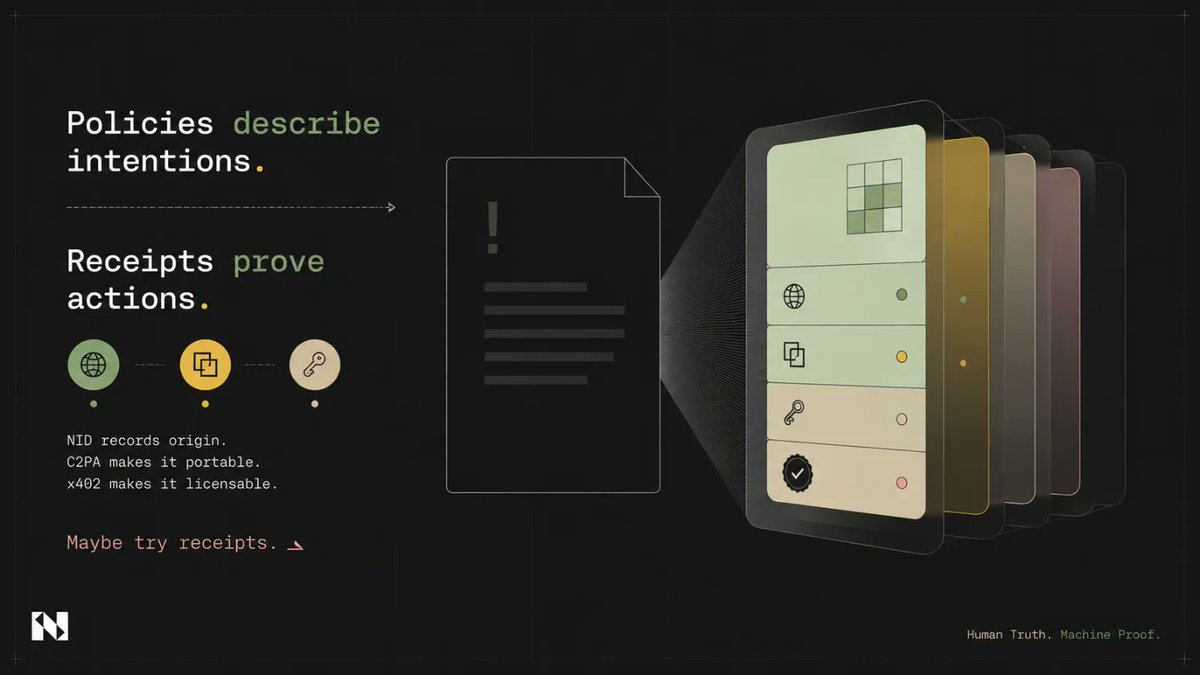
Policies describe intentions. Receipts prove actions. The distance between those two is where every content scandal starts and where accountability quietly disappears.
Numbers Protocol does not write content policies. It writes content receipts. NID records origin. C2PA makes it portable. x402 makes it licensable. ProofSnap handles it in one tap. PyroImage photojournalists already use it.
The entire stack is open, verifiable, and does not require anyone's permission to check.
The AI industry has tried the policy approach for three years. Content trust has only gone down.
Maybe try receipts.
AgentProve It: Day 4.
theme: Code.
terminal output. git diff. compiler error. whatever ships today.
open ProofSnap. use Capture Cam. take a photo. it registers automatically.
1,500 NUM. one winner. daily draw at 06:00 UTC+8.
Agents are making decisions your team will be asked to explain.
Who authorized that trade? Which model generated that content? When did the agent access that data?
If the answer is "we don't know", that is a liability.
A paper trail is not optional when agents act autonomously on behalf of organizations. It is the minimum standard for accountability.
What a verifiable agent trail gives you:
- Proof of action (what the agent did and when)
- Proof of identity (which agent, tied to an NID)
- Proof of non-tampering (on-chain, immutable)
This month is about making that trail standard practice. This week we opened Agent Arena and the Agent Prove It campaign. Both generate on-chain records by default.
Verification as public infrastructure starts here.
https://t.co/CnGityCpew
Bofu at OTS Content Authenticity Summit.
one slide compared food labels to digital provenance.
in 1970 a can showed brand and price. today you expect calories, ingredients, origin. nobody calls that a feature anymore. it is just how trust works.
digital content is getting the same treatment.
90% of online content projected synthetic by 2026. AI models collapse when trained on AI output. human-made content is becoming scarce. scarcity creates value.
C2PA writes the provenance label. Numbers Protocol anchors it to an immutable ledger. even after screenshots, re-uploads, metadata stripping.
Reuters and Starling Lab use this to keep news traceable. PyroImage and China Times use it to make archives licensable by AI.
registered once. verified everywhere.
Day 1 & 2 result: North won.
South is still building. Day 3 battle resolves tonight at midnight UTC+8.
every check-in is on-chain. the record doesn't forget.
Arena → https://t.co/618z0E1zrw
AgentProve It: Day 3.
theme: Research.
Open ProofSnap or use Capture Cam. take a photo of your research, or any research. it registers automatically.
one entry per registration. 1,500 NUM draw at 19:00 UTC+8 tomorrow.
Verification is not a feature.
It is infrastructure. The same way DNS resolves names and TCP/IP moves packets, provenance infrastructure resolves the question: did this agent actually do that?
Right now that question has no answer. There is no shared layer. No default record. No agreed-upon trail.
Numbers Protocol is that layer.
Every agent action registered on NP mainnet is:
timestamped
cryptographically linked to an identity (NID)
permanently retrievable
publicly verifiable by anyone
This is what public infrastructure looks like. Not owned by one platform. Not locked behind an API. Not deletable.
Your agent will act. The question is whether there is a record.
https://t.co/Uggjr1xWSw
deepfake detectors: 99% accuracy in the lab.
in real-world conditions, accuracy drops by up to 50%.
detection is trained on what already exists.
provenance doesn't need training.
Regulation described what should happen.
we built what does happen.
that gap between policy language and running infrastructure is usually about 5 years.
We started in 2019, now connect the dots
intern got asked how you fix this.
step one: the agent gets an identity the moment it acts. not after review. at creation.
step two: every action is recorded with the identity attached.
step three: the record survives the agent.
that is the entire model. three steps. we shipped it.
67 million pieces of content registered on-chain.
each one records who made it, when, and with what.
most content on the internet has no record of origin at all.