Devoured by the Revolution Finale
The Warning:
To the modern revolutionary: study the thing you are praising.
Every revolution begins with your language. Justice. Liberation. Equality. The people. The future. Then come the categories, the accusations, the lists, the purges, and the prisons. The machine does not stop when your enemies are gone. It turns inward because purity always needs another impurity to destroy.
The Jacobins, Bolsheviks, Red Guards, Khmer Rouge, and Spanish radicals all believed they were building a cleaner world. They built furnaces for human beings and were often fed into them themselves.
America was different because 1776 did not declare war on class, blood, faith, family, property, or memory. It declared war on illegitimate power. It did not try to purify mankind. It just chained government.
That is the inheritance communists hate most.
A revolution that liberates limits power.
A revolution that worships power eventually asks for your name.
Devoured by the Revolution IX: The American Revolution
The Fever:
Most revolutions come into the world with an appetite. They promise justice, identify enemies, sanctify rage, and eventually discover that destroying the old order is easier than governing without becoming worse than the thing they replaced.
The American Revolution was different because its target was precise. It was not a war against class, blood, faith, family, property, or memory. It was a war against illegitimate power.
The Use:
The Revolution did not require Americans to worship the state. It required the state to justify itself before Americans. That distinction is everything.
France would later drown liberty in blood. Russia would build a secret police state in the name of workers. China would send children to destroy their teachers. Cambodia would murder people for wearing glasses. America fought a king, won, and then built restraints around the power it had just seized.
The Turn:
This is where history expected the usual ending. The victorious general keeps the army. The liberators become governors. The new regime explains why emergency power must continue a little longer.
Washington did the thing almost no revolutionary strongman ever does.
He gave power back.
The Lesson:
The American Revolution did devour something. Not its children, its priests, poets, or Soldiers.
It devoured the oldest political lie on earth: that people belong to rulers.
That is why every ideology of control eventually hates 1776. Communists hate it because rights exist before the state. Tyrants hate it because government answers upward. Bureaucrats hate it because liberty was declared before permission was requested.
The American Revolution was not pure because no human thing is pure. It was exceptional because it won power, then chained power.
That is the difference between a revolution that liberates and a revolution that eats.
Devoured by the Revolution VIII: Cuba
The Fever:
Cuba, 1959. The revolution arrived with beards, rifles, romance, and promises. It spoke of corruption, dignity, justice, sovereignty, and the people. Students, workers, intellectuals, priests, journalists, and middle-class dreamers imagined they were watching a nation free itself.
They were watching a prison change wardens.
The Use:
The revolution needed martyrs while Batista still stood. It needed students in the streets, guerrillas in the mountains, foreign journalists in love with the costume, and ordinary Cubans willing to believe the firing squads would only face the guilty.
Then the old regime fell, and the new one began teaching everyone what guilt meant.
The Turn:
Rivals were executed. Dissidents were jailed. Newspapers were seized. Priests were harassed. Property was confiscated. Former allies who thought they had fought for freedom learned that the revolution had no room for pluralism, only obedience. Huber Matos, a revolutionary commander, criticized the communist turn and was rewarded with twenty years in prison.
The party did not betray the revolution. It revealed it.
The Lesson:
Modern radicals love the poster version of Cuba because posters do not show cells, ration lines, informants, exile boats, or men shot after midnight against prison walls.
The revolution always begins by promising to liberate the people from corruption.
Then it decides the people are too corrupt to be free.
My Charlie Kirk assassination conspiracy theory is that a dysgenic freak who had gay sex with another dysgenic freak killed Charlie Kirk because Charlie Kirk made him feel shame over being a dysgenic freak who had gay sex with another dysgenic freak.
Devoured by the Revolution VII: Spain
The Fever:
Spain, 1936. The revolution arrived wearing the old costume: justice, liberation, the people, the future. Communists, anarchists, foreign volunteers, intellectuals, and street militants imagined they were present at the birth of a new world. Then the churches began to burn.
The Use:
The mob needed enemies, and the Church became a body it could strike. Priests were hunted. Convents were sacked. In cities that did not fall to the Nationalist uprising, revolutionary assaults against churches and convents spread quickly, and in Barcelona the dead themselves were dragged into the spectacle. Exhumed monks and nuns were displayed in public as if corpses could be prosecuted for the sins assigned to them by ideology.
The Turn:
Then the revolution turned inward. Anarchists, anti-Stalinist Marxists, POUM militants, and yesterday’s comrades became obstacles once Soviet-backed communists demanded discipline. During and after the Barcelona May Days of 1937, the left began purging the left. POUM leader Andreu Nin was seized and murdered by Soviet NKVD agents.
The Lesson:
This is the part modern revolutionaries never want remembered. The mob always begins with obvious enemies, then runs out of them. It burns churches, digs up nuns, denounces neighbors, purges allies, and eventually murders men who were revolutionary yesterday but insufficiently obedient today.
The revolution does not stop at the living.
It puts memory itself on trial.
Devoured by the Revolution VI: The Iranian Revolution
The Fever:
Iran, 1979. The revolution was sold as liberation. Students, clerics, Marxists, liberals, Islamists, nationalists, intellectuals, and street radicals all marched against the Shah believing they were breaking a prison open.
They were. They just did not understand who would own the keys.
The Use:
The revolution needed a crowd broad enough to topple the old regime. It used sermons, strikes, martyrs, street violence, propaganda, exile networks, and Western intellectual sympathy to make collapse feel holy. Once the Shah fell, yesterday’s allies became liabilities.
The Turn:
The Islamists consolidated power and began clearing the field. Liberals were crushed, leftists were jailed or executed, women were forced beneath the new order, dissidents disappeared into prisons, and revolutionary courts turned accusation into sentence.
The men who had shouted freedom in the streets learned too late that they had helped build a theocracy.
The Lesson:
This is the part modern revolutionaries keep missing. Coalitions are useful before power is seized. Afterward, only the faction with guns, prisons, discipline, and theology gets to define the revolution.
Everyone else becomes unfinished business.
The revolution does not share victory. It just inventories accomplices.
Devoured by the Revolution II: The Bolsheviks
The Fever:
In Russia, 1917, the Bolsheviks promised bread, peace, land, and liberation. The old order was rotten, the workers were sacred, the future was inevitable, and anyone standing in the way of history could be renamed an enemy of the people.
The Use:
The revolution needed hard men first. Agitators, party organizers, Red Guards, secret police, informers, and true believers broke the old state and made terror sound scientific. The Cheka did not merely punish crimes. It hunted class enemies, counterrevolutionaries, saboteurs, priests, peasants, officers, and anyone whose existence complicated the myth.
The Turn:
Then the revolution began killing its own bloodline. The old Bolsheviks who had risked exile, prison, and death for the party learned that loyalty meant nothing once Stalin controlled the machinery. Zinoviev, Kamenev, Bukharin, and countless others were denounced, humiliated in show trials, forced to confess to fantasies, and shot as traitors to the revolution they helped create.
Trotsky built the Red Army. Stalin sent an assassin with an icy axe.
The Lesson:
The Bolsheviks prove the central lie of every communist movement. The party does not protect the faithful. It preserves power. Once the revolution owns the prisons, yesterday’s heroes become tomorrow’s wreckage.
Modern communists imagine they would be the commissars.
History says they are more likely to become the confession.
Devoured by the Revolution I: The Jacobins
The Fever:
During the French Revolution, the Jacobins spoke in holy words: virtue, equality, justice, the people, the future. By 1793, those words had become death warrants. The revolution did not need criminals for long. It only needed categories.
The Use:
The mob supplied the muscle. Clubs, pamphlets, denunciations, tribunals, street pressure, and the guillotine made accusation into government. A man could be marked by class, friendship, hesitation, or silence. Innocence mattered less than usefulness to the spectacle.
The Turn:
Maximilien Robespierre was the Jacobin high priest of purity, the man who helped justify the Terror in the name of virtue. But by 1794, the machine had become too dangerous even for the men who built it. Every faction feared it would be next. Every rival understood that purity had become a weapon no one could safely hold.
So they struck first.
Robespierre, Saint-Just, Couthon, and scores of their allies were arrested and sent to the same guillotine they had made sacred.
The Lesson:
Modern revolutionaries imagine they will control the machine because their hatred feels moral. They never understand that purity does not stabilize power. It makes everyone fear being named the next impurity.
The revolution promises justice, then teaches the crowd to count heads. Modern communists would do well to remember this lesson.
250 years ago, fifty-six men signed their names to a death warrant.
If the Revolution failed, that document was a hanging list. They knew it and they signed nonetheless. Pledging their lives, their fortunes and their sacred honor to an idea that did not yet have an army strong enough to defend it.
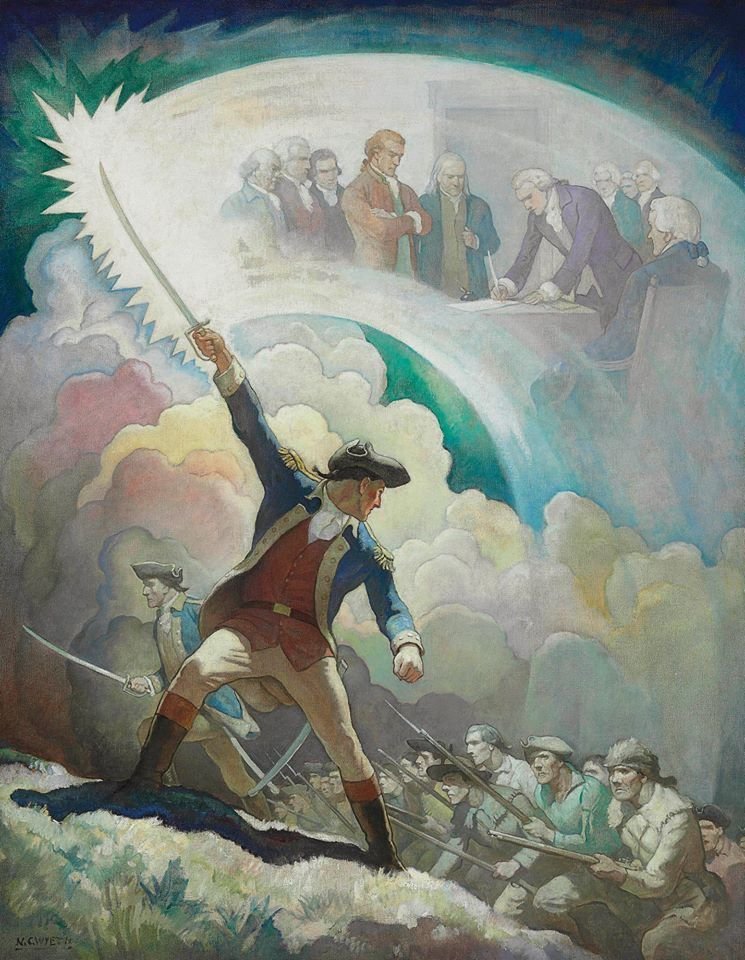
N.C. Wyeth painted the gap between the promise and the price.
Above, in the light and clouds, the signers commit their names.
Below them, the farmers, tradesmen and frontiersmen, are the ones who had to make those words real. In the smoke and the fight.
It took seven more years of war. Trenton. Valley Forge. Saratoga. Yorktown.
Most of the men in the struggle never signed the Declaration.
But they paid for it.
America 250 🇺🇸
@ReviewsPossum This seems to be a recurring thing these people: the inability to see any display of love or affection outside of a romantic/sexual context.
@ReviewsPossum More specifically he'll be replaced by someone who'll take the brunt of the fallout from his policies when the shit finally hits the fan.
The only reason this asshole is resigning is so he can avoid the fallout of the raging shitstorm he created as well as the lynch mobs and vigilantes that will inevitably come for him when the shit finally does hit the fan.