$HOOD has been on a run lately, and there are three catalysts: the new AI agent trading feature, the Trump account app going live, and the pattern day trader rule change.
I think all three are real. None of them move the needle enough for Robinhood to decouple from bitcoin:native.
My mental model: Bitcoin is a giant 1.5 trillion-dollar orange sun, and Robinhood is a planet orbiting it. For HOOD to truly break free, the gravitational pull has to become irrelevant. I don't think any of this news gets it there. And with Robinhood hosting a crypto-focused event next month, it might actually pull it closer.
Long term, I still think Robinhood becomes a finance behemoth. Short term, wherever Bitcoin goes, HOOD probably follows.
Anthropic just filed to go public.
My take: the valuation is more justifiable than SpaceX, but the long-term question nobody is asking loudly enough is distribution. Claude doesn't live anywhere by default. $GOOGL has Android, Chrome, and YouTube. $META has Facebook, Instagram, and WhatsApp. Anthropic has to be sought out.
Data is the other side of it. YouTube alone might be the greatest training source on the planet. That gap is real.
I love Claude. I use it every day. But loving a product and betting on it winning a ten-year AI race are two different things.
Full conversation with @hamids below:
He finally did it. After an incredible 200%+ run in less than six months, @hamids actually trimmed some of his $MU position once it broke the $1,000 mark.
In the newest episode of @buyholdrant, we break down exactly what went into his decision to take some chips off the table, how he manages portfolio allocation when a stock grows to over 33% of his holdings, and whether he has any regrets yet.
Here is what else was on the docket this week:
• Micron's Hub Score Downgrade: We look under the hood at why Earnings Hub just dropped Micron from an A to a B, and why it's a side effect of its trailing PE hitting 48 rather than a broken thesis.
• The Bull Case for $RIVN: Hamid lays out eight reasons he's more convinced than ever on RIVN right now (especially with the R2 mass-market vehicle and deliveries starting next week).
• The Anthropic IPO: Anthropic finally filed to go public. We compare it to the recent SpaceX IPO talks, discuss the sheer amount of liquidity hitting the market right now, and I share my take on why distribution and data moats (like $GOOGL's) are the real long-term battlegrounds for these AI models.
• $HOOD & bitcoin:native: Has HOOD officially decoupled its price action from Bitcoin after its recent breakdown?
https://t.co/XnnACPUvJ0
Has $HOOD decoupled from bitcoin:native?
It's something I've been thinking about quite a bit over the last few days.
I think it's important to look at what's actually driving the stock higher.
1. Agentic Trading
Robinhood recently announced its Agentic Trading feature, which allows users to connect an AI agent to a dedicated Robinhood account and execute trades automatically. It's an interesting concept, and I like the innovation, but the bullish implications feel largely unproven at this point. We simply don't know whether agentic trading will outperform human investors or even beat the S&P 500. My suspicion is that a lot of users will end up losing money while experimenting with it.
2. Trump Accounts App
The Trump Accounts app launch has generated some attention, but I don't see a meaningful financial impact for Robinhood. My understanding is that Robinhood is being compensated by the government on a cost-plus basis, so there is some revenue attached to the project. However, the real opportunity was never the contract itself. The biggest potential win was the marketing exposure and customer acquisition that could come from being prominently featured within the app.
After downloading it, though, I came away underwhelmed. Robinhood's branding is fairly subdued, with its logo appearing alongside several other partners. It feels more like a sponsor than a centerpiece of the experience. As a result, I don't think the app is likely to become a major growth driver for Robinhood.
3. PDT Rule Changes
The recent Pattern Day Trader rule changes are definitely a positive development. However, I don't think they materially change the trajectory of Robinhood's business since they affect only a relatively small portion of the user base.
My broader point is that none of these catalysts are strong enough, in my view, to justify a lasting decoupling from Bitcoin.
Now, it's certainly possible that a series of small positive developments creates a "success by a thousand cuts" effect. Sometimes enough minor wins can add up to something meaningful. But I think the news flow surrounding Robinhood lately is too incremental for that explanation to fully account for the move.
If Bitcoin can stabilize around $70,000, then maybe Robinhood can maintain these elevated levels. That's possible.
However, that's not my base case.
My base case is that Bitcoin trades lower at some point in 2026. The way I think about it, Bitcoin is the sun, a roughly $1.5 trillion asset with an entire ecosystem of smaller, correlated assets orbiting around it. Robinhood, with an approximately $85 billion market cap, is one of those orbiting planets. When Bitcoin moves meaningfully lower, I expect Robinhood to eventually get pulled back down with it.
To me, this looks more like a breakout fakeout than evidence that Robinhood's relationship with Bitcoin has fundamentally changed. We saw something similar just a few weeks ago when Robinhood briefly rallied to roughly 0.0012 BTC per share before falling back toward 0.0009 BTC and even making new relative lows against Bitcoin.
So my conclusion is simple: either Robinhood hasn't actually decoupled from Bitcoin, or I'm being incredibly stubborn. Time will tell which one is true.
Put on your hoodies folks.
Robinhood has been traded with $BTC all year.
Today, the market is pricing in agentic finance + Trump Accounts + new PDT rules along with various other catalysts to begin the divergence from Bitcoin.
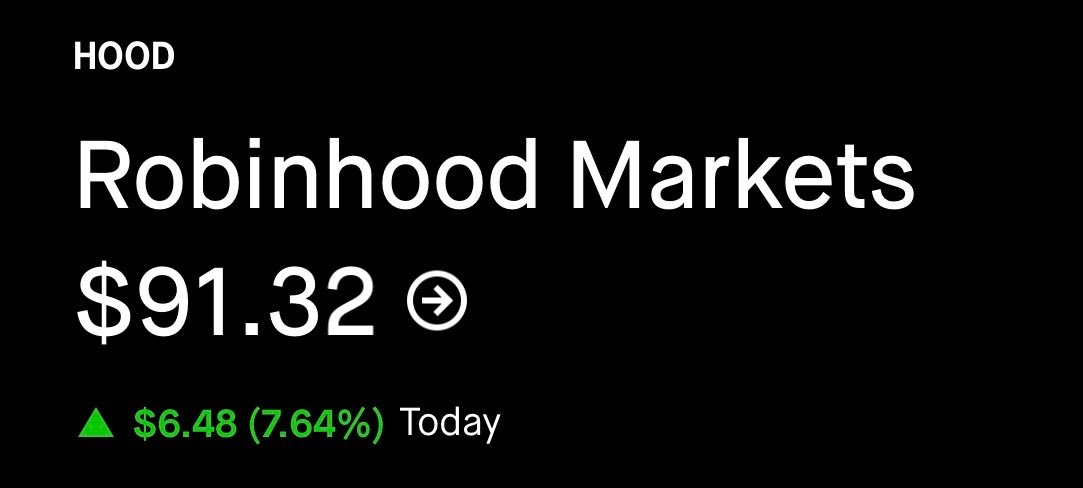
First time seeing $90s in 4 months!
$HOOD +7%
Has anyone else noticed government websites are suddenly… beautiful?
Not “good for government.”
Actually good.
Clean grids. Modern typography. Vibes.
What happened?
I thought government websites were supposed to be the best example of the worst designs.
Then in August 2025, something quietly changed.
An executive order ("Improving our Nation through Better Design") established the National Design Studio, tasked with redesigning how Americans interact with their government online and put a real mandate behind something that has been ignored for decades:
Make public services not just functional… but usable and beautiful.
That’s a massive shift.
For years, government software felt like it was built by the lowest bidder, optimized for paperwork instead of people. Now it’s starting to look like something you’d expect from a startup.
That said, I have two critiques:
1. It's all new builds, not retrofits. The beautiful sites are brand new websites. Legacy government sites, the ones Americans actually have to use, remain untouched. The real test isn't a landing page, it's the IRS.
2. Landing pages are the easy part. Everything the NDS has shipped so far is essentially marketing. I want to see what they do with a genuinely complex user flow: benefits applications, passport renewals, estimated tax payments. That's where design actually changes lives.
Still, it’s rare to see a piece of legislation produce such a positive, immediate, and visible impact.
And honestly?
If this keeps up, don’t be surprised when startups start copying the government.
Just finished another episode of Buy Hold Rant with @hamids 🔥
Key highlights:
• $RIVN R2 launches June 9th (finally!)
• $MU hits $970+ - still undervalued at $1T market cap?
• $RACE's $650k EV can't even beat a $TSLA Model S 😬
• SpaceX IPO financials are... interesting
• I fully exited ethereum:native
I also covered my 3-factor selling strategy, and we tackled great listener questions!
Market's wild right now, but staying disciplined pays off 📈
https://t.co/viptF9hj05
June 9 is the big day. 🙌 R2 officially launches!
✉️ Order invitations begin
⚡️ Customer deliveries start
🚘 Demo drives open at all Rivian Spaces
Don’t miss out—learn more at https://t.co/1yGqkAvuqg. 🔗
Rumors are swirling that $IMAX may be exploring a sale, with names like $AAPL, $NFLX, and $SONY reportedly in the mix.
Once or twice a year, I like to take a small swing-trade type of bet rather than a long-term investment, and IMAX is definitely an interesting candidate here.
And if Apple ends up acquiring them, you just know the rebrand to “iMax” is coming 😉
🎙️ Episode 40 just dropped! 🎉
📈 I increased my $RIVN position by 70% at $12.69 - perfect timing as it jumped 6% the next day! We did a full walkthrough of the new R2 configurator and discussed why I think we're at a turning point for the company.
🚀 @hamids continues trimming his $RKLB position as it trades at 110x revenue, though it's still his second-largest holding. We debated what might happen when SpaceX IPOs.
💾 $MU discussion: Hamid is holding strong and won't sell a single share under $1,000.
🤖 $NVDA earnings dropped during our recording - double beat but stock down 2.5% after hours.
https://t.co/p28aNUfkA4
My preference for $IREN isn't a knock on $NBIS or $CRWV's model, it's just a different bet on where the bottleneck and the risk actually sit.
Four things drive it for me:
1. IREN owns the land, the data centers, and the power connections.
2. The constraint is not just GPUs, it's power and space. Plus, IREN's gigawatt-scale power pipeline is way harder to replicate.
3. IREN's $BTCUSD mining operations throw off real cash flow, so they can fund GPU expansion without leaning as hard on high-interest debt.
4. On valuation, IREN trades at a lower multiple than Nebius and has the lightest leverage of the three. The tradeoff is customer concentration; $MSFT is something like 60% of IREN's ARR target for the end of this year.
The internet loves to frame this as winner-take-all. I don't see it that way. The demand for AI compute is so far ahead of supply that there's room for all three to do well. They're not really fighting over the same slice; they're each building into a shortage. CoreWeave, Nebius, and IREN can all succeed at the same time, and most likely will. Picking IREN isn't a bet against the other two. I just believe they have the strongest strategy overall.
$EOSE Q1 2026 Earnings: The “Clean-Up” Quarter Just Got Weird
A massive pivot from last quarter’s credibility disaster, but the story is now entering uncharted territory.
The Good:
• Revenue came in at $57M (+445% YoY), which was a beat and, more importantly, the first revenue beat in over a year.
• More importantly, revenue was actually aligned with expectations this time around. For EOS, rebuilding credibility with investors matters just as much as growth itself right now.
• The balance sheet also saw a dramatic transformation. Cash declined by $152M to $472.4M, but total liabilities fell by roughly $680M.
• Net cash position improved by more than $530M QoQ. A large portion came from non-cash debt revaluations, but the balance sheet is materially less burdened than before.
The Concerning:
• Backlog declined by roughly $50M (9%). For a company in hypergrowth mode, you ideally want backlog expanding, not shrinking.
• Despite the flashy $500M+ net income figure, this was largely driven by accounting gains. Operationally, adjusted EBITDA was still a $68M loss. EOS is still burning significant cash to scale.
The new Frontier Power USA joint venture with Cerberus is the real wildcard.
Cerberus is committing $100M, while EOS is expected to contribute up to $150M.
There are two very different ways to interpret the 2 GW reservation agreement:
Bull Case:
EOS is vertically integrating and proving out its technology at scale alongside a Tier-1 partner. If successful, it could make the product far more bankable for future third-party customers.
Bear Case:
External demand may not be ramping fast enough to absorb future manufacturing capacity, so EOS is effectively creating its own demand through a related entity structure.
The real question is whether Frontier Power USA becomes a launchpad for broader commercial adoption… or simply a mechanism to keep factory utilization high while the company searches for sustainable outside demand.
At this point, my EOS position is firmly on the chopping block because of all the weirdness surrounding the story lately. I’ll continue reviewing the situation over the coming months, but at roughly a 2% position size, I view the risk of continuing to hold as fairly minimal for now.
We released a new Savvy Trader "Analytics" feature on Savvy Trader portfolios, most of which you can see for any portfolio even before subscribing...it's SUPER COOL! Thanks to @dustinalper
What do you think?
Episode 39 of @buyholdrant is in the books!
This week @hamids and I covered:
• Trimming $RKLB at 105x revenue (and to celebrate my 30x return)
• Why $MU is still undervalued at $800 with a 9 forward P/E
• $IREN's massive $3.4B $NVDA deal
• New Analytics tab launch in Savvy Trader
https://t.co/9MB655ayvi