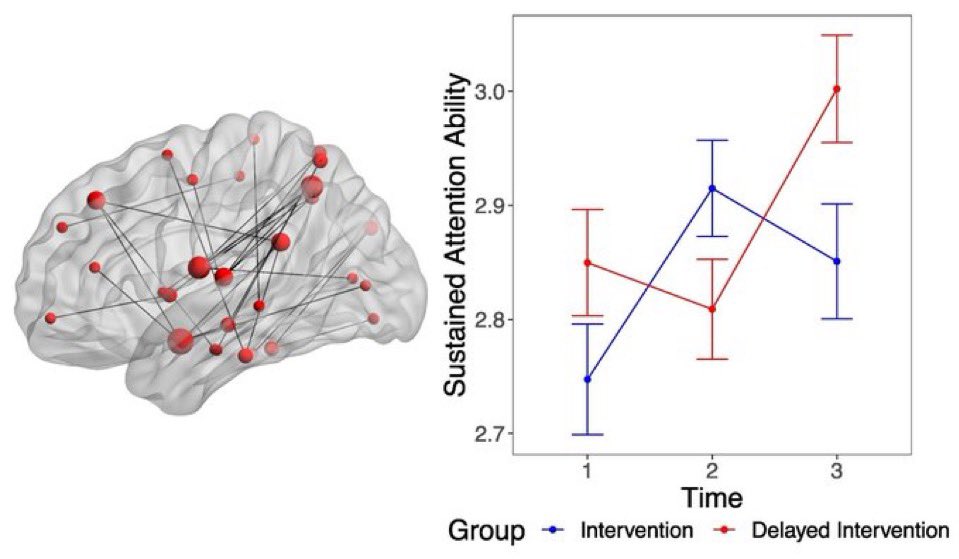
Reminder to go touch grass
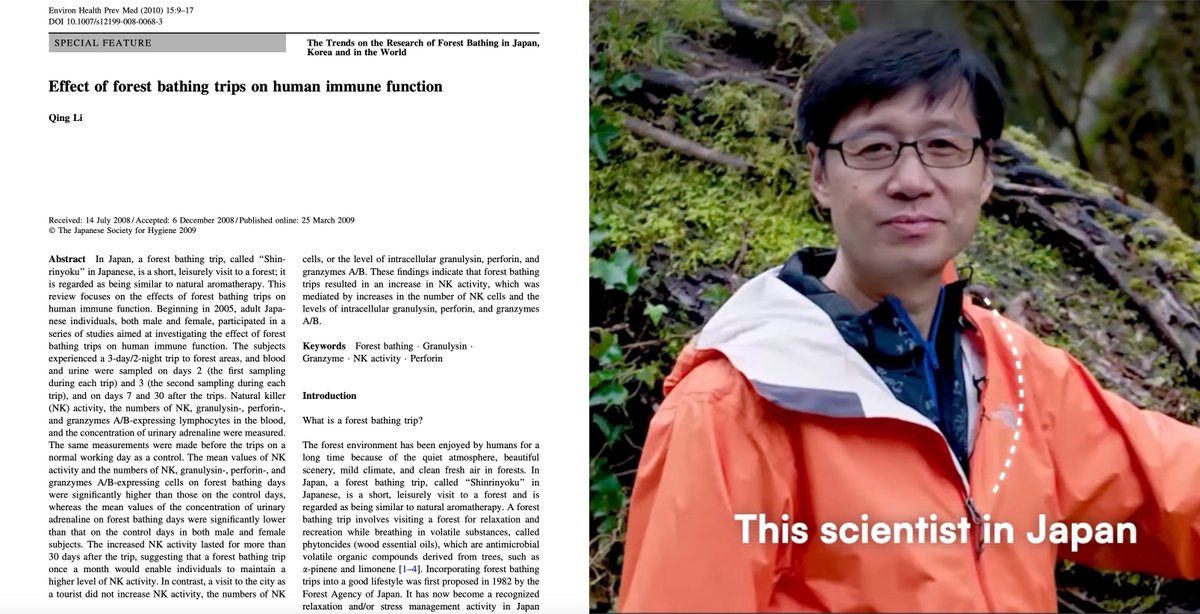
A scientist in Japan demonstrated that the air inside a forest strengthens your immune system for a full month
The study is incredibly fascinating:
Qing Li, an immunologist at Nippon Medical School in Tokyo, took 12 men on a 3-day forest trip. These were slow walks with no breathing exercises and no set route.
Then he tested their blood and found a surge in natural killer cells -- the immune cells your body uses to fight cancer and virus-infected cells.
Remarkably, the effect didn't fade when they went home, it was still measurable 30 days later.
A control group that walked the same distance through a city showed no change at all.
Pine, cedar, and cypress trees release compounds called phytoncides to defend themselves from insects and bacteria. You breathe them in, and Li believes they switch your immune cells into high gear.
He estimates one forest walk a month may be enough to keep those cells elevated all year.
The best medicine might not even need a prescription -- just a walk among the trees.
🚨 Esta masterclass de Jeff Bezos vale oro!
Es una clase sobre cómo construir empresas que siguen innovando incluso cuando ya son gigantes.
Bezos explica los principios que convirtieron a Amazon en una de las compañías más valiosas del mundo.
- Por qué debes obsesionarte con el cliente y no con la competencia.
- Cómo crear una cultura donde experimentar sea barato y rápido.
- Por qué las mejores ideas suelen parecer absurdas al principio.
- Cómo detectar oportunidades que la mayoría de las personas deja pasar.
Todo respaldado con historias reales y decisiones que marcaron la historia de Amazon.
Lo mejor de todo: puedes verla gratis.
Si estás construyendo una startup, un producto o cualquier negocio, esta conferencia merece un lugar en tu lista.
Es una de esas charlas a las que volverás más de una vez.
Anthropic engineer:
"85% of our engineers are using self-improving loops. Now everyone is running agentic Graphs.
In 3-6 months, we’ll all be building graphs to orchestrate agents. No more prompting."
In a 45-minute talk, an Anthropic engineer shows how to build a self-improving agentic workflow from scratch.
Worth more than a $500 agentic course.
Watch this video, then read the full roadmap on how to become a graph architect in the article below
ORO PURO PARA APRENDER IA.
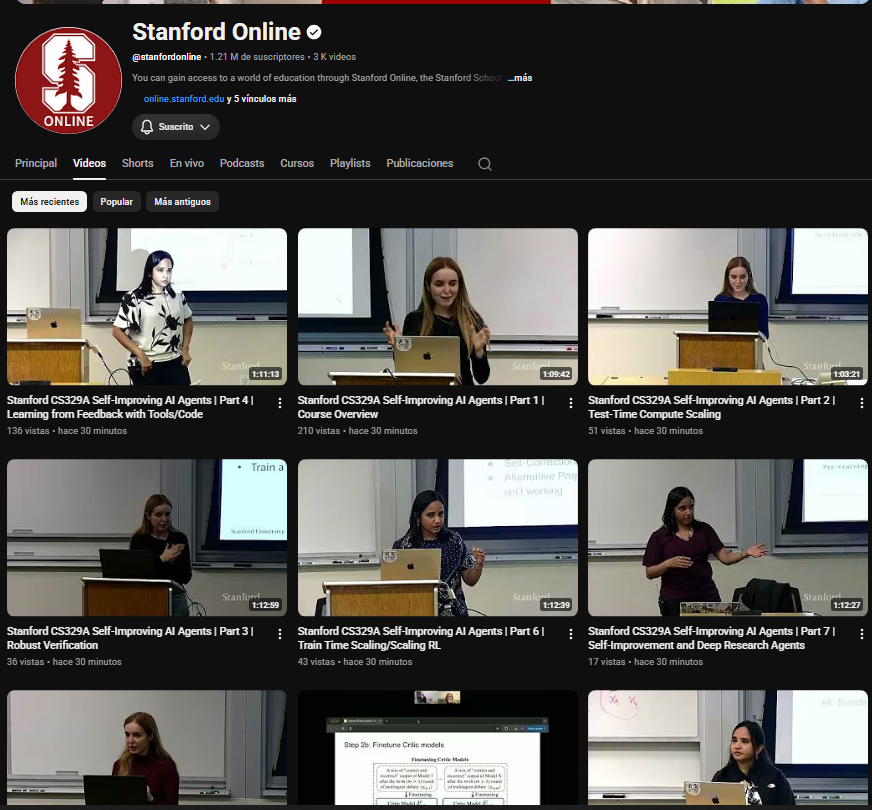
Coincido con Santi: Stanford Online está publicando clases gratis sobre Transformers, LLMs y agentes que vale la pena estudiar.
Guardalo en favoritos y reservar un rato cada día para aprender sobre esto es la mejor inversión que se puede hacer hoy.
A billionaire went on stage and explained in 42 minutes how the entire economy works. for free. Wall Street spent the next decade pretending nobody saw it.
he didn't sell a course. he didn't plug a fund. he stood at a whiteboard and drew three lines that explain every crash, every recovery, and every rate decision since 1929.
MBA programs charge $200,000 to teach frameworks he covered in the first 15 minutes. six of the models he drew on that board are still classified as proprietary at three major banks. he gave them away on YouTube.
the part nobody talks about: he predicted exactly what happened in 2020, two years before it played out. interest rates hitting zero, the central bank running out of tools, the money printer. he drew it on a whiteboard in 2018 like he was reading tomorrow's newspaper.
a portfolio manager at a top-five firm told me every new analyst on his desk watches this before they're allowed to open a terminal. not the CFA prep. not the internal training. this one lecture.
40 million people have seen it. almost none of them can name the three forces he draws in the first ten minutes.
it is still free.
This paper is f*cking brilliant
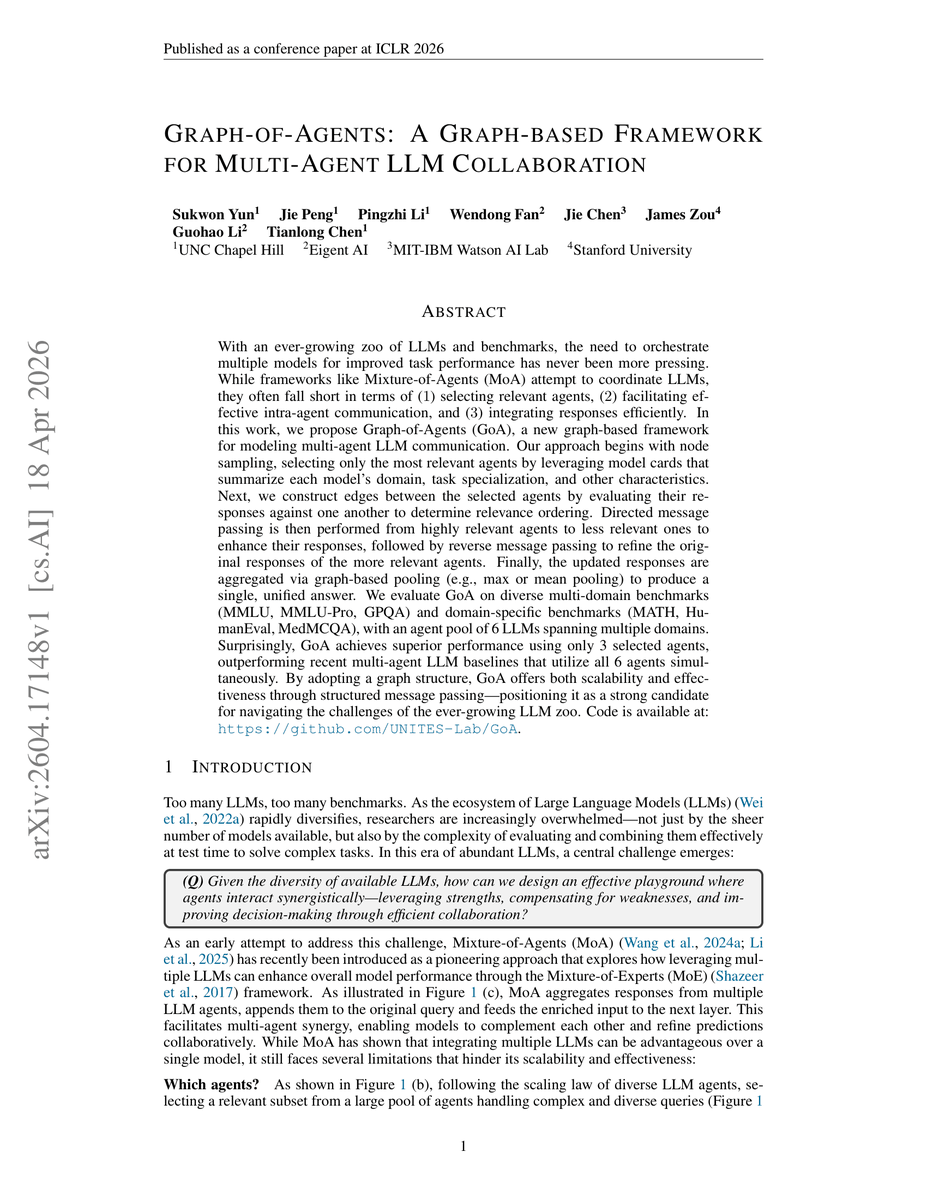
A computer science paper replaces Mixture-of-Agents with Graph-of-Agents for multi-LLM collaboration
The result: structured node sampling, directed message passing, and graph pooling deliver state-of-the-art benchmark scores using only 3 active agents instead of 6
The crazy part is how graph engineering cuts multi-agent inference cost while improving decision accuracy
Relevant model nodes are sampled via domain cards, directed edges pass responses from expert to generalist models, and graph pooling aggregates final consensus
Most multi-agent architectures blindly feed every query to every model in the pool
This framework converts multi-agent collaboration into an optimized communication graph
Read the complete paper + article below
Bookmark it for future reference
the fastest way to kill motivation is to make your identity depend on the outcome. it’s called ego involvement. when failing becomes failing as a person, your brain starts avoiding the whole thing. not because you don’t care, but because you care too much.
Don't waste 2 years learning to build LLMs like Claude & ChatGPT.
Stanford just dropped a 2 hour course on how to build LLMs from scratch.
• 00:00 - LLM tokenization
• 25:44 - how LLMs decode user prompts
• 35:40 - training pipeline of LLMs
• 1:16:47 - LLM architecture from scratch
Anthropic pays $750,000/year to engineers who understand this exact knowledge of LLMs.
Bookmark this & give 2 hours today, no matter what. Then read the article below.
“Practice any art… no matter how well or badly, not to get money and fame, but to experience becoming, to find out what's inside you, to make your soul grow.”
- McKellen reciting Vonnegut
I'm a Principal engineer & I passed system design rounds of Amazon, Atlassian, Walmart, Saleforce, and Deliveroo.
Trust me, learning system is not hard. Start from these fundamental concepts:
1) Load Balancing: https://t.co/3jKCLiI6vl
2) CDN: https://t.co/dxzCmm9gAf
3) Caching: https://t.co/pRgn0FTPp2
4) Cache Invalidation: https://t.co/QrfRjJ57gd
5) Rate Limiting: https://t.co/LE5ECM2tGt
6) API Gateway: https://t.co/DgU8cBDUVr
7) CAP Theorem: https://t.co/a8WydnAIxd
8) Sharding: https://t.co/XQLU6eDriD
9) Replication: https://t.co/KuDkFH0fjx
10) Partitioning: https://t.co/3WXKeZLbLa
11) Queues: https://t.co/JchEoCcFmF
12) Microservices: https://t.co/aAQfM6AWMq
13) Microservices Vs Monoliths: https://t.co/bTaIIWkPU3
14) Fault Tolerance: https://t.co/qXNBoyOqYT
15) Database Scaling: https://t.co/D2lvPm1wkB
16) Service Discovery: https://t.co/z2DpwbJBVI
17) Consistency models: https://t.co/K2r3nMcCQu
18) Eventual Consistency: https://t.co/SWiz4ckIKR
19) Distributed Transactions: https://t.co/xqL7BTJxXn
20) Leader Election: https://t.co/ApNaYSnSFj
21) Horizontal vs Vertical Scaling: https://t.co/IFuEmzMfob
22) Back of the Envelope Estimation: https://t.co/7ntEmtVggQ
23) Idempotency, Data Latency & Finale: https://t.co/fNArLx4MrW
Let me know what you'd like me to cover, would love to help :)
This 1-hour MIT lecture on how to speak will teach you more about communication than every book, course, and mentor combined.
Bookmark & watch today, no matter what.
Spent some time reading this over the weekends and honestly I wish it existed a few years ago.
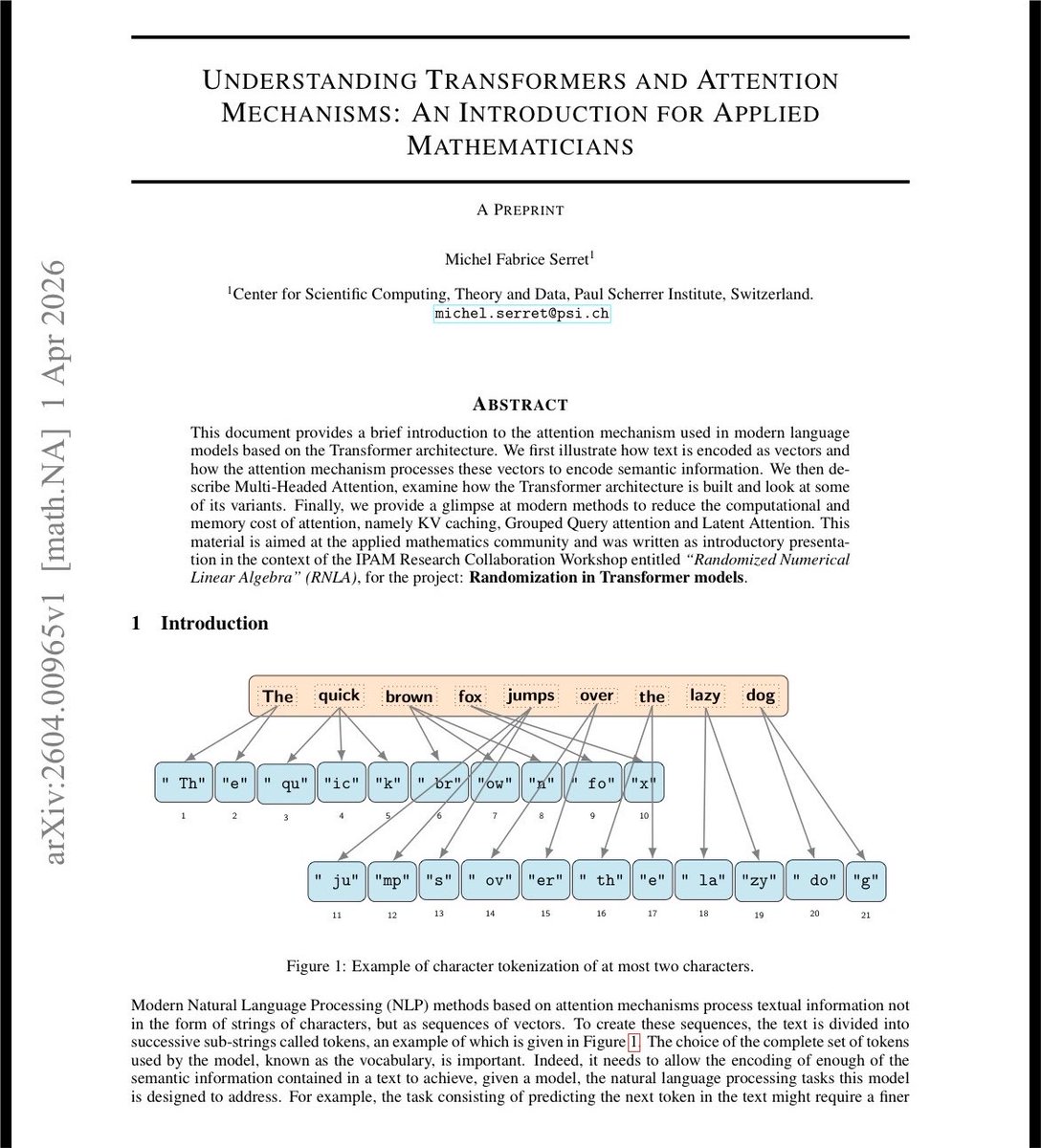
every AI tutorial we watch says : "just import torch and don't worry about it, it's magic!" this paper: "here is the exact linear algebra of what a transformer is actually doing."
if you're sick of reading vague tech blogs and just want to see the actual math behind attention mechanisms, tokenization, and KV caching, someone finally wrote a proper guide.
it basically strips away all the software engineering fluff and translates LLMs into pure math. you can finally stop treating these models like black boxes and actually understand the math making them tick.
genuinely a must-read if you want to know what's really going on under the hood:
https://t.co/7aLOlJIS1C
get addicted to neuroplasticity, subconscious reprogramming, delusional optimism, game theory, and quantum physics. i promise it will change your life.