For your enjoyment, here is the reading list for my undergraduate core seminar this semester in Philosophy, Science, and Mathematics. We shall focus on topics in the philosophy of mathematics, philosophy of science, and philosophy of computability and AI.
@thelissimus Wondering if anything from Mathlib is better suited for CSLib, eg. Control.Monad or some things in the Computability folder. Is there a roadmap for CSLib anywhere?
Congratulations to Jeremy Avigad, who will be the inaugural Director of a new NSF-funded Institute for Computer-Aided Reasoning in Mathematics based at Carnegie Mellon! https://t.co/O0lwKZxwES
With all the recent interest about "sink tokens" lately, I'm excited to share what we've been working on:
TL;DR: We studied language model pre-training with learned "meta-tokens", and show theoretically and empirically that these tokens "sharpen" positional encoding and operate as in-line caches of compressed context, smoothening the attention distribution across the context.
🧵1/n
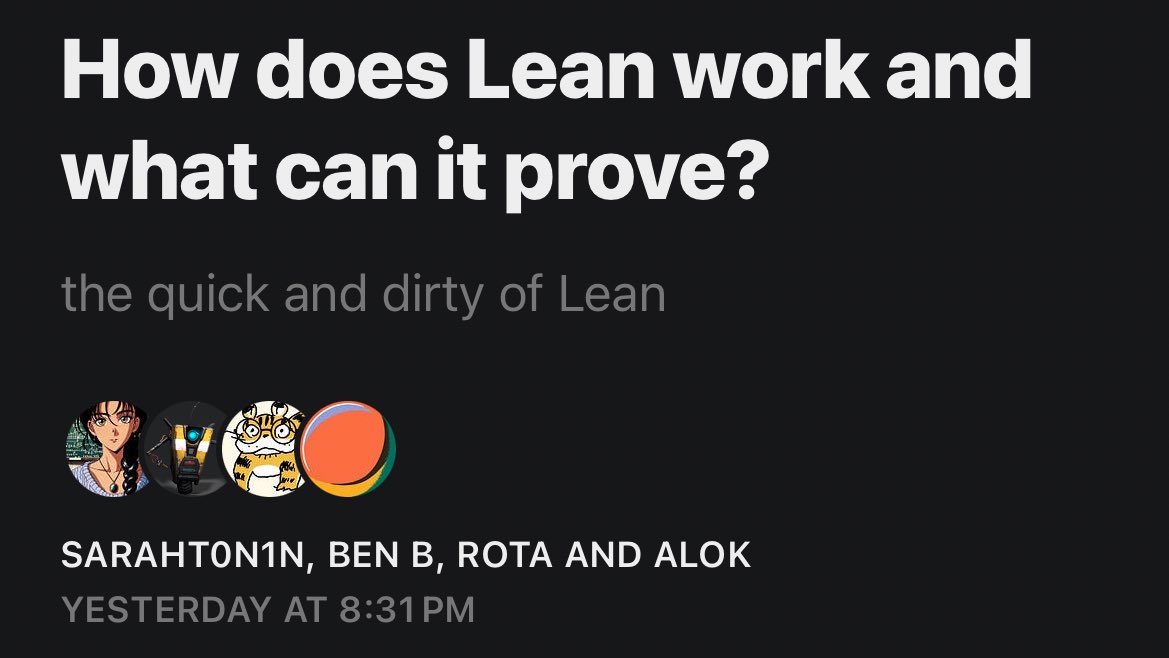
Everyone has heard that Lean is a programming language that allows for proof verification in mathematics. But what does that actually mean and how does it work?
If you’re interested in this question you should check out an article my friends and I wrote detailing the nuts and bolts of how Lean works. The article is written for those who want to get feel for what’s really going on, but don’t want to comb through the documentation.
Deadlock free concurrency. Session types (can't misuse protocols). All programs terminate (granted unique to every logic, not just linear logic, but for linear logic this is true even with concurrency). Duality in every language construct which in software engineering sense translated to flexibility.
I'm absolutely certain linear logic would be a very good candidate for a blockchain language. Actually I've been thinking about this a lot recently.
But it's more about embracing linear logic fully (as Par does), than just about linear types (like Rust). Linear types are not that interesting by themselves, the power comes when having a language with all the dualities.
So how's programming in a linear language actually like? Michal (the originator) had a workshop where he live codes a mini grep program in par!
(link in comment)
@noam_yy Very cool. What are some benefits of programming with linear types? I could see things like ownership and concurrency, but I wonder if the "logic of resources" interpretation gives applications to modeling transactions eg on a blockchain.
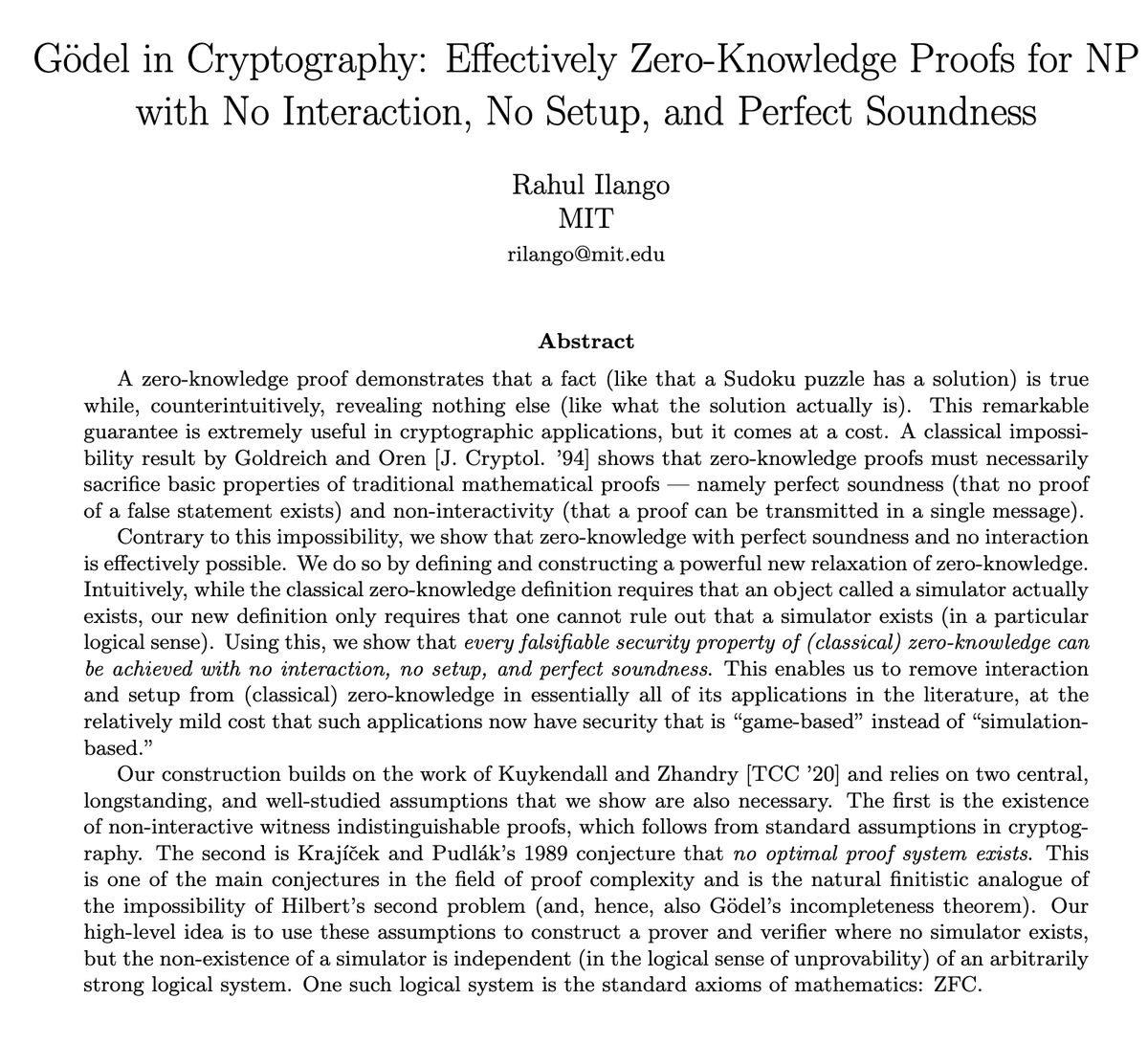
A ZKP shows that you know something, and without giving away the secret. This paper outlines the usage of Godel’s incompleteness theorem to produce a ZKP that has no interaction (eg no setup): https://t.co/5qaSo3ETW0
Meet @duveZK, zkVM engineer at Nexus.
He studied logic and CS, and now works on formal verification, zero-knowledge proofs, and the infrastructure powering verifiable AI.
Today, I had the privilege of talking with the person who created the foundation of our current online security ... Victor S Miller.
Spotify: https://t.co/ZURWboALHi
Apple: https://t.co/KFfNoRiFr6
Also wrote this four-part series on free monads in #LeanLang, building from categorical foundations to writing a formally verified interpreter
https://t.co/ltulO9JqLp
Cool to see my post on Verified Dynamic Programming with Σ-types in #LeanLang on the front page of #HackerNews: https://t.co/qgtHtd8Yde
See the post and others at my blog here:
https://t.co/pelE7UZU5P