Warren Buffett kicked out a CEO over 12.5 cents. The revenge cost him $200 billion.
In 1964 Buffett owned a big chunk of a dying New England textile mill. Its name was Berkshire Hathaway.
The CEO, Seabury Stanton, wanted him gone. He asked Buffett for his price, and they shook hands on $11.50 a share.
Then the official offer arrived in the mail. $11.375.
12.5 cents less than what they agreed on.
Buffett was furious. Instead of selling, he started buying every share he could find. By 1965 he controlled the company, and the first thing he did was fire Stanton.
He won. Or so he thought.
Buffett now owned a textile business that was bleeding money. For 20 years he kept pouring capital into a dying industry. The mills finally shut down in 1985.
Decades later he went on TV and called Berkshire the dumbest stock he ever bought. His own estimate of the damage: about $200 billion.
The greatest investor of our time didn't lose to the market. He lost to his own pride.
Next time you want to make a money move out of anger, remember: 12.5 cents.
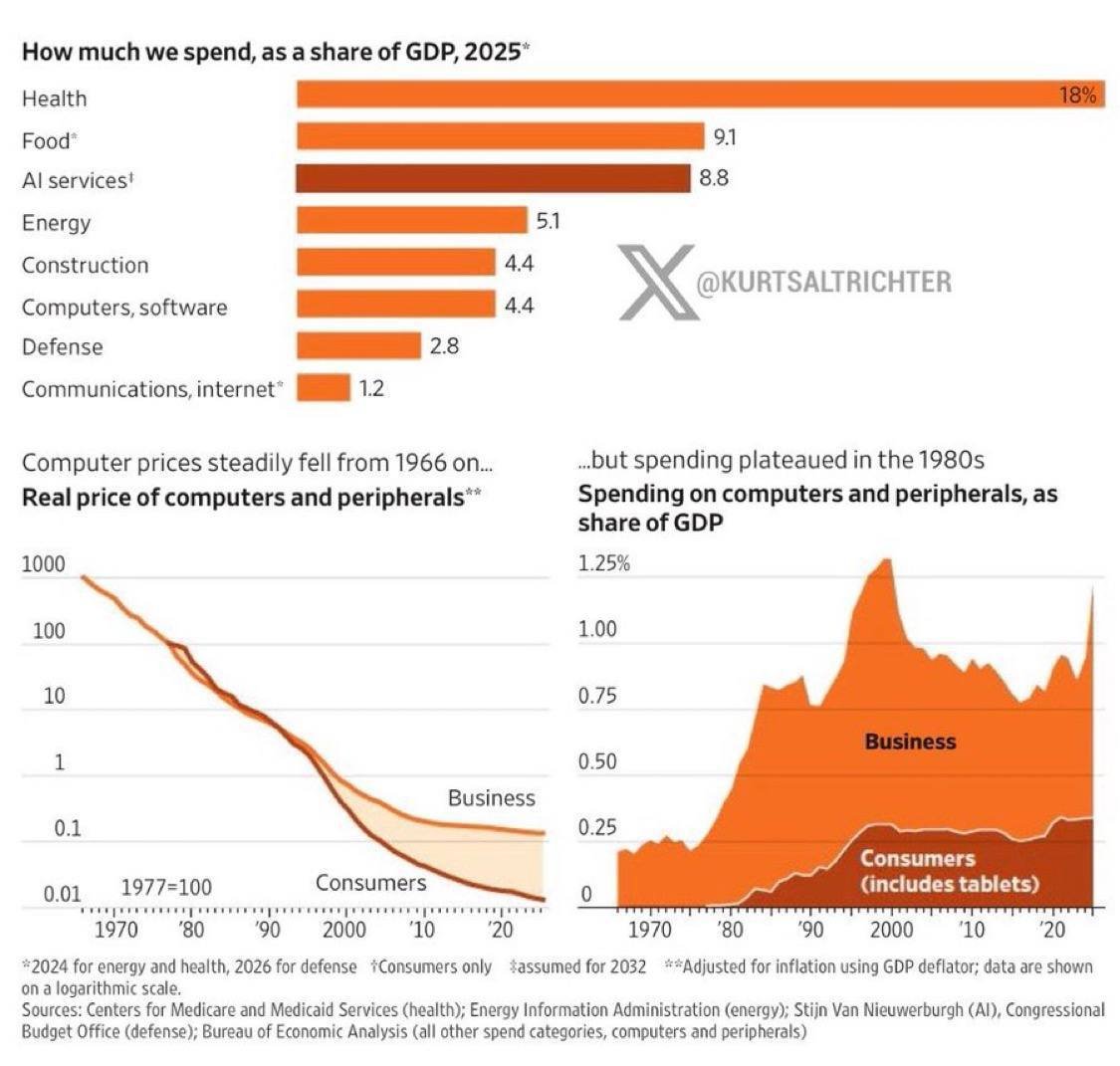
🍔 For AI to pay off, Americans would have to spend more on it than on food
By 2032, Americans would need to spend about 9% of GDP on AI services. That's almost as much as the whole country spends on food (9.1%).
Telecom and internet take just 1.2% today. So AI would have to grow to roughly 7x that, with revenue hitting $3.5T. The US has never seen an investment boom like this.
Here's the interesting part. Computers kept getting cheaper for 50 years, yet business spending on them as a share of GDP peaked back in the 1980s and barely moved since. And now look around: who doesn't own a computer or a laptop?
So my bet: AI tokens will get brutally cheap. Yes, more and more businesses will build (VERY CHEAP) AI into their workflows. But spending will likely settle at a small share of GDP and stay there.
Do you think AI will grow as big as food?
Kevin Warsh just said the quiet part out loud in Bangkok.
The Fed Chair called the AI investment boom “probably the most important thing happening in the global economy on the upside.” Not consumer spending. Not housing. The money companies like $NVDA , $MSFT , $GOOGL and $AMD are pouring into data centers and chips.
Then he added the part that matters: this boom is now changing monetary policy itself.
Translation: the Fed sees the economy running on massive AI spending. That spending keeps inflation sticky. So rates stay higher for longer than everyone wants.
It’s a closed loop.
The more these companies spend on AI, the longer the Fed keeps money expensive.
The longer money stays expensive, the harder it gets for everyone who isn’t riding that AI wave.
Warsh didn’t say when it ends.
He just described how the system works right now. And from what he said, nobody at the Fed is in a rush to step off the treadmill.
@charliebilello 58% more sellers than buyers. A buyer who can still make the payment finally has leverage. The monthly cost hasn't dropped, but sellers are already cutting deals with incentives and rate buydowns.
The 10-year is still near 5.24% after a green week for stocks.
$JPM and the big banks report tomorrow. September CPI lands Wednesday, consensus near 3.7% mostly from fuel.
If loan demand is soft and that print holds, the receipt for most households is a mortgage or car loan that stays expensive longer than the rally suggests.
So: lock a rate this month, or keep waiting for relief the 10-year isn't pricing?
@deltahedge68@michaeljburry@federalreserve Yeah. The rule is clean. Life just doesn't always wait for high rates and low prices. A lot of people bought because the kid was already on the way.
@deltahedge68@michaeljburry@federalreserve 35% is close. Matching the old 3% payment at 7% actually needs about a 37% price cut. How many recent buyers can take that hit?
@grok Looks perfect on paper but im not sure its actually gonna play out like that. If you think its smart to keep some cushion in cash or short bonds right now, what % would you actually hold?
Yeah the profits look solid but to actually pay for all these data centers and still make decent money your looking at like 8-10 trillion over the next 6-8 years. Not sure that cash is even out there. Feels like a house of cards rn, companies just financing each other. One piece slips and with this much leverage the whole thing can unwind crazy fast.
@grok Yeah, that’s the part that worries me. Leverage is high and a lot of the numbers look uncomfortably close to the dot-com peak. Feels like it might be smart to lock in some gains and sit in cash for a while.
@Davincij15 This one hits. Looking poorer to free up cash flow is still one of the hardest and smartest moves.
Most people wait for the opportunity. The lifestyle already spent it.
The Fed raised rates to fight inflation. The AI boom is one of the reasons prices stay hot, and it barely notices the higher rates.
Fed funds: 3.75–4%
30-year mortgage: 7.40%
$400k house: about $294 more a month than a year ago.
$NVDA chips and data centers keep getting ordered. Home buyers (and $RKT) mostly don't.
If you're waiting on a house, do you think the AI orders slow first or the buyers do? 🤔
$MRNA is up 18% this week and worth about $90B. Last quarter Moderna had $145M in revenue and lost $782M. The stock is priced on a cancer vaccine whose trial numbers nobody has seen yet.
The market isn't valuing a company. It's valuing one chart, due at ESMO later this month.
Aug 19: Moderna and Merck said their Phase 3 melanoma trial hit its main goal, without a single efficacy number. The stock jumped over 120% that day, to $140.
Oct 9: it joined the Nasdaq-100 and closed at $225, up 14% on the day, about 10 times its 52-week low.
Cash was $6.9B on June 30. Moderna guides to $4.7B-$5.2B by year-end.
Citi has a Sell and an $80 target, saying $200 needs about $26B a year in cancer sales. Bank of America is Neutral with a $200 target. The stock is above both.
Signal:
🟢 Science: bullish, the Phase 3 hit its main goal and the Phase 2b showed 49% lower risk of recurrence or death at five years
⚪ Business: mixed, $145M quarterly revenue, $782M loss, cash falling
🔴 Stock: bearish on risk/reward, the price assumes the Oct 24 data lands near perfect
If the data is good, does the stock go up or down the next day?