Companies have been charging you for being busy. You just never saw the bill.
Every ad is a bet that you're too busy to check. AI agents are never too busy.
Who loses when the buyer stops being distracted?
Bookmark it to read later. https://t.co/6lXnbUbTLO
Charlie Munger was 99 years old and worth about $2.6 billion when he admitted on camera: "I basically screwed up."
The CNBC host asked him what he'd change if he could do it all again.
His answer: "I might have had multiple trillions instead of multiple billions."
His mistake was starting too late. More years of compounding, and in his words: "I know I would be the richest man on Earth."
Then he pointed at the house around them. He'd lived in it for 70 years. Buffett has lived in his for about 60.
They both watched rich friends build huge mansions. And almost every time, Munger said, the mansion made them less happy, not more.
Billions in the bank, a plain old house, and he still felt he started too late.
What's the one thing you wish you'd started earlier?
Companies have been charging you for being busy. You just never saw the bill.
Every ad is a bet that you're too busy to check. AI agents are never too busy.
Who loses when the buyer stops being distracted?
Bookmark it to read later. https://t.co/6lXnbUbTLO
I'm reading a book that has genuinely messed with my head. I can't look at the market the same way anymore.
"The Fiscal Theory of the Price Level" by John Cochrane. Written in 2023. I swear it reads like he had access to this month's headlines. Every chapter I put it down, open the news, and get chills.
It all starts with one line:
"Inflation breaks out when people don't expect the government to fully repay its debts."
Sit with that for a second. Now look at America in 2026.
A $1.99 trillion deficit in a single year. That's $5.5 billion of new debt every single day, including the day you're reading this. Gross debt around $40 trillion. Inflation, the one everyone swore was dead, is back at 3.7% and climbing.
Then Cochrane drops the part nobody on TV wants to hear. The Fed can't save us on its own. Every rate hike makes the government's interest bill bigger. If nobody fixes the budget, that bill just turns into more debt.
On September 16 the Fed hiked for the first time since 2023. The same month, America's yearly interest bill crossed $1 trillion for the first time in history. More than the entire defense budget. Just to pay interest.
Higher rates. Bigger interest bill. Bigger deficit. Repeat. I read about that loop in the book, then watched it happen on the news.
Then it hit the markets. When Treasuries reprice, every borrower on earth reprices with them. The 10-year hit 5.34% on October 1. The highest since 2002.
$CRWV felt it first. CoreWeave borrowed tens of billions to build AI data centers. Its interest bill more than doubled in a year, and it now guides to as much as $940 million in interest for a single quarter. On October 14 its 2032 bonds touched a 15% yield. The stock dropped about 15% in one day. The CEO's answer? The market is being irrational.
$ORCL is feeling it too. Oracle went all in on AI spending. S&P cut it to BBB-, one step above junk. Its credit default swaps just hit an all-time record. In plain English, the market is paying more and more to insure against Oracle not paying its debt back.
That's when it clicked for me. The book is about governments, but the rule underneath it is about everything. A debt is worth exactly what people believe will be repaid. An AI newcomer, a tech giant, the country that prints the dollar. Same rule.
Right now the market is quietly asking that question about all three.
Is it an easy read? No. There's real math, and plenty of economists will fight you on it. But nothing I've read this year explains what's happening to our money this clearly.
If you have savings, a portfolio, or just a paycheck, read this book before the next headline hits. One of the most mind-blowing books I've ever picked up.
Companies have been charging you for being busy. You just never saw the bill.
Every ad is a bet that you're too busy to check. AI agents are never too busy.
Who loses when the buyer stops being distracted?
Bookmark it to read later. https://t.co/6lXnbUbTLO
Elon Musk told a TV host in 2007 exactly what he would build for the next 20 years. Almost nobody took him seriously.
Watching it now is unsettling. He calmly lists things that sounded absurd at the time:
- A SpaceX capsule replacing the Space Shuttle to fly cargo and astronauts to the space station.
- A $49,000 four-door electric sedan.
- Then a "Model 3" at around $30,000. He named it a decade before it existed.
- Tesla service centers "somewhere between like a Starbucks and an Apple store."
Then the host listed his rivals: Bezos, Branson, Paul Allen, Boeing, Lockheed Martin, China, Russia.
His answer: "We have no serious competition."
At that point, his rocket had never reached orbit.
Sounds like pure arrogance. His reasoning was physics.
Branson's craft was suborbital, about Mach 3. SpaceX was going for orbit, Mach 25. Energy scales with the square of velocity:
- Branson's problem: about 9 units of energy.
- SpaceX's problem: about 625 units.
- And on the way back, you have to burn all of it off.
He still bought a ticket on Branson's flight.
So what did he see back then that Boeing and Lockheed missed?
He was either the most overconfident founder alive, or the only one who had done the math. Probably both.
The full interview is 20 minutes. The Branson part alone is worth it.
Companies have been charging you for being busy. You just never saw the bill.
Every ad is a bet that you're too busy to check. AI agents are never too busy.
Who loses when the buyer stops being distracted?
Bookmark it to read later. https://t.co/6lXnbUbTLO
Companies have been charging you for being busy. You just never saw the bill.
Every ad is a bet that you're too busy to check. AI agents are never too busy.
Who loses when the buyer stops being distracted?
Bookmark it to read later. https://t.co/6lXnbUbTLO
CEO of Microsoft AI Mustafa Suleyman thinks your next meeting will be negotiated by two AIs before you even say hello.
Your AI and mine will connect in advance. They'll brief us both before we meet and handle the follow-up afterwards. In his words, it's going to be "like a second brain."
Sounds like science fiction. His reasoning is surprisingly simple.
Almost everything on your screen is a workaround. Every app, every button, every drop-down menu exists because computers are "too dumb to understand the words that are coming out of my mouth."
The DeepMind co-founder thinks all of it is going to get washed away.
What replaces it isn't a smarter search bar. It's an AI that knows:
- How you're feeling today.
- What you need to get done.
- Your hobbies and your family.
- What you can't stand.
Which raises a strange question. If two AIs already had the conversation, what exactly are we meeting for?
Suleyman calls it "a new digital species." Something that will feel like a member of the family.
He's either describing the most useful thing ever built, or the most personal thing we've ever handed to a tech company. Probably both.
The full clip is 2 minutes. Worth every second.
Companies have been charging you for being busy. You just never saw the bill.
Every ad is a bet that you're too busy to check. AI agents are never too busy.
Who loses when the buyer stops being distracted?
Bookmark it to read later. https://t.co/6lXnbUbTLO
Every time you borrow, you take money from your future self. At some point, that future self has to pay it back.
That's the core of Ray Dalio's famous 30-minute video on how the economy works. Millions of views later, it's still the simplest explanation I know.
His logic is almost mechanical. Your spending is someone else's income. When you borrow and spend more, someone else earns more, looks safer to lenders and borrows too. That's how booms are built.
But borrowing pulls spending forward. Later you have to spend less than you earn to pay it back. That's why credit creates cycles:
- Short ones, 5 to 8 years, steered by central banks through interest rates.
- Long ones, 75 to 100 years, when debt quietly grows faster than income until it can't.
The long cycle peaked in the US in 1929, in Japan in 1989 and in most of the world in 2008.
Not all debt is bad, though. Dalio's example:
- A loan for a big TV earns nothing to pay it back.
- A loan for a tractor lets you harvest more and repay the debt.
His three rules work for a family as well as for a country:
- Don't let debt grow faster than income.
- Don't let income grow faster than productivity.
- Do everything you can to raise productivity.
Which of the three is hardest for you?
Bank of America $BAC is down almost 6% today, to about $51. The $1.2B money-laundering fine gets the headlines. It doesn't explain the revenue miss.
Signal:
🔴 Revenue $29.96B vs $30.58B expected. The fine sits in costs, not revenue
⚪ EPS $1.08 vs $1.10 expected without the fine, $0.91 with it
🟢 Card losses fell to 3.22% of balances, from 3.46% a year ago. Customers are still paying
On the weekly chart the next support is $46-47.5. It held there in March and April, and it's one of the biggest volume shelves on the chart. I think the price drifts down to that zone. Below it, the next one sits around $44-45.
Where do you think the price goes from here?
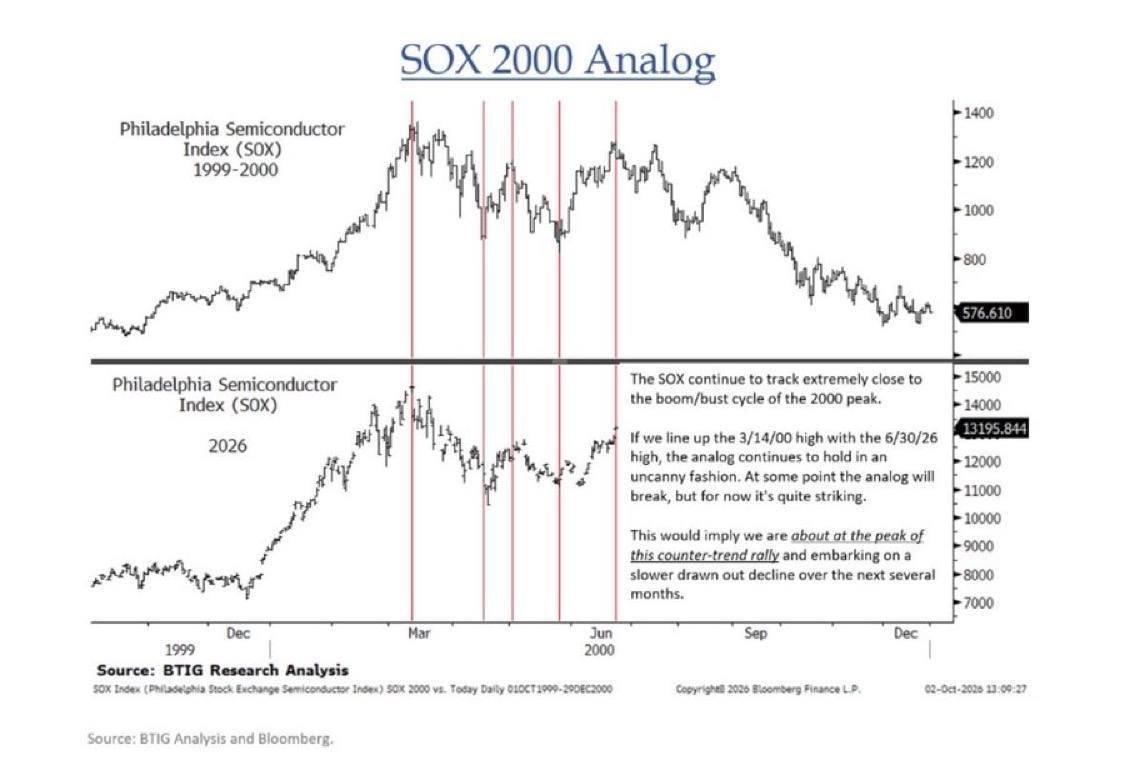
🤔 Chip stocks are replaying 2000
The semiconductor index $SOXX is moving a lot like it did in 2000, the year the dot-com bubble burst. Line up the March 14, 2000 high with the June 30, 2026 high and the two charts track each other almost step for step.
BTIG chart analyst Jonathan Krinsky thinks we're near the top of this bounce, with a slower slide over the next few months to follow.
I've seen dozens of these "perfect match" charts over the past couple of years, and so far almost none of them played out. But one day one of them might 😅
Will 2026 repeat 2000?
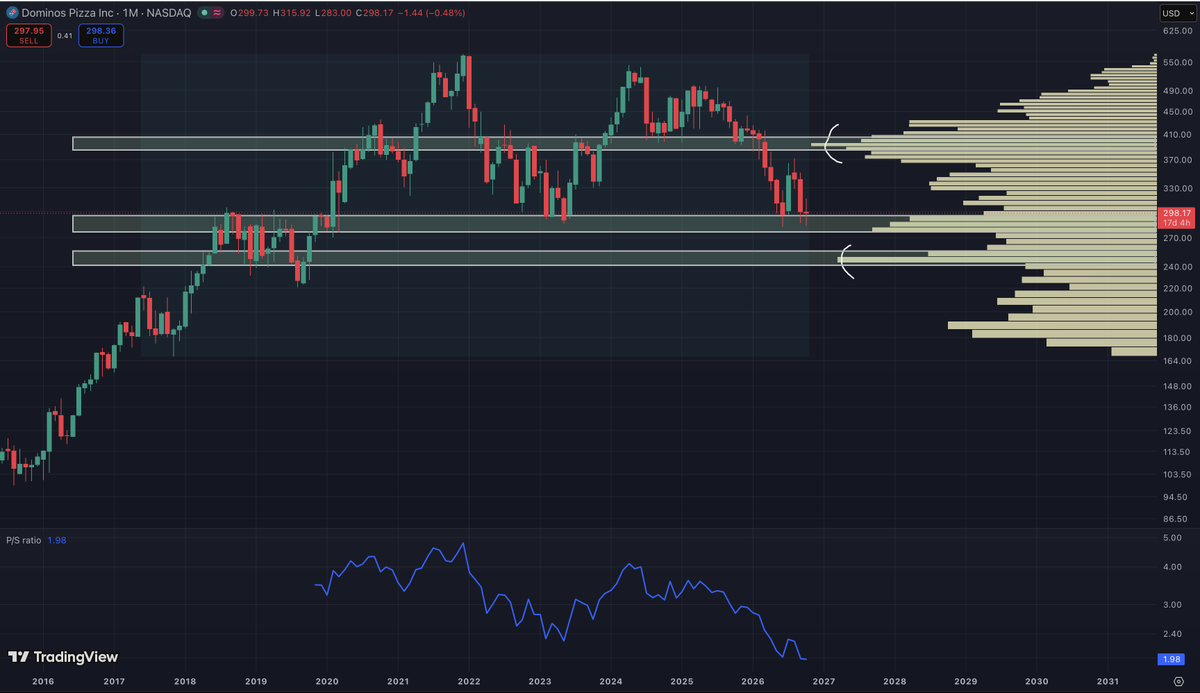
Domino's $DPZ beat earnings this morning, but the stock still fell as much as 9%, to $283. Profit was good. Sales growth wasn't.
Signal:
🟢 EPS $4.60 vs $4.33 expected
🔴 Sales at existing US stores up just 0.3%, vs 5.2% a year ago
🔴 Weaker outlook: US sales growth at the low end, and 125-150 net new US stores this year, down from 175+ planned in February
The stock is now sitting in the $280-295 support zone. It held there in 2023 and again in June. I think it breaks this time and drops to the next support at $245-255.
I'm not buying at this price. I'd look at it again around $245-255 as a defensive stock that pays a decent dividend. At $250, the $7.96 yearly dividend works out to about 3.2%.
Where do you think the price goes from here?
$GOOGL
👆 Well, there it is: Google’s free cash flow has turned negative for the first time in a long while. 🤷♂️
The AI revolution is steadily draining ever more cash from the hyperscalers… 😂
Nvidia keeps $55.60 of every $100 in sales, and Microsoft, Alphabet, Amazon and Meta are paying for it. Their reported margins don't show that bill yet.
$MSFT, $GOOGL, $AMZN and $META plan $720-745B of capex this year, much of it on servers and chips.
For $NVDA that's profit today. For the buyers it's depreciation spread over years. Their cash already feels it: Alphabet's free cash flow went negative in Q2, Meta's was $784M.
This holds only while AI revenue grows faster than the depreciation. If it doesn't, the buyers cut orders, and Nvidia loses volume and pricing power at once.
Whose margin cracks first, Nvidia's or its customers'? The customers' depreciation bill comes due whether demand shows up or not.
Missed the market this week (Oct 5-9)? These are the stocks behind the week's biggest headlines, and how much they moved.
🟢 Winners
$CCI +20%: towers rallied as SpaceX's spectrum deal put tower owners back in the story
$MRNA +18%: data catalyst ahead, the stock ran into it
$SBAC +15%: same tower trade as $CCI
$HUM +11%: most of the gain came on Friday
🔴 Losers
$ASTS −13%: the SpaceX deal made its direct-to-phone rival look smaller
$INTC −12%: AI chip selloff after the OpenAI and FT headlines
$VZ −9% and $TMUS −9%: SpaceX hasn't sold a single phone plan, yet carriers lost about 9% each
Shrugged off: $NVDA −2% despite the $150B buyback news
Insider buy of the week: $BORR, Tor Olav Trøim bought $17.9M in three days
The backdrop: Michigan sentiment fell to 46.3 from 48.1, the 10-year yield sits at 5.24%, and CPI lands next week.
Which of these moves do you think holds up?
Starbucks is still mid-turnaround. Now it has reportedly looked at buying Chipotle, a company worth almost 40% of Starbucks itself.
Per the FT, $SBUX worked with advisers on a takeover of $CMG . CEO Brian Niccol ran Chipotle for six years before Starbucks.
Starbucks margin: 14.4%, down from 16.7% two years ago. A deal this size likely means heavy debt or new shares.
Growth plan, or a way around a slow fix? Until the margin recovers, I'd say the second.