I’m here to report that the hype is real
Parenthood is a peak life experience once the kids are all 4+
The first few years are tough and real work. But it does pay off handsomely later. For almost all parents I know
Broadcom $AVGO annual price returns (excluding dividends) by year were approximately:
Year Return
2023 +99.6%
2024 +107.7%
2025 +49.3%
2026 YTD* +38.5%
What a ride.
$NOW is up 54% since I wrote this. If the SaaSpocalypse is over (not a given) after short term earnings, the indiscriminate decline across all of SaaS will have been one of the best buying opportunities of the decade.
Ken Griffin, founder of Citadel, explains how a 25-year-old used AI tools to turn a pet insurance business into a billion-dollar sale:
Griffin tells the story of a friend who owned a pet insurance business and handed the keys over to his 25-year-old son to run.
The son realised the tools now available to him changed what was possible for a small operator:
"I can use social media. I can find when somebody posts a photo of a puppy on Facebook. I can determine the breed of dog through an AI image generation scanning mechanism. I can deliver a custom message to that consumer. If it's a woman, male, age, demographic, yes. Congratulations on your new golden retriever. You will love your dog for the rest of its life and it will love you. Be there for it when it needs you. Buy spot pet insurance."
The result?
"They sold the business a few weeks ago for a billion dollars."
For Griffin, that story is a preview of where competition is heading.
The advantages that used to protect big companies are now being handed to anyone with the right tools:
"Competitive moats that large companies have depended upon are going to be filled in with AI tools. So the ability for small companies to take on incumbents will be higher than ever. This is a bit of a fantasy land for entrepreneurs."
He traces the shift back to an earlier turning point:
"Cloud computing was the first part of this narrative."
Griffin uses his own industry to drive it home. Compute power used to be a fortress only the largest players could afford to build:
"If you go back 10 years ago, for example, in finance, a startup could take us on in terms of having access to compute. We used to have data centers full of nine figures of hardware. We now use data centers full of billions of dollars of hardware, but a startup can lease the same hardware footprint if it wanted to."
And the pattern, he says, only accelerates:
"These moats to competition continually get eroded. It's a really incredible time to be an entrepreneur."
I just got back from SF and I FEEL INSPIRED.
I spent 5 days with frontier AI model teams, AI startup founders, and 3 billionaires.
My takeaways:
1. I had lunch with 3 billionaires. All of them are buying SaaS companies and rebuilding them agent-first. They were deeply inspired by Bending Spoons and Ryan Cohen's eBay deal. Buy the company, cut the headcount, rebuild the tech, add agents, add features, make more valuable experience, raise prices.
2. The frontier model companies are hungry for usage data from the field. They can see API calls and token counts. They can't see the actual workflows. If you're deep in a niche using these models in ways the model companies haven't seen, that understanding is incredibly valuable. Usage intelligence is the new alpha.
3. Consumer AI is massively underbuilt. Every billboard in SF is either B2B inference infrastructure or vertical agent companies. The entire city is optimized for enterprise. Meanwhile you have companies like Cal AI doing $50M ARR in 18 months as a consumer app. I met with a cool few teams doing consumer AI (@paulscherer / @ekuyda)
4. MCP came up in literally every conversation. The companies exposing their product as MCP endpoints are getting pulled into deals they never pitched for. The ones that aren't are becoming invisible to agents. This is the new SEO. If agents can't find you, you don't exist. Building products for agents is the new zeitgeist in general.
5. Not uncommon for hot seed rounds to be $25-50 million valuations. I saw a Series A at $450 million
6. If I had a dollar every time someone mentioned "forward-deployed engineer" this trip I could have funded a seed round. It's the hottest role in SF right now. The person who sits between the agent and the customer, making sure everything actually works.
7. The mood around open source shifted. A year ago it felt like open source was chasing the frontier models. Now founders are telling me Gemma and DeepSeek are good enough for 80% of what they need at a fraction of the cost. The "which model do you use" conversation is being replaced by "which model for which task." Model loyalty kinda feels dead.
8. Voice agents came up more than I expected. Multiple founders told me voice is the interface for the next billion users. The billion people who will never type a prompt will absolutely talk to one.
9. The Obsidian community in SF is weirdly intense. Multiple founders showed me their vaults unprompted. Like showing someone your home gym. It's a flex now. The quality of your knowledge base (second brain?) is becoming a status symbol among builders.
10. Maybe it was just the people I met but the age of the founders is shifting. I met more founders over 40 this trip than any trip before and more founders under age 21 than ever before. Founders getting older and younger at the same time.
11. I spoke to a lot of fast-growing startups, VCs and frontier models who are hiring content creators right now.
12. The restaurant scene in SF is actually better than it's been in years. Founders are going out more. Alcohol is out, not surprisingly.
13. SF doesn't feel like the only place anymore. We all have access to the same frontier models. We all read the same X feed. A founder in NYC or Lagos is calling the same APIs as a founder in SoMa. So in the past it felt like SF was always lightyears ahead, doesn't feel that way anymore. It's okay not to live in SF and have BIG DREAMS.
14. The coworking spaces in SF are half empty but the coffee shops are packed. People want to be around people. I had a few startup ideas here....
15. Walking around the Mission I noticed something: the street-level businesses, the taquerias, the barbershops, the laundromats, none of them use any AI at all.
16. I heard the phrase "agent debt" for the first time. Like technical debt but for agents. When you hack together an agent workflow fast and never clean it up, the system prompts conflict, the memory gets polluted, the tools overlap. 6 months later the agent is doing weird things and nobody knows why lol.
17. Met a few people who carry two phones now. One for personal. One that's basically an agent terminal running Telegram or iMessage connections to their agent fleet.
It's always amazing to get that dose of inspiration in SF. I FEEL INSPIRED.
But I'm so happy to be back home, locked in and building.
We're 12-18 months into a shift that will take 15 years to play out. The urgency in every conversation was real.
What an incredible time to be building.
I’m a fan of @andrewrsorkin. I’m also a fan of his @CNBC interview with @JeffBezos. Finally got to listen beginning to end and it did not disappoint. Jeff came prepared and I thought, shared his seemingly pent-up thoughts and ideas transparently. https://t.co/drnzmpVGQd
“Everybody out there who is a potential entrepreneur, make sure you focus [on customers]... You will be creating value for society if you’re successful at pleasing your customers.” - @JeffBezos
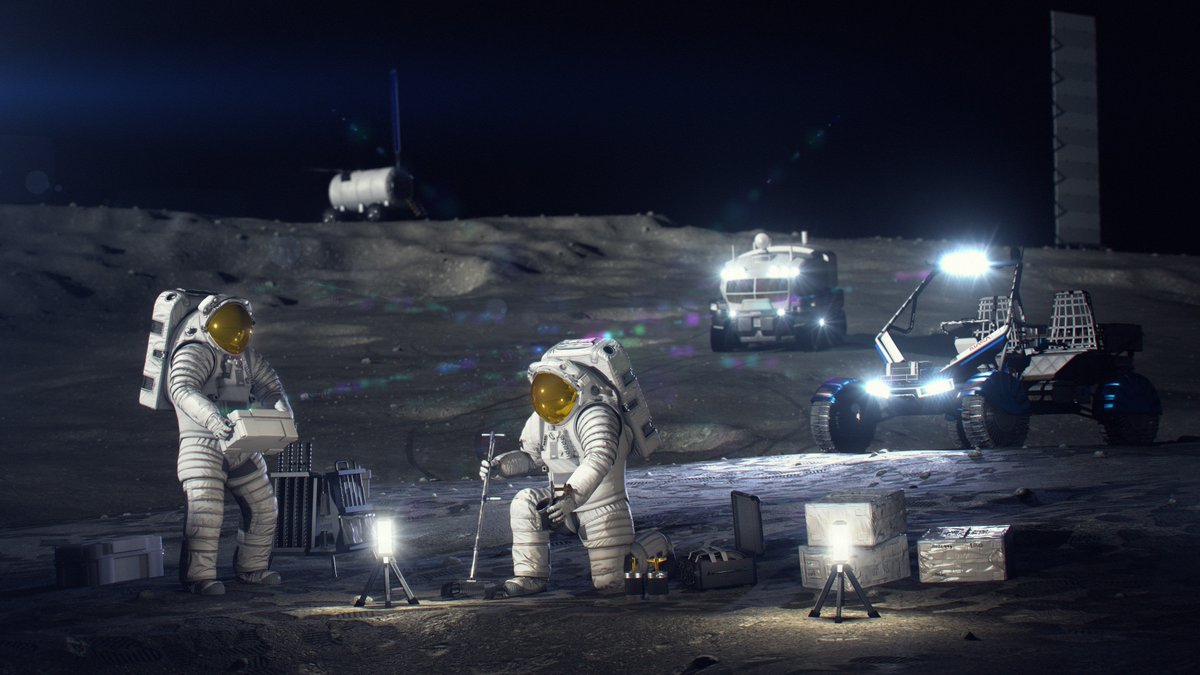
We're building a Moon Base!
@NASAMoonBase will serve as a habitat where astronauts live and work during long-term science missions.
Join us at 2pm ET on Tuesday, May 26, for a live news event where we’ll share updates on our lunar exploration plans: https://t.co/IJXA7xYwju
Elon Musk's first wife once described what it's like to watch him fail.
She said he doesn't react the way normal people react. When a rocket explodes, most people in the room go silent. Some cry. Some start calculating the financial damage.
Musk pulls out his phone and starts making calls. Not emotional calls. Engineering calls. "What failed. When can we fix it. When's the next launch." His voice doesn't change. His face doesn't change. The rocket that just cost $60 million is already in the past. The next one is all that exists.
She said it was the most unsettling thing she'd ever witnessed. Not because he was cold. Because he genuinely wasn't affected. The failure didn't register as failure. It registered as data. An experiment that produced results. Results that inform the next experiment.
This is why he wins. Not because he doesn't fail. He fails more spectacularly than anyone in history. He wins because failure occupies zero psychological space. It enters as data and exits as action.
Most people lose not because they fail but because they spend weeks processing the failure before acting again. Musk spends zero seconds. The gap between failure and next attempt is a phone call.
As the recently expanded partnership with @AnthropicAI demonstrates, @SpaceX is offering AI compute as a service at significant scale.
We are in discussions with other companies to do the same.
Over time, especially with orbital data centers, we expect to serve AI at extremely high scale.
BREAKING: SpaceX reportedly picks NASDAQ as listing venue for its initial public offering, as early as June 11th, set to list shares on June 12th, under the ticker $SPCX, per Reuters
A few months ago, I saw someone posting a certain kind of erotica on X. They were images of hundreds upon hundreds of telescopes spread across what appeared to be ranch land. The telescopes were arranged in a pleasing pattern, and had motorized contraptions guarding them, and were so numerous that all of my nerdogenous zones were activated.
And so off to Central Texas we went to witness Starfront Observatories firsthand.
https://t.co/93mXZe1uKS
One big question I got about the observatory is if we have ever pointed all the scopes at one spot? The answer is yes!
This is the result of one such effort, 1650 hours of exposure in Ursa Major!