New information says bat kills due to industrial wind turbines are "worse than we thought". Do you think there might be bats here, in the project area for @EDFofficiel "Northern Breezes" on forested Crown land? Has an @IESO_Tweets contract already. #bill140 will block enviro concerns
Meanwhile, in Ontario, more wind turbines proposed for farmland, forested Crown land. @IESO_Tweets@ONenvironment Appalling Evidence Emerges to Suggest Wind Turbine Bat Deaths in US Now Rival Those of Devastating Extinction Level White-Nose Disease https://t.co/i7CNejD1Cg
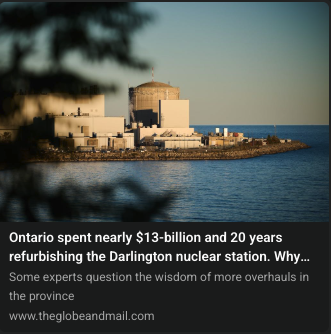
The Globe and Mail questions the wisdom of refurbishing Pickering. I fought to preserve the station when closure seemed inevitable.
Its $26.8 billion refurbishment buys a broader scope than Darlington's, including 48 new steam generators, turbine-generator upgrades & a deep-water intake.
These improvements are expected to add nearly an SMR worth of power, up to 200 MW, enough for another 200,000 homes, while extending Pickering's life by 30-plus years.
Pickering already has something enormously valuable: a licensed nuclear site with transmission connections, lake-water access, cooling infrastructure & a skilled workforce.
Closing it would strand much of that investment while leaving Ontario with an estimated $3.4 billion decommissioning obligation. Refurbishment defers that expenditure, allows decades more electricity revenue & gives its dedicated decommissioning fund more time to compound before those liabilities come due.
This is among Ontario's most practical, lower-risk routes to securing 2,200 MW of firm, low-carbon power. Refurbishments have a strong delivery record & Pickering's capital cost per MW is below the four-unit BWRX-300 estimate.
The Globe raises legitimate questions about Darlington's outages & additional capital costs. But its framing distorts what refurbishment involves & what Ontario receives for its investment.
The headline's “20-year refurbishment” combines a decade of planning with a decade of execution. Darlington generated electricity throughout the planning period. From 2016, its reactors were refurbished sequentially, generally keeping the other three producing power. No unit took ten years, and refurbishment times improved with experience.
Additional sustaining capital deserves scrutiny, especially deferred replacements. As Journalist Maclearn acknowledges, upgraded turbine rotors will also add 84 MW across Darlington, enough for 84,000 homes.
More misleading is the impression that major component replacements are peculiar to CANDU. American PWR reactors have required costly turbine overhauls & complete steam-generator replacements. These are routine lifecycle activities across the nuclear industry, yet the article presents them as a distinctive weakness of Canadian reactor technology.
CANDU's replaceable pressure tubes offer an advantage: the reactor core can be renewed, whereas a conventional reactor pressure vessel cannot practically be replaced. A second refurbishment could extend CANDU station life to 90–100 years, while improved pressure tubes may permit 35-year intervals, subject to validation & licensing.
CANDUs have achieved exceptional capacity factors internationally, aided by on-line refuelling. Darlington Unit 1 generated continuously for 1,106 days, a world nuclear record. Point Lepreau's troubled refurbishment is an outlier, not a fair proxy for the wider record.
The decision to refurbish Darlington and Pickering was among Ontario's soundest energy investments.
@globeandmail@OPG@CanadaNuclear@OCNI_ @PWUConnects @Sflecce
"Galloo Island is truly irreplaceable". Once slated for giant wind turbines, Galloo Island in Lake Ontario now a nature preserve. #windturbines@ONenvironment#wildlife#nature
https://t.co/07M3RFlHJf
Turns out shutting down two perfectly good reactors at Indian Point, which supplied roughly a quarter of downstate New York's electricity, on the promise that renewables and Quebec hydropower would replace them was... ill-advised.
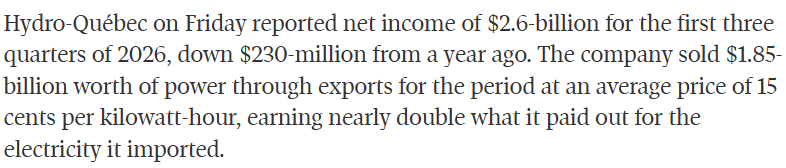
Natural gas filled much of the gap. The Quebec transmission line arrived five years after the reactors closed, and now Hydro-Québec is warning that drought may force it to curtail exports.
@NRDC@riverkeeper
Sister ship Voyager 1 is currently ~24h 00m 00s of light travel time from Earth, or 25,902,000,000 km / 16,095,000,000 mi / 173.145 AU (2026:322:120000:1L) ONE LIGHT-DAY from Earth! …
"
New Yorkers were told for years that this cable would help replace Indian Point: by Riverkeeper in 2017, by Hydro-Québec and the developer in 2021, and by the governor’s office this June."
@rupasubramanya TFW's should be for seasonal agricultural work only as the program was initially designed for. Using TFW's for full time, year round work is depressing wages and is fueling resentment towards immigration.
@okistatawan@TheophanesRex@RichardHanania That's a bad AI map, it shows two Calgary's, Edmonton is in Saskatchewan, there is a phantom major population centre on Baffin island, Newfoundland is labeled New Brunswick.
@nickcapra_gpc@Sflecce Germany's nuclear free grid has far higher electricity costs and far higher CO2 emissions/kWh than Ontario's nuclear dominant grid but lets celebrate higher pollution levels in Germany because envrionmental activists think nuclear is bad.
In the words of Germany's Minister of Energy:
"The phaseout of nuclear was a huge mistake, a huge mistake and we miss this energy."
Yet many ideological voices in Canada still champion this policy path and insist we repeat history.
By closing its nuclear plants, Germany lost 20 GW of 24/7 emissions-free generating capacity at affordable prices.
That's nearly enough generating capacity to meet the average electricity demand of a country the size of Poland.
Ontario can not afford to make that same mistake.
[Hydro Quebec] "says it is dealing with its four driest consecutive years since hydrological data began to be compiled in the 1940s."
gas into "green" alchemy continues: ON imports to US exports
https://t.co/7ovD8Di056
After 17 years, is the contaminated well water in Chatham-Kent fixed? NO. And now, @ONenvironment and Ontario govt proposing to delete key environmental protections for "renewable" energy projects via #bill140. Just in time for an @IESO_Tweets RFP. "This is not sand": the story of Chatham-Kent contaminated water continues - Wind Concerns Ontario https://t.co/QVpvegc7F4
Note that the Sir Adam Beck generating station at Niagara Falls was built in 1922. It’s over 100 years old, and its concrete experiences far more stress than anything at Pickering.