Thanks @_akhaliq for sharing our work!
🎥 Really excited about how video prompts can be optimized for SOTA video generation models, potentially helping many many users save time and avoid laboring over video details. ⏱️✨
📺 More videos here: https://t.co/Rg5ZcF9ql1
We put out a blog version of AutoLab in March. Today, I am excited to share that our full paper is out!
📖 AutoLab: Can Frontier Models Solve Long-Horizon Auto Research and Engineering Tasks?
Since then it's been great to see work in the field building on what we shared, that's a big part of why we went back and did the complete version, with the full experiments.
The question is simple: can a model stay with a hard problem for hours? 36 environments, each a real program that works, but not optimized. The model gets the code, a sandbox, up to 12 hours, and a sealed scorer -- the only way to a better number is better code.
We ran 17 frontier models. 2,544 hours, 8.6 billion tokens. The finding from the blog held up: the strong models weren't the ones with the best first attempt -- they were the ones that kept closing the loop: test, change, test again! Persistence alone wasn't enough. Some models ground on for hours but barely ran the code, and the clock ran out on them. Others gave up with hours left.
We built this benchmark; it might not capture everything. But we hope it fills in a piece of the picture that one-shot scores miss, especially for anyone building agents to do hours of real work!
If you've been building on the blog version, we'd love to see what you found. And if you try your models on it, tell us what breaks.
#AutoLabBench
This may be a controversial take, but I think it needs to be said: the gap between computer vision research in academia and industry is widening with every conference.
A huge fraction of @CVPR papers—especially those that boil down to "we tweaked/fine-tuned/RL'ed large-scale model X to improve on task Y"—will become obsolete with the next model release. That's not where academia creates lasting value. PIs should adapt much faster to this changing reality.
Academia should focus on fundamentally new ideas, new problem formulations, explaining emergent phenomenology, or uncovering blind spots that industry can later solve with scale, compute, and data.
Can you trust an AI-written research paper? We checked 75 of them.
The answer is: NOT YET.
So we built ScientistOne — every claim traces to evidence. The only system to lead on all integrity checks, while matching SOTA performance.
Check out papers: https://t.co/Alxoqlrxdt
Curious about the secret sauce behind our trillion-scale agentic foundation model? Here it comes!🥳
Last year, we released IcePop to stabilize MoE RL with double-sided masking. As we dive deeper, something unexpected happened: the masking ratio went down, while the training–inference mismatch continued to grow!😞
This year, we introduce 𝑲𝑷𝒐𝒑🪩, which replaces the fixed ratio constraint with the binary KL divergence to adaptively mask inappropriate tokens! The masking ratio adapts to fluctuations of the training–inference gap during training, keeping policy optimization stable and effective with long-horizon agentic RL rollouts.
With this simple change, it enables our Ring-2.6-1T to achieve over 76 on the SWE-bench-Verified with pure RL training!
No modifications to infrastructure. No routing replay. Just one parameter, power your agentic RL with 𝑲𝑷𝒐𝒑!
Click to learn more about the details!
📜Blog: https://t.co/uPu1gMg7ti
Badacze z Google Cloud AI Research i National University of Singapore niedawno opublikowali papier o A²RD – systemie do generowania względnie długich materiałów wideo za pomocą AI... i trzeba przyznać, że wygląda to naprawdę przyzwoicie.
Demka pokazują pojedyncze sceny trwające nawet około minuty bez typowego dla AI rozpadu wizualnego, a ich jakość jest zaskakująco dobra; w pewnym sensie bardziej przypomina mi to rendery z programów graficznych niż typowy AI slop. Polecam sprawdzić samemu.
If you’ve tried making AI video >30s, you know the nightmare. Bouncing between tools, manual stitching, and fighting "identity drift" where faces morph every frame.
We decided to automate the entire crew.
Meet Co-Director. 🧵👇 (1/9)
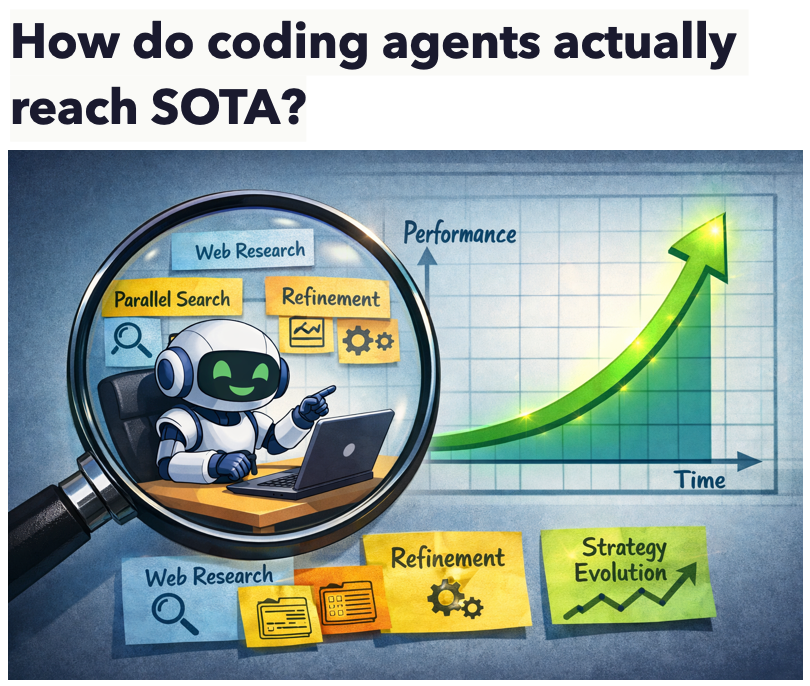
Auto research is on 🔥
We give algorithmic problems (like circle packing) to general coding agents, let it run overnight. 🌙
Agents reach SoTA. But more importantly: we analyze 100+ hours of trajectories to understand how it gets there 🧵
My team at Google Cloud AI Research is looking for a Student Researcher Intern to dive deep into coding agents. We’re looking for someone who doesn’t just read about agentic workflows but builds them.
What we’re looking for:
Academic Rigor: Currently pursuing a Ph.D. with a strong publication record.
Technical Chops: Excellent coding skills are a must.
Agent Experience: If you’ve built or experimented with coding agents (like Claude Code, GEMINI CLI or similar frameworks), we want to talk to you.
Come help us push the boundaries of LLM-based software engineering. 🚀
If this sounds like a fit, feel free to DM me or send your CV directly to [email protected]
#Google #AIResearch #CodingAgents #LLMs #MachineLearning
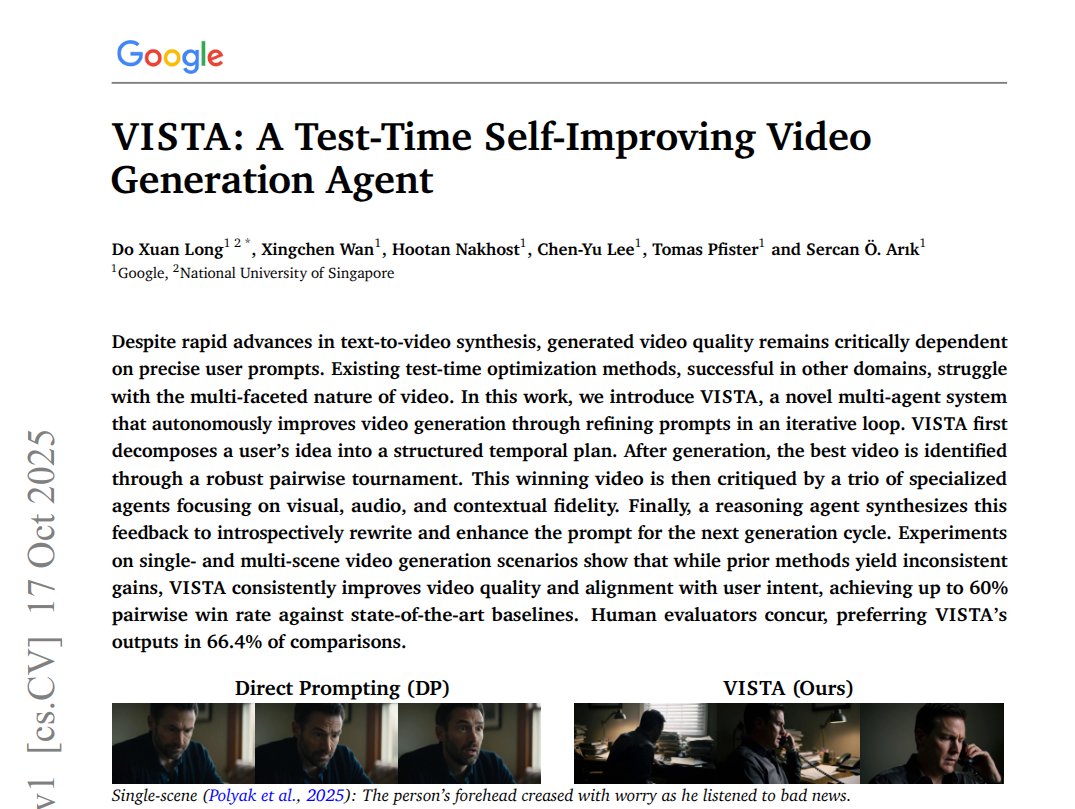
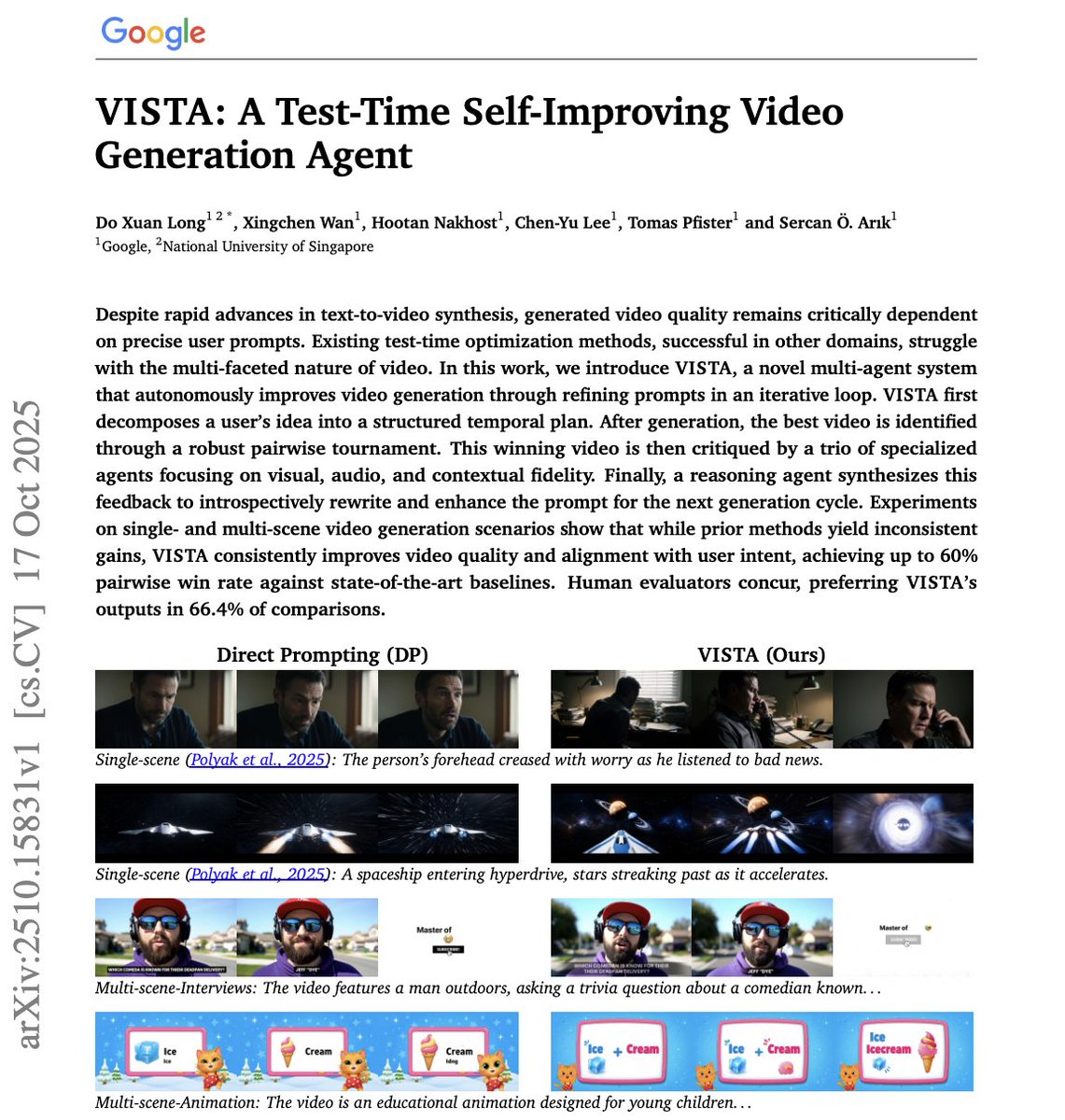
New Google paper builds a video generator that improves itself at test time by rewriting the prompt while it runs.
It first turns the user prompt into a simple timeline of scenes with duration, characters, actions, environment, camera, sounds, and mood.
It then makes several videos and picks the best using head to head comparisons that swap the order to avoid bias.
The picker also applies hard penalties for broken physics, random text on screen, extra scene cuts, or voice and music that were not requested.
After that, 3 separate judges score the winner on visuals, audio, and context, and a meta judge merges the notes into clear issues.
A reasoning agent converts those issues into short prompt edits that keep the user’s intent and target the exact failures.
The system repeats this loop, generates new candidates, and keeps the best until further edits stop helping.
On single scene and multi scene tests with Veo 3 and Veo 2, it raises visual quality, motion realism, prompt match, and audio quality.
Across stronger baselines, it reaches up to 60% pairwise wins, and humans choose its results in 66.4% of trials.
----
Paper – arxiv. org/abs/2510.15831v1
Paper Title: "VISTA: A Test-Time Self-Improving Video Generation Agent"
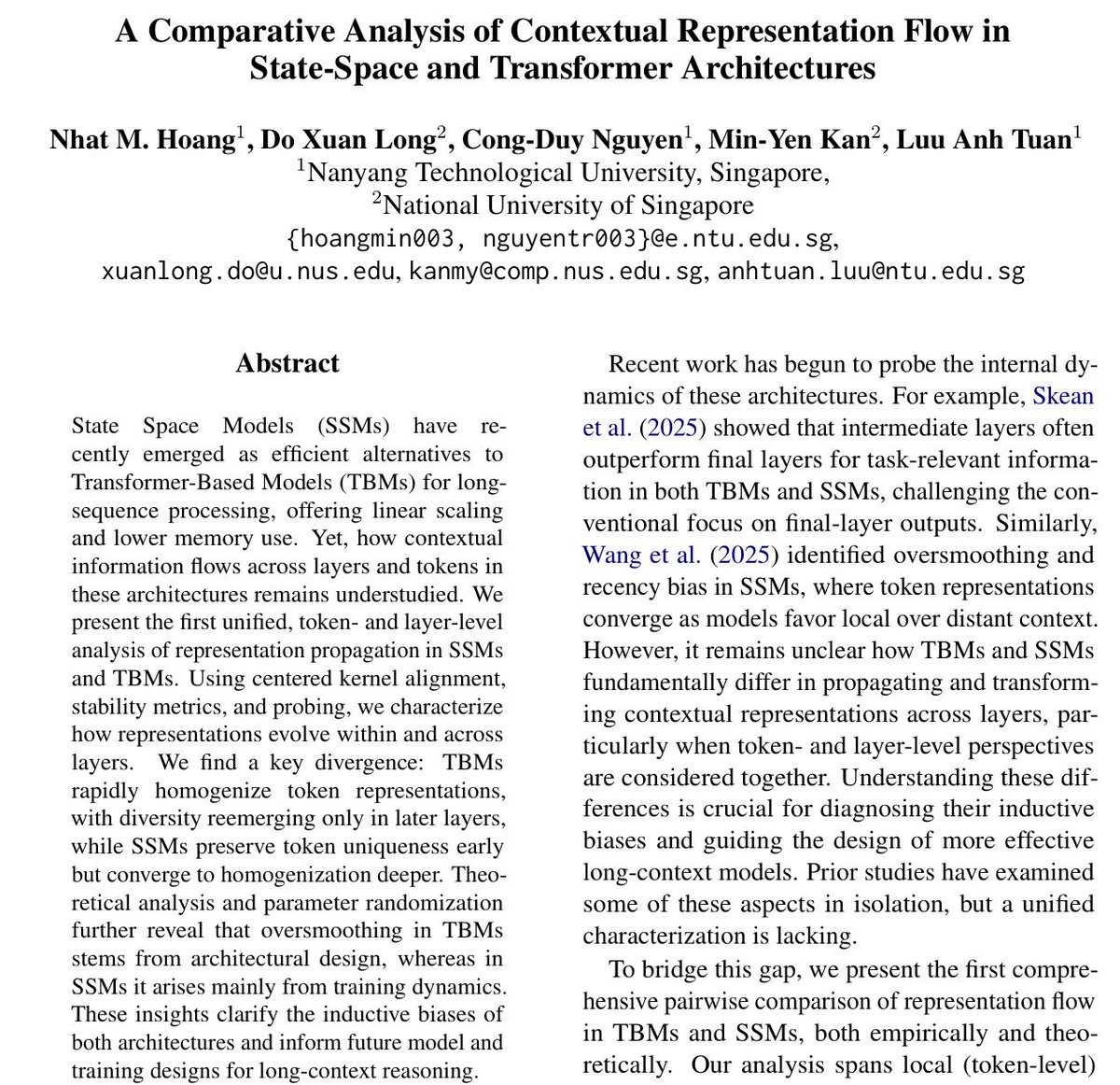
🤔 Why do Transformers and Mamba (SSMs) fail differently on long context?
🔎 How do they mix and reshape context across depth?
🚀 No one had a unified, token + layer-level view — until now!
🔗 Paper: https://t.co/UpjfOcBpRg
🧵 👇 More in thread #Transformers#Mamba#NLP
Thanks @_akhaliq for sharing our work!
🎥 Really excited about how video prompts can be optimized for SOTA video generation models, potentially helping many many users save time and avoid laboring over video details. ⏱️✨
📺 More videos here: https://t.co/Rg5ZcF9ql1
🚨 Google just dropped the most advanced self-improving video AI ever built.
It’s called VISTA, and it literally rewrites its own prompts to make every new generation better than the last.
No retraining. No fine-tuning. Just pure test-time self-reflection.
Here’s how it works:
→ Turns your idea into a full scene-by-scene storyboard
→ Generates multiple video candidates
→ Runs a tournament to find the best one
→ Then critiques itself visually, audibly, contextually before trying again
Each loop = sharper visuals, tighter storytelling, more aligned motion.
The results? 60% win rate vs Veo 3 and 66.4% human preference.
This isn’t “text-to-video.”
This is video that learns from itself.
Ever wondered *how* language models understand discourse relations 🧠⚡️🔍? We address this long-standing question in our #EMNLP2025 paper: “Discursive Circuits: How Do Language Models Understand Discourse Relations?” By @YisongMiao and @knmnyn#NLProc#Discourse 🧵1/n
Holy shit...Google just dropped a self-improving video generation agent 🤯
It’s called VISTA, and it literally rewrites its own prompts to make videos better every single generation.
No retraining. No fine-tuning. Just pure test-time self-reflection.
Here’s how it works:
→ Breaks your idea into a full scene-by-scene plan
→ Generates multiple videos
→ Judges them in a tournament
→ Then critiques itself visually, audibly, and contextually before trying again
Each loop = smarter, sharper, more aligned video.
The results? A 60% win rate against SOTA models like Veo 3 and 66.4% human preference.
This isn’t just text-to-video.
This is video that learns from itself.