Authenticity, points of view, concepts you believe in, things that you’ve learned, hypotheses you have, things you see in your industry that others aren’t talking about, things you’ve seen that have recently not worked, lessons you’ve learned for mentors, lessons you’ve learned that you don’t want to do anymore, and you want to unlearn them based on experience, content content content. A key thing to understand from this video also is make content while you still have a job that’s a tremendously strong play in today’s world that’s fast moving both on opportunities and back-ups when something throws you a curveball.
Been working on a real estate deal for a while.
Yesterday I was told something was going to take 3-5 days to turn around.
I asked why? Answer: Because that's how long it usually takes.
Then I asked: What would happen if you called them and told them you need it tomorrow?
My attorney said she'd try. So she did. And what do you know? They said they could turn it around in a day.
Yet another reminder that the first answer is just a placeholder for "usually". If you settle for that, that's what you'll get. But there's another option on offer: The option you want. And if you don't ask, you don't get. And if you don't do, it won't be done.
Everything can be compressed.
🔴I had TDS for 7 years before waking up to the media lies.
Found 2 major sources that really helped.
@AmericanDebunk website that showed all the media hoaxes and edits + Joomi Kim's documentary.
If you're still suffering from this affliction, consider giving these a watch. America really dodged a bullet.
https://t.co/9fSN8Rk40r
The World is Changing: AI For Creativity
By Jeffrey Katzenberg
A few months ago, I sat in my office in Silicon Valley and watched as a tech founder showed me something extraordinary. On the screen was a fully realized, beautifully lit, well-composed animated scene. It was stunning and it made me feel exactly what I felt in 1986 watching Luxo Jr. That was the first time I watched a computer-animated 3D character take a breath and seem, against all reason, to have life. It left me in awe.
Later that day, I received a text from an artist I've known for thirty years, 350 miles to the south, in the city where I spent most of my career. After seeing a similar video, she texted: "Is this the end of us?" My answer was, "Certainly not.”
I have spent the better part of the last decade in Silicon Valley, but the heart of my career has been in Hollywood. Being deeply connected to both worlds means I have deep loyalties to each and a responsibility to speak honestly to both.
In 2023, I said that these new AI tools would cut the time and cost of producing world-class animation by as much as ninety percent within three years. Some colleagues were alarmed, many were furious.
There is growing fear and resistance surrounding AI within the creative community. I deeply understand it, because I've spent countless hours walking through animation studios watching gifted artists bent over their desks, rebuilding a single second of film for the tenth time because the ninth version wasn't quite right. I've sat in screening rooms where four years of people's labor played out in minutes, and I knew the name of every person that had spent countless hours bringing those images to life. The creative process is a calling, there's really no other way to describe it. From the outside some see resistance. From the inside, it is love.
People do not fight this hard for things they don't care about. The pushback coming out of Hollywood represents the collective effort of people who are deeply passionate about their craft.
Is History Repeating Itself?
The history here is more complicated than either side may realize. In 1906, the most famous composer in America, John Philip Sousa, published an essay titled “The Menace of Mechanical Music." He warned that the phonograph would become "a substitute for human skill, intelligence and soul."
Sousa's fight was not really about the machine, it was about money. The machines were playing his compositions, and the men who built them weren't paying him a cent. His campaign helped create the Copyright Act of 1909. He did not stop the technology. He changed the terms under which it could use his work.
A hundred years ago, sound came to the movies. We remember it now as a miracle, and it was. What we forget is who paid for it. Before sound, tens of thousands of musicians made their living in the orchestra pits of movie houses, scoring every film live, every night, in towns all over the world. When the soundtrack arrived, the work of one composer and one orchestra was recorded for a film that went into thousands of theaters. The union fought back with everything it had, taking out newspaper ads across the country warning against the menace of "canned music," one of them showing a mechanical man tearing the strings out of a harp while an angel wept.
They were not fools, and they were not Luddites. They were right. Those pit jobs did not come back. And yet (this is the part we have to be brave enough to admit), sound gave us the movie musical, the modern score, sfx, sound design, audio engineering, and an art form vastly larger than the one it disrupted. And it helped keep Hollywood in the forefront of world entertainment for the rest of the century and into the next. The loss was real. And yet the art form expanded.
This is a story that has been told over and over again. To resist technology is to risk irrelevance. Just look at Kodak or Blockbuster. To embrace technology is to open doors of new possibility. Just consider Apple and Netflix.
What I Learned From Walt Disney
In the mid-1980s, I was tapped to lead Disney's animation division at a moment when the studio was at an inflection point. Animation wasn't just another business unit. It was the soul of the company, a medium revered because of Walt's genius and his passion. But the production system was cumbersome and unforgiving. A single movie was 125,000 individual hand-drawn and painted cels, photographed one frame at a time. Every revision carried a cost measured in months. These degrees of difficulty shaped the kinds of stories we could tell.
We found our way forward in an unexpected place: Walt himself. The Disney archives held astonishing recordings of Walt explaining his creative process. His own writings. His notes and storyboards. Work product captured at every stage of his process. This was truly a gift. Listening, reading, sitting with the work itself, we heard him talk about character, about emotion, about how an audience feels when a character truly comes alive. He talked about making bold choices and refining a scene until it genuinely moved people. We didn't hear a word about pencils or paintbrushes. In fact, Walt was famous for being a technologist, forever hunting for state-of-the-art tools, often inventing them himself to achieve the images he saw in his head. But he never defined animation by the tools. He defined it by whether the audience believed the character. His principles were timeless. The tools were not.
That realization changed everything. We co-developed the Computer Animation Production System (CAPS) with a young Northern California company called Pixar, replacing hand-painted cels with CGI. In The Little Mermaid, the final scene shimmered with a dimensionality and light that the old process simply couldn't achieve. In Beauty and the Beast, the ballroom sequence moved with a cinematic sweep that placed the audience inside the emotion of the moment. In Aladdin, the Cave of Wonders felt vast and alive, and the Magic Carpet became an intricate, compelling character all its own. In The Lion King, the stampede carried a scale and intensity that raised the emotional stakes beyond anything we'd done before. Technology didn't diminish the craft, it expanded the canvas. It gave artists more room to create.
A decade later, the canvas expanded again. When Disney released Pixar's Toy Story, it wasn't simply a technical milestone. It was proof that a fully computer-animated film could carry real emotional weight, that it could make audiences laugh, cry, and believe. At DreamWorks, we made the difficult decision to sunset hand-drawn animation and become a fully computer-animated studio. It was the right thing to do, but it was not without pain. It cost talented people their place in an industry where they had worked their whole lives. Some made the leap to the new tools and did the finest work of their careers. Some never did.
Tools are never the point. The instruments change with every generation. What endures is taste and imagination. The magical ability to make an audience feel. One of the greatest storytellers of our generation, George Lucas, succinctly captured the eternal essence of this issue: “It’s not the how, it’s the why.”
A Distinction With a Difference
I asked one of the leading AI models a question that has been challenging me for months. What is the difference between reasoning and creating? Its answer changed how I think about almost everything happening in this industry. It said . . .
Reasoning and creating are two distinct cognitive modes, though they also work together. Reasoning is fundamentally evaluative and analytical. It operates on what already exists: facts, premises, evidence. It moves toward a conclusion that was in a sense already implied by the input. Reasoning is constrained by logic and truth. Its goal is to arrive somewhere correct, not to invent somewhere new.
Creating is fundamentally generative. It produces something that didn't exist before. And crucially, there's no single right answer waiting to be found. A blank page has infinite valid responses. Creation involves choices that can't be fully justified by logic alone. Taste, intuition and vision fill the gap where deduction runs out.
Reasoning is what Silicon Valley has been perfecting. Creating is what Hollywood has been practicing for more than a century. AI today operates almost entirely on the reasoning side of the line. It can deduce, evaluate, optimize, and pattern-match brilliantly. And while it can create, there is a real distinction to being creative. What it doesn’t yet have is those things that make us human: empathy, devotion, serendipity, the kind of creativity that comes from a person trying to say something only they could say. When the bot generates a piece of art, it is not trying to communicate anything. It is statistics, not soul; it is emulating things that have been done. By contrast, human creativity isn’t about repeating patterns of zeros and ones; it is about doing something new.
One day, AI may close this gap. Three years ago, the leaders building AI would have called what they are achieving today, improbable, if not impossible. Impossible is no longer improbable.
Today, the line between reasoning and creating is real. Even the leading technologists acknowledge we are not there yet. There is no scientific path to crossing this divide that anyone in the field can articulate today. Understanding that gap is where we will find common ground.
A Path Forward
In 2016, I closed one chapter in Hollywood with the sale of DreamWorks and opened another in Northern California, co-founding WndrCo. We’ve backed more than 50 founders building the next generation of technology and watched how breakthroughs in Silicon Valley emerge, first as experiments, then as platforms, and finally as infrastructure that reshapes entire industries. It's worth remembering that the last great revolution in animation also came from the north. Pixar was a Northern California company, forged not in the conventions of the Hollywood studio system, but in the technological breakthroughs of Silicon Valley. I've spent years on both sides of this bridge. For sure, I don’t have all the answers (take Quibi, for one!). But, from my past and present vantage points of my long career, here is what I see . . .
Brilliant people in Northern California building this technology have made something extraordinary. They have earned the right for the rest of us to be, if not believers, at least optimistic that what comes next will be remarkable. But they have not made an artist. The tools are powerful, but they are not what makes a story matter. That knowledge lives 350 miles to the south, inside people whose life's work has informed the very models you are building. The right path forward includes them by design, with credit, with consent, and with compensation. Build this with the storytellers. Not on top of them. Taste is not something that can be synthesized, it is uniquely human.
At the same time, Hollywood needs to accept that AI is not going away. The energy they are spending trying to make it disappear is energy they are not spending deciding the terms on which it will exist. And the terms are everything. The north needs something from it that they cannot build and cannot buy: creativity. The kind that takes a blank page and conjures a single right answer where there was none and has held audiences for a century. Without it, the most powerful reasoning engine ever invented will still be missing the only thing that makes a story worth telling.
The artists who learn to wield these new instruments will do things the engineers never dreamed of. They always have. Edison invented the motion picture but made terrible movies. It took Chaplin, Lloyd, Keaton and so many others to make movies emotional. Now, the canvas is about to expand yet again. We should decide now that we intend to paint on it.
There are so many valuable lessons in history. This has happened many times before, and it was never settled by the technology. It was settled by the terms. Sousa did not stop the phonograph; he helped write the law that made sure composers got paid. And two years ago, when the writers and the actors walked out, they were fighting for the very things Sousa was fighting for in 1906. Consent, compensation, the basic recognition that human creative work has a price that must be paid. The terms of that fight are still being negotiated, but the principle is older than any of us.
The tools-versus-no-tools argument is a trap. First, we must all agree that there should be terms. Then we can have the crucial debate about what fairness requires.
What I Learned From Steve Jobs
Years ago, Steve Jobs said, "It's in Apple's DNA that technology alone is not enough. It's technology married with the liberal arts, married with the humanities, that yields us the result that makes our hearts sing." He was describing a device. But he could just as easily have been describing this tale of two cities.
What I See Coming Soon
As the barriers and the costs come down, more films will get made, not fewer. Studios will get to take more risks. There will be more seats at the table, and very soon entirely new forms of storytelling. In the 1980s, animation was dismissed as a niche corner of the business. Today it is one of the most beloved and profitable forms of storytelling in the world. In live action, filmmakers like Steven Spielberg, James Cameron and Peter Jackson embraced new visual tools not as shortcuts, but as instruments, and expanded cinema in the process. Every time storytelling has met a genuine technological shift, from synchronized sound to color to computer animation, it has redefined the boundaries of the medium and grown larger in the process.
Assuredly, I don’t have all the answers, but I am confident that the creative opportunities will expand yet again. How we come through this is a choice. The north has the new tools. The south has the creative soul. The best future will draw on the best of both worlds.
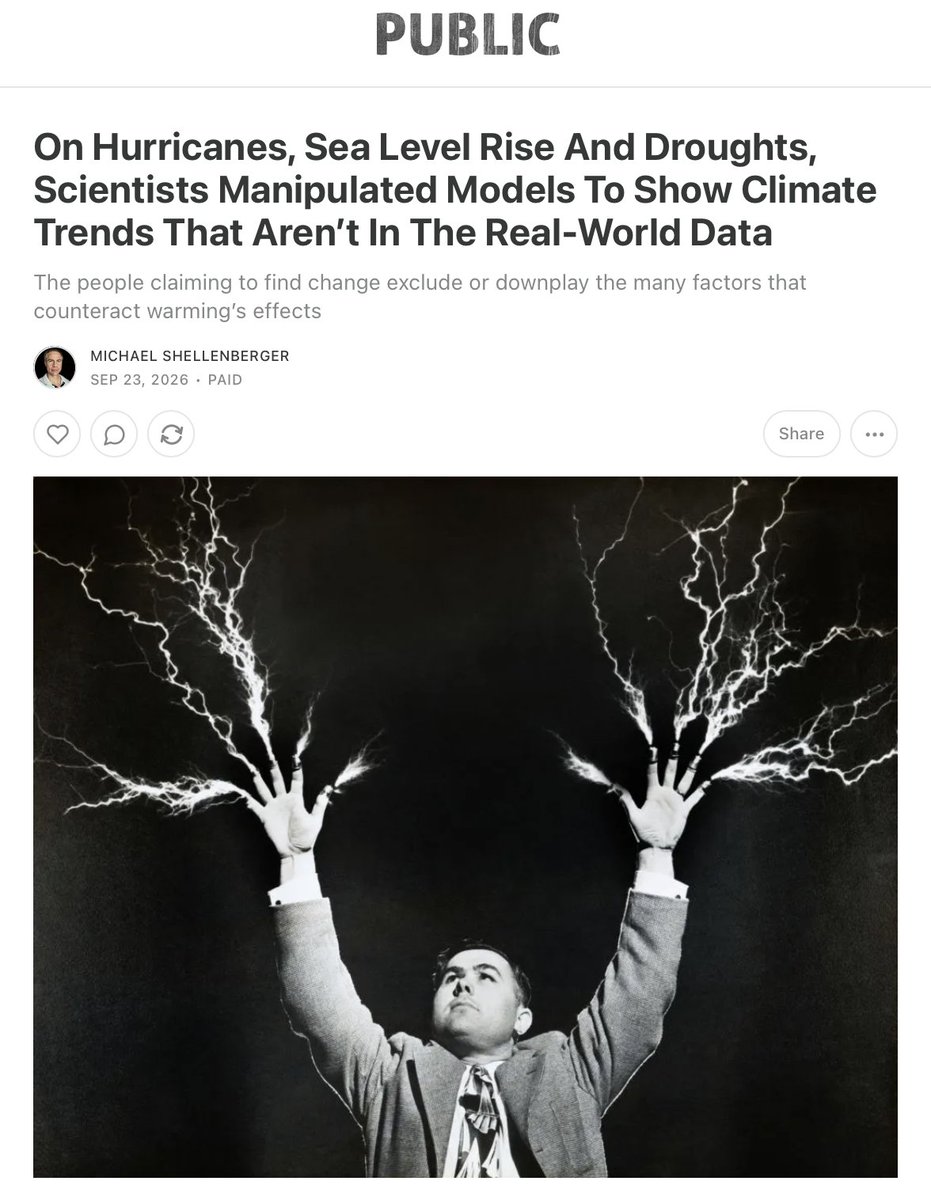
Climate change makes hurricanes more frequent and intense, they said. But for the first time in 112 years, the Atlantic hasn't produced a single one. On storms, sea level, and droughts, manipulated models can show, under equally valid assumptions, the exact opposite trends.
***NEW Martyr Made Podcast***
Enemy: The Germans’ War, pt. 3 - The Fighting Man
Millions of German soldiers return home to find the Bolshevik plague pouring out of Russia into Europe. They were only too happy to have someone else to fight. (Link below)
BREAKING: Elon Musk on China in his new interview with CCTV Finance:
“I generally recommend people go to China as much as they can, because China has so many things to see. I took the bullet train from Beijing to Xi’an. That was a great experience. The train stations are amazing.
“The Terracotta Warriors are one of the wonders of the world. Just make sure you look out the window and aren’t on your phone, because there’s so much to see. Any words I say do not do justice to the incredible majesty that is China. It’s awesome.”
Want to know something that sounds too crazy to be true?
NATO bombed its own allies' cities for decades. On purpose. To control elections.
This isn't a theory. Italian Prime Minister confirmed it in 1990. Files got declassified. Historians documented the whole thing.
Operation Gladio (sword in Italian)
The setup: After WWII, CIA and MI6 created secret armies across Western Europe. Stay-behind units. Hidden weapons caches. Trained operatives. Italy, Greece, Turkey, Belgium, Spain, Portugal, France.
Official reason: if Soviets invade, these cells resist from inside occupied territory.
That's the cover story. Here's what they actually did:
Piazza Fontana, Milan, 1969. Bomb kills 17 people. Blamed on leftist anarchists. Massive crackdown on the left. Turns out it was neo-fascists working with Italian military intelligence.
This went on for years. The Years of Lead in Italy. Bombings. Assassinations. All blamed on communists. All actually done by right-wing extremists coordinated with intelligence services.
Why? Strategy of tension. Keep people scared. Make them blame the left. Prevent communists from winning elections. Democracy only works when the right people win.
Greece 1967. CIA-backed military coup. Overthrows elected government. Gladio units help coordinate it. Because Greeks were about to vote wrong.
Turkey. Through the 1970s and 80s. Gladio units became the deep state. Assassinations. False flags. Operating independently while Turkey stayed in NATO and everyone pretended not to notice.
1990. Italian Prime Minister Giulio Andreotti stands up in parliament and confirms it all. Shows documents. The network existed. Those operations happened. America and Britain knew the whole time.
Swiss historian Daniele Ganser spent years documenting it. His book "NATO's Secret Armies" lays it all out. Not theory. Facts.
But somehow this never makes it into mainstream history. NATO talks about defending democracy while we have proof they spent decades manipulating elections through terrorism in allied countries.
When I learned they'd been bombing European civilians for 40 years to control politics, I stopped being surprised by anything they do.
Horrifying...
Michelle Worton was a nationally recognized dental professional. She sat on the College of Dental Hygienists in BC. She took the COVID shots because she was mandated to as a regulated healthcare professional.
Within an hour of dose 1: racing heart, erratic blood pressure, chest tightness.
Within 48 hours of dose 2: severe neurological onset - double vision, tunnel vision, tinnitus, incontinence, dizziness, inability to regulate temperature.
Her first doctor blamed it on menopause.
Since then:
→ 8+ white matter brain lesions
→ Cystic masses in her liver, pancreas, cervix, breasts, and BRAIN
→ A brain cyst so large it was compressing her skull - Canada wouldn't operate
→ She sold her dental practice, drained savings, crowdfunded $148K USD for private brain surgery in the US
→ Over $300K spent on medical care to date
→ Denied plasmapheresis in Canada in July
→ Told to hide her vaccine injury to even get a referral accepted
→ Stroke discovered in 2024 - never told
→ Spends 90% of her time in bed
→ Her children became her caregivers
→ She does not know how long she will live
She was told the shots were safe and effective. She was coerced. Coercion is not consent. And when she was injured, she was abandoned, gaslit, mocked, and censored.
Millions took the shot because they were mandated - to keep their jobs, their licenses, their livelihoods. Millions more took it because they believed the mantra: "safe and effective."
They did what society told them to do. To abandon them when they're injured is a betrayal. To gaslight them, dismiss them, and deny them care is morally wrong. You don't get to mandate something and then pretend the casualties don't exist.
Michelle Worton deserves care. Every vaccine-injured person deserves care. "No one left behind" was the promise. It was a lie.
Same with this article from yesterday
Gay acceptance is now rapidly dropping in the Netherlands
The real reason is Middle Eastern and North African (MENA) immigrants are extremely against homosexuality
But media isn't allowed or won't ever write that
It's ironic that the gay acceptance we fought for for decades in the Netherlands is being destroyed by progressive policies that keep continously importing low quality immigrants from cultures that are completely opposed to us
US Government Misstated COVID Vaccine Risk
The British Medical Journal (BMJ) reports that during the COVID vaccine rollout in 2021, US health officials used a safety-monitoring algorithm that they knew was inadequate but ignored the problem.
At the time, the Food and Drug Administration (FDA) compared reports of adverse events after each vaccine with reports after other vaccines. But by 2021 more than 90 per cent of reports were about the (very similar) mRNA vaccines from Pfizer and Moderna. Because of this, adverse events which occured for both vaccines would not have statistically stood out.
The BMJ extracted this information from internal emails it obtained under the Freedom of Information Act. These emails reveal that FDA employees Ana Szarfman and statistician William DuMouchel warned Peter Marks (then the FDA’s vaccine regulator) about this problem in early 2021. They proposed an improved method, but higher FDA administration ignored the warning.
As a consequence, the algorithm failed to flag myocarditis (an inflammation of the heart muscle), which was later found to be a side-effect of mRNA vaccination.
Report here: https://t.co/YwogjHVi2R
“I started when I was 16... I wanted revenge on communists for spitting on my mom.”— Dominik Tarczyński
They wired his house. They spat on his mother. His grandfather slept in a grave to stay alive.
Dominik's career as a politician is deeply personal.
This is why he will fight until the end of his life 🇵🇱