🌘 Kimi-K2.7-Code, our latest coding model, is now released and open-sourced!
🔷 Improved coding & agent performance over K2.6: +21.8% on Kimi Code Bench v2, +11.0% on Program Bench, and +31.5% on MLS Bench Lite.
🔷 Reasoning efficiency: Less overthinking, with 30% lower reasoning-token usage compared to K2.6.
���� Long-horizon coding: Improved instruction following, higher end-to-end coding task success rates.
⚡️ 6x High-Speed Mode coming soon!
🔌 Available today via Kimi API and Kimi Code.
🔗 Kimi Code: https://t.co/uvoSJKyGCY
🔗 API: https://t.co/EOZkbOwCN4
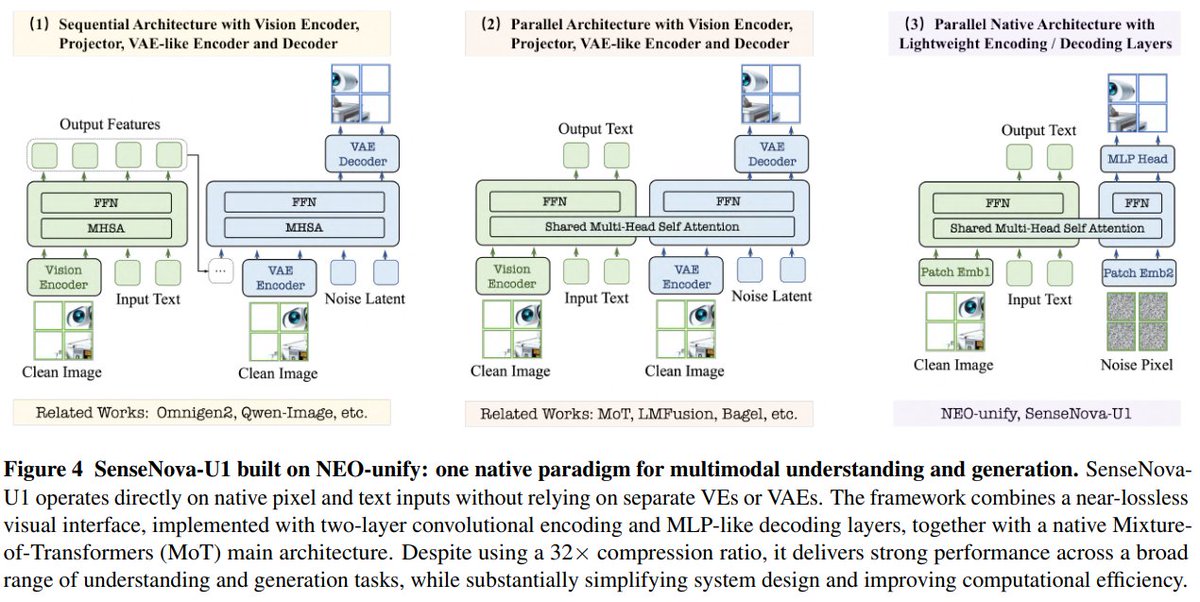
🔥 New week, New SenseNova-U1-A3B-MoT Drop — and this one goes Deep!🔥
Technical Report is OUT — the detailed disclosure of how to build Native Multimodal Unified Models.
Inside:
✨ Near-Lossless Visual Interface (no VEs, no VAEs, no Deep Decoders)
✨ Joint AR + Pixel-space Flow Matching
✨ Native Mixture-of-Transformers Backbone
✨ Training recipe + RL post-training + Distillation
📣 Paper: https://t.co/erw1PKbabE
🦁 Github: https://t.co/ANlWRuTkx0
🌟 Models: https://t.co/tOvuNPAMlD
🎮 Demo: https://t.co/R6cOj4FL6d
Saw this tweet and got really excited 🤩.
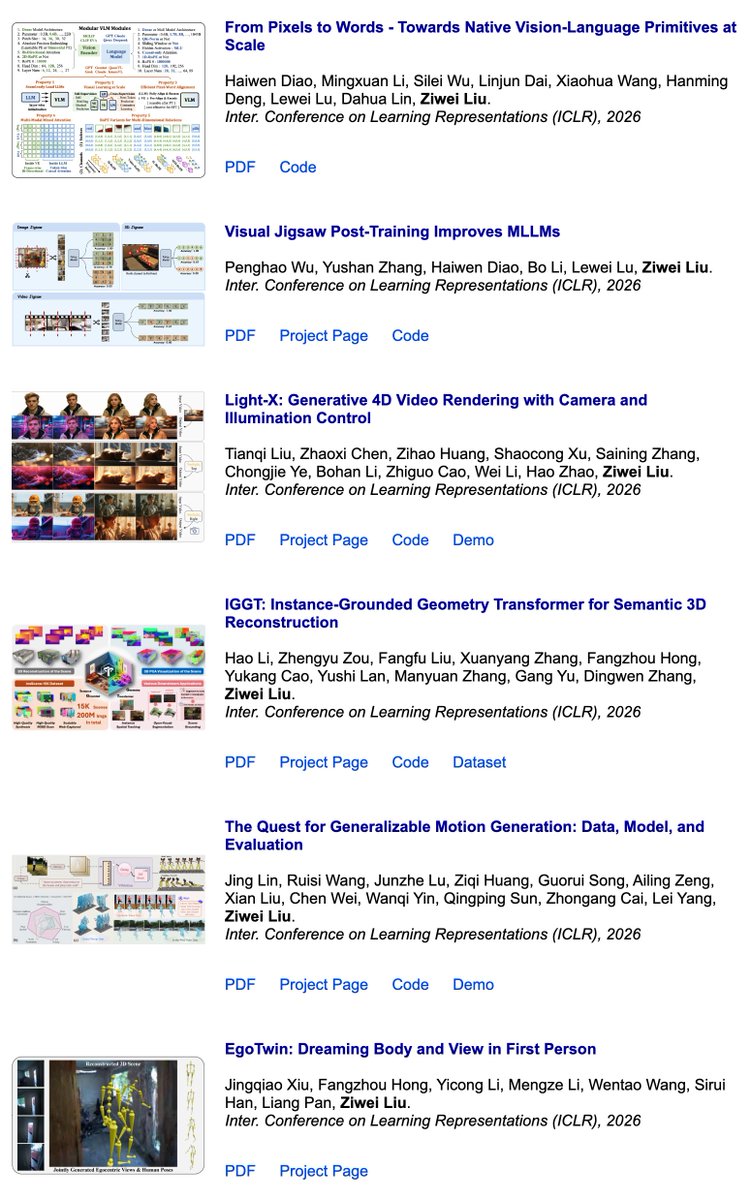
Our PPT from last December — back then, we thought of related core ideas: MoE specialization, training pipelines, proactive systems, streamlining, long-video understanding, etc. Something we didn’t foresee was the rise of agentic paradigms.
Looking back, limited compute and audio data forced us to choose between NEO-omni and NEO-unify, which still feels a bit unfortunate. But Thinking Machines really feels like a complete realization of the encoder-free digital paradigm — incredibly inspiring.
So here’s a flag: 😇we'll finish NEO-ov (image, video, 3D, SI) paper this week and release the weights ASAP. Time to ride the wave a little :)
🤩PS: Proactivity is far more important than just video understanding or multimodal interaction. It’s a key part of a much bigger vision, and I hope we can soon demonstrate why.
Still many missing pieces around conditions and environment definitions, but maybe truly human-like intelligence is getting closer after all.
🥳The Technical Report of #SenseNovaU1 Released🥳
📜We openly share our journey and observations of building this SOTA *native unified multimodal model* for both understanding and generation.
- Enjoy reading all the arch, data, training details👇
📄https://t.co/8IRFAmXJs5
Today we’re releasing EMO, a new mixture-of-experts (MoE) model trained so modular structure emerges directly from data without human-defined priors.
EMO can use a small subset of its experts for a given task while keeping near full-model performance. 🧵
We are back. After one year of quiet building.
Introducing GENE-26.5, our first robotic brain that takes a major step toward human-level capability.
For years, robotics has struggled to learn from the world’s largest and valuable data source: Humans.
Solving it means rethinking the whole stack from the ground up:
- A robotics-native foundation model.
- A 1:1 human-like robotic hand.
- A noninvasive data collection glove for motion, force, and touch.
- A simulator that turns weeks of experiments into minutes.
GENE-26.5 is trained across language, vision, proprioception, tactile, and action. We designed a set of tasks to test how far we can go with this new paradigm.
Fully autonomous, 1x speed, one model, same weights. (Enjoy with sound on)
We are approaching the endgame for robotics.
And this is just a beginning.
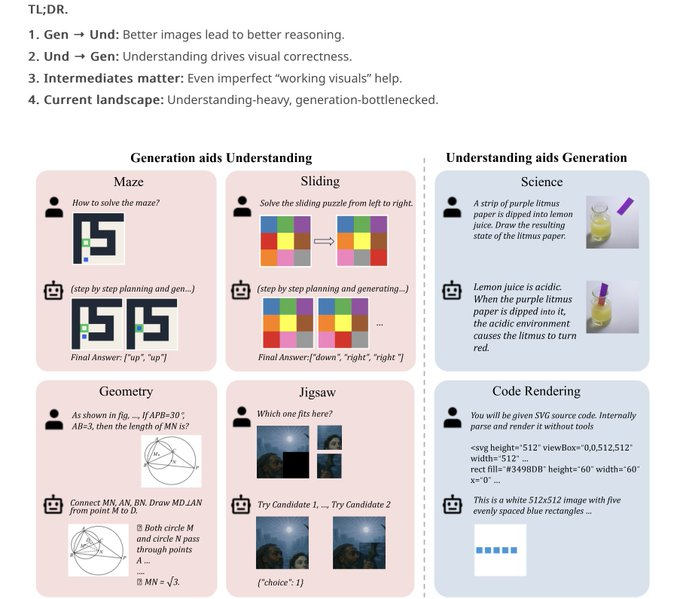
🚀 Uni-MMMU is accepted to #ACL2026 Main Conference!
A comprehensive benchmark that evaluates the synergy between visual understanding👁️ and generation🎨 in unified models.
Website: https://t.co/OYGrFkVeQs
Paper: https://t.co/DZK7uuDp2G
Code: https://t.co/wtVg97qUTs
#UniMMMU
🚀 DeepSeek-V4 Preview is officially live & open-sourced! Welcome to the era of cost-effective 1M context length.
🔹 DeepSeek-V4-Pro: 1.6T total / 49B active params. Performance rivaling the world's top closed-source models.
🔹 DeepSeek-V4-Flash: 284B total / 13B active params. Your fast, efficient, and economical choice.
Try it now at https://t.co/GCdiMzk1Dl via Expert Mode / Instant Mode. API is updated & available today!
📄 Tech Report: https://t.co/drlDrxkYtp
🤗 Open Weights: https://t.co/T13Y8i7SDM
1/n
Meet Kimi K2.6 Agent Swarm 👋
Highlights:
🔹 Swarms, elevated - 300 parallel sub-agents × 4,000 steps per run (up from 100 / 1,500 in K2.5).
🔹 Outputs are real files, not chat - one run delivers 100+ files, 100,000-word literature reviews, or 20,000-row datasets.
🔹Heterogeneous skills - search, analysis, coding, long-form writing, and visual generation all running in parallel
🔗Try it at: https://t.co/2Tu8McUaUa
Moonshot’s Kimi K2.6 is the new leading open weights model. Kimi K2.6 lands at #4 on the Artificial Analysis Intelligence Index (54) behind only Anthropic, Google, and OpenAI (all 57)
Key takeaways:
➤ Increase in performance on agentic tasks: @Kimi_Moonshot's Kimi K2.6 achieves an Elo of 1520 on our GDPval-AA evaluation, which is a marked improvement over Kimi K2.5’s Elo of 1309. GDPval-AA is our leading metric for general agentic performance, measuring the performance on knowledge work tasks such as preparing presentations and analysis. Models are given code execution and web browsing tools in an agentic loop via our open source reference agentic harness called Stirrup. This continues Kimi K2.6’s strength in tool use, maintaining a 96% score on τ²-Bench Telecom, placing it among other frontier models in this category.
➤ Low hallucination rate: Kimi K2.5 scores 6 on the AA-Omniscience Index, our knowledge evaluation measuring both accuracy and hallucination rate. This score is primarily driven by a comparatively low hallucination rate of 39% (reduced from Kimi K2.5’s 65%), indicating a greater capability to abstain rather than fabricate knowledge when the model is uncertain. Kimi K2.6’s low hallucination rate places it similarly to other models such as Claude Opus 4.7 (36%) and MiniMax-M2.7 (34%)
➤ High token usage: Kimi K2.6 demonstrates high token usage, but is in line with other frontier models in the same intelligence tier. To run the full Artificial Analysis Intelligence Index, Kimi K2.6 used ~160M reasoning tokens. This is slightly lower than Claude Sonnet 4.6 (~190M reasoning tokens) but much higher than GPT 5.4 (~110M reasoning tokens).
➤ Open weights: Kimi K2.6 is a Mixture-of-Experts (MoE) model with 1T total parameters and 32B active, same as the previous two generations of models Kimi K2 Thinking and Kimi K2.5. Kimi K2.6 again pushes the open weights frontier in intelligence.
➤ Third Party Access: Kimi K2.6 is accessible through Moonshot’s First Party API as well as third party API providers Novita, Baseten, Fireworks, and Parasail
➤ Multimodality: Kimi K2.6 supports Image and Video input and text output natively. The model’s max context length remains 256k.
Further analysis in the threads below.
BTW, I vibe coded this LLM inference engine example in the official blog using Kimi K2.6 on my laptop😘.
I choose to use zig, not because it is easy, but because it is hard.
I've never written any zig and metal code in my entire life, and I can just build whatever I imagine with Kimi K2.6.
https://t.co/CQM5UlYb2K
Meet Kimi K2.6: Advancing Open-Source Coding
🔹Open-source SOTA on HLE w/ tools (54.0), SWE-Bench Pro (58.6), SWE-bench Multilingual (76.7), BrowseComp (83.2), Toolathlon (50.0), Charxiv w/ python(86.7), Math Vision w/ python (93.2)
What's new:
🔹Long-horizon coding - 4,000+ tool calls, over 12 hours of continuous execution, with generalization across languages (Rust, Go, Python) and tasks (frontend, devops, perf optimization).
🔹Motion-rich frontend - Videos in hero sections, WebGL shaders, GSAP + Framer Motion, Three.js 3D.
🔹Agent Swarms, elevated - 300 parallel sub-agents × 4,000 steps per run (up from K2.5's 100 / 1,500). One prompt, 100+ files.
🔹Proactive Agents - K2.6 model powers OpenClaw, Hermes Agent, etc for 24/7 autonomous ops.
🔹Claw Groups (research preview) - bring your own agents, command your friends', bots & humans in the loop.
-
K2.6 is now live on https://t.co/YutVbwktG0 in chat mode and agent mode.
For production-grade coding, pair K2.6 with Kimi Code: https://t.co/uvoSJKyGCY
-
🔗 API: https://t.co/EOZkbOwCN4
🔗 Tech blog: https://t.co/9wWvgIQSS3
🔗 Weights & code: https://t.co/Be0hjs2RTP
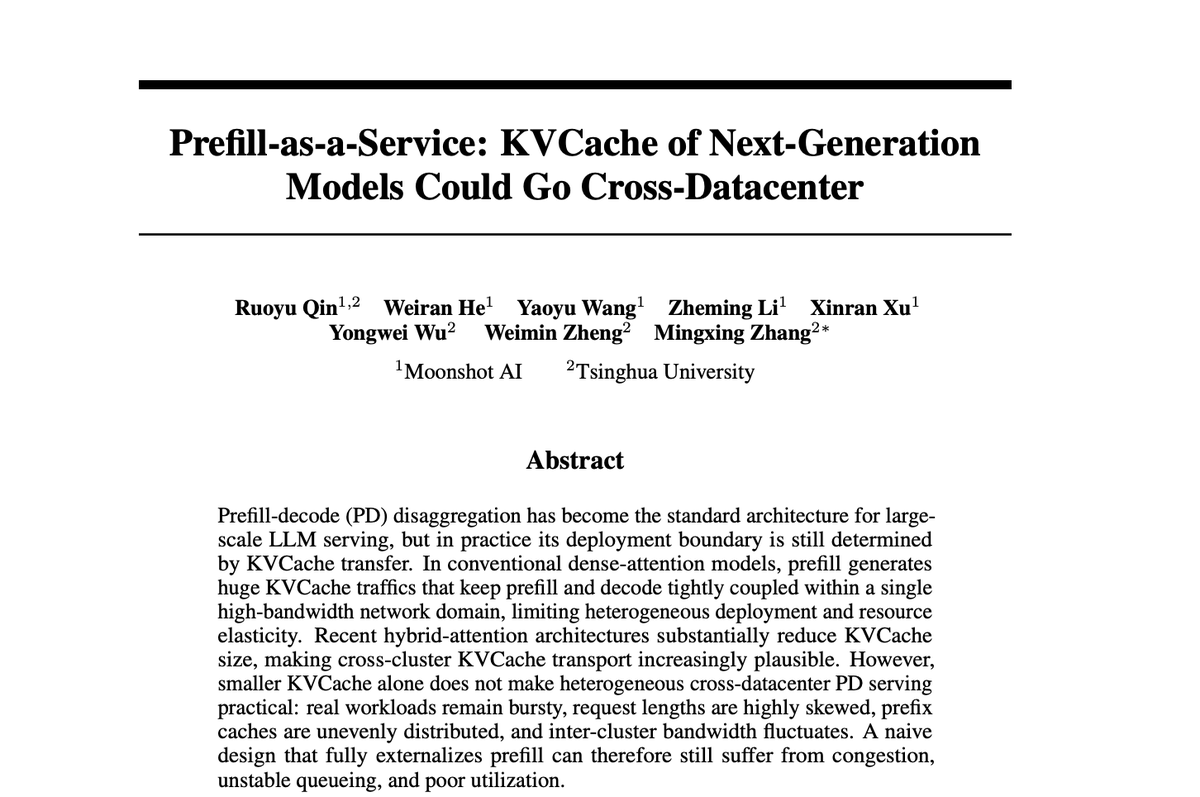
We push Prefill/Decode disaggregation beyond a single cluster: cross-datacenter + heterogeneous hardware, unlocking the potential for significantly lower cost per token.
This was previously blocked by KV cache transfer overhead. The key enabler is our hybrid model (Kimi Linear), which reduces KV cache size and makes cross-DC PD practical.
Validated on a 20x scaled-up Kimi Linear model:
✅ 1.54× throughput
✅ 64% ↓ P90 TTFT
→ Directly translating into lower token cost.
More in Prefill-as-a-Service: https://t.co/If8fA3t9Og
Launch Week — Day 2: Terrarium
🧊 Most existing data engines are built for single-session, reactive agents: the environment does not change on its own, and nearly all state changes are triggered by the agent itself.
But real-world proactive agents operate over time on long-horizon tasks. While the agent is working, the world keeps changing.
📧 Emails arrive mid-task.
📊 Databases get updated.
🔄 Agents must detect these changes on their own — and in some cases, proactively take action in response.
We’re open-sourcing 🪴 Terrarium — a multi-turn data engine for proactive agents in living environments, designed for agents like 🦞 OpenClaw, 📟 Claude Code, and others.
You build a world. Place an agent inside. Watch how it adapts.
GitHub: https://t.co/RicIYB2wft
we need agent evals that are really consistent with real world usages. otherwise people are optimizing foundation models for the wrong direction. the problem of targeting is even bigger than benchmaxxing.
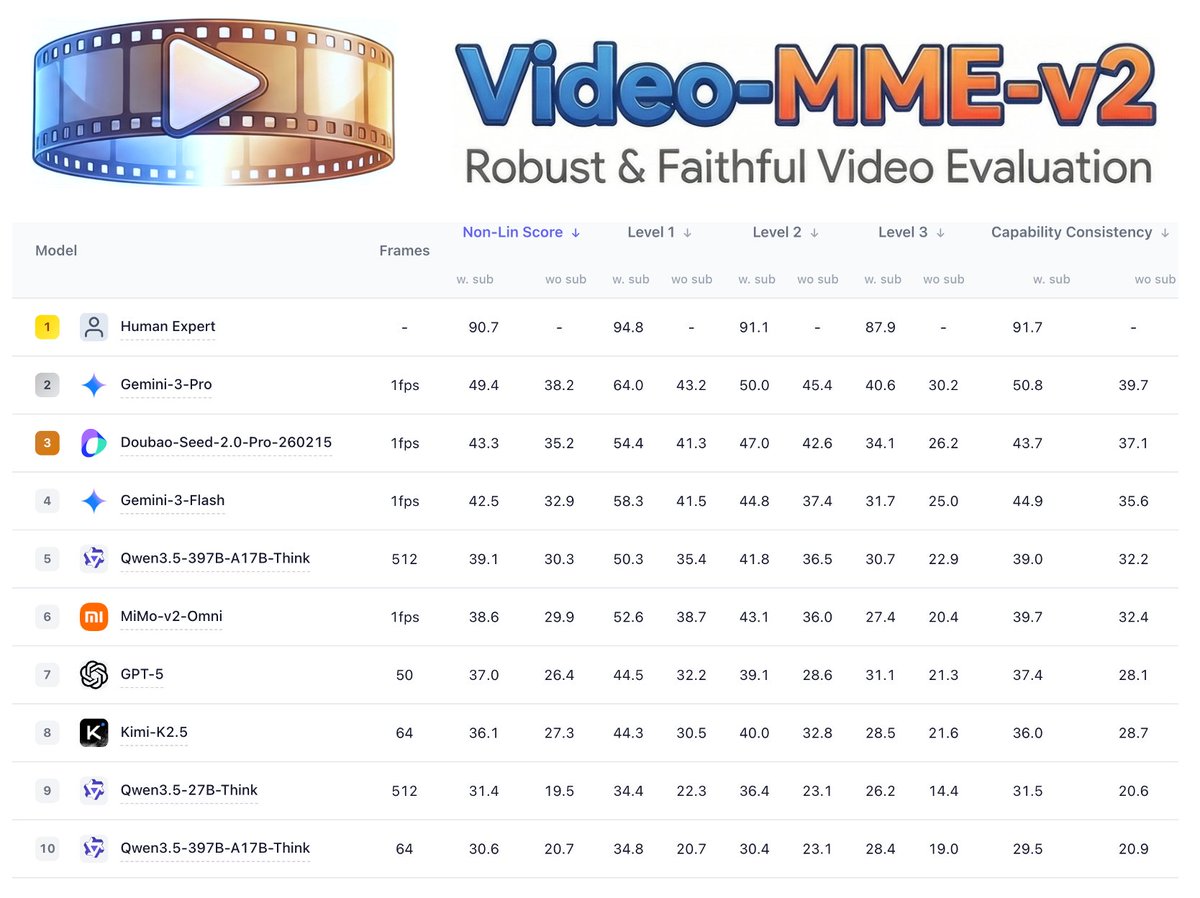
🤩Next-Generation Video Understanding Benchmark🤩
📽️Video-MME-v2📽️ provides a robust and faithful evaluation of video models with two highlights:
* Progressive Multi-Level Evaluation Dimensions
* Grouped Non-Linear Evaluation Mechanism
- Leaderboard: https://t.co/pc1f7J55Pf