NEWS: First post-quantum Bitcoin (sBTC) transfer on Stacks, Bitcoin’s execution layer.
Transfer live on mainnet.
Shows how Bitcoin layers can be ready for post-quantum even before Bitcoin L1. More importantly, we can help contribute to Bitcoin’s quantum upgrade. Forward!
@ZestProtocol@Stacks Nice job guys, truly. You build great products.
All of @Stacks will benefit from advancements in DEX tooling.
Even more likely now that we grow the pie and onchain BTC economy.
These pools will be included in trading routes on @Bitflow in a few minutes
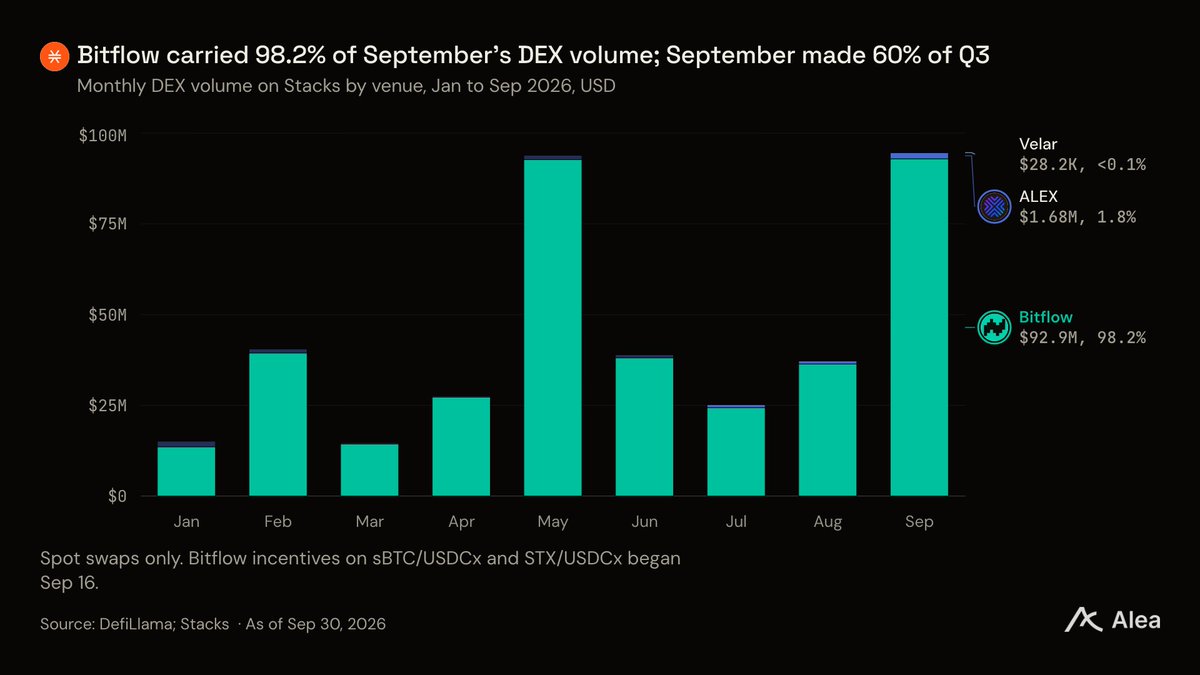
DEX volume on Stacks reached $94.6M in September, 2.5 times August's $37.3M.
Bitflow carried 97.8% of Q3's volume. Its pools turned over 22.3x in September, the highest of the four months.
NEWS: Bullish (NYSE:BLSH) has deployed Bitcoin into bond 3 launch of Stacks.
This bond was for 1,000 BTC. Bullish, along with 21Shares maxed out the capacity.
Bond 3 was fully sold out!
Bullish 🐂
5/ The trading market for Bitcoin is live.
@Bitflow is the open-source trading market for Bitcoin on Stacks, where holders trade BTC and provide liquidity to earn.
Bitflow is leading this category, with billions of USD in cumulative volume flowing through the exchange.
Stacks is building Bitcoin capital markets, the yield, credit and trading markets that Bitcoin, the world’s leading digital asset, still lacks.
Stacks Founder @muneeb explains why they matter 🟧
Learn more below. 1/7 👇
THE BLOCK: Franklin Templeton launched two ETFs combining U.S. equities and bitcoin exposure, with dividends from the underlying stocks systematically reinvested into bitcoin, the asset manager said Thursday.
The Franklin U.S. Equity Bitcoin DRIP Index ETF (FBEQ) tracks an index of about 500 large-cap U.S. companies, while the Franklin U.S. Innovation Bitcoin DRIP Index ETF (FIBT) tracks 100 large Nasdaq-listed companies.
Both ETFs will have initial allocations of 95% to equities and 5% to bitcoin, and expense ratios of 0.09% and 0.19%, respectively.
An important discussion.
I hate the term “payments” for this but it’s true that if people aren’t transferring value using bitcoin then what we’ve built is pretty uninteresting (even if financially valuable).
For all of my fellow losers. Today is 10/24/26
Pythagorean triple day: 10²+ 24²= 26²
Can only happen in first third of a century and will be last one of our lifetime (unless you live another 80+ years)
If a protocol bragged about TVL and never mentioned fees and/or rewards paid out, would you trust it with your Bitcoin?
That's where @Stacks and @bitflow stands out. Real user, real utility, real yield.
1/ Limit Orders are live on Bitflow 🌊
Name your price. Go touch grass. Bitflow’s keeper goes to work and tries to fill your order when the pair hits your target or better. if it can’t fill, it waits. 👇
Bitcoin’s execution layer.
Increasingly convinced that there will likely be one main execution layer for Bitcoin. Game theory of staking dynamics, combined with liquidity concentration, points to this.
Staking dynamics: Ethereum has one major source of low-risk yield: the consensus yield. Even though you could earn higher-risk, higher-return yield elsewhere, most capital goes to the lowest-risk option: the effective ETH fed rate. Multiple on-chain Bitcoin yield options would converge on the lowest-risk yield that is meaningful enough. Offering higher yield with added risk can’t lure that capital away. The Bitcoin layer that can offer the effective BTC fed rate yield at scale is the one with the largest market cap and economy size.
Liquidity concentration: We saw this with Solana vs. Ethereum L2s. A single execution chain offers better UX, and everyone benefits from concentrated liquidity rather than fragmented liquidity and assets spread across multiple L2s (the various Ethereum ones).
We can try to put a valuation framework for what Bitcoin’s execution layer should be worth (an exercise for another post). Right now, I’m just making the point that the probability of getting N different execution layers is very low (unstable equilibrium and bad UX for users). Either one major execution layer exists where, say, 10-30% of BTC supply is actively deployed, or Bitcoin remains a passive asset.
I’m an optimist by nature; I believe that we’ll get one major Bitcoin execution layer.
🚨CLOSED SOURCE SOFTWARE IS DEAD
... especially in web3. Security researchers are now achieving hash-perfect recompilation of Rust projects' source code, using AI. And then they find Critical vulnerabilities.
Insanely cool work by @osec_io, love it👏
https://t.co/M69RdaRFCG