This is wild... Russia seems to be threatening a *commercial* satellite that provides imaging services to Ukraine:
▸ starting about two weeks ago, Russia started maneuvering five (!) of their classified satellites to the same orbital inclination as the ICEYE satellite
▸ these burns were big, on the order of 100 m/s, clearly using chemical propulsion given the speed of the burns — very expensive and deliberate maneuvers
▸ as of last Friday, all five Russian satellites are now co-planar, at ~97.8° inclination, with three of ICEYE's satellites, and aligned in other orbital elements (e.g. RAAN) that make it clear they're specifically targeting this set
▸ I am a little skeptical that Russia is specifically targeting -X36 — there are two other satellites at the same inclination/RAAN (-X37 and -X38) — but the Russian sats are now all within striking distance of -X36, which is why people are concerned about it specifically; the closest cross-track distance is an estimated 500 meters (!!), all while the satellites are orbit 550 kilometers above Earth
▸ Russia has unleashed a cyberattack on a commercial satellite before (Viasat), and it is official Russian policy that commercially-owned infrastructure that aids in military efforts "may be legitimate target[s] for a retaliatory strike.”
▸ there's speculation that this could be a precursor to an RPO mission (meaning: physically grabbing the satellite or some other kind of non-kinetic attack like blinding/jamming)
Worth tracking closely. And unfortunately more evidence that space is militarizing, fast.
C.S. Lewis:
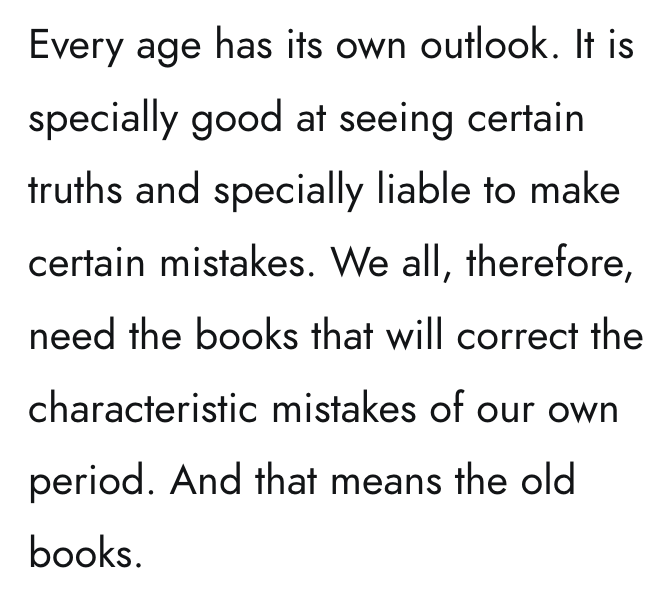
> Every age has its own outlook. It is specially good at seeing certain truths and specially liable to make certain mistakes. We all, therefore, need the books that will correct the characteristic mistakes of our own period. And that means the old books.
> All contemporary writers share to some extent the contemporary outlook—even those, like myself, who seem most opposed to it. Nothing strikes me more when I read the controversies of past ages than the fact that both sides were usually assuming without question a good deal which we should now absolutely deny. They thought that they were as completely opposed as two sides could be, but in fact they were all the time secretly united—united with each other and against earlier and later ages—by a great mass of common assumptions.
> We may be sure that the characteristic blindness of the twentieth century—the blindness about which posterity will ask, “But how could they have thought that?”—lies where we have never suspected it, and concerns something about which there is untroubled agreement between Hitler and President Roosevelt or between Mr. H. G. Wells and Karl Barth. None of us can fully escape this blindness, but we shall certainly increase it, and weaken our guard against it, if we read only modern books. Where they are true they will give us truths which we half knew already. Where they are false they will aggravate the error with which we are already dangerously ill.
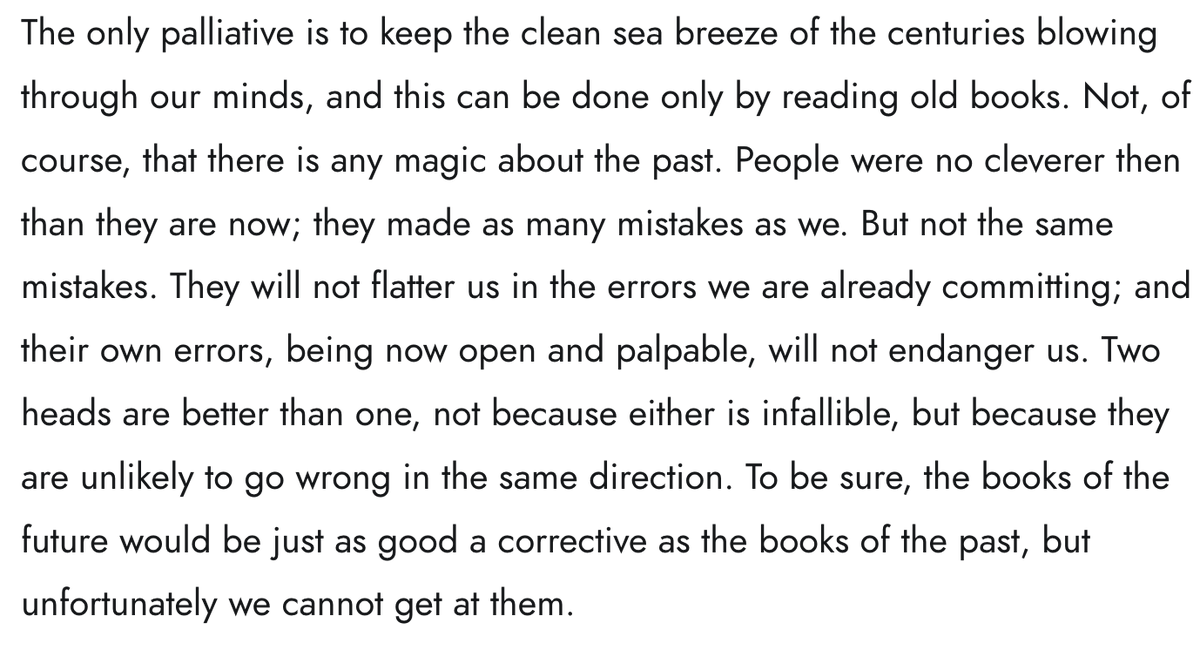
> The only palliative is to keep the clean sea breeze of the centuries blowing through our minds, and this can be done only by reading old books. Not, of course, that there is any magic about the past. People were no cleverer then than they are now; they made as many mistakes as we. But not the same mistakes. They will not flatter us in the errors we are already committing; and their own errors, being now open and palpable, will not endanger us. Two heads are better than one, not because either is infallible, but because they are unlikely to go wrong in the same direction. To be sure, the books of the future would be just as good a corrective as the books of the past, but unfortunately we cannot get at them.
https://t.co/46Fm8PdV2X
You buy a German anvil. It contains 83 moving parts and requires winding twice a day. It's forged from excellent steel, holds tolerances across all three striking faces to within three microns, includes a beautifully indexed horn-adjustment mechanism nobody asked for, and requires a proprietary 11-point spanner should you need to replace the rebound calibration bushing. It runs flawlessly for years, but one day it starts up in limp mode because the onboard anvil-management system detects that it's overdue for its 50,000-strike inspection.
You search AliExpress for a Chinese anvil, and are presented with a multitude of offerings from such household-name brands as DUKXJYIBF, HDBTGMXI, AND UEJQIP. They're all priced to within a few pennies of each other, appear completely identical except for the nameplate, and obviously all came out of the same factory. You text your blacksmith friend to ask if they're legit. He tells you he got one like that from KIXJBU a few years ago, and that it's been great and a terrific deal. You thank him, but KIXJBU seems to have folded so you buy the one from UEJQIP. When it arrives, it feels suspiciously light. You scratch it and realize it's iron-plated aluminum.
You buy an American anvil. It's five times the price of the competition, but it comes from a brand that your great-grandfather used to love. It comes boxed with a warranty registration postcard, twenty pages of safety instructions, assay certificate, and a regulatory slip which lists its FCC certification and ITAR registration. It looks just like your friend's KIXJBU. There's a "Made In China" sticker on the bottom.
You buy a Russian anvil. It arrives coated in cosmoline, wrapped in newspaper from 1974, and weighing 40% more than advertised. The finish looks like it was machined with a shovel. The face is not flat, but somehow this does not matter. You drop it off a truck, accidentally leave it outside for six winters, and use it to straighten a bulldozer blade. It's fine.
You buy a Swedish anvil. It comes flat-packed in a long cardboard box with cheerful Neo-Grotesk lettering and a line drawing of a smiling man assembling it with an Allen key. The instructions contain no words, only pictograms showing the anvil face, horn, waist, feet, and 112 identical-looking fasteners. Halfway through assembly, you discover that the pritchel hole was installed upside down, but only because you used peg B17 where you should have used peg B71. Once assembled, it is clean, stable, and works better than it has any right to. You immediately wonder whether you should have bought two.
You buy a Japanese anvil. It arrives wrapped in rice paper inside a paulownia box, accompanied by a certificate bearing three generations of signatures and a photograph of the first production example being presented to the Emperor. The face has been hand-polished by a seventy-eight-year-old master whose family has made striking surfaces since the Muromachi period. You are given detailed instructions for oiling it with a cloth folded in a specific way. It is the most beautiful object you own. You never quite work up the nerve to strike it.
when i was a kid, my dad (formerly a physics grad student) was shittalking the romans for building these giant aqueducts when the greeks understood centuries earlier that water would go back up a hill
i asked him how they would have held the pressure and he was like "huh."
There's a common misconception that Brutalist buildings were unpainted, but thanks to microscopic analysis of the exteriors we can now recreate what they looked like in their prime.
I missed this but lol. We issued a Section 303 PD for transformers and grid components in 2022. Trump rescinded it as part of a “Green New Scam” thing and now realizes he needs it.
When simulation becomes the norm, it weakens the human capacity for discernment. As a result, our social bonds close in upon themselves, forming self-referential circuits that no longer expose us to reality. We thus come to live within bubbles, impermeable to one another. Feeling threatened by anyone who is different, we grow unaccustomed to encounter and dialogue. In this way, polarization, conflict, fear and violence spread. What is at stake is not merely the risk of error, but a transformation in our very relationship with truth.
A 1979 PDP-11/44 (an early Programmed Data Processor) ran a simple AI model, proving efficient code can make AI work even on very limited hardware.
📹Daves Garage






![pronounced_kyle's tweet photo. This is wild... Russia seems to be threatening a *commercial* satellite that provides imaging services to Ukraine:
▸ starting about two weeks ago, Russia started maneuvering five (!) of their classified satellites to the same orbital inclination as the ICEYE satellite
▸ these burns were big, on the order of 100 m/s, clearly using chemical propulsion given the speed of the burns — very expensive and deliberate maneuvers
▸ as of last Friday, all five Russian satellites are now co-planar, at ~97.8° inclination, with three of ICEYE's satellites, and aligned in other orbital elements (e.g. RAAN) that make it clear they're specifically targeting this set
▸ I am a little skeptical that Russia is specifically targeting -X36 — there are two other satellites at the same inclination/RAAN (-X37 and -X38) — but the Russian sats are now all within striking distance of -X36, which is why people are concerned about it specifically; the closest cross-track distance is an estimated 500 meters (!!), all while the satellites are orbit 550 kilometers above Earth
▸ Russia has unleashed a cyberattack on a commercial satellite before (Viasat), and it is official Russian policy that commercially-owned infrastructure that aids in military efforts "may be legitimate target[s] for a retaliatory strike.”
▸ there's speculation that this could be a precursor to an RPO mission (meaning: physically grabbing the satellite or some other kind of non-kinetic attack like blinding/jamming)
Worth tracking closely. And unfortunately more evidence that space is militarizing, fast.](https://pbs.twimg.com/media/HJWAMSpbwAAyxMc.jpg)