Everyone needs to see this. Hundreds of Israeli settlers are coming down from hilltops and setting entire Palestinian villages on fire. Full on pogroms.
THIS IS SATANIC ✡️🇮🇱
An Israeli soldier throws a stun grenade into a car carrying a Palestinian family, trapping them inside to absorb the blast.
Reports confirm one of the children inside is now permanently blinded for life.
🚨URGENT: Dr. Hussam Abu Safiya’s life is in immediate danger, Physicians for Human Rights Israel and his lawyer warned Saturday, after a prison visit revealed the director of Kamal Adwan Hospital bearing fresh, severe injuries to his head, eyes, ears, and neck, so disfigured his own attorney initially struggled to recognize him.
🔹Attorney Nasser Odeh, who saw Abu Safiya Thursday at the underground Rakefet interrogation facility in Nitzan Prison, said he arrived shackled hand and foot, escorted by masked guards, struggling to breathe and speak, unable to sit upright, and repeatedly on the verge of losing consciousness.
🔹Abu Safiya told him that after his Supreme Court appeal was heard June 10, four or five guards entered his solitary cell at Ganot Prison and beat him with a hammer and batons, and that since his June 24 transfer to Rakefet he has been beaten daily, losing consciousness several times without receiving medical treatment.
🔹“This is the last time you will see me,” he told his lawyer. “They brought me here to kill me. I don’t see myself surviving. This is the end.”
🔹PHRI notes the escalation in torture began directly after Abu Safiya challenged his detention in court. He has been held without charge since December 27, 2024, under Israel’s Unlawful Combatants Law.
🔹The group has appealed to Israel’s attorney general and prison service demanding his immediate transfer, an independent medical examination, and an urgent judicial visit “before it is too late.”
Photo: Amnesty International
Jewish-American orthopedic surgeon Dr. Mark Perlmutter, says he witnessed the aftermath of Israeli soldiers tying two Palestinian children’s hands behind their backs and burying them alive at Nasser Hospital, their cries silenced beneath the dirt.
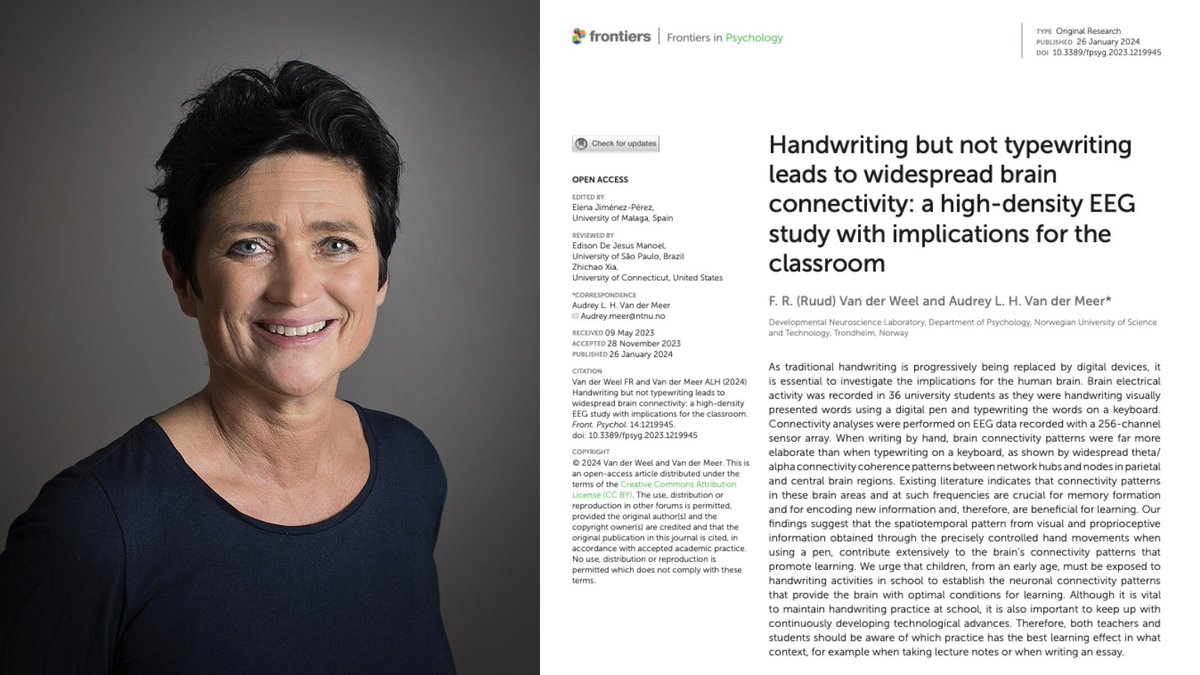
A Norwegian neuroscientist spent 20 years proving that the act of writing by hand changes the human brain in ways typing physically cannot, and almost nobody outside her field has read the paper.
Her name is Audrey van der Meer.
She runs a brain research lab in Trondheim, and the paper that closed the argument was published in 2024 in a journal called Frontiers in Psychology. The finding is brutal enough that it should have changed every classroom on Earth.
The experiment was simple. She recruited 36 university students and put each one in a cap with 256 sensors pressed against their scalp to record brain activity. Words flashed on a screen one at a time.
Sometimes the students wrote the word by hand on a touchscreen using a digital pen, and sometimes they typed the same word on a keyboard. Every neural response was recorded for the full five seconds the word stayed on screen.
Then her team looked at the part of the data most researchers had ignored for years, which is how different parts of the brain were communicating with each other during the task.
When the students wrote by hand, the brain lit up everywhere at once.
The regions responsible for memory, sensory integration, and the encoding of new information were all firing together in a coordinated pattern that spread across the entire cortex. The whole network was awake and connected.
When the same students typed the same word, that pattern collapsed almost completely.
Most of the brain went quiet, and the connections between regions that had been alive seconds earlier were nowhere to be found on the EEG.
Same word, same brain, same person, and two completely different neurological events.
The reason turned out to be something nobody had really paid attention to before her work. Writing by hand is not one motion but a sequence of thousands of tiny micro-movements coordinated with your eyes in real time, where each letter is a different shape that requires the brain to solve a slightly different spatial problem.
Your fingers, wrist, vision, and the parts of your brain that track position in space are all working together to produce one letter, then the next, then the next.
Typing throws all of that away. Every key on a keyboard requires the exact same finger motion regardless of which letter you are pressing, which means the brain has almost nothing to integrate and almost no problem to solve.
Van der Meer said it plainly in her interviews.
Pressing the same key with the same finger over and over does not stimulate the brain in any meaningful way, and she pointed out something that should scare every parent who handed their kid an iPad.
Children who learn to read and write on tablets often cannot tell letters like b and d apart, because they have never physically felt with their bodies what it takes to actually produce those letters on a page.
A decade before her, two researchers at Princeton ran the same fight using a completely different method and ended up at the same answer. Pam Mueller and Daniel Oppenheimer tested 327 students across three experiments, where half took notes on laptops with the internet disabled and half took notes by hand, before testing everyone on what they actually understood from the lectures they had watched.
The handwriting group won by a wide margin on every question that required real understanding rather than surface recall.
The reason was hiding in the transcripts of what the two groups had actually written down.
The laptop students typed almost word for word, capturing more total content but processing almost none of it as they went, while the handwriting students physically could not write fast enough to transcribe a lecture in real time, which forced them to listen carefully, decide what actually mattered, and put it in their own words on the page.
That single act of choosing what to keep was the learning itself, and the keyboard had quietly skipped the choosing and skipped the learning along with it.
Two studies. Two countries. Same answer.
Handwriting makes the brain work. Typing lets it coast.
Every note you have ever typed instead of written went into your brain through a thinner pipe. Every meeting, every book highlight, every idea you captured on your phone instead of on paper was processed at half depth.
You did not forget those things because your memory is bad. You forgot them because typing never woke the part of the brain that would have made them stick.
The fix is the thing your grandmother already knew.
Pick up a pen. Write the thing down. The slower road is the faster one.
So to sum up:
- the EU cut itself off from Russian oil and gas
- is suffering from unprecedented energy supply issues from the Middle-East
- has industrial energy costs 2-3X higher than its competition
- produces 40% LESS electricity than the US despite having 33% MORE people (and 75% less electricity than China)
And their move - right now, in this context - is to deliberately raise the cost and slow the rollout of Chinese solar, the cheapest and fastest-deploying form of electricity in the market, on the flimsy pretext it's a "security threat."
You'd think the bigger "security threat" would be having your industrial base relocate to countries that didn't voluntarily price themselves out of energy. Or, for that matter, ensuring that any new AI infrastructure or industrial projects gets built anywhere but Europe.
Beyond parody.
Feel confused by the complexity of Middle Eastern history? @EmpirePodUK is here to help. Over the next month we will provide all the background you need to understand the current conflicts.
In our first episode we look at the aftermath of the 1967 War. How did the Six-Day War redraw the map of the Middle East and establish Israel as a regional superpower? How did the catastrophic Arab defeat unleash a new wave of armed Palestinian resistance? Did the road to modern Islamic extremism begin in Egyptian prisons?
https://t.co/CvBe7MbMR6
Indonesia is on track to become the world champion of tropical deforestation. Under the Prabowo administration, over 433,000 hectares were cleared in 2025, nearly double the previous year. Driven by mining and palm oil, the loss equals six times the size of Singapore.
Every decision maker in politics, industry etc. should read this. Or better yet the original WMO report it’s about (linked in the article).
And then think very seriously:
What am I doing to stop this?
Is it enough?
How do I want to be remembered?
https://t.co/nXQxccpDZW
First, the Omani FM came out and revealed that there was a deal on the table that met Trump's demands, but that he instead chose war.
And now, it is revealed that the British National Security Advisor was also part of the talks, and he too attests to the fact that A) there was no imminent threat from Iran, B) Trump could have gotten a surprisingly good deal if he stuck to diplomacy.
But the perhaps most damning quote in the story comes at the end, attributed to an unnamed diplomat:
“We regarded Witkoff and Kushner as Israeli assets that dragged a president into a war he wants to get out of.”
https://t.co/7NWeHUvVDA
Similarities between Israel's bombing of Gaza and Tehran are growing stronger.
In both cases, it appears Israel is using AI without any human oversight.
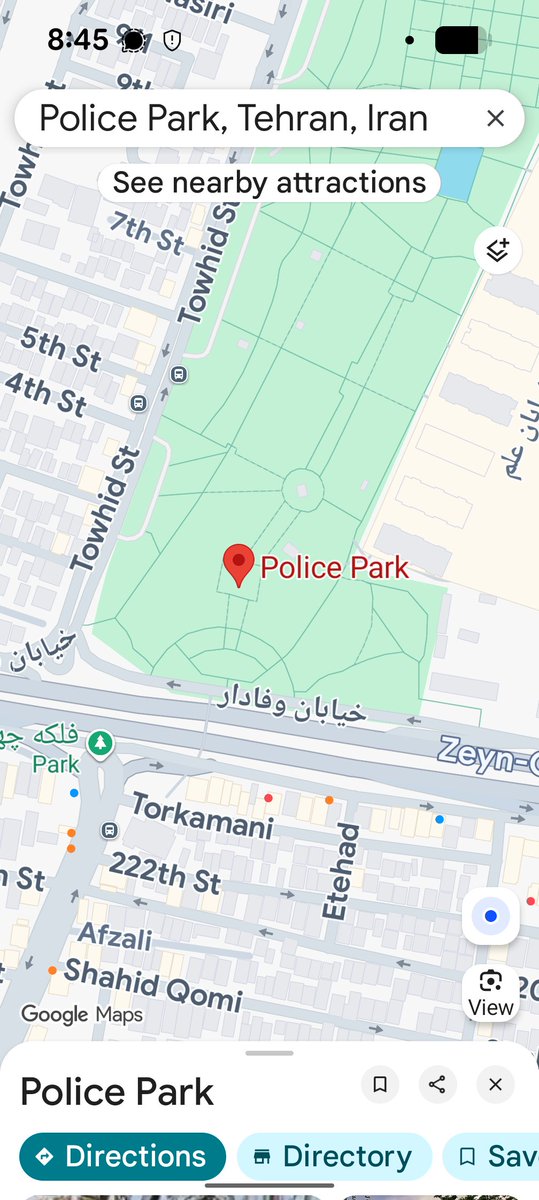
For instance, Israel has bombed a park in Tehran called "Police park." It has nothing to do with the police.
But it appears AI identified it as a target since Israel is bombing all government related buildings.
No one in Israel brothered to check and find out that it is just a park.
This is Ferdowsi Sq central Tehran. People on the ground say the bombing campaign is beyond anything they have seen and seemingly indiscriminate.
Increasingly, Israel and the US appear to be following the Gaza playbook, having failed to achieve a quick regime implosion.
Some observations and comments on Trump and Israel's war on Iran:
1. Tehran is not looking for a ceasefire and has rejected outreach from Trump. The reason is that they believe they committed a mistake by agreeing to the ceasefire in June - it only enabled the US and Israel to restock and remobilize to launch war again. If they agree to a ceasefire now, they will only be attacked again in a few months.
2. For a ceasefire to be acceptable, it appears difficult for Tehran to agree to it until the cost to the US has become much higher than it currently is. Otherwise, the US will restart the war at a later point, the calculation reads.
3. Accordingly, Iran has shifted its strategy. It is striking Israel, but very differently from the June war. There is a constant level of attack throughout the day rather than a salvo of 50 missiles at once. Damage will be less, but that isn't a problem because Tehran has concluded that Israel's pain tolerance is very high - as long as the US stays in the war. So the focus shifts to the US.
4. From the outset, and perhaps surprisingly, Iran has been targeting US bases in the region, including against friendly states. Tehran calculates that the war can only end durably if the cost for the US rises dramatically, including American casualties. After the assassination of Ayatollah Khamenei, Iran says it has no red lines left and will go all out in seeking the destruction of these bases and high American casualties.
5. Iran understands that many in the American security establishment had been convinced that Iran's past restraint reflected weakness and an inability or unwillingness to face the US in a direct war. Tehran is now doing everything it can to demonstrate the opposite - despite the massive cost it itself will pay. Ironically, the assassination of Khamenei facilitated this shift.
6. One aspect of this is that Iran has now also struck bases in Cyprus, which have been used for attacks against Iran. Iran is well aware that this is an attack on a EU state. But that seems to be the point. Tehran appears intent on not only expanding the war into Persian Gulf states but also into Europe. Note the attack on the French base in the UAE. For the war to be able to end, Europe too has to pay a cost, the reasoning appears to be.
7. There appears to be only limited concern about the internal situation. The announcement of Khamenei's death opened a window for people to pour onto the streets and seek to overthrow the regime. Though expressions of joy were widespread, no real mobilization was seen. That window is now closing, as the theocratic system closes ranks and establishes new formal leadership.
Again: The question "How will this end?" should have been asked before this war was triggered. It wasn't.
An Iranian man left this comment on my YouTube channel. This is without a doubt the single best explanation of the reality facing Iranian people today👇
"As an Iranian, I can tell you the situation is no longer just political—it's existential. We are trapped between two collapsing structures: one internal, one external. On one hand, we face a deeply dysfunctional government, led by the Supreme Leader and the Islamic Republic’s unelected institutions.
Decades of economic mismanagement, suppression of dissent, and brutal ideological control have alienated multiple generations. No one believes in reform anymore—because every attempt has either been co-opted or crushed. But here's the paradox: We are also terrified of regime collapse—because we've watched the aftermath of Western intervention in countries like Iraq, Libya, Syria, and Afghanistan. Each was promised freedom; each descended into chaos, civil war, or foreign occupation.
So no, we don't trust the U.S. or Israel. Not because we support our regime—but because we know how imperial powers treat ‘liberated’ nations in the Middle East.
Freedom, in their language, often means vacuum, fire, and permanent instability. Right now, many Iranians live with three truths at once: The Islamic Republic is morally and politically bankrupt. The alternatives offered by foreign actors are not liberation—they’re collapse.
A bad government is survivable. No government is not. We are not silent because we agree. We are cautious because we’ve learned—too well—what happens when superpowers decide to "help." In a sentence: Iran is a nation held hostage by its own regime, but haunted by the fate of its neighbors. We are stuck in a house we hate, surrounded by fires we fear more."
Guardian fuckery continues.
The mass death of billions is getting closer, but hey, "most people are unaware" says the ever innocent Guardian newspaper.
Hmm... wonder why that might be?
Maybe it's because its latest article on the biggest shit show in the history of humanity is nestled in the middle of other day's news - i.e., articles on reading being a good way to stop dementia, or an actor dying, and the Liverpool/Sunderland match.
Maybe, just maybe, it's because the Guardian and the rest of the liberal media are so pathetically incapable of calling a spade a spade. What the fuck does "a hellish "hothouse" earth" actually mean? Let's look it up. Oh yes, in the appendix of Prof Tim Lenton's last report it says 2 billion deaths at 2C, coming along in the next 10 years or so. OH! okay. A bit more important than a cure for a disease, an actor's dying, and a football match.
And last maybe just, really just maybe - if the Guardian really wanted to make people "aware" then well there are a hundred ways it could do it, but they would all involve risking the finances, status and privileges of the western liberal class - and well, that really would not do - at least not to save those brown and black people "over there" before "it" comes for us.
Why do you think the Guardian supported liberal slave owners two hundred years ago?
Some things never change.
(Oh yes, and the nice picture doesn't really help either, wouldn't you say?)
https://t.co/SADVCbEib1