Can Bitcoin run smart contracts?
RGB++ is a non-EVM Bitcoin layer that combines Bitcoin’s UTXO model with the RGB protocol and the Nervos blockchain to create native Bitcoin smart contracts.
Our research team wrote a beginner’s guide to how it works. Check it out below:
https://t.co/vTA5DyLXEM
We’re very happy to see crypto-agility being taken seriously by others in the industry.
Native account abstraction for EOAs is clearly the right path for Ethereum.
Right now, Ethereum EOAs are tightly linked to ECDSA keys. In practice, that means regular user accounts are bound to one cryptographic signature system.
EIP-8141 tries to move Ethereum closer to full native account abstraction, where user authorization is decoupled from one protocol-defined signature path.
In simple terms, the proposal introduces a new Ethereum transaction type that breaks a transaction into separate “frames” and allows accounts to define their own validation logic.
Think of a normal Ethereum transaction today as one bundled action:
“Here is my ECDSA signature. I am the sender. I pay gas. Now execute this action.”
EIP-8141 wants to split that into modular steps:
“First, run this validation logic.”
“Then approve who is allowed to act.”
“Then decide who pays gas.”
“Then execute one or more actions.”
This would make Ethereum EOAs far more flexible — or, as we would put it in @NIST terms, more crypto-agile.
And crypto-agility is the key to post-quantum readiness.
The deeper problem is not simply choosing a new post-quantum signature scheme. It is giving accounts the ability to use different signature schemes, and allowing multiple schemes to coexist at the same time.
This is also why we think CKB’s architecture is worth studying in this context.
On CKB, transaction authorization already lives in programmable Lock Scripts, not in a hardcoded signature scheme at the protocol layer.
That means new signature algorithms can be deployed at the script, or “application,” layer; coexist with existing schemes; and be adopted permissionlessly.
SPHINCS+ is already live on CKB mainnet. @quantumpurse already uses it. Other post-quantum schemes can follow the same path.
If Ethereum adopts EIP-8141, it will be moving toward crypto-agility through native account abstraction.
CKB was designed around cryptographic flexibility from the start.
Survival favors the chains best able to adapt to a changing environment.
This is why we CKB ✊
We recently announced the formation of the Common Knowledge Base Association, or CKBA.
Naturally, there are questions.
Why are we doing this? What are our plans? What does this mean for CKB?
We’ll answer all of these in time. But before we do, it’s worth clarifying something important:
These questions are loaded with assumptions about CKB and our relationship to it.
The confusion is understandable. Somewhere along the way, the industry became comfortable treating blockchains like products—operated by companies.
CKB is not that.
CKB is public infrastructure—maintained and advanced by people who share a common set of ideas.
Like Bitcoin, it is not dependent on, owned by, or controlled by any one entity.
And that includes us.
We’re old school; to us, a blockchain that can be halted, reorged, restarted, or have its assets seized by a controlling entity is not a blockchain.
It may be marketed as one, it may be treated as one, the market may even believe it is one.
But not us.
To us, decentralization, security, immutability, and permissionlessness are non-negotiable.
They are what make blockchains blockchains; everything else is a glorified database.
So when we say that “CKBA is the new coordination layer for the CKB ecosystem,” we mean something that may surprise many people.
Heavily inspired by Bitcoin, CKB is based on Nakamoto consensus.
And, in Nakamoto consensus-based systems, there’s no (need for) coordination.
They still produce order, but that order emerges from the behavior of independent and free entities that pursue their own incentives by following an optimal strategy introduced by the system’s constraints.
In simple terms, CKB doesn’t need CKBA.
The system works because everyone minds their own business, and everyone minds their own business because the system works.
We have no control over that.
CKBA operates somewhere else entirely: at the social layer.
Our role is not to govern CKB; it’s to support the diverse and decentralized ecosystem of contributors around it.
To coordinate resources, improve communication, support contributors, and help aligned people find each other.
We’re a group of cypherpunks and misfits defined, perhaps most of all, by low time preference.
This has its downsides—and it’s unfortunate that this has become a contrarian position—but for better or worse, we can’t help ourselves.
We’re painfully aware that we’re building public infrastructure that should outlive us.
And we’re not the only ones building.
We have our vision and all, but we’re not calling the shots.
If you don’t like our vision, impose your own.
Build on CKB.
Who’s stopping you?
CKB will keep ticking, block by block, from one state transition to another, whether we’re here or not. Whether we, or you, approve of it or not.
And if you are aligned with our vision, join us 👇
https://t.co/jfYSycDi3W
Are you tired of endless upgrade discussions about hard forks?
Are you interested in playing with the latest advances in post-quantum cryptography or zk proofs?
Check this out to learn more about CKB & unleashing maximum flexibility with RISC-V👇
https://t.co/Jt8W4Da0HX
You can only ignore #nervosnetwork for so long. One day you’ll wonder how you didn’t see it all years ago. $CKB truly is inevitable. 3x ML-DSA variants and 2x Falcon variants in the same night. Other chains are still scrambling for solutions and I’m flipping them sunny side up.
It is excited to announce that Quantum Purse is now LIVE on $CKB mainnet! 🚀
Quantum Purse is the first quantum-safe lightweight SPHINCS+ wallet power by Nervos CKB blockchain and RISC-V. Download & try it out (start with small amounts first! 🙂): https://t.co/QqHRakGjTC
Follow for updates & join the quantum-safe movement on CKB! #CKB #QuantumPurse #PostQuantum #SPHINCS #RISCV
🔥 GIVEAWAY: 500 quantum-safe CKB TO THE FIRST 10 HEROES! Drop your address bellow 👇
🧅Tor / Onion networking, now in CKB v0.204.0:
Privacy, reachability, and censorship resistance—Tor improves node behavior in three ways:
- IP privacy: no direct exposure of your real-world address.
- Inbound reachability: accept peers without port forwarding.
- Censorship resistance: harder to block, harder to observe.
Run your node over Tor guide: https://t.co/SOQ5Tv6qiN
Config details: https://t.co/sEuJ7FXXNX
CKB v0.204.0: https://t.co/4oNggq4OLd
@CKBDevrel@NervosNetwork
👋 Dear @NervosNetwork community,
We’ve been quiet for a while… because we’ve been building something big 🚀
️⚡️ A complete upgrade that modernizes the entire $CKB wallet experience and adds native @Bitcoin support
We remain fully committed to the #Nervos ecosystem:
✅ CKB
✅ DAO staking
✅ All on-chain assets
…now expanded with Bitcoin, aiming to become a leading wallet for RGB++ and the Lightning Network 🎯
The first release will support everything CKBull offers + Bitcoin, under our new name: Bitcoin Light.
🗓 @BitcoinLightApp will launch as A NEW APP in December 2025. CKBull will stay available, but without active maintenance.
Explore what’s coming at 👉 https://t.co/Kr0vEsEMG4
Stay tuned! 🚀
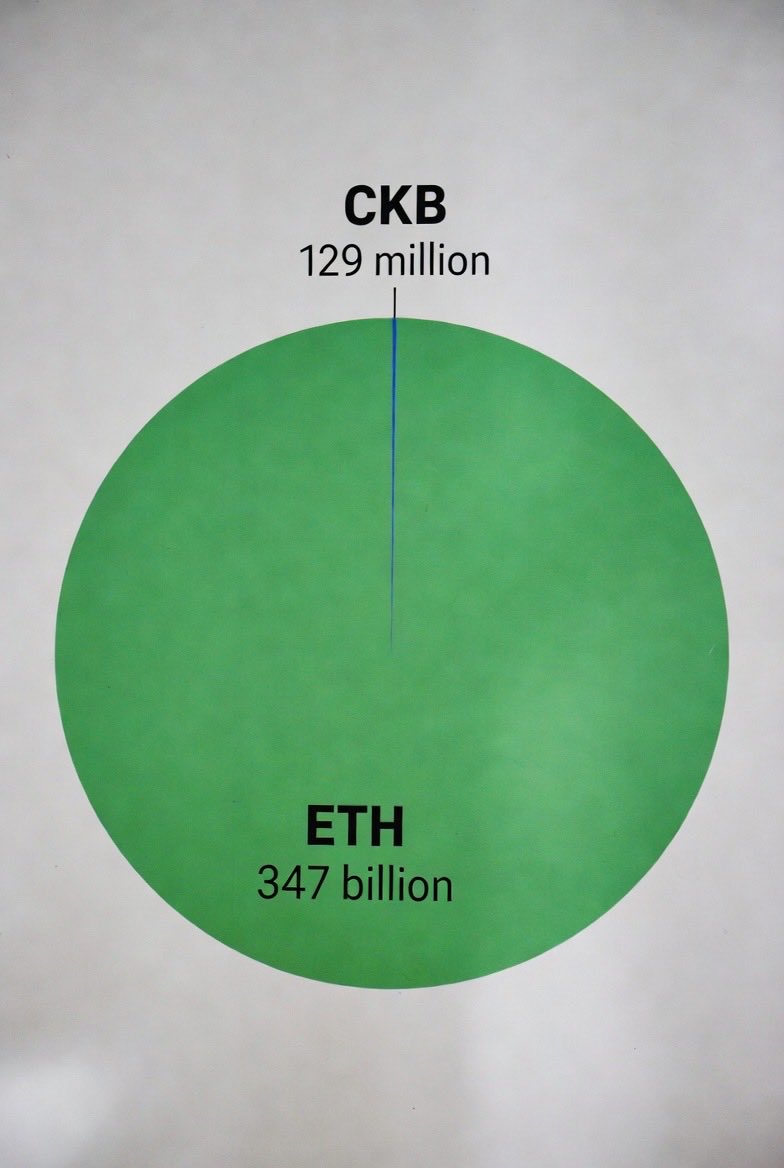
Vitalik wants $ETH to be RISC-V architecture and Quantum protected. $CKB is presently leading both well remaining true to $BTC POW grassroots, why does this matter? It’s the APEX PREDATOR of blockchain and at 1/4 ETH MC were 665x— get good study CKB
They say quantum computer attacks on blockchain is 10 years away.
I sat down with @matt_bitcoin Director of @NervosNetwork at @MiningDisrupt last week.
We had a serious discussion on this topic and how $CKB has positioned itself in a unique way that even @VitalikButerin admires.
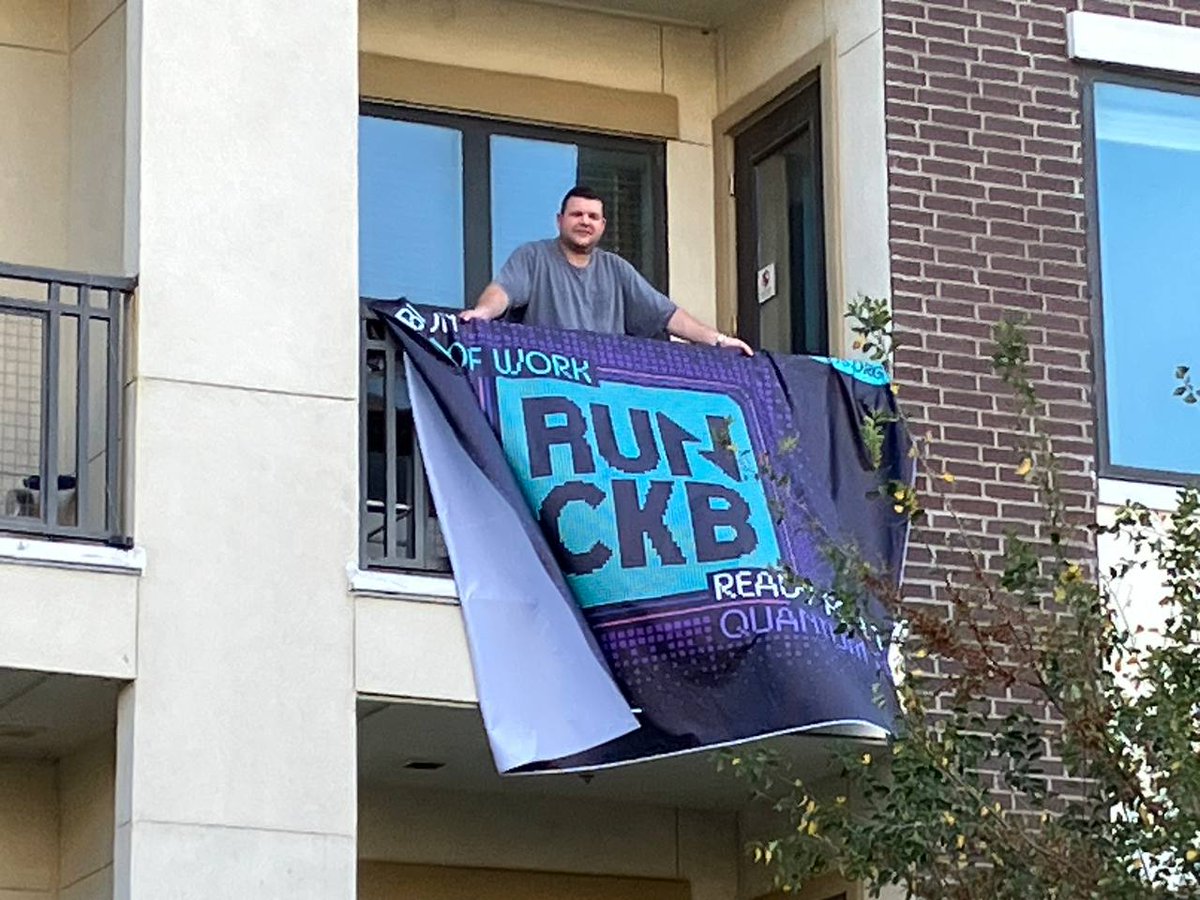
I stole the @NervosNetwork booth backdrop after the @MiningDisrupt conference and hung it out the airbnb for the world to see. $CKB
I felt like the pope blessing all the people passing by!
���� Curious how Fiber handles liquidity? Here's a complete survey of all the solutions we've reviewed and what we plan to implement.
Surveyed Solutions
01 Shaduf++
Paper: Shaduf++: Non-Cycle and Privacy-Preserving Payment Channel Rebalancing (https://t.co/KthPpWpGX4)
The intermediate user can shift funds between adjacent channels.
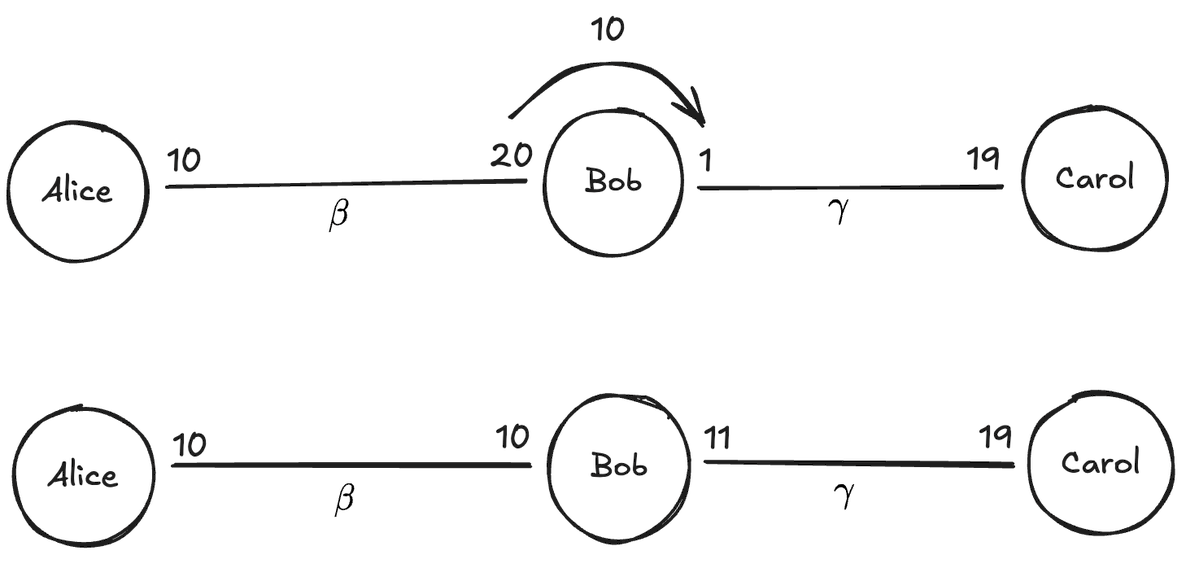
Say there're two channels. Channel Beta is between Alice and Bob with the distribution: (Alice: 10, Bob: 20). Another Channel Gamma is between Bob and Carol with the distribution: (Bob: 1, Carol: 19). Bob can shift 10 from (Alice, Bob) to (Bob, Carol) and the distributions become:
- (Alice: 10, Bob: 10)
- (Bob: 11, Carol: 19)
Limitations:
- Users can only shift funds between channels after recording the binding via an on-chain transaction.
- Channels binding will specify the max allowed shifted-out amount in both channels.
- For each channel, the sum of all max allowed shifted-out amount in all recorded bindings should be no greater than the channel capability. All the information is available on-chain so anyone can verify this. This is also the reason that shift requires an on-chain transaction to record the binding.
How to use:
- It can be used as a fallback that when a forwarding node has no enough balance in the outbound channel. If it has enough fund in the inbound channel, it can try to shift funds between channels.
- A node can scan its channels and schedule shifts in advance to improve the funds distributions in these channels.
02 Split
Paper: Study and Implementation of Split Multi-Channel Rebalancing Strategy for Off-Chain Payments (https://t.co/rN9tbQfN7r)
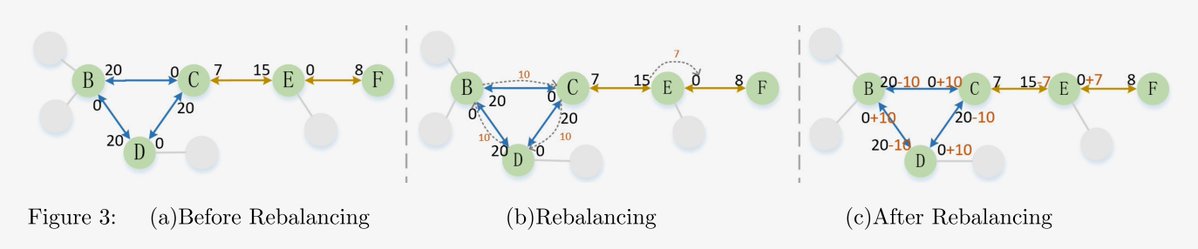
This paper has brief introduction to Revive and Shaduf as well.
B→C→D→B are performing Revive, C→E→F are performing Shaduf
Split is a rebalancing planning algorithm. It monitors the traffic in the network and generates a rebalancing plan to shift funds between channels. In simple words, it automate the execution of Shaduf.
The planning algorithm is based on another paper: P. Li, T. Miyazaki, and W. Zhou, Secure balance planning of off-blockchain payment channel networks (https://t.co/LOp77AvOAh). The core contribution is PnP, a balance planning service that determines how much funding should be initially deposited into payment channels given estimated payment demands among network nodes.
03 Horcrux
Paper: Horcrux: Synthesize, Split, Shift and Stay Alive Preventing Channel Depletion via Universal and Enhanced Multi-hop Payments (https://t.co/ISJbVDhPpX)
This protocol is like an automatic Shaduf++ on payments. It establishes a Virtual Channel along the payment path to implement funds shifting.
Other virtual channel designs:
1. Stefan Dziembowski, Lisa Eckey, Sebastian Faust, Julia Hesse, and Kristina Hosátková, Multi-party virtual state channels (https://t.co/opvrmxGlJ5)
2. Stefan Dziembowski, Sebastian Faust, and Kristina Hosátková, General state channel networks (https://t.co/1ouYfFDAAe)
3. Aggelos Kiayias and Orfeas Stefanos Thyfronitis Litos, Elmo: Recursive virtual payment channels for bitcoin (https://t.co/eH5KP0EB5Q)
4. Lukas Aumayr, Pedro Moreno-Sanchez, Aniket Kate, and Matteo Maffei, Breaking and fixing virtual channels: Domino attack and donner (https://t.co/utrf2BmVUs)
04 Musketeer
Paper: Avarikioti, Z., Schmid, S., & Tiwari, S. (2023). Musketeer: Incentive-Compatible Rebalancing for Payment Channel Networks (https://t.co/Eh6UWEGRfB)
All users submit their liquidity and bid.
- Liquidity: How much sellers are willing to allocate for routing/rebalancing.
- Bid: How much buyers are willing to pay for rebalancing the channel.
The protocol generates rebalancing plan based on the global liquidity and bid submissions.
05 Starship
Paper: Xu, M., Yu, W., Shang, G., Qi, G., Duan, D., Wang, S., Li, K., Zhang, Y., & Cheng, X. (2025), Starfish: Rebalancing Multi-Party Off-Chain Payment Channels (https://t.co/Pb2SDmdBUG)
Shaduf requires N on-chain transactions to submit bindings. Starship batches these transactions in a star topology, where a central hub connects to N peers. However, the batch requires synchronous consensus from all N+1 parties. The paper uses atomic broadcast, but other BFT consensus algorithms also work.
06 Cycle
Paper: Hong, Z., Guo, S., Zhang, R., Li, P., Zhan, Y., & Chen, W. (2022). Cycle: Sustainable Off-Chain Payment Channel Network with Asynchronous Rebalancing. (https://t.co/9n2YhbX4Ju)
Rebalancing for a cycle topology. All parties in the cycle maintain a global offset Delta via a consensus algorithm using off-chain messages. In all the channels in the cycle, it is assumed that amount of Delta balance has been transferred from the sender to the receiver.
For example, for the cycle consisting of 3 channels:
- Alice to Bob: Alice 0, Bob 200
- Bob to Charlie: Bob 0, Charlie 200
- Charlie to Alice: Charlie 0, Alice 200
After applying the global offset Delta = -100, the balance becomes:
- Alice to Bob: Alice 100, Bob 100
- Bob to Charlie: Bob 100, Charlie 100
- Charlie to Alice: Charlie 100, Alice 100
Instead of sending real payments to rebalance the channel, Cycle turns the problem into how parties reach consensus on the global offset Delta.
07 Lightning Pool
Paper: Osuntokun, O., Fromknecht, C., Paulino, W., Gugger, O., & Halseth, J. (n.d.). Lightning Pool: A Non-Custodial Channel Lease Marketplace. (https://t.co/OlwGbJuwuK)
Lightning Pool solves liquidity problem using an auction on inbound channel bandwidth. Sellers promise to create channels with the required duration, and buyers pay the lease fee to these inbound channels.
To support the channel lease market place, fiber must support following features:
- Single funded channels. The inbound channel is fully funded by the seller.
- A mechanism to ensure sellers pay the lease fee. Sellers can pay the fee off-chain or promise to pay when they receive funds from the lease channels.
- A mechanism to ensure a channel is open for the required duration.
See also:
- 闪电网络:技术与用户体验(五):流动性获取(https://t.co/EWVjFmo70c)
- Liquidity Advertisement by Blockstream (https://t.co/g5aUinzoPl)
- Amboss Space Magma (https://t.co/qomxQw2Zfo)
08 Submarine Swap
Atomic swap between L1 (CKB) and L2 (Fiber). If Alice wants inbound channel, she can pays the service provider Bob on Fiber (so Bob will have balance to forward payments to Alice), and Bob will pay back the received funds to Alice on CKB.
See also:
- Loop | Builder's Guide: https://t.co/PYUUEB5LMY
- 闪电网络:技术与用户体验(五):流动性获取(https://t.co/EWVjFmo70c)
09 Zero-Conf Channels
When users trust the service provider, users can send funds to the service provider on chain and the service provider will open channels to users and transfer the funds after deducting the fee immediately. Users can confirm the channel immediately after receiving the fund tx without waiting for confirmations on-chain.
10 JIT (Just-In-Time) Channels
When the service provider forwards HTLC to a user and the user has not enough inbound bandwidth, the service provider will open a new channel to provide inbound bandwidth for the user. The service provider can ask users to pay the fee via other channels using the same payment hash.
11 Liquidity Ads
Liquidity Ads (https://t.co/LOp77AvOAh) create a decentralized marketplace where nodes advertise their willingness to sell liquidity at specific rates. Buyers can discover these offers through the Lightning gossip protocol and request liquidity when opening dual-funded channels or performing splices. This eliminates the need for centralized liquidity marketplaces and provides market-driven pricing for channel capacity.
The specification introduces a `payment_type` field enabling multiple fee payment methods. Some examples:
- `FROM_CHANNEL_BALANCE`: Fees deducted immediately from the buyer's channel balance during the funding negotiation.
- `FROM_HTLC`: Fees deducted from future HTLCs routed through the channel, enabling zero-balance onboarding
- `FROM_FUTURE_HTLC`: Deferred fee payment from subsequent payment flow
- `EXTERNAL_PAYMENT`: Out-of-band payment mechanisms
Planned Solutions
☑️ Submarine Swaps
Submarine swaps enable atomic exchanges between on-chain CKB and off-chain Fiber channels, providing a trustless mechanism for users to manage liquidity without custodial risk.
Why Most Suitable for Fiber:
- Leverages existing HTLC infrastructure already implemented in Fiber
- Provides immediate liquidity access without protocol changes
- Non-custodial and trustless, aligning with decentralization principles
- Solves the critical inbound capacity problem for new users
Implementation Plan:
- Develop submarine swap service provider infrastructure. The commitment lock script may just work for the on-chain part of the swap.
- Create both normal swaps (on-chain to Lightning) and reverse swaps (Lightning to on-chain)
- Establish competitive fee structures (base fee + percentage)
☑️ Liquidity Ads
Why: Easy to implement
☑️ JIT (Just-In-Time) Channels
JIT channels allow users to receive Lightning payments immediately without pre-established channels, with the sender opening channels on-the-fly when first payment arrives or receivers have no enough inbound capacity.
Why Most Suitable for Fiber:
- Dramatically lowers user onboarding friction
- Reduces upfront capital requirements for end users
- Proven successful in Lightning Network ecosystem
Implementation Plan:
- Research LSPS2/bLIP-52
- Report on how to build LSP infrastructure with automated channel management
- Implement fee deduction mechanism from first received payment
- Implement single-funded channel support if not already available
- Implement zero-conf channel support if not already available
- Create standardized API for wallet integrations
☑️ Liquidity Pool Marketplace
A channel lease marketplace where liquidity sellers auction inbound bandwidth to buyers needing receiving capacity.
Why Most Suitable for Fiber:
- Creates sustainable economic incentives for liquidity providers
- Addresses the "inbound liquidity" problem systematically
- Enables price discovery for liquidity services
Implementation Plan:
- Implement single-funded channel support if not already available
- Implement zero-conf channel support if not already available
- Design and implement smart contracts to support lease channels
- Design marketplace API for buyers and sellers
- Design auction mechanism for channel leases (duration-based pricing)
Solutions to Watch
These solutions are inefficient and costly to maintain; we can monitor them for future developments.
- Shaduf++
- Cycle
- Split
When I first discovered Bitcoin it was under $1 USD.
Today it is over $100,000 USD.
How long do you think it will be before I’m making a similar tweet about CKB?
Everyone is freaking out about Quantum Computers... You know who isn't freaking out? $CKB
People will realize that Nervos Network will be the Blockchain that brings Quantum protection others can't.
Nervos is $BTC + $ETH combined
Follow the technology.. not your feelings!
#BlockchainLife2025 #Crypto
#quantumcomputers