Finally squeezed the esp32s3 HMI into the Blackbox prototype, battling hardware feels nostalgic in the AI era. Loving the increased viewing angle. The new MCU let's me run a $CKB light client on-board with headroom to incorporate stuff like the NFC reader thats also now inside.
In case you're wondering about the state of quantum safety on Chia, Sol just one-shotted supporting SHRINCS in chialisp. Will work on chain right this minute and only took a few minutes https://t.co/DI26mR0VJu
you're thinking too small. i don't need terabytes of random bits. i need a seed and a complete rejection of elliptic curves.
from this seed i grow an astronomical number of one-time secrets. each secret becomes a hash chain. you can walk forward through the chain but never backward. i arrange these chains into winternitz one-time signatures, and their public keys become leaves of merkle trees. those trees become leaves of larger trees. trees all the way up. a hypertree.
but first, at the bottom, i plant the FOREST OF RANDOM SUBSETS. FORS. the message is reduced to a string of ones and zeros. groups of bits select leaves from independent merkle trees. i reveal the corresponding secrets and the neighboring hashes, and you reconstruct the roots. the roots become a single hash. this is the message's signature, born from the forest.
now i sign that hash with a winternitz key. i prove the key belongs to a merkle tree by revealing its authentication path. i sign that tree's root with another key from the tree above. and again. and again. we ascend through layers of hash chains and sibling nodes until the entire structure collapses into ONE ROOT.
32 bytes. that's my public key. the entire forest is committed to those 256 bits.
i don't store the forest. i don't even remember which leaves i've used. the forest is deterministically regenerated from the seed whenever i need it. the message itself tells me where to go.
there are no elliptic curves here. no discrete logarithms. no hidden algebraic relationship waiting for a mathematician to invert. only preimages, hashes, and an unfathomable number of ones and zeros arranged into trees whose branches authenticate each other.
you can have my elliptic curves. you can have my RSA. but you cannot have the forest.
the forest is stateless. the forest remembers nothing. the forest verifies everything.
@epure_liviu@ckba_build you are trivializing consensus across a disparate group.
"just code the fork and validators run it!" is radically different from "freeze the vulnerable BTC"
quantum migration is a challenge, but so is consensus.. look at the 5 years it took for Ethereum secp256r1 precompile
don't settle for the hype being pushed on you from on high
CKB has been steps ahead for the better part of a decade, it's only a matter of time.
Decentralization is a spectrum, while P2P is a paradigm shift. You're too smart to settle.
RUN CKB
Rob (@robbieklages) says @arc leapfrogged the blockchains before it, the same way each AI model leapfrogs the last.
"There's been so many blockchains that came before, and all of that is a learning moment."
"Arc has been able to leapfrog all of them, the same way AI models leapfrog one another."
"It truly feels that Arc is a next-generation blockchain, built with the benefit of everything the industry learned before it."
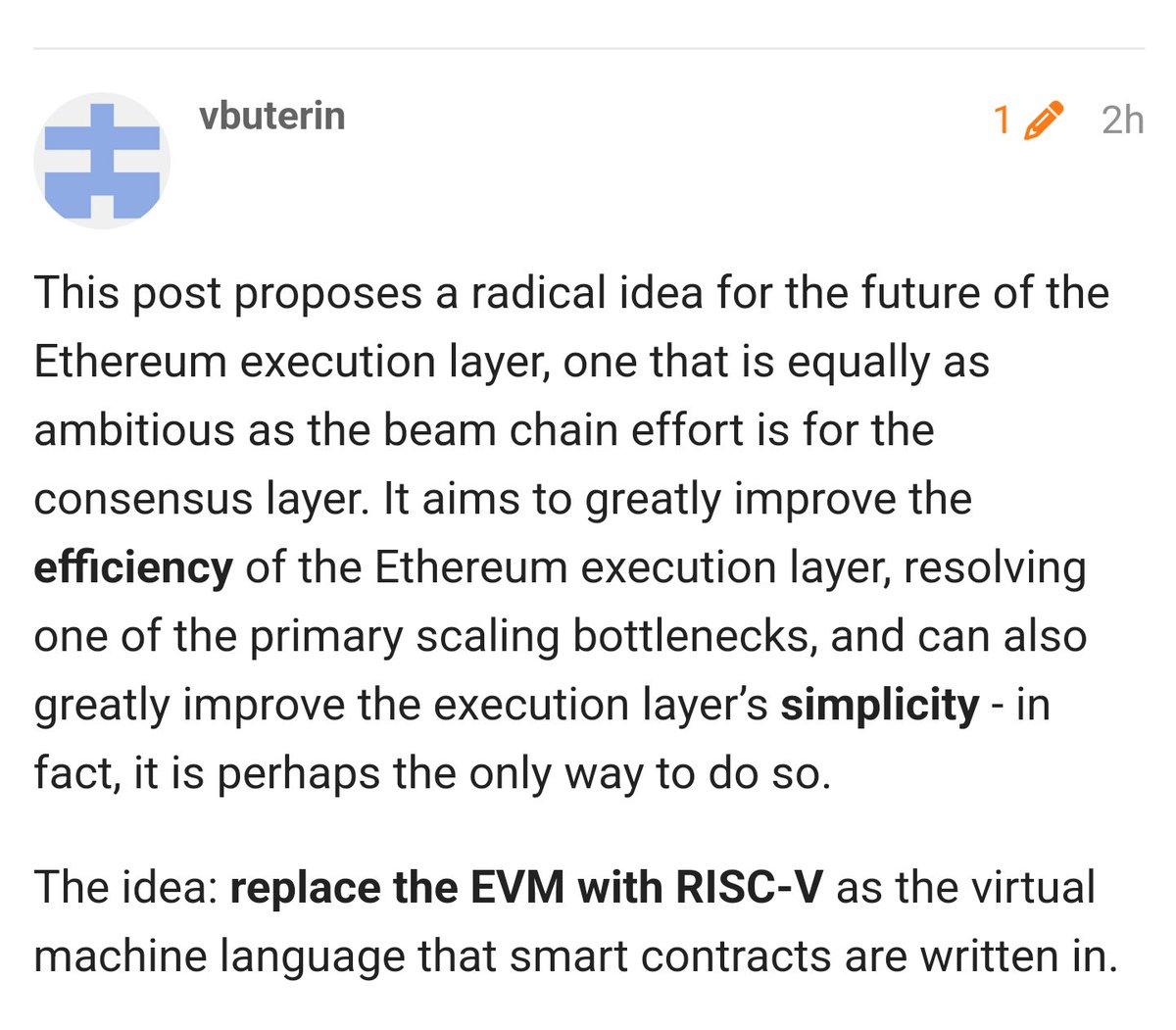
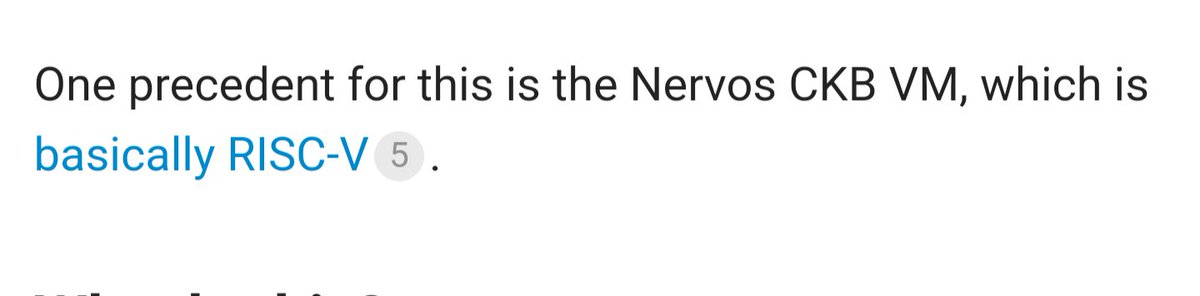
CKB led the way with RISC-V based VM: Vitalik proposes switching from EVM to a RISC-V model similar to CKB-VM
This would be a monumenal shift in approach @VitalikButerin 👏
https://t.co/UDsYjn6F0w
@zengjiajun_eth fee-based models have a structural challenge
Block supply gets constrained, fees increase, demand to use the chain reduces, which in turn decreases fees, increasing demand
While this is logical, it can not reach equilibrium. Revenue uncertainty is bad for bp's with real costs
@KittyCatRightM3@hasufl let's say 50% of the network is eclipsed-- on each fork, slashing is enforced for being offline
which chain is the canonical chain?
If you don't understand fork selection in proof of work, we don't need to continue conversing.