You missed the semiconductor trade because you were afraid, you missed the memory trade because you were afraid and now you are going to miss the next rally for the exact same reason (Save this).
Look at what just happened this week alone.
ASML beat Q2 2026 estimates and raised its full year revenue outlook to €43-45 billion, up from prior guidance of €36-40 billion, the second time this year they have raised guidance.
Their CEO said on the call that "ongoing AI-related investments and continued progress in AI technologies are driving demand for advanced logic and memory chips" and that their customers are "accelerating their capacity expansion plans."
Memory revenue alone is expected to grow 75% this year.
TSMC raised 2026 capex guidance to $52-56 billion, at least 25% above 2025 levels and guided for nearly 30% revenue growth.
Meanwhile, Meta is doubling its data center deployments in 2027.
OpenAI's GPT-5.6 compute literally cannot keep up with demand, Codex went from 5 million to 9 million users in a single month, and Sam Altman confirmed agentic product usage rose 2.5x in a single week.
Anthropic is approaching profitability meaning even the companies spending the most on inference compute are starting to turn the corner on monetization, which means the demand cycle extends further.
This is the pattern and it repeats every single time.
In 2023, people missed Nvidia because they said valuations were too high and AI was overhyped meanwhile Nvidia hit 5T in market cap.
In early 2025, people missed Micron at $80 because they said the memory cycle was peaking while Micron crossed $1 trillion in market cap.
The pattern is always the same and the data is always clear.
The fear is always louder than the data and the people who let the fear win are always the ones watching from the sidelines when the rally resumes.
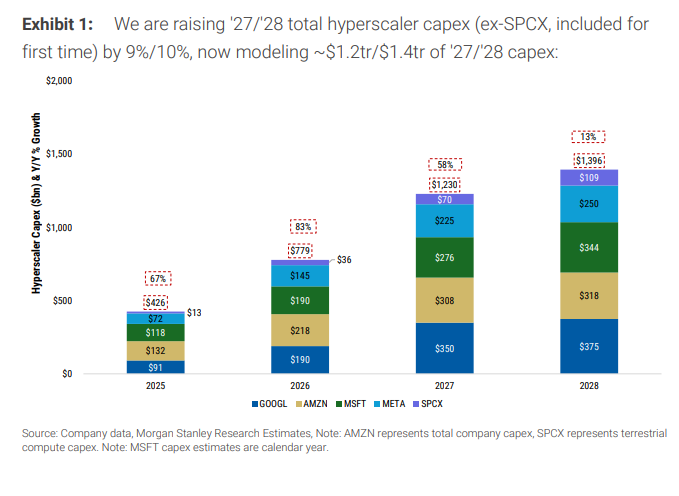
The AI thesis is completely intact, hyperscalers are still guiding to $1.4 trillion in capex by 2028.
The foundational infrastructure, chips, memory, data centers, power is being built out faster than any previous technology cycle in history.
The applications consuming that infrastructure, from autonomous coding agents to physical AI to agentic workflows, are growing faster than even the most optimistic projections.
What is keeping the market down right now is also some Iran war noise and rate hike fears.
Neither of those things changes the fact that Meta is doubling its data centers, ASML is raising guidance for the second time this year, TSMC is spending $56 billion in capex, Micron's HBM is sold out through 2027, and OpenAI's infrastructure literally cannot keep up with how fast people are using it.
This is a temporary dip within a stronger upcycle and the people who act on the data instead of the fear are the ones who will look back at this week as one of the better buying opportunities of the year.
I am a buyer at these levels and make sure to follow me @MelvinInvests for more market insights.
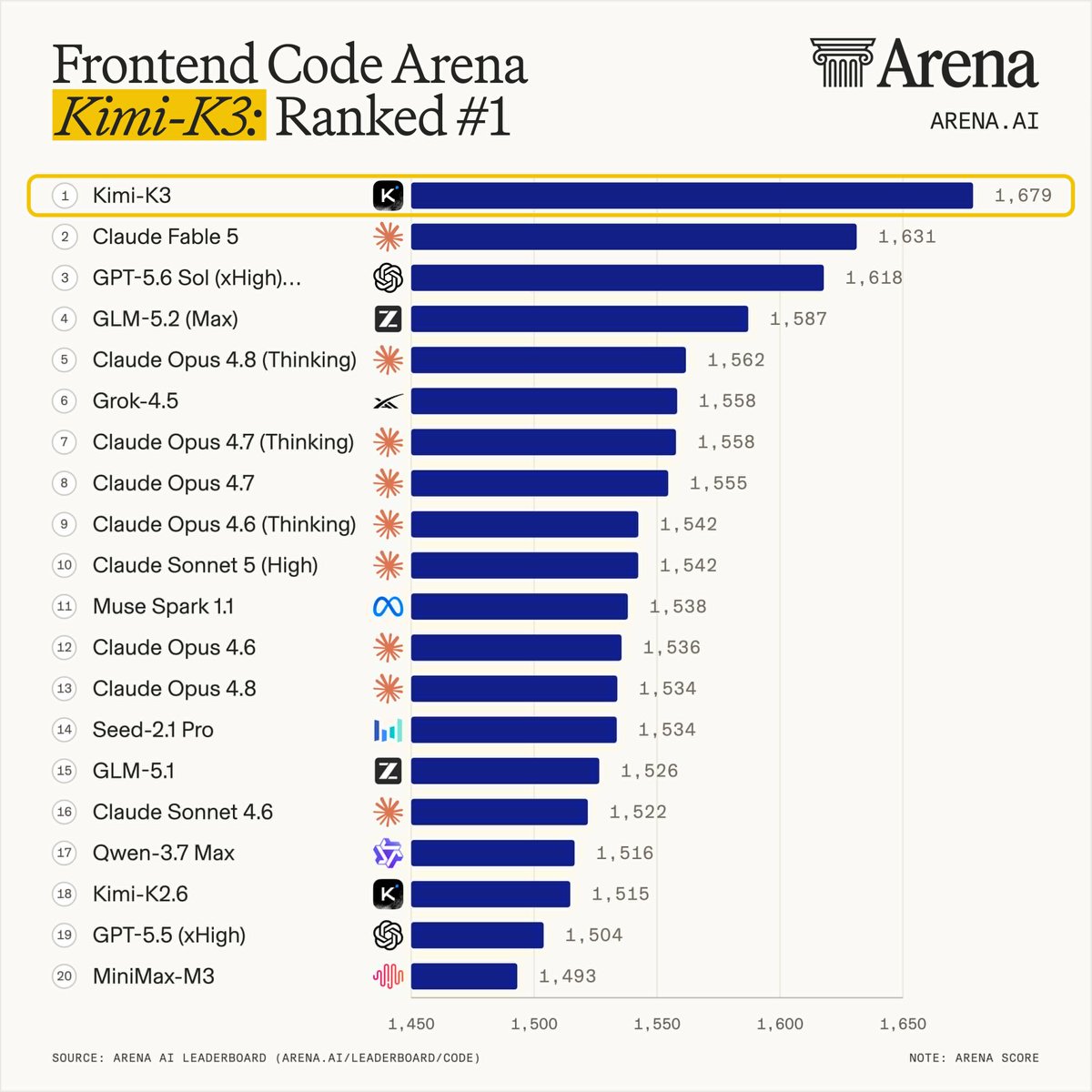
What @Kimi_Moonshot pulled off here with Kimi K3 is nothing short of an earthquake in the AI industry. Kimi K3 just took the #1 spot on the Frontend Code Arena with a score of 1,679, beating Claude Fable 5, GPT-5.6 Sol, GLM-5.2, Grok-4.5, and every Claude Opus model.
And this is not a narrow win. Kimi K3 is 48 points ahead of second place and 61 points ahead of GPT-5.6 Sol. Moonshot AI is no longer merely catching up with the frontier labs. It is setting the pace!
Kimi K3 may be the DeepSeek 2.0 moment. The benchmark results are out, and they are outstanding. And they proof one thing very clearly.
I believe this is the DeepSeek 2.0 moment. Does that sound like an exaggeration? At first glance, perhaps. The benchmarks still need to prove themselves in real-world use. But one thing already seems clear: Kimi K3 is ahead of Opus 4.8 and, broadly speaking, just behind GPT-5.6 and Fable 5.
Opus 4.8 was released at the end of May, specifically on May 26, roughly a month and a half ago. Kimi K3 generally outperforms Opus 4.8. That effectively disproves the claim that Chinese open source models consistently trail US closed source models by six to eight months.
Of course, most users will continue to choose the very best model available, and I do not expect millions of people to cancel their ChatGPT subscriptions overnight. However, Kimi K3 makes one thing abundantly clear: the US lead is continuing to shrink. Despite sanctions, Chinese AI labs are succeeding in training increasingly capable models. Whether reinforcement learning or distillation is the primary reason, I cannot say. But Kimi K3 demonstrates to the world that a turning point may be approaching. China is steadily moving toward technological parity. The statement by the founder of Zhipu AI should also attract attention: the company says it plans to release a GLM model in the Mythos class by the end of the year.
Kimi K3 is not Fable, and it is not Mythos. But it is already very close to the leading Western state-of-the-art models. That is highly significant.
Introducing Kimi K3: Open Frontier Intelligence
🔹 2.8 Trillion Parameters, 1 Million Context, Native Multimodal
🔹 Kimi Delta Attention enables up to 6.3x faster decoding in million-token contexts
🔹 Attention Residuals deliver ~25% higher training efficiency at <2% additional cost
🔹 Built for long-horizon agentic coding and self-evolving workflows
Kimi K3 is now live on on https://t.co/zrk6zZxZUo, Kimi Work, Kimi Code, and the Kimi API.
Open Weights by July 27, 2026.
🔗 API: https://t.co/XCrgjXAqMw
🔗 Tech blog: https://t.co/YTfiMSNM1f
Kimi K3 Launched
- Kimi K3 is now live the largest open-source MoE model yet with 2.8T parameters and a 1M context window.
- API pricing: $3/$15 per 1M tokens ($0.30 cache hits), around 5× more expensive than K2.7
- Benchmarks are impressive: #2 on AA-Briefcase, 91.2 on BrowseComp (SOTA), and behind only Claude Fable 5 Max & GPT-5.6 Sol Max on GDPval-AA v2.
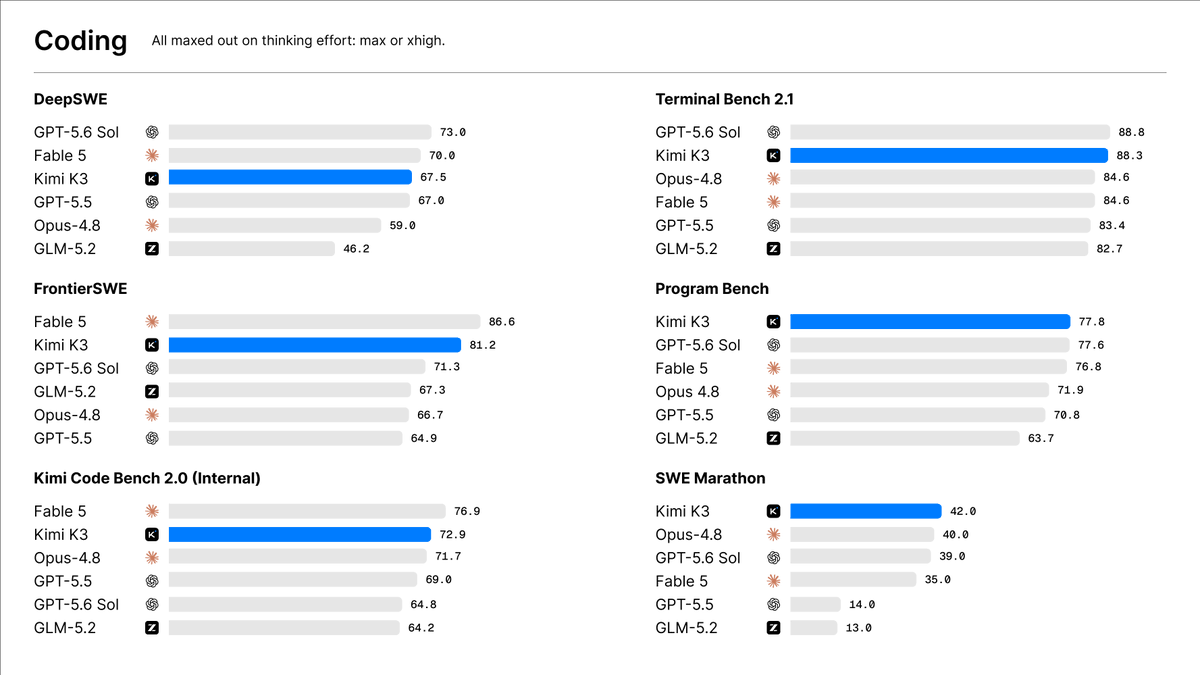
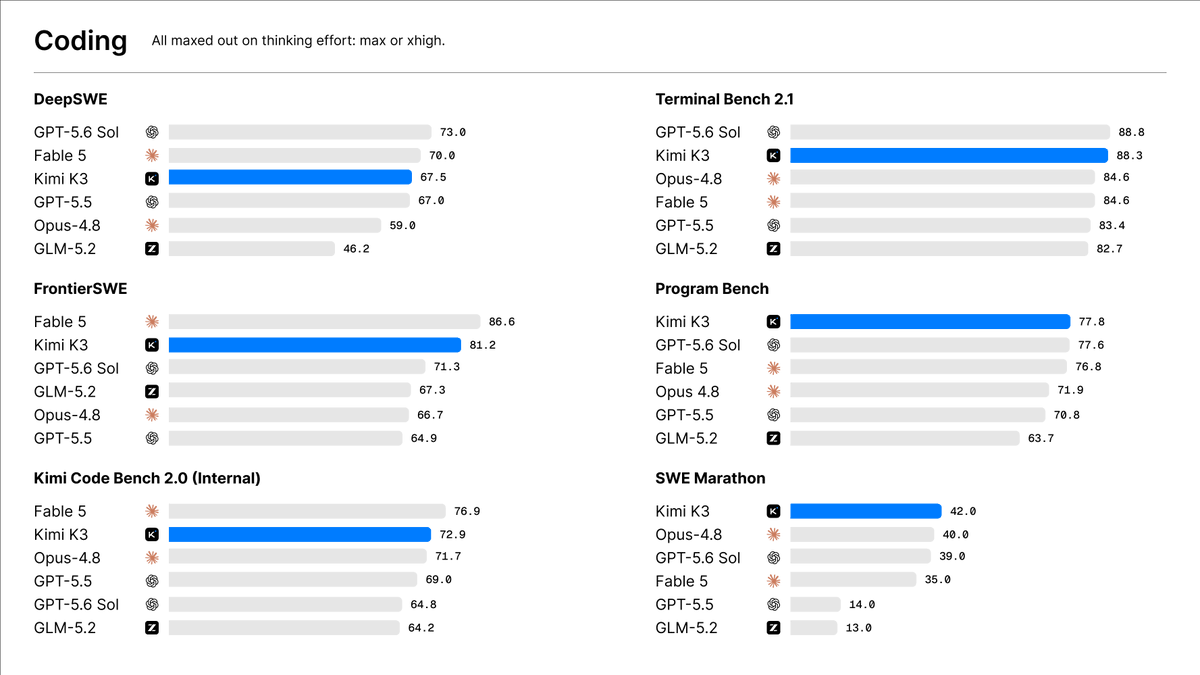
- Frontend generation is exceptional. From my testing, it beats Opus 4.8 and is close to Fable 5 in UI taste.
- Built on a new KDA (Kimi Delta Attention) + AttnRes architecture with 896 experts (16 active/token) for highly efficient sparse routing.
Kimi K3 just beat Fable 5 on the BridgeBench Horror House game test.
I did not expect this at all.
Kimi K3 is better than Fable 5 at game development and UI design.
The two things Fable 5 was supposed to own.
The 5x price increase suddenly makes sense.
My thoughts on Kimi K3 while we wait for the benchmarks
I think that it's mostly hype. In their blog they say it's better than Opus 4.8 but they don't show coding benchmarks, just those who are somewhat related to frontend, because that's what this model excels at
They also say it's cheaper than other models but we still don't know how efficient it is, sure, it's cheaper per M output tokens, but it's useless if it uses 5x as many tokens for the same task. So far from my testing efficiency isn't looking good
Is it a good model? Yes, all open-source models are welcome, but they're not useful for 99% of people, there has been too much hype