Just did a big data cleanup pass on https://t.co/yBbMRs2s5G
A reminder that it's completely free if you want to keep up with what's happening in crypto daily
Condensed data and no noise
Free
Technology drives natural deflation, yet central banks force inflation to keep debt afloat. The gap between the two? The greatest wealth transfer in history—from workers to asset holders. We need a system built on truth, not manipulation. #Bitcoin#DeflationaryFuture
Today's video is pretty important.
I think I'm early on this insight, and I will take 4 specific action now, well ahead of time.
https://t.co/lHveFeTMP6
Flights to the Middle East are being cancelled.
I think the war with Iran is upon us.
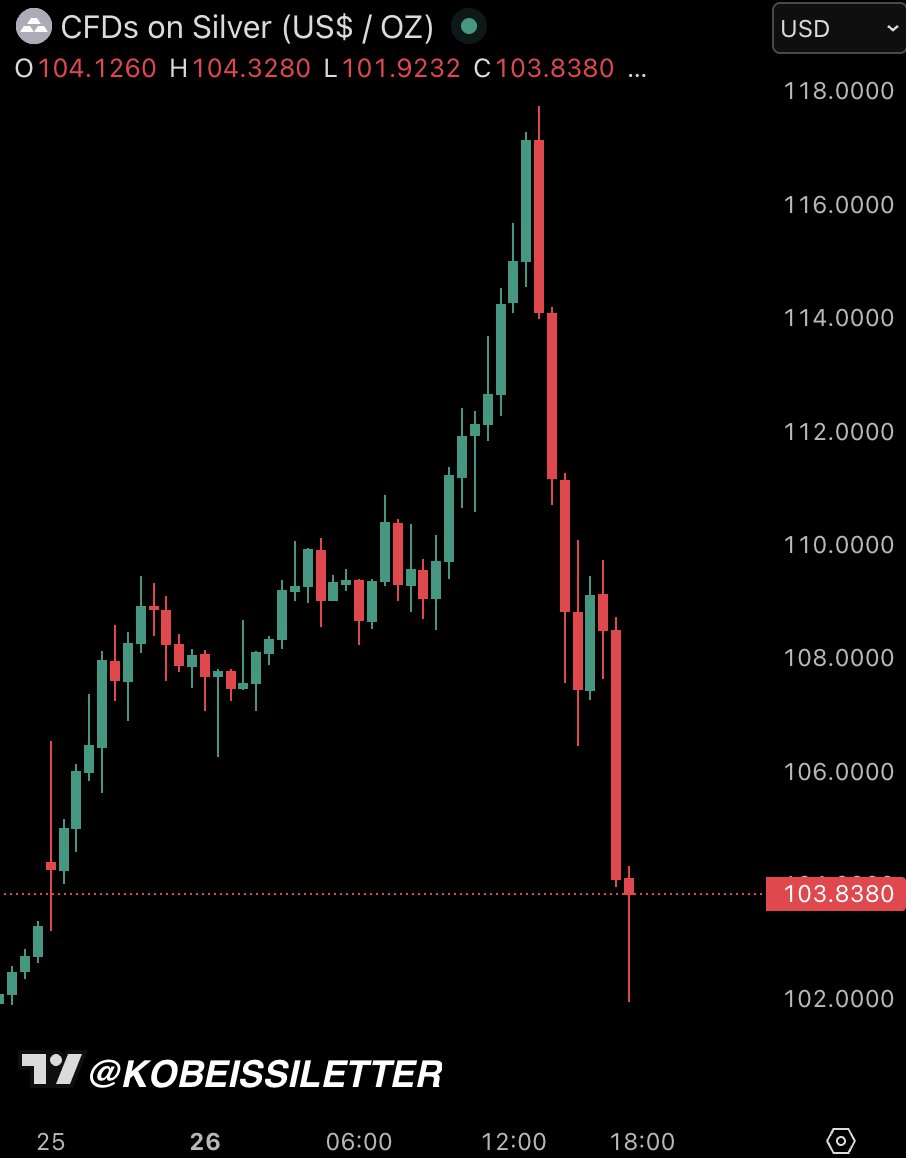
In hindsight it will be obvious why Gold and Silver pumped.
Risk assets are likely to get a hit in the short term.
Hence my bias is still bearish for $BTC and for the rest of crypto.
After surviving a battery of tests, SunRISE is one step closer to their day in the Sun.
The six tiny satellites that make up SunRISE will work together as one giant radio dish to track the radio bursts coming from deep within the Sun’s atmosphere. Launch is slated for late-2026.
Learn more: https://t.co/kD1c6VE8rZ
Huawei is honored to be chosen by stc Bahrain to accelerate the next phase of its TechCo journey through EVOLVE 2.0. The companies have signed an MoU to support stc Bahrain's transformation into a digital platform company built on network, cloud, data, and AI.
Read this. The Minnesota state prison system suggests Gregory Bovino outright lied about the target of the operation during which agents shot and killed Alex Pretti.
While the crypto bill might be delayed to keep working on it, I am very confident that a bill will get done soon. I have spoken to over 10 senators on both sides of the aisle in the past 24 hrs and I believe they all are working in good faith to get something done. Always gets tense at the end.
We have a lot of exciting launches related to Codex coming over the next month, starting next week. We hope you will be delighted.
We are going to reach the Cybersecurity High level on our preparedness framework soon. We have been getting ready for this.
Cybersecurity is tricky and inherently dual-use; we believe the best thing for the world is for security issues to get patched quickly. We will start with product restrictions, like attempting to block people using our coding models to commit cybercrime (eg ‘hack into this bank and steal the money’).
Long-term and as we can support it with evidence, we plan to move to defensive acceleration—helping people patch bugs—as the primary mitigation.
It is very important the world adopts these tools quickly to make software more secure. There will be many very capable models in the world soon.
Must read. Common questions I receive on Wyckoff Method. Here is the answer.
There are two variations of the Wyckoff Accumulation Schematic here there are:
#1 and #2 - but how do we know which will play out?
Both are bullish setups leading to markup.
The two Wyckoff accumulation schematics (often labeled Schematic 1 and Schematic 2) represent common variations of how the accumulation process unfolds in a trading range (TR) after a downtrend.
Both follow the same core Wyckoff principles and five phases (A–E), but they differ primarily in Phase C the test for remaining supply and how the range resolves into the markup phase.
These schematics come from Wyckoff's original teachings (later adapted and popularized by figures like Robert G. Evans at the Stock Market Institute/Wyckoff Analytics). They illustrate idealized patterns of institutional ("Composite Man") accumulation.
Key Similarities
Both occur after a prolonged downtrend.
Phase A: Stops the decline with Preliminary Support (PS), Selling Climax (SC), Automatic Rally (AR), and Secondary Test (ST) → defines the TR boundaries.
Phase B: Sideways consolidation ("building the cause") where smart money accumulates on low volume, shaking out weak holders.
Phase D: Signs of Strength (SOS), Last Point of Support (LPS), and breakout preparation.
Phase E: Markup (uptrend) begins as supply is exhausted.
Volume decreases on tests of support and increases on rallies/breakouts.
Goal: Accumulate shares quietly before a major advance.
Key Differences: Schematic 1 vs. Schematic
2
Aspect
Schematic 1 (with Spring)
Schematic 2 (without Spring / Higher Low Test)
Phase C Test
Features a Spring (or terminal shakeout) price briefly breaks below the TR support (below SC/ST lows), often on wide spread and high volume, then quickly reverses upward. This traps sellers and tests for any remaining supply.
No true downside break. Instead, the test in Phase C forms a higher low compared to the SC/ST. Price holds above the prior support level without undercutting it significantly.
Aggressiveness
More aggressive shakeout designed to scare out remaining weak hands/panic sellers. Classic "fakeout" below support.
More subtle/stealthy —support holds firmly; no dramatic trap needed because supply is already exhausted or weaker.
Recognition
Most recognizable and "textbook" version; dramatic breakdown + reversal often provides high-conviction entries (especially on the Spring test or Last Point of Support after recovery).
Less obvious; looks like simple consolidation or a failed breakdown attempt. Breakout often occurs more directly from the range without a prior dramatic reversal.
Trading ImplicationSpring → test of Spring often best low-risk entry (buy the recovery). Higher probability if volume dries up on the breakdown and surges on reversal.
Entries around higher-low tests or early SOS.
Avoid forcing a Spring expectation — missing this variant can cause traders to overlook valid setups.
Frequency / Requirement
Spring is common but not required many real accumulations show this.
Shows a TR where price never truly violates support also valid and frequent in stronger basing patterns.
In essence:
Schematic 1 = "dramatic test" version (Spring shakes out supply aggressively).
Schematic 2 = "quiet test" version (support holds without breach; higher low confirms strength earlier).
Real charts often blend elements of both. The absence of a Spring doesn't invalidate accumulation it just means the test of supply was less violent. Wyckoff emphasized context, volume behavior, and the overall narrative over rigid adherence to one schematic. If you're analyzing a specific chart, the presence/absence of a clear Spring (plus volume and support behavior) is usually the quickest way to classify which variant you're seeing.