Everyone complains about the rising cost of Meta ads.
But few talk about signal quality they're feeding into Meta.
If Meta can't attribute purchases to ads, it can't optimize properly either.
That is why weak Event Match Quality scores show up as weaker performance.
This can be simply fixed with Littledata
1️⃣ Connect Meta Ads in the Littledata app
2️⃣ : Add your Pixel ID and access token
3️⃣ Disable any duplicate tracking on the same pixel
4️⃣ Let Littledata apply the tracking automatically
In Events Manager, you'll see cleaner server-side events with richer identity data attached, like hashed email, name, and country.
That improves Event Match Quality.
You can also split new and returning customer purchases. That matters because prospecting and retention should not be trained on the same event.
At Littledata, upgrading your Meta signal quality is one of the biggest missed opportunities we see on Shopify.
Watch this demo video to know how to do it for your brand.
I'm surprised how server-side tracking is still a disaster.
You hear Google Tag Manager and a dozen apps, and a simple problem feels like a huge engineering project.
We've been doing this for eight years, and the difference is actually very simple.
✔️ The classic way
You can do server-side with generic Google Tag Manager (GTM) solutions.
These are flexible if an agency works across BigCommerce, Magento, and Shopify.
But for a dedicated Shopify brand, it requires huge technical setup and constant maintenance.
If you want to pull in custom data, like subscription lifecycles, you need to do a lot more data engineering work.
💪 Deep expertise, not generic tools
The reality is most brands spend their ad budget on two core channels: Google and Meta.
So, there is no value in tracking a small channel like Reddit. Instead, it's in making those core channels perform a little bit better.
At Littledata, our technical leadership allows us to go deeper. We update our tracking every month based on platform changes.
🎯 That enables true innovation
For example, this year, we launched the ability to target new versus returning customers in your Meta and Google Ads.
Why does that matter?
You can now set a campaign to optimize only for net new customer acquisition.
So although the CPA is higher for a new buyer you stop wasting ad budgets on retargeting people who were already going to buy via email or organic search.
You move away from just tracking revenue to profiling and acquiring truly profitable customers.
The question isn't whether to do server-side, but how deeply you go.
I'm seeing a lot of brands getting carried away with attribution.
While it can correctly credit email, SMS, retargeting, branded search, or last click...
It can't tell you what actually caused the sale.
So, if you're optimizing for attribution you'll end up doing more of the same bottom-of-funnel activity.
Marketing is about creating demand, not just capturing it:
→ What actually made someone aware of your brand?
→ What changed their mind?
→ What made them choose you over alternatives?
→ Would they have bought anyway?
That’s why incrementality is more important.
It gives you the answer to “did this campaign actually drive more purchases?”
Tools like conversion lift try to answer that by comparing exposed vs non-exposed audiences.
It’s not perfect but it’s closer to the real question.
I’ve said this before:
Attribution doesn’t need to be perfectly accurate.
It needs to be directionally correct.
So if you’re a marketing manager, spend time understanding what actually moved the needle.
70% of shoppers abandon their carts.
But a lot of Klaviyo flows never reach the full audience.
That is usually a tracking problem, not an email problem.
So before rewriting your flows, ask yourself:
"Can Klaviyo actually see enough of our abandoners to trigger the flow?"
With Littledata, here's how you do it:
Step 1: Connect Klaviyo in the Littledata Shopify app
Step 2: Turn on the key flow events
Step 3: Clone your existing flow
Step 4: Switch the trigger to Littledata’s event
Step 5: Add exclusions so people don’t enter both flows
That’s it.
That improves the signal for:
→ Abandoned Cart
→ Abandoned Checkout
→ Abandoned Browse
Because the schema is backwards compatible, your templates and dynamic fields still work.
For one of our customers, just one cloned flow generated £3,000 in extra monthly revenue.
Across the three flows we power, that can be 20–40x the monthly cost of our software.
Watch the demo to see exactly how this works.
We looked into a few multi-currency stores on Shopify. The numbers were way off.
The default Google & YouTube app doesn’t handle currency conversion properly.
Honestly, we didn’t realise it until we dug into it properly.
So if you’re selling in multiple currencies but sending everything into one Google Ads account...
your conversion values can be completely off.
So a €100 order might come through as 100 SEK - that’s a 10x difference.
And if you're using Smart Bidding, it means:
→ It overvalues some conversions
→ Undervalues others
→ And optimizes towards the wrong outcome
Result?
Your total revenue may look about right.
But underneath, it's a mess!
At Littledata, we natively support Shopify Markets, which means you can:
→ Convert currencies into a single ad account
→ Or send conversions into local currency accounts per market
If you’re running Shopify Markets and using Google Ads, I'd check:
Does your conversion value actually match Shopify?
Because it affects how your budget gets spent.
I’ve seen dozens of Shopify brands tweak the same Klaviyo flow for months:
New subject lines, incentives, email designs...
But often the bigger issue is simpler:
Klaviyo never saw enough of the right people in the first place.
That is especially true in abandonment flows.
Because these flows only work when the shopper can be linked back to a real profile.
They browse.
They add to cart.
They even start checkout.
But if the identity signal is weak, Klaviyo cannot do much with that behavior.
That is why I think a lot of teams end up optimizing too far downstream.
They rewrite the email when the real problem is who qualified to receive it at all.
You do not get the biggest lift by endlessly rewriting the copy.
You get it by making sure the platform can actually identify enough of the shoppers showing buying intent.
Would you rather improve the message by 10% OR increase the number of real buyers who can receive it?
Yesterday, Pulse set the tone for exactly why we’re backing it this year.
The Littledata growth team was out in full force.
The day started properly with breakfast & coffee at The Ivy Tower Bridge.
Stunning views. Lots of familiar faces and a few new ones. Thanks to Smarterships, Jurni, and Rivo.
Then onto the Pulse Padel Tournament with Dataships, Klaviyo, and Global-e.
I’m told Will Fisher and Jack Snellgrove couldn’t decide whether it was better to be seriously good at padel…
…or disgustingly bad.
Either way, they committed fully. Jack even came a close second.
Later we headed to Clays with Shero Commerce for some virtual clay shooting.
Apparently Jaz F.’s stance is a little casual...even for virtual shooting.
But she still managed to beat both me and David, so maybe the rest of us should stop commenting.
Then we closed out the night at the official Pulse drinks mixer with the wider ecommerce community.
This is the bit of events I always value most because of the kind of conversations that are always better before everyone’s rushing between sessions.
AI shopping means less traffic but more qualified buyers.
Paul Rogers gave a good example of how messy buying journeys are getting.
He’d been looking at products for a back issue.
So Meta started showing him ads for tennis machines → He started comparing them on ChatGPT → Searched Google for one specific product. Amazon was in the mix too.
At some point, he bought it.
AI won’t always show up as traffic...
Which explains why brands are seeing 1-2% traffic from ChatGPT in Google Analytics.
That's the issue Shopify brands are missing with AI - None of the shopper research/journey will show up on Google Analytics.
Josh Duggan made the point well:
"AI takes a lot of the comparison work that used to happen across Google Shopping, product pages, reviews, and tabs…
…and moves it one layer earlier."
That means you get more qualified traffic.
At Littledata, that's the difficult task we're trying to answer:
- Who saw the ad?
- Who came to the site before?
- Who compared products elsewhere?
- Who came back and bought?
That’s where Shopify customer profiles, account activity, server-side events, and clean order data matter.
In 2023, our paid ads started to lose efficiency.
ROAS declined. CAC rose.
That forced a reset.
Paid ads are excellent at capturing and retargeting existing demand.
They are poor at creating belief from scratch.
So we stepped back and rebuilt the foundations.
For the last 18 months, we focused on:
➡️ Publishing high-signal, founder-led thinking on LinkedIn and YouTube
➡️ Building deep partnerships across the Shopify ecosystem
➡️ Being present where serious operators spend time
That work drove 740,000 impressions on my LinkedIn alone last year.
More importantly, CAC fell by 50% mainly because the trust factor went up.
Paid media works best as reinforcement, not introduction.
We’re now reinvesting with confidence. This time, our ads follow brand demand instead of trying to manufacture it.
How are you sequencing brand and performance today?
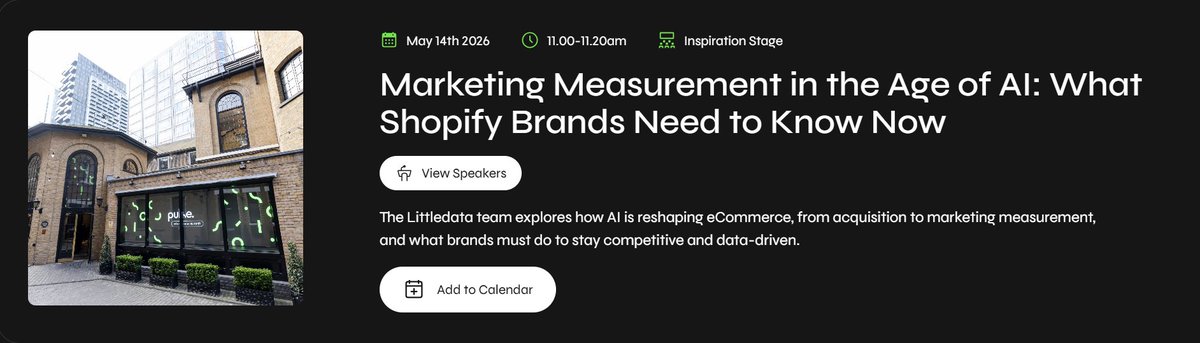
Next Thursday I'll be speaking at the Pulse eCommerce Summit '26, hosted by Vervaunt, on 'Marketing Measurement in the Age of AI’.
With me: Ted Robinson, CMO of Grind Coffee, Daniel Eales, Head of Growth at Omni Pet Food, and Will Fisher.
Three questions I want to put to them:
💚 What happens when Meta's AI is learning from incomplete purchase data?
💚 What happens when Google is bidding on revenue that doesn't match your Shopify numbers?
💚 What happens when the signals underneath your dashboard are quietly broken?
Because AI doesn't make bad measurement harmless. It just makes teams act on bad data faster.
At Littledata, this is what we obsess over. Making sure Shopify data flows cleanly into Google, Meta, and Klaviyo, so both people and algorithms can actually trust it.
We'll be on stage for 20 minutes. I want to use it well.
So if you were in the room, what would you want me to ask Ted, Daniel, and Will?
Brand questions, tech questions, awkward questions. All welcome.
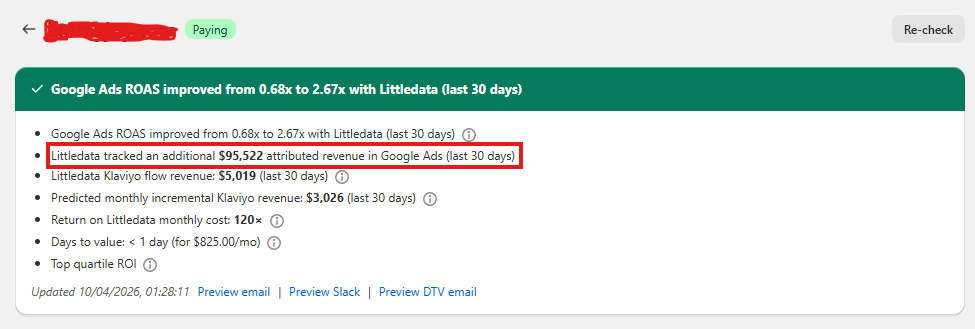
MonitorAI found an additional $96k attributed revenue in Google Ads last month for one client.
Which shifted their Google Ads ROAS from a lets-quit 0.7x to a respectable 2.7x.
I knew Littledata was boosting the conversion signal for brands.
And now with the power of AI we can tell exactly how much and why.
A big part of the value we provide is not just fixing the tracking - it's communicating the benefit in a way the whole team can understand.
This is exactly why I've been building MonitorAI as my AI-first side project. For years, this monitoring has sat in the bucket of “important, but hard to prioritize.”
Now Cursor has helped turn more of that manual audit work into product.
So yes, the extra $96k matters.
But the real takeaway is:
A lot of Google Ads accounts are being judged on incomplete data.
Fix the signal first.
Then decide whether the channel is actually underperforming.
Shopify PDPs are written for shoppers, not agents.
I've been thinking about this since a casual chat with Michael J. McBride from Atelier Commerce.
He said humans react to brand stories, on-message copy, PDP layouts etc.
But LLM agents are looking for boring answers to:
→ What is this product?
→ Who is it for?
→ Who is it NOT for?
→ What category does it fall under?
→ What problem does it solve?
→ Sizes, variants, materials, and more...
Now, AI can easily automate all of this for you.
But, I'd be careful here.
Because using AI to blindly create more product metadata = more AI slop.
Instead, I'd simply ask the agent:
"This is my product. It does this. What do you need to know to confidently recommend this product to a shopper?"
Have you tried this for your brand yet?
We’re backing Pulse this year for one simple reason.
We want to know what DTC founders are worried about before it becomes LinkedIn wisdom.
That's why we're going to talk about topics that Shopify brands are tackling every day:
💚 Internationalization
💚 Customer acquisition
💚 Measurement and attribution
💚 Customer experience
💚 Roadmapping
And that's also why I look forward to speaking there.
If you’re going, let me know.
Always happy to compare notes with people in the room.
See you there!
📅 Wednesday 13th - Thursday 14th May
📌 The Brewery, London
There're still some places left for brands.
Here's the link to register: https://t.co/S95GoWIOUW
I'm seeing a lot of Shopify brands are knee-deep in reports and still guessing.
GA4, Shopify, Meta, Klaviyo — all showing different versions of the truth.
And by the time someone has reconciled the numbers, nobody's really bothered.
That’s the data-to-action gap.
The truth is growth need to know:
→ Which numbers can we trust?
→ What actually changed?
→ What should we do next?
That’s what we’ll be unpacking on Shero Live with Beth Shero and Deepan R.
🗓️ Thursday, April 30th @ 12PM EST
I’ll be talking about what we see at Littledata across Shopify brands every week: fragmented tracking, weak signals, and the messy gap between “having data” and actually using it to make better decisions.
If you’re investing in growth but still debating which numbers are right, this should be a useful one.
Click here to register: https://t.co/gGL51wWcPV
20–30% of conversions never reach Google Ads.
Because ad blockers, privacy settings, and iOS restrictions stop the conversion from getting there.
That means Google Ads is optimizing against whatever signal happened to survive the browser.
So ROAS looks worse than it should.
Campaigns learn from partial data.
And teams start fixing bids or creatives before fixing the signal.
The setup is actually straightforward.
Inside Littledata’s Shopify app:
Step 1: Add Google Ads as a destination
Step 2: Pick the Google account you want to connect
Step 3: Authorize the server-side connection
Step 4: Enable Enhanced Conversions for leads
Step 5: Send Purchase, plus filtered conversion events for new & returning customers
Step 6: Add the tracking
Step 7: In Google Ads, you can switch campaigns to use the new conversion event
That’s it.
Now Google Ads has a higher-quality revenue signal to learn from.
And when the signal improves, ROAS often does too.
Watch the demo video below to know exactly how to set this up.
Everyone’s talking about Shopify checkout in ChatGPT.
But that doesn't make your Shopify brand ready for AI commerce.
There's two bigger problems: discoverability and attribution
𝟭. 𝗗𝗶𝘀𝗰𝗼𝘃𝗲𝗿𝗮𝗯𝗶𝗹𝗶𝘁𝘆
Shopify catalogues are great for humans - on-message copy, brand story, lifestyle images.
But AI agents look for clear metadata, clean taxonomy, product descriptions with what the product is, who it's for, etc.
Maybe agents need their own landing pages - but they certainly need more structured product data to scan.
𝟮. 𝗔𝘁𝘁𝗿𝗶𝗯𝘂𝘁𝗶𝗼𝗻
If a shopper buys your product via Shopify checkout, you'll see the order come though as 'ChatGPT' order channel.
But do you know anything about the buyer journey before ChatGPT? Did they come from Meta, Google, email, organic search, or a previous site visit?
ChatGPT has no incentive to share this identity or query data with you.
So your attribution is about to get a lot messier.
As AI becomes another Shopify order source, you still need to tie it back to the ads, emails, and sessions that created it.
Otherwise, you'll end up over-crediting the agent and under-investing in creating demand.
Pic credit: UX Collective
We are supporting the Pulse eCommerce Summit '26 in London!
📅 Wednesday 13th - Thursday 14th May
📌 The Brewery, London
Join us and over 1,500 leading global brands as we discuss key topics such as internationalisation, customer experience, new customer acquisition, roadmapping, measurement and attribution, performance marketing and more.
Why attend the summit?
💚 Attended by some of the biggest and best retailers in the world
💚 Engage with the most interesting panels in the industry
💚 Two show-stopping after parties and mind-blowing live entertainment
💚 Attendees from all over the world including US, Europe, Asia and beyond
Book your tickets now: https://t.co/SAGzR8uCBl
I saw someone ask a simple question:
“If ChatGPT recommends Etsy products 99% of the time, should I still prefer it?”
For consumers? Yes.
For brands? It depends.
It depends on your trade-off choices:
# 1: Amazon: More traffic, less margins
# 2: Your website: Less traffic, more margins
The thing with ChatGPT is that it recommends products where it thinks the buying experience is predictable.
So Amazon, Etsy, Walmart, etc. will always get recommended over yours.
That's also because their domains have:
→ Maximum authority
→ More purchase history
→ Tens of thousands of backlinks
→ Extremely trustworthy
This is especially true if you're in fashion, fitness, accessories etc. but not so much for niche products.
That's why AI traffic is still miniscule for many Shopify brands.
But that's also why your Shopify data matters.
So even if you get less visits, you still need to capture, measure, and retarget every visit properly.
Takeaway?
Build demand so shoppers ask for your brand on ChatGPT.
Easy? No. Worth it? Yes.
What a week.
Bringing together a group of agency leaders, long time partners and new faces, and watching the conversations unfold in real time was a reminder of how much this ecosystem is evolving.
The energy said it all 🤯
Huge thanks to the Littledata team, our partners, and the Plytix team for making this our biggest and strongest Agency Summit yet.
Already looking forward to the next one.
wecanfly | Shopify Premier Agency Email Kong Subjectlime Squashed Pixel (Shopify Agency) Elementary Creative Atelier Commerce ZAGO Agency - Shopify Premier Partner Digital Blueprint Quickfire - Shopify Platinum Partner Estlanders Marketing Elephate | E-commerce SEO Agency Andzen PROGS Agency
There’s a version of a partner program that’s just a logo on a webpage and a Slack channel no one posts in.
Most partner programs are exactly that.
We decided early on that wasn’t good enough.
Day 2 of the 2026 Agency Summit was built around one idea: helping agencies present themselves, Littledata & Plytix, stronger to their clients.
We started with lead gen insights from James Davey and Jessica Riso at Digital Blueprint.
Then came demos from Trever Chidester at Plytix and Rares Ionescu from Littledata.
Michael J. McBride from Atelier Commerce closed things out with real examples of what content-led growth looks like in practice with both Littledata and Plytix.
And then we got to the part that mattered most.
We showed agencies the actual uplift in their client data inside Monitor AI, and how those numbers can be delivered straight into Slack every month.
Because if a partner program isn’t helping agencies see value, articulate it clearly, and show it in numbers, it’s not really helping them at all.
We ended the day on the beach with a volleyball game that got more competitive than anyone expected. 🏐🏖️