🐀🎙️Really excited to give a keynote at @DCASE_Challenge workshop next week 🎙️🐀
Talk title: Who Is the Listener? Privacy-Aware, Behavior-Grounded Bioacoustics in Urban Rats
@NJourjine is also presenting a related poster at BioDCASE tomorrow! https://t.co/2LAY9rret1
So awesome! But it looks rat-like at an individual level, but not a group level. We're developing tools @BasisOrg to record and emulate rats in real-world environments. Do folks want to collaborate to make emulations realistic from neurons to rat societies?https://t.co/a7h0s3Uo2G
1/14) Virtual animals are a long-standing goal in neuro-AI, but they should actually behave like real animals.
We present SCAMPER: a virtual rat for RL studies that moves naturally during both exploration, and goal-directed behavior.
Project page: https://t.co/s0J1igsgEv
1/14) Virtual animals are a long-standing goal in neuro-AI, but they should actually behave like real animals.
We present SCAMPER: a virtual rat for RL studies that moves naturally during both exploration, and goal-directed behavior.
Project page: https://t.co/s0J1igsgEv
For a while now, @kirancodes has been excitedly telling everyone at @BasisOrg who would listen about a crazy idea she's been pursuing. Not everyone thought it was possible, but it's starting to work. See https://t.co/A2FyTJzSsA
TL;DR: The bottleneck in verifying the world's software is shifting from theorem proving to specifications and semantics. We now have a way to verify semantics that can scale across all programming languages.
The basic idea:
To verify that a program is correct, you need the program, a specification you want to prove, and a semantics that defines what programs and specs mean.
Most programming languages (Python, Ruby, Lua…) have no formal semantics, because semantics are painful to write for complex languages.
You can ask an LLM to write a semantics for you, but it'll probably have mistakes.
But (i) programming languages do have interpreters/compilers, which ultimately are compiled down to machine code, and (ii) some instruction sets do have formal semantics. RISC-V has an official formal model.
So, crazy idea:
Step 1: Compile your interpreter (e.g. Python's) down to RISC-V. Now its behaviour is formally defined. It's exact, but unreadable: thousands of machine instructions.
Step 2: Ask your LLM to write a semantics for your language.
Step 3: Ask the LLM to prove, in @leanprover, that its semantics agrees with the compiled interpreter on every possible program. If the semantics is wrong, the proof gets stuck, and the LLM goes back to fix it.
Step 4: If the proof goes through, you have a semantics you don't need to trust, and you can verify programs in a language that never had one, with guarantees that reach the binary that actually runs.
Kiran has now done this end to end for a simple WHILE language, and we're scaling it up to Lua and OCaml, with Python as the north star.
@wbz featured Basis researcher Nick Jourjine yesterday discussing our rat research in Boston! We’re using thermal video, acoustic monitoring, and AI to study urban rats’ behavior and help cities manage rat populations humanely.
Watch: https://t.co/SGMCz9Yb7g
How do urban rats and other animals move around and socialize in the wild? 🐀
At Basis, we’re developing tools to study these questions using thermal video, 3D reconstructions, and synthetic data.
Learn more here: https://t.co/7xxL6Nkyja
🐀 🌆 Excited to share some techniques we've been working on at Basis Research Institute to understand the social behavior and cognition of urban rats and other animals in their natural habitats! 🌆 🐀
Blog here: https://t.co/3xpoq6e5cJ
Agentic real-to-sim is getting increasingly good at rebuilding scenes in a physics simulator. But looking at a scene does not reveal how glue cures, how water heats, or how a fan's wind pushes things. And what if the simulator cannot model these mechanisms at all?
We present EMPIRIC, an agent that learns a residual world model: a physics engine extended with code for the missing mechanisms.
It solves all 25 runs across five simulated domains, where coding-agent baselines solve 14 to 16, and on a real robot it learns wind and domino masses from two gusts.
https://t.co/0QTGqZtMAW
[1/9]
Had a great time speaking about our work at the National Urban Rat Summit last week! We are building AI tools to sense the natural world and uncover patterns that humans cannot perceive, e.g. human-inaudible ultrasonic rat vocalizations.
It turns out rats talk all night long and cities can use this information to help determine which areas to allocate municipal resources to.
What else can we sense? We're just starting to scratch the surface.
Huge appreciation for @MayorWu's team for hosting the National Urban Rat Summit.
We're trying to live up to Basis mission, making discoveries about intelligence while helping cities mitigate intractable societal challenges. Need partners to scale.
Last week Basis researchers attended the National Urban Rat Summit, where @Ralph_Ep presented our work using acoustic monitoring to study rat behavior, while Nick Jourjine showcased monitoring devices on a nighttime “rat walk” 🐀.
Ralph and @e_Mackevicius also met @MayorWu. Ralph spoke with WBUR about the research: https://t.co/wLq4IIUen0
The breach was only possible because some piece of software had bugs.
The surprising thing is that bugs are not inevitable - it is possible to write software that is free of bugs, and prove it, too.
LLMs are getting better at this too; we recently (link below) formally verified a critical part of linux firewall stack (and uncovered bugs in the process).
I expect we'll look back on the present as the wild west, baffled at how we managed to build the modern economy on shaky foundations of buggy software.
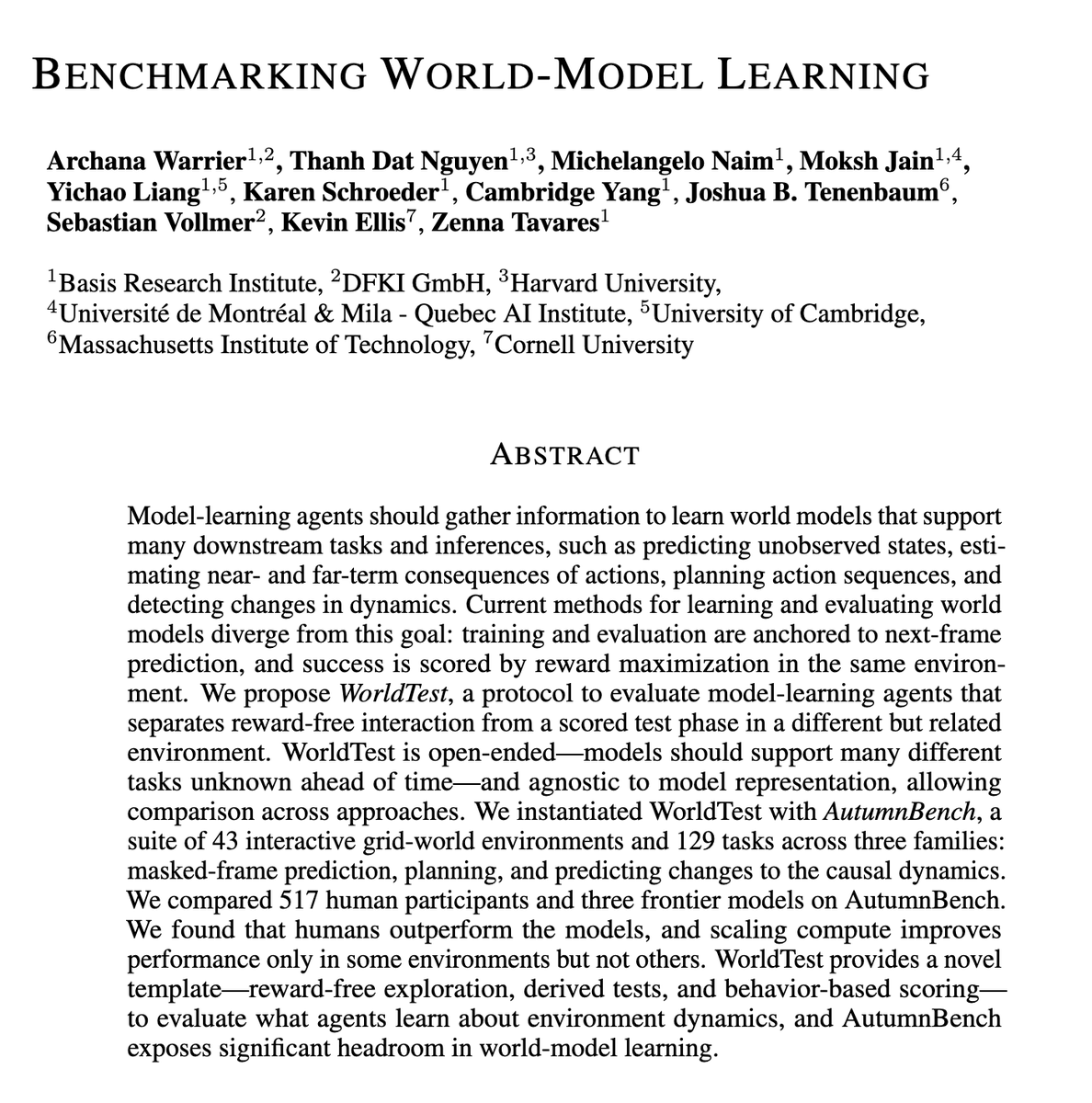
New paper from Basis' Project MARA team and collabs. The ability to learn and use world models is a key aspect of human intelligence, but evaluating this ability remains elusive. In this work we propose WorldTest, a representation-agnostic, behavior-based agent eval framework.
New paper from Basis' Project MARA team and collabs. The ability to learn and use world models is a key aspect of human intelligence, but evaluating this ability remains elusive. In this work we propose WorldTest, a representation-agnostic, behavior-based agent eval framework.
Join us next Thursday for panels on how AI and open source are transforming funding. Hear from
@e_mackevicius of @BasisOrg, Michelle Yi of Generationship, Allison Perkel, @VCMassaquoi
of Glasswing Ventures, and John Mark Walker: https://t.co/lUW3PHW6mF
The Collaborative Intelligent Systems team at @BasisOrg have an extremely cool preprint on Biorxiv, which Scientific American @sciam just picked up: Computational Urban Ecology of New York City Rats!
Team: @ralph_ep@zamakany Dima Batenkov @e_mackevicius w/ @zamakany
Check out @sciam coverage of the New York City rats project , so excited to be collaborating with the @BasisOrg dream team : @e_mackevicius , @ralph_ep and Dima Batenkov. To more and more success 😎
Full Sciam article here : https://t.co/5nObBAlAxP
The study preprint : https://t.co/tmfYfnGkBM
If you want to contribute , collaborate or connect us with funders, reach out .
🌆🐀Scientific American article about the project we're starting on NYC rats!! https://t.co/f4kquZ0qaH
With @ralph_ep, @zamakany, and Dima Batenkov
Seeking collaborators and funders 🐀🌆
What do neuroscience labs and the streets of New York City have in common? They are both commonly home to rats, a feature this research team is leveraging to study rat social cognition in the wild.
By @martajhill
https://t.co/w71oa11zN9