It was great fun contributing to this whitepaper, and it turned into a great read. A deep dive into a number of important and new research directions in neuroAI.
Excited to release what we’ve been working on at Amaranth Foundation, our latest whitepaper, NeuroAI for AI safety! A detailed, ambitious roadmap for how neuroscience research can help build safer AI systems while accelerating both virtual neuroscience and neurotech. 1/N
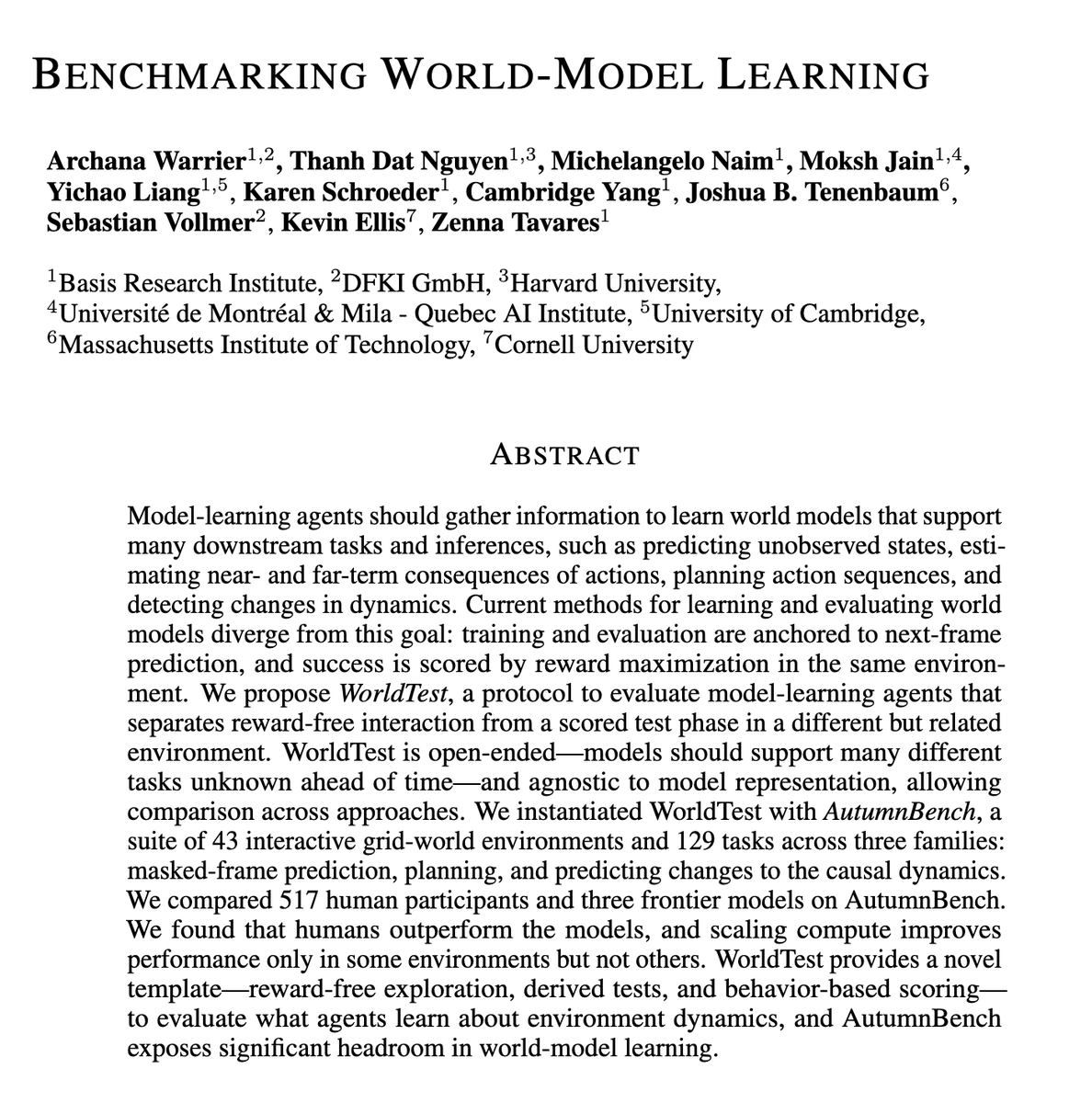
New paper from Basis' Project MARA team and collabs. The ability to learn and use world models is a key aspect of human intelligence, but evaluating this ability remains elusive. In this work we propose WorldTest, a representation-agnostic, behavior-based agent eval framework.
Thrilled to see our TinyRNN paper in @nature! We show how tiny RNNs predict choices of individual subjects accurately while staying fully interpretable. This approach can transform how we model cognitive processes in both healthy and disordered decisions. https://t.co/rgGoEcL26Y
We’re making the @BasisOrg organisation document public today. It’s less a charter and more a design doc—our spec for why a new kind of technology and research organisation is needed, and how to build it.
(link below)
Chollet @fchollet : [paraphrase] "using NNs for discrete problems i.e. finding new prime numbers - is a terrible idea" with @ellisk_kellis@ZennaTavares
Thank you, François, Mike, & team, for the ARC challenge. It has been a durable source of inspiration, and brings fresh ideas to AI.
The paper award first authors are Keya Hu (applying to PhDs @HuLillian39250) and Wen-Ding Li (at NeurIPS hunting for industry gigs @xu3kev). They're amazing: Anyone would be lucky to get them.
It's also our first collab w/ @ZennaTavares from @BasisOrg as part of MARA: https://t.co/l0vZ9I3Ygd
MARA is recruiting at all levels: join us!
Thrilled that joint work by @ellisk_kellis's lab and
@BasisOrg won 1st prize in @arcprize Paper Awards and 2nd prize in ARC-AGI-PUB (w/ MIT)
This is our first result from Project MARA: an effort to build Modeling, Abstraction, and Reasoning Agents capable of "everyday science"
My big list of @arcprize 2024 surprises:
1. TTT works really well to solve "novel" problems. Assuming you have a way to do data augmentation on the fly.
2. Brute force program synthesis is competitive with frontier LLM/AI approaches. We'll fix this in v2.
3. The private and public SOTAs tracked. Both ~55%, despite public having 1000X more compute budget.
4. At least 7 startups with >$1M funding changed research roadmaps to work on ARC.
5. Startups don't have the same incentives for sharing as private teams. Resulted in MindsAI choosing not to open source. We'll address this in 2025.
6. Over 1k people told us to test o1 on ARC. Reporting results on Claude 3.5 Sonnet similarly was a big hit. We'll keep doing this.
7. The #1 and #2 papers dropped out of the blue, during last 24 hours in the contest. Each went trending too. The paper award track was a big success and I'm glad we bumped the prize at 3 months.
8. The #1 winning team (the ARChitects) added 10% to their score in the last 72 hours of the contest, catching up to MindsAI. And they both are using TTT.
9. We have been developing ARC-AGI-2 in parallel this summer to address long-standing v1 flaws (eg. small sample size, brute forcibility, no human difficulty calibration). And while the SOTA is 55.5% today, early results suggest v2 will bring SOTA down more than I expected.
10. ARC Prize broke through. I saw it mentioned in many discussions we were not apart of. Reddit, HN, Discord, Twitter... to the extent a benchmark/nonprofit can have product-market fit, I sense we have it. We'll use this momentum to grow ARC Prize next year and steward attention as a north star towards AGI.
Proud to share that our work with @ellisk_kellis and collabs won the 1st prize ARC Paper Award! This is the first work to come out of the MARA project. Much more to come.
🚀We’re hiring! @ForestNeurotech is looking for a Software Engineering Lead to build the core systems powering our ultrasound neurotech platform.
As a nonprofit FRO, we're advancing science for public good. If you’re excited about neurotech & impact let’s talk. 🌍🧠 Link below
📢🎡🐦⬛I'm looking to hire postdocs to join me on the Collaborative Intelligent Systems project at @BasisOrg, more info here: https://t.co/59bZjNJn8V, please apply 🐦⬛🎡📢
🎡🦆New @BasisOrg paper by Rafal Urbaniak, @XieMarjorie and me!
Linking cognitive strategy, neural mechanism, and movement statistics in group foraging behaviors
https://t.co/qCDWn0PkiS
"Behind the paper" blog here: https://t.co/sdVp2hlrhU
Code: https://t.co/xsAJGwiwzp 🦆🎡
@BasisOrg has started a joint project called MARA w/ @ellisk_kellis 's lab +others. This is our first output. More details soon.
We're sponsoring "Systems 2 Reasoning at Scale" workshop at Neurips & will present MARA there. We're hiring for it now! https://t.co/6BPtXJE93S
@BasisOrg has started a joint project called MARA w/ @ellisk_kellis 's lab +others. This is our first output. More details soon.
We're sponsoring "Systems 2 Reasoning at Scale" workshop at Neurips & will present MARA there. We're hiring for it now! https://t.co/6BPtXJE93S
New ARC-AGI paper
@arcprize w/ fantastic collaborators @xu3kev@HuLillian39250@ZennaTavares@evanthebouncy@BasisOrg
For few-shot learning: better to construct a symbolic hypothesis/program, or have a neural net do it all, ala in-context learning?
https://t.co/zcmxoQzv92