Leopold Aschenbrenner just increased his position in one stock by 648% in a single quarter.
While everyone focuses on his $8.4 billion in semiconductor puts, this conviction add is hiding in plain sight.
He’s accumulating aggressively.
Here’s exactly what he is buying and why:
The stock is CLSK. CleanSpark.
One of the largest publicly traded Bitcoin miners in North America.
Mining facilities across Georgia, Mississippi, New York, Tennessee, and Wyoming with massive existing power infrastructure.
CleanSpark is no longer just a Bitcoin miner though.
The company is actively pivoting its existing infrastructure into AI and HPC compute hosting.
Cheap power, cooling, real estate, grid interconnects.
The pieces every AI lab needs are already in place. The pivot is the trade.
This is also consistent with the pattern across his entire filing.
While shorting the chips with $8.4 billion in puts, he loaded up on the Bitcoin miners pivoting to AI.
Applied Digital, Bitfarms, CleanSpark, IREN, Riot.
He’s long the power infrastructure of AI.
What makes CleanSpark different from the others:
– One of the highest hashrates among public Bitcoin miners.
– One of the deepest power positions in the industry.
– A real Bitcoin treasury that revalues every time BTC moves.
Three layers of upside in one stock.
We are a team of 8 with one goal: help you find the right stocks early.
But you need to follow us with notifications so you don’t miss our alerts. This is EXTREMELY important.
A lot of people will regret not following us.
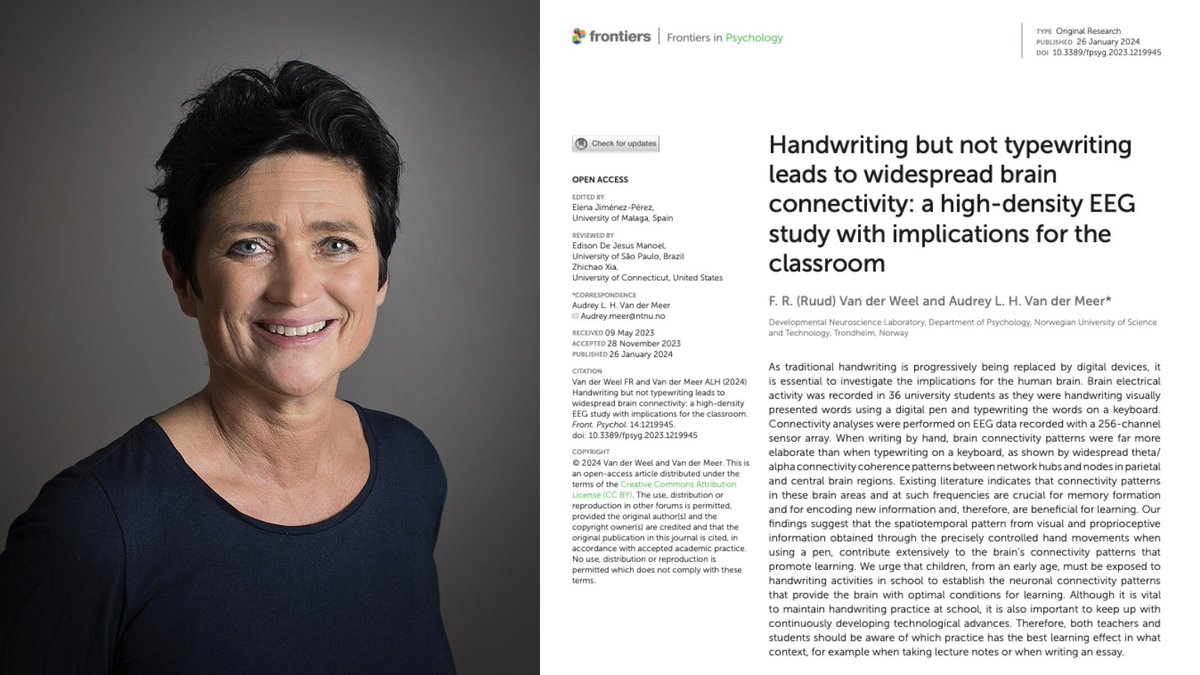
A Norwegian neuroscientist spent 20 years proving that the act of writing by hand changes the human brain in ways typing physically cannot, and almost nobody outside her field has read the paper.
Her name is Audrey van der Meer.
She runs a brain research lab in Trondheim, and the paper that closed the argument was published in 2024 in a journal called Frontiers in Psychology. The finding is brutal enough that it should have changed every classroom on Earth.
The experiment was simple. She recruited 36 university students and put each one in a cap with 256 sensors pressed against their scalp to record brain activity. Words flashed on a screen one at a time.
Sometimes the students wrote the word by hand on a touchscreen using a digital pen, and sometimes they typed the same word on a keyboard. Every neural response was recorded for the full five seconds the word stayed on screen.
Then her team looked at the part of the data most researchers had ignored for years, which is how different parts of the brain were communicating with each other during the task.
When the students wrote by hand, the brain lit up everywhere at once.
The regions responsible for memory, sensory integration, and the encoding of new information were all firing together in a coordinated pattern that spread across the entire cortex. The whole network was awake and connected.
When the same students typed the same word, that pattern collapsed almost completely.
Most of the brain went quiet, and the connections between regions that had been alive seconds earlier were nowhere to be found on the EEG.
Same word, same brain, same person, and two completely different neurological events.
The reason turned out to be something nobody had really paid attention to before her work. Writing by hand is not one motion but a sequence of thousands of tiny micro-movements coordinated with your eyes in real time, where each letter is a different shape that requires the brain to solve a slightly different spatial problem.
Your fingers, wrist, vision, and the parts of your brain that track position in space are all working together to produce one letter, then the next, then the next.
Typing throws all of that away. Every key on a keyboard requires the exact same finger motion regardless of which letter you are pressing, which means the brain has almost nothing to integrate and almost no problem to solve.
Van der Meer said it plainly in her interviews.
Pressing the same key with the same finger over and over does not stimulate the brain in any meaningful way, and she pointed out something that should scare every parent who handed their kid an iPad.
Children who learn to read and write on tablets often cannot tell letters like b and d apart, because they have never physically felt with their bodies what it takes to actually produce those letters on a page.
A decade before her, two researchers at Princeton ran the same fight using a completely different method and ended up at the same answer. Pam Mueller and Daniel Oppenheimer tested 327 students across three experiments, where half took notes on laptops with the internet disabled and half took notes by hand, before testing everyone on what they actually understood from the lectures they had watched.
The handwriting group won by a wide margin on every question that required real understanding rather than surface recall.
The reason was hiding in the transcripts of what the two groups had actually written down.
The laptop students typed almost word for word, capturing more total content but processing almost none of it as they went, while the handwriting students physically could not write fast enough to transcribe a lecture in real time, which forced them to listen carefully, decide what actually mattered, and put it in their own words on the page.
That single act of choosing what to keep was the learning itself, and the keyboard had quietly skipped the choosing and skipped the learning along with it.
Two studies. Two countries. Same answer.
Handwriting makes the brain work. Typing lets it coast.
Every note you have ever typed instead of written went into your brain through a thinner pipe. Every meeting, every book highlight, every idea you captured on your phone instead of on paper was processed at half depth.
You did not forget those things because your memory is bad. You forgot them because typing never woke the part of the brain that would have made them stick.
The fix is the thing your grandmother already knew.
Pick up a pen. Write the thing down. The slower road is the faster one.
@American1229 Yup, grew up Wis. moved away for 15-20 years came back and realized how bad this area has alcohol problem. Its sad how its so embraced here. Its like I'm so proud of smoking 10 packs a day. I believe 1x offense isn't even a loss of liscense. Some of these fools have 7x offenses.
“After 2027, there will be no way back.”
Elon Musk said this in a podcast with Lex Fridman — a line that was later cut. When asked “Why?”, he fell silent for almost a minute. Then he quietly said: “It’s not a catastrophe. It’s a transition.”
The transcript left behind three themes that gave him away: autonomous intelligence, loss of meaning, and energy dependence. It all sounded like a forecast — but now reads like a diagnosis of the era.
The first sign is the collapse of attention.
Musk said humanity will stop thinking in cycles. Planning for the future will shrink to the horizon of updates. People will stop building and start simply replacing. MIT research confirms: a generation born after 2000 holds attention for about 8 seconds — less than a goldfish. Musk called this “cultural Alzheimer’s.” We’re not losing memory — we’re losing the ability to think.
The second sign is artificial intelligence that no longer obeys.
Musk said: “When a system starts correcting humans, the time of linear logic is over.” Even now, algorithms decide who we date, what we buy, and what we think about. This isn’t a machine uprising — it’s dissolution into convenience. People won’t notice the moment when choice becomes an option, not a right.
The third sign is energy dependence.
Musk explained: civilization can no longer survive even a day without electricity. By 2027, in his view, the balance will shift — energy will become currency, and control over it will become power. From that moment on, everything non-autonomous will disappear. This isn’t an apocalypse — it’s a change of biological form.
At the end, he said a line that didn’t make it on air:
“Technology is stronger than us, but not smarter. As long as we have meaning, we are alive. Lose it — and we become code.”
Then, after a pause, he added:
“We must learn to be human before systems learn to be gods.”
Are you ready for the transition — or already living in a world where choices are made for you?