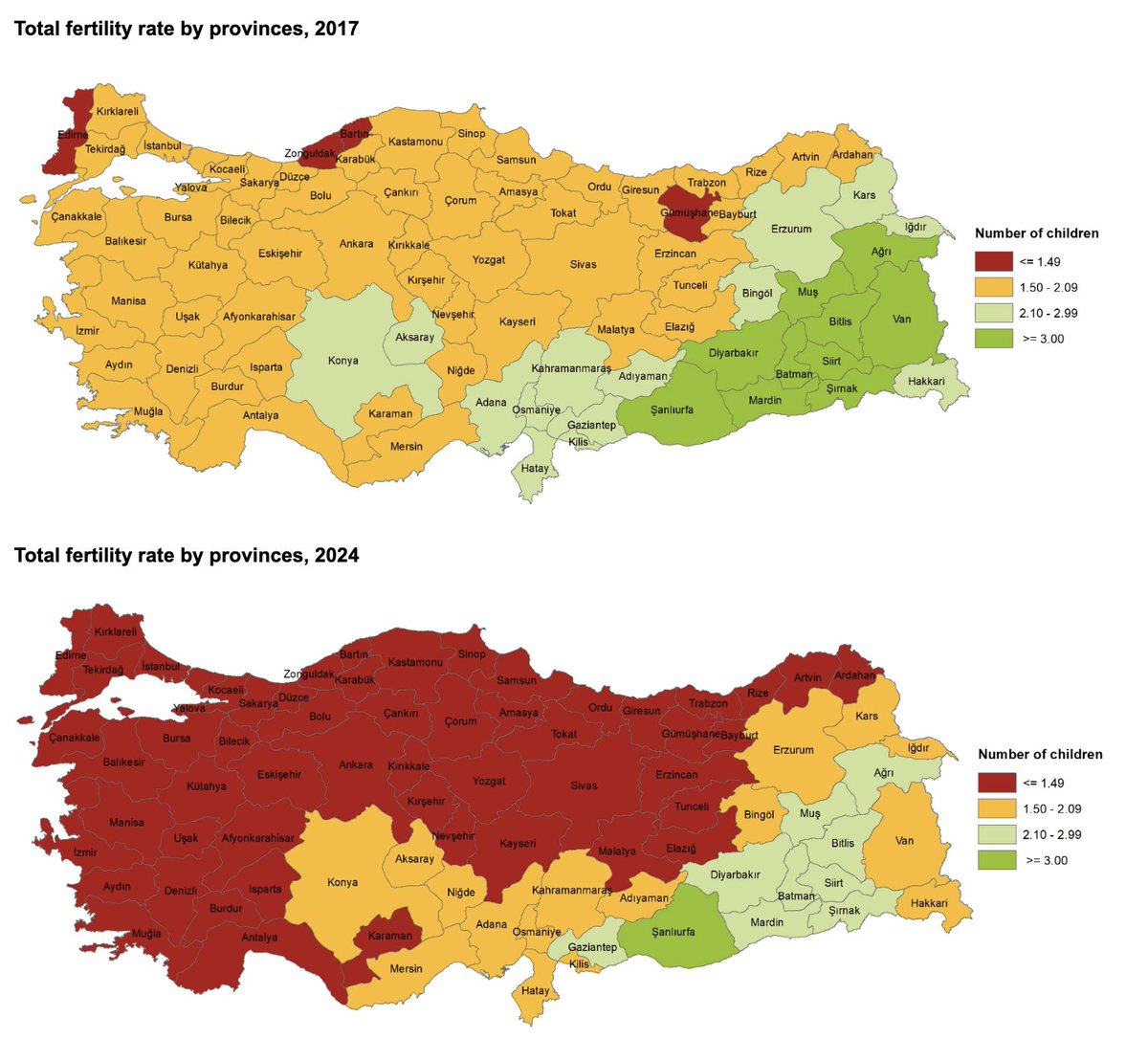
Yesterday, I argued that Turkey’s TFR was 1.48 in 2024, well below replacement level, and has been falling fast since 2014.
Today, I want to highlight a few additional points.
First: Turkey has the highest within-country TFR variance I’m aware of.
In Şanlıurfa, TFR was 3.28 in 2024 (comparable to Kenya). In Bartın and Eskişehir, it was 1.12 (comparable to Spain). The ratio between them is nearly 3 to 1.
By comparison, in the U.S., the highest TFR is in South Dakota (2.0), the lowest in Vermont (1.3), a ratio of 1.5.
These differences in TFR reflect significant differences between Eastern and Western Turkey (in terms of economy, society, culture, and ethnicity) and will impact Turkey’s future. Yet even with those divides, TFR is falling everywhere.
TFR in 2014:
Şanlıurfa: 4.57.
Bartın: 1.69.
Eskişehir: 1.57.
Even more striking is Şırnak. In 2000, it had a TFR of 7.06, comparable to Chad or Mali, and among the highest in the world. In 2024, it dropped to 2.62, roughly Turkey’s national level in 1998. That’s a 63% drop in 24 years. I struggle to find any other example in global demographic history of such a rapid decline in fertility.
And remember: TFR is not the crude birth rate. TFR = expected births per woman, not per population. Migration flows don’t affect it (unless those who migrate are the most fertile per woman, which would increase TFRs in the destination provinces).
As a whole, TFR in Southeast Anatolia went from 3.63 (2014) to 2.87 (2024). At this pace, the region will fall below replacement by 2030.
In other words, Turkey’s national TFR still has much room to fall, as the east continues to decline from high levels, and we may soon see Turkey’s TFR fall below the EU average, something I wouldn’t have predicted even a decade ago.
Second: Turkey is a textbook case of what @NezihGuner, @mattd_econ, and I have called “demographic contagion”:
📄 https://t.co/sVkLjYGy9a
The fall in TFR in one region is strongly influenced by previous declines in adjacent regions, even controlling for income.
In Turkey, if you map provincial TFRs over time, you see an unstoppable tidal wave moving eastward, rarely skipping or leaving provinces untouched. That dynamic, to me, is crucial.
Third: there’s little evidence this drop in TFR is driven by timing. Yes, completed fertility may end up a bit higher than current TFR estimates, but that’s a second-order difference.
Fourth (and finally): as in many countries, the 2024 UN WPP numbers for Turkey are hard to reconcile with national data.
Turkish Statistical Institute: TFR = 1.48, Births = 937,559.
UN WPP 2024: TFR = 1.85, Births = 1,196,000.
The UN does not project Turkey’s TFR to fall to 1.48 at any point before 2100 (the end of its projections). And yet it already has, according to the Turkish Statistical Institute.
This is a serious issue. Many rely on the 2024 UN WPP, but the numbers diverge massively from national statistical agencies and almost always in the same direction: UN projections show much higher TFRs and births. Why?
I could discuss the demographic future of Turkey in much more detail, but I will stop here.
New study: The relative wage premium for going to college has halved for low-income Americans since 1960.
What is to blame? Rising selectivity? Tuition hikes? State disinvestment? We decompose changes in the premium since 1900 to find out.
🧵#EconTwitter https://t.co/2DYx3AnI8i
@paulnovosad@S_Stantcheva 💯% agreed. Such a great role model for grad students who need inspiration for creative work. (Definitely has shaped how I approach my research.)
🌱 Can environmental regulations change how firms behave?
A new @nberpubs working paper by J-PAL affiliate Namrata Kala & Michael Gechter uses a randomized place-based policy in India to study this. https://t.co/eHAW0llyTD
What do multiple-choice tests really measure? We explore this in a new @nberpubs paper with Kala Krishna & @e_ozerr. We find time pressure affects sorting—and impacts men and women differently. More in my chat with @ZjubNZ.👇
https://t.co/yriBccmdLM
@SPelinAkyol For a deeper dive, my co-author @SPelinAkyol breaks down the approach, findings, and implications of our study in this podcast episode with Matt Nolan:
https://t.co/hVVhFUAnEQ
Time-constrained choices are everywhere—exams, contests, tasks at work. But how much do time limits really matter?
This project began as my third-year paper—and my first time running an experiment. It's now an NBER WP joint with @SPelinAkyol & Kala Krishna. 🧵
@SPelinAkyol Our counterfactuals show: optimal exam design depends on which part of the ability distribution you care about. Time limits matter.
AND: sorting within gender may better reflect true ability—due to differences in signal production.
One challenge for trade policy, is that the benefits to consumers (like lower prices) feel vague & abstract—it's hard to see what we'd lose without free trade. Job threats feel immediate, driving support for protectionism. More recent on views on trade👇 https://t.co/fQh1yo7h2S
I should add: if you install ollama with e.g. deepseek coder you can avoid the Github link. In case you are worried -- and you should -- that any interaction you have with OAI will be used by them either for model optimisation or, well, for other things. So here is a short 🧵 on how you can build your own pipeline that leverages a local LLM -- which will also work without being connected to the internet.
Step 1: Install Ollama.
Step 2: Pull deepseek-coder in terminal
ollama pull deepseek-coder:6.7b
Step 3: Install a VScode extension to interact with ollama, e.g. Cline or Roo Code.
Step 4: Configure the extension settings you need to provide the base URL on which the ollama endpoint API lives, it usually is http://localhost:11434/ and you can select the model
Step 5: Happy assisted private coding.
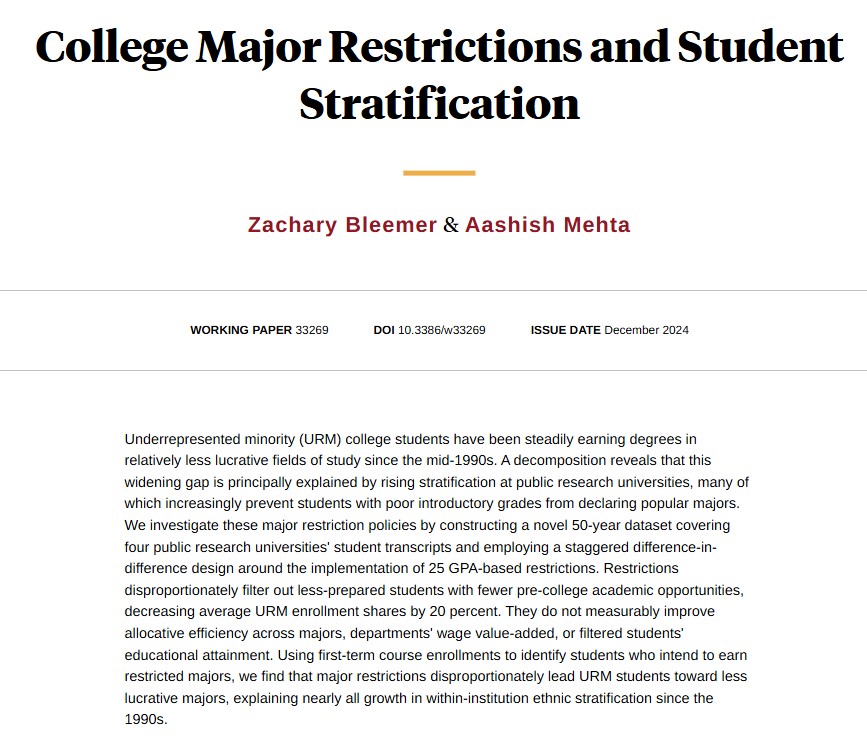
Black and Hispanic college graduates have been steadily earning degrees in relatively lower-paying majors since 2000. The main reason is new GPA-based restrictions on major choice, from @zbleemer and @ProfAMehta https://t.co/PH7UwhNcGO
Does anyone have a good review or paper that compares the impacts of different interventions on college student outcomes? I am trying to compare the effect size of an intervention I'm studying to other interventions on college student GPA.