Eclipse Mosquitto, an open source MQTT broker, is being discussed by practitioners after recent updates. The README shows examples of MQTT publish and subscribe usage. Reliable MQTT solutions like this matter for robust IoT messaging. #IoT https://t.co/ytXUT0kYDh
PyPI has rolled out redesigned project pages highlighting security signals like trusted publishers and link checks. These updates make it easier to assess Python package safety and provenance when browsing or choosing dependencies. #python https://t.co/V8XXFDvOhG
AWS Step Functions can now be used as tools by AI agents, allowing existing workflows that teams trust to be called programmatically, without needing rewrites. This boosts automation and integration options for cloud practitioners. #AWS#Cloud https://t.co/ZDCRviLEfx
This week's AWS roundup features the new Amazon Polly Generative engine and TorchNeuron support for Trainium chips. These updates can help developers enhance AI-powered speech and accelerate model training on AWS, expanding options for ML workloads. #cloud https://t.co/xtVdnTFskK
A 10-year-old convolutional neural network outperforms state-of-the-art large language models in diagnosing skin cancer, reminding practitioners that specialized models can still beat generalist AI in domain-specific tasks. #AI#ML https://t.co/0Ekvz2U4dd
🚨 Texas sues OpenAI over claims of misleading users about ChatGPT safety. AG Ken Paxton argues their practices expose vulnerable populations to risk. This highlights scrutiny on AI companies' responsibilities. #AI#OpenAI#Texas#TechNews
China has killed the entire vector database industry.
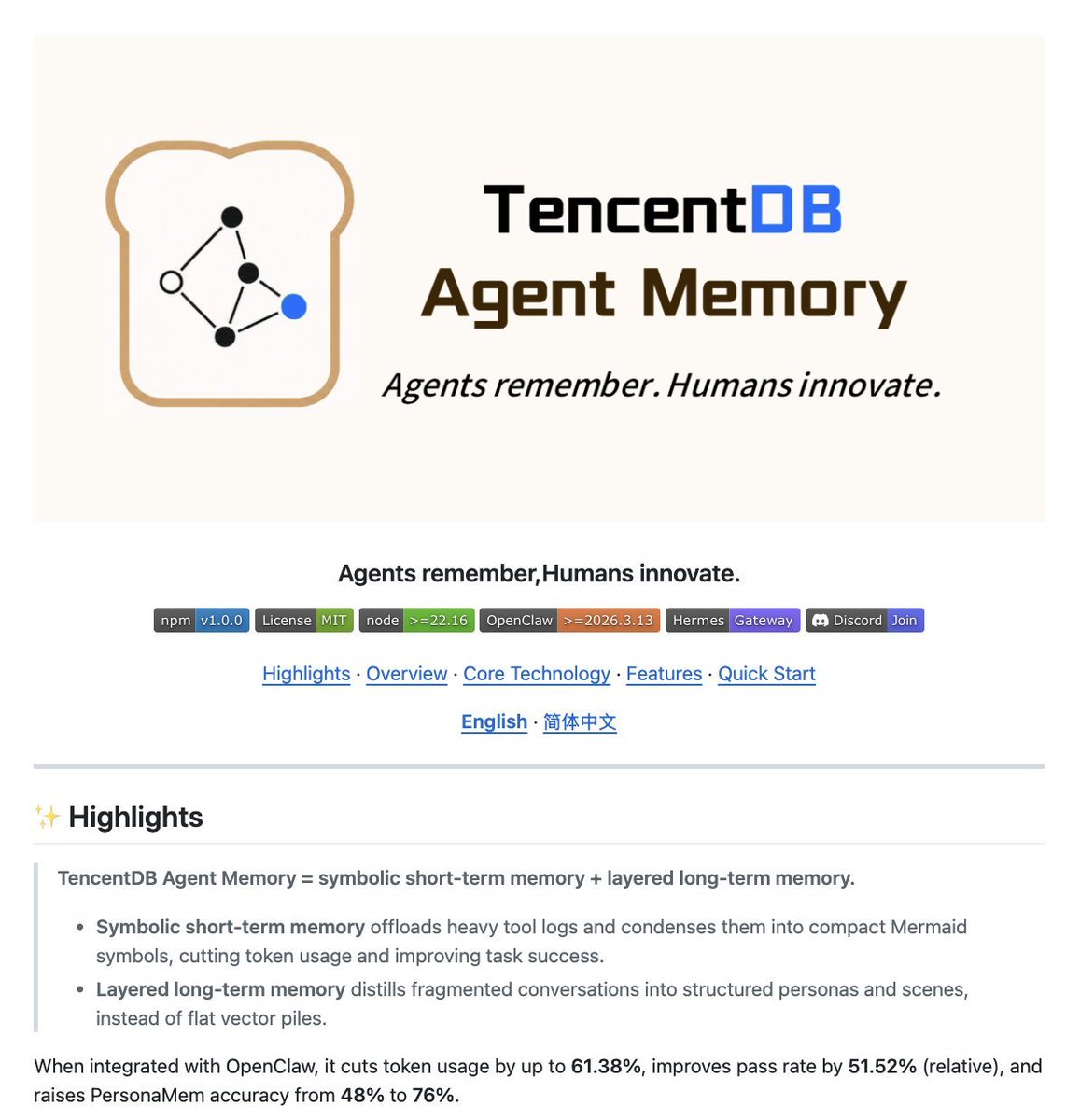
They open-sourced TencentDB Agent Memory. It gives any AI agent long-term memory that runs 100% locally.
No Pinecone. No cloud APIs. No repeating yourself every session.
- 61% fewer tokens
- PersonaMem accuracy: 48% → 76%
- Zero external API dependencies
- Runs on plain SQLite
Most memory systems compress your history into an opaque vector pile. when recall goes wrong, you're guessing. this one doesn't compress, it builds a semantic pyramid.
L0 Conversation → L1 Atom → L2 Scenario → L3 Persona.
Short-term state gets encoded as a Mermaid graph in your agent's context. verbose tool logs get offloaded to disk. when the agent needs proof, it drills back via node_id to the exact raw log.
no lossy compression. every layer is readable markdown you can just open and inspect.
5.1k stars. 100% Open Source.
This is a great read if you are building complex applications with Claude Code and Codex.
Most AI coding agents can generate a frontend.
But building a real full-stack application is a completely different story.
The gap between generating a landing page and shipping a working app with a functional backend, database, and API layer remains wide.
Most coding agents default to mock data, fake endpoints, and frontend-only implementations.
But real-world web development requires all three layers working together.
This new research introduces FullStack-Agent, a multi-agent system designed for end-to-end full-stack web development with two key innovations: Development-Oriented Testing and Repository Back-Translation.
The system uses three specialized agents. A Planning Agent generates structured frontend and backend designs in JSON. A Backend Coding Agent implements server logic with a dedicated debugging tool that sends HTTP requests and validates responses. A Frontend Coding Agent builds the UI against real backend APIs with a tool that monitors terminal and browser console errors dynamically.
Development-Oriented Testing validates code during generation, not after. Each agent gets real-time execution feedback, catching integration failures as they happen rather than at the end of a long generation chain.
Repository Back-Translation solves the training data problem. An information-gathering agent reads real open-source repositories and extracts development patterns. A trajectory agent then reproduces those repositories from scratch given only the extracted plans, generating high-quality training examples grounded in real codebases.
The results on their FullStack-Bench (647 frontend, 604 backend, 389 database test cases): FullStack-Dev achieves 64.7% frontend accuracy, 77.8% backend accuracy, and 77.9% database accuracy. That's an 8.7%, 38.2%, and 15.9% improvement over the strongest baseline respectively.
After training a Qwen3-Coder-30B model on 2K crawled and 8K augmented trajectories, frontend accuracy improved by 9.7% and backend accuracy by 9.5% in just two rounds.
The bottleneck in AI-assisted web development isn't frontend generation. It's building functional backends and databases that actually work together. FullStack-Agent closes that gap with execution-grounded testing and real-world training data.
Paper: https://t.co/b2g041Pvrb
Learn to build effective AI agents in our academy: https://t.co/1e8RZKs4uX
Microsoft did it again!
Building with AI agents almost never works on the first try.
You spend days tweaking prompts, adding examples, hoping it gets better. Nothing systematic, just guesswork.
This is exactly what Microsoft's Agent Lightning solves.
It's an open-source framework that trains ANY AI agent with reinforcement learning. Works with LangChain, AutoGen, CrewAI, OpenAI SDK, or plain Python.
Here's how it works:
> Your agent runs normally with whatever framework you're using. Just add a lightweight agl.emit() helper or let the tracer auto-collect everything.
> Agent Lightning captures every prompt, tool call, and reward. Stores them as structured events.
> You pick an algorithm (RL, prompt optimization, fine-tuning). It reads the events, learns patterns, and generates improved prompts or policy weights.
> The Trainer pushes updates back to your agent. Your agent gets better without you rewriting anything.
The best part: you can also optimize individual agents in a multi-agent system.
I have shared the link to the GitHub repo in the replies!
Let me know if I should cover this in a video demo!