Nine machine learning models, one formula each.
Linear regression fits a weighted sum by gradient descent. The perceptron wraps it in a sign function and nudges the weights toward each misclassified point. Logistic regression squashes it into a probability with the sigmoid.
KNN votes among the nearest points. PCA projects onto the top eigenvector of the covariance. An RBF SVM's boundary bends more as its kernel narrows.
🌊🌡️The warmest fall ocean @calcofi has measured. Every season since 1949, CalCOFI has sailed the same grid of stations off California. This season, scientists found the upper ocean further above normal than on any cruise in the record. 🧵⤵️
Some archaea—an ancient group of microorganisms—have an entirely novel genetic code, according to a 2025 study in Science. Their genetic code reassigns a DNA “stop” signal to incorporate the rare amino acid pyrrolysine into their proteins.
The findings expand our understanding of how alternative genetic codes evolve and hint at new molecular tools for biotechnology applications. https://t.co/SNz70GImAi #ScienceMagArchives
How did life on Earth begin? On the latest episode of The Quanta Podcast, host Samir Patel sits down with writer @yasemin_sap to discuss the new generation of scientists rethinking what life was, is, and could be.
Listen now: https://t.co/d3IDfMI5rJ
.@SpaceX is a company built by thousands of talented people. Some of my friends and brilliant colleagues work there, and they deserve recognition for what they have accomplished.
This is a significant milestone for space exploration and another step toward building a sustainable human presence in space.
I believe that, in the long term, developing industries beyond Earth, from orbital data centers to space-based solar power stations and manufacturing, could benefit humanity. It will create new economic opportunities, expand our capabilities, and eventually reduce some of the environmental pressures on our planet.
Of course, none of this is guaranteed. There are enormous technical, economic, and environmental challenges to overcome. But these are challenges worth addressing through research, engineering, and innovation.
I believe in science and technology, and in our ability to use them to build a better future.
Metabolism is catalyzed by electric fields within enzymes, but the building blocks of enzymes are made by metabolism. How did this chicken-and-egg situation arise?
Check out our Perspective in @J_A_C_S !
https://t.co/CNhAnGlMJq
I’m actively looking to match ambitious scientists with funding.
Through some combination of my writing, podcasts, in-person events, scientific research and other activities that my friend @markwbudde would call “hypernetworking,” I’ve managed to meet a lot of wealthy individuals interested in funding ambitious scientists. I’ve had my own work funded this way, and though it’s not sustainable enough to replace the work of larger funding bodies of the NIH, for the right kind of person it is just what they need.
I am writing this post because I am helping one of these groups – Fulcrum Science – find projects worth giving money to.
While I’m pretty flexible, I’m particularly interested in hearing from people who are actively working on open sourced LLMs for frontier biology.
Plenty of groups have shown what is possible with frontier, closed-source LLMs. I’ve also seen it in my own work (which I hope to talk about soon). I also think that the absolute frontier of intelligence isn’t required to do interesting things in science.
I’d like to help match an existing lab – academic or industry – with a decent sum of funding to showcase what open sourced models can do in biology.
Pitch me what you’d do.
Please note, I am not looking to hear about any projects that involve Claude or ChatGPT for any reasoning, experimental analysis, or embodied automation stuff. Open source only!
I’m also open to hearing about other things within biology. If you have an idea you have struggled to get funded, and you have a good reason for me to believe you, please reach out.
My email is eryneym [at] https://t.co/LFSC13FgpH. You can also DM me on Twitter.
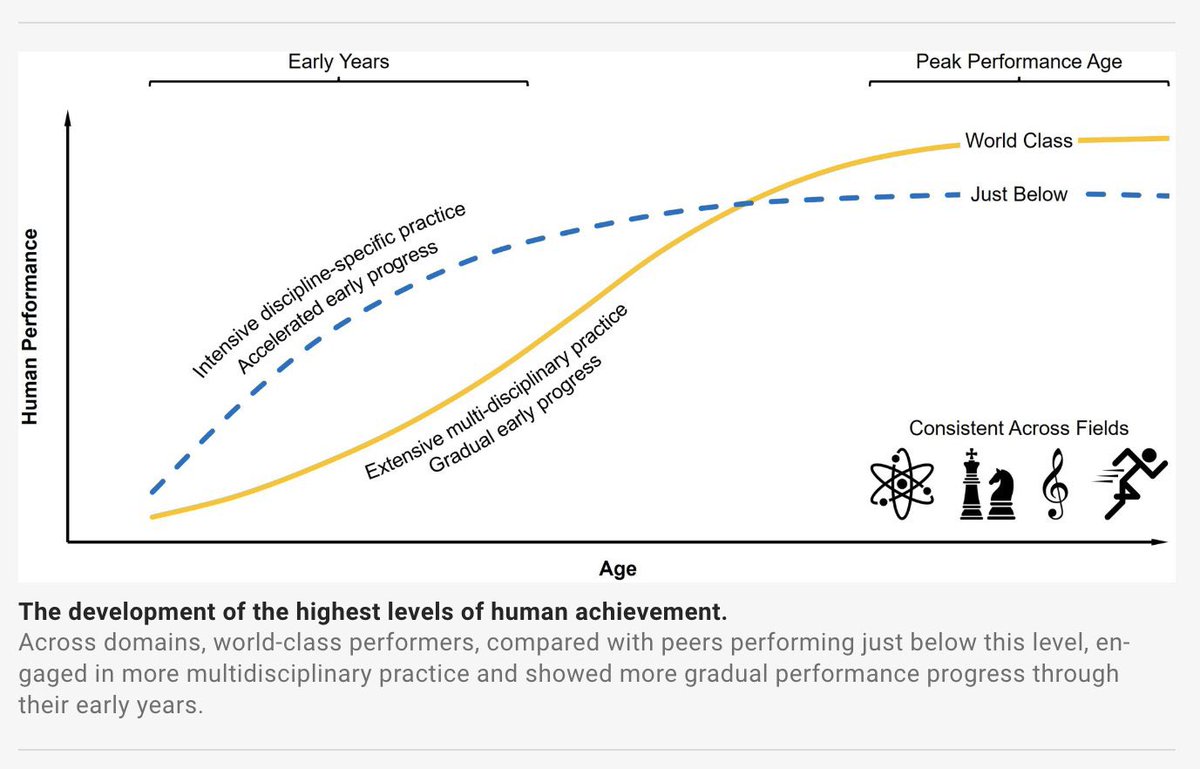
Fascinating paper just published in Science.
The authors analyze the career trajectories of top performers across multiple domains, including Nobel laureates, elite chess players, Olympic gold medalists, and more.
Their central finding challenges a common belief.
Intensive, single-discipline training at a young age does confer an early advantage, but this advantage fades over time.
By contrast, individuals exposed to multidisciplinary practice early in life tend to start more slowly. Yet, over the long run, they are more likely to reach world-class performance, eventually overtaking early specialists, who often plateau just below the very top.
An important reminder that breadth early on can be a powerful investment in long-term excellence.
Link to the paper in the first reply.
We’re moving our communication away from X! After 15 years, it’s time to continue the conversation somewhere new. This account will stay online as an archive – a little time capsule of science stories, discoveries… and to be honest, probably far too many posts about coffee! 😉
@gtconway3d Republicans play with fire here. If they go too much on defending Trump, this could backfire really ugly if new information will show him more implicated
New dates for a long-debated New Mexico fossil site reveal that dinosaurs were thriving and regionally diverse until the end-Cretaceous asteroid strike 66 million years ago, according to a new study in Science. https://t.co/XMl7UqpXHa