After nearly 18 years in tech, working with Fortune 500 companies and leading teams across continents, I always knew entrepreneurship was calling. Here’s my journey from employee to founder 🚀🧵
Waiting for Elon Musk to start Buying $TE , Solar, Texas Dems will make the big move soon for 2027 Rocket Up for TE. Shorts are on the Wrong side, They Short, I Buy More, Thank you.
$TE A look at the company’s latest official disclosures reveals a rock-solid fundamental foundation. First, production capacity requirements through 2027 are already locked in—a fact underscored by the most recent third-quarter report (following a staggering 145.92% year-over-year revenue surge). Furthermore, the company has secured a major 641MW long-term contract with power generation giant Clearway Energy and earned an "A" rating—the highest possible—for bankability from Intertek CEA.
Second, the company benefits from a rare tariff exemption combined with a fully localized U.S. supply chain. It has obtained a coveted exemption from the U.S. Department of Commerce regarding "Section 232" tariffs on polysilicon, and has forged deep partnerships with materials leader Corning and solar tracking system pioneer Nextracker to build a "Made in the USA" competitive moat across the entire value chain.
Third, the company has made a comprehensive entry into energy storage and AI data center infrastructure. Through the acquisition of KORE Power, it has expanded into battery energy storage systems (BESS) and the data center market. Additionally, the approval to repurpose the Giga Arctic "mega-site" in Norway for AI data center development has effectively shattered the previous ceiling on the company’s valuation.
$CVX looks cheap to me.
You pay about $12 for every $1 of free cash it makes a year (cash left after running the business).
From 2021 to 2025 that averaged about $14.
Its dividend is about 3.4%.
The catch: profits ride on oil near $97 a barrel, up from $69 a year ago.
$TE Major structural shift underway in U.S. solar module pricing—and it’s turning into a massive tailwind for T1 Energy ($TE):
TOPCon Pricing Surging Ahead of Dec 4 Tariffs: According to new Q4 data from procurement platform Anza, U.S. module prices have jumped 35%+ since July ahead of the December 4 Section 232 polysilicon minimum import price (MIP) taking effect—pushing TOPCon quotes from ~$0.28/W up to $0.38/W, alongside sharp spikes in PERC (~$0.385/W) and HJT (~$0.39/W).
The Real Catalyst for $TE (Domestic Content Economics): Because import tariffs just raised the price floor for foreign panels, the premium for U.S.-made modules over imports has compressed dramatically—making domestic modules a near no-brainer for developers chasing the 10% IRA Domestic Content tax credit bonus. Roughly half of U.S.-cell supply is already sold out for Q4 as buyers scramble to lock in 2027 volume.
Industry Validation from $FSLR: Even First Solar ($FSLR) CEO Mark Widmar acknowledged on their Q3 earnings call that TOPCon commands a multi-cent energy-value premium over CdTe thin-film panels.
$TE’s Positioned to Capture the Upside: With its Texas TOPCon manufacturing footprint, a newly granted Commerce Department Section 232 polysilicon waiver, and 3.5+ GW already contracted for 2027 (including 1.6 GW of fresh Q3 offtake deals), $TE is sitting right in the sweet spot of constrained U.S. supply and rising ASPs.
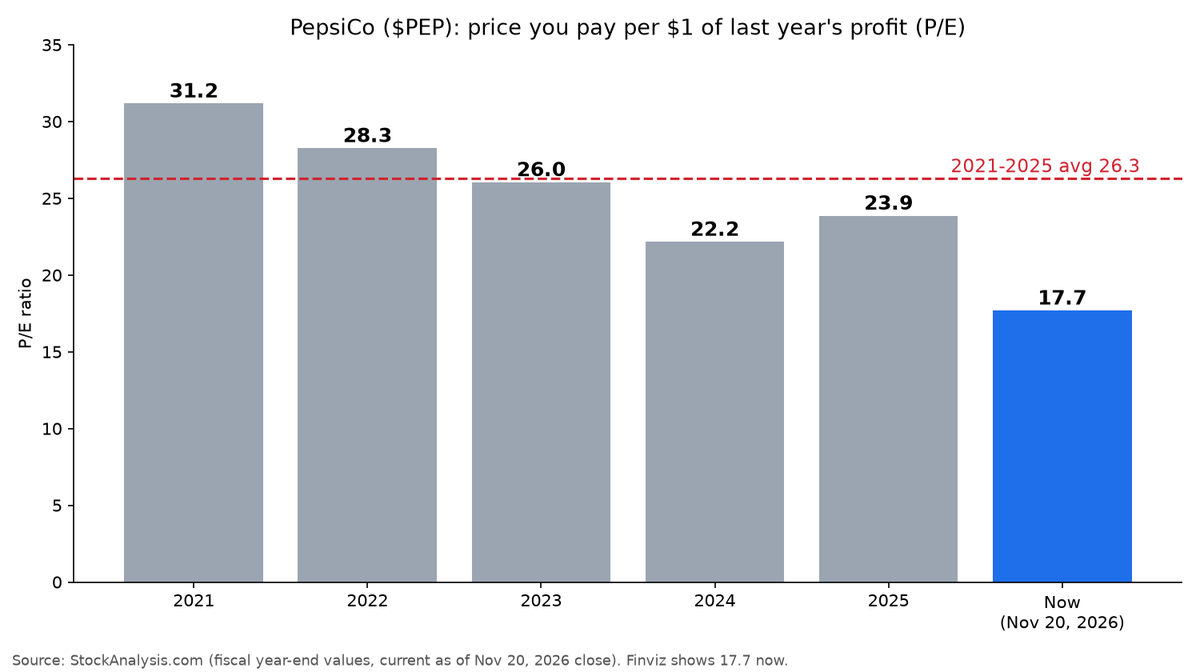
$PEP looks cheap to me.
You pay about $18 for every $1 of profit it made last year.
At the end of each year from 2021 to 2025 you paid $22 to $31.
It also pays about a 4% dividend.
The catch: North America is weak. Drink volumes fell 2% last quarter and snacks were flat.
@MaryamNSharif Good work but only in specific areas, hope to see this spreading in all areas. Even in Lahore I saw faulty lights in underpasses which were OK last year. Anyway good job!