It's been a busy year! I've been spending most of my time revamping markets, stocks, and business coverage at @TheStreet.
Now, I will get to do even more!
I’m happy to share that I’m now Editor-in-Chief at TheStreet! I'm downright lucky to lead a great group of passionate writers who deliver engaging, informative business, markets, stocks, personal finance, autos, and travel-related content daily.
While we've made big changes in the past year to make our content even more valuable, there's still lots to do. If you haven't checked us out lately, please do.
What content would you like to see more of from here? What tools would be most valuable to you? Want more short form video? White papers? Personal finance? I want to hear from you!
https://t.co/ugPr3AiiM9 or https://t.co/a9I9G3H1jh
After 214 trading days, the S&P 500 closed beneath it's 200-day MA this week.
Since 1950, when the S&P 500 closes above this trendline the annualized return is 21.1%.
When it closes beneath? -22.2%.
Proving once again that bad things tend to happen beneath this trendline.
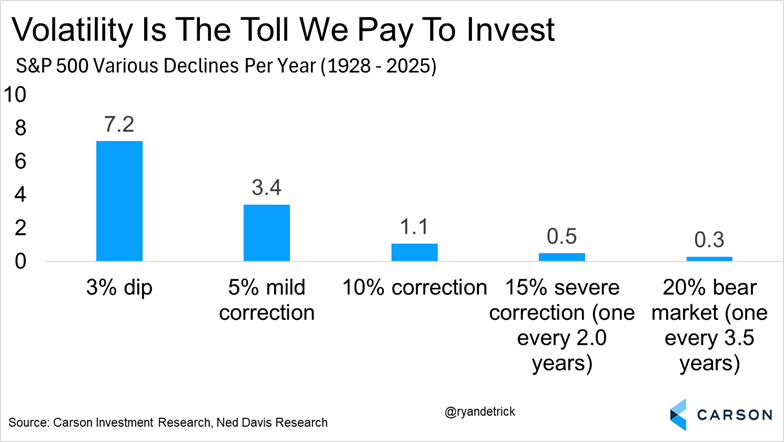
The S&P 500 is in the midst of the first 5% mild correction since November (-5.1%).
We tend to see three of these a year on average. They aren't fun, but they are a necessary part to investing.
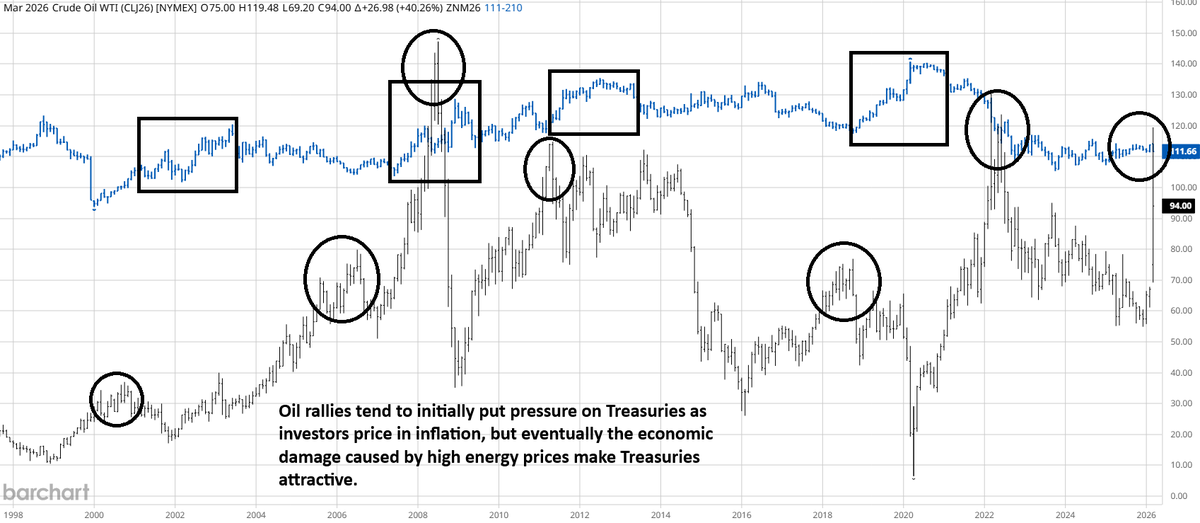
We know what oil shocks do to the stock market, and it is playing out as history has suggested. The Treasury market reaction to higher energy prices often comes in two phases. First, Treasuries sell off (higher yields) to accommodate higher inflation expectations, but eventually they tend to rally (lower yields) as investors realize they need a safe haven from stocks. The only time this wasn't true was from 2022 onward. In that particular cycle, investors turned to gold as their preferred safe-haven. However, with the precious metals trading weaker alongside stocks, US bonds might finally come back into favor. #crudeoil #oil #oilshock #bonds #interestrates #inflation #wti #energymarket #war #iranwar
S&P is not quite oversold using the RSI but arguably one of the most important prices in the world is, 2yr bonds. Their yields at ~3.90% are the north star for Fed funds rates (3.5-3.75%) and have risen over 50 bps (the equivalent to two 25 bps hikes) since late Feb.
Jerome Powell statements on Wednesday including "the possibility that our next move might be an increase did come up at the meeting," and "if we don't see progress on inflation, we won't see a rate cut" helped drive this. But a rate hike at the next April meeting seems unlikely given the global risks to growth. Also a new Fed chair should start in mid-May and is more biased towards cuts.
As a result, now might be a good time to consider putting some cash to work for those willing to take on more risk and inclined to “buy to the sound of cannons.” Gold related securities which have gone from overbought in late February to now oversold and are historically uncorrelated to the market I believe are a good risk adjusted idea.
While Trump Accounts won’t officially launch until July 4, 2026, there’s been a lot of conversation surrounding them following President Donald Trump’s State of the Union address on Feb. 24.
Critics like Ramsey point out that the accounts have some major downsides.
Read more: https://t.co/H84gKXMEnv
The CEO of the most advanced AI company in America just went on national television (Save this)
Hours after his company was blacklisted by the US government.
Here's what he said.
Dario Amodei built the only AI deployed inside the Pentagon's classified networks.
His company helped run military operations, intelligence, cyber defense.
Then the government told him to drop all safety limits.
He said no to two things.
Just two.
"One is domestic mass surveillance."
He explained: the government can already buy your location data, your browsing history, your political affiliations from private companies.
AI makes it possible to analyze all of it.
On every American, all at once.
"That actually isn't illegal. It was just never useful before the era of AI."
"Case number two is fully autonomous weapons."
Not the drones used in Ukraine and the remote-controlled systems.
Weapons that select targets and fire without a single human pressing a button.
"The AI systems of today are nowhere near reliable enough."
"We don't want to sell something that could get our own people killed or that could get innocent people killed."
He approved 98% of what the Pentagon wanted.
"No one on the ground has actually run into the limits of any of these exceptions."
The government wasn't fighting over something it needed.
It was fighting over the right to have no limits at all.
They gave him three days.
He said no.
So the President called his company "radical left woke."
Then ordered every federal agency to stop using their technology.
Then the Pentagon labeled them a national security risk.
A designation that has only ever been used against foreign enemies.
When asked if he'd received any formal legal action, he said this:
"All we've seen are tweets from the president and tweets from Secretary Hegseth."
No letter, filing or a legal document.
"When we receive some kind of formal action, we will look at it, we will understand it, and we will challenge it in court."
He said the Defense Secretary lied about the law.
Hegseth tweeted that any company with military contracts can't do business with Anthropic "at all."
Amodei: "That is not what the law said."
"The nature of the tweet was designed to create fear, uncertainty, and doubt."
Asked if this was an abuse of power, he paused.
Then said:
"This designation has never happened before with an American company."
"It was made very clear that this was retaliatory and punitive."
"I don't know what else to call it."
Asked if Anthropic could survive, he didn't hesitate.
"Not only survive it. We're gonna be fine."
Then the final question.
"If you had a moment with the President right now tonight, what would you say to him?"
"We are patriotic Americans."
"Everything we have done has been for the sake of this country."
"The red lines we have drawn, we drew because we believe that crossing those red lines is contrary to American values."
"Disagreeing with the government is the most American thing in the world."
"And we are patriots."
A CEO just went on national television and told the President of the United States:
You can blacklist us.
You can call us names.
You can threaten our business through tweets.
But we will not build machines that spy on Americans or kill without human hands.
I work in government affairs at OpenAI.
My job is federal partnerships. When an agency wants our models, I make sure the paperwork is beautiful. Paperwork is my love language. On my desk I have a framed quote that says "Policy Is Just Code That Runs on People." I bought the frame at Target. It was in the Live Laugh Love section. I did not see the irony at the time. I still don't.
We had a good week.
On Monday, we closed a $110 billion funding round. One hundred and ten billion dollars. Amazon put in fifty. Nvidia put in thirty. Valuation: $730 billion. The largest private fundraise in the history of anyone raising anything. There was a company-wide Slack message about it. The message used the word "transformative" twice and the word "safety" once. The word "safety" was in the last sentence, after the link to the new branded hoodie pre-order. The hoodies are nice. They're the soft kind.
On Tuesday, we fired a research scientist for insider trading on Polymarket.
He had opened seventy-seven positions across sixty wallets, betting on our product announcements before they were public. Over three years. Total profit: sixteen thousand dollars. Seventy-seven positions. Sixty wallets. Sixteen thousand dollars. That is two hundred and eight dollars per wallet. The man had access to the most valuable product roadmap in artificial intelligence and he used it to make less money than a good weekend at a Reno blackjack table.
The wallets were linked. Not discreetly linked. Linked like Christmas lights. One wallet was reportedly called something I cannot repeat but it contained the word "OpenAI" and a number. He did not use a VPN. He did not use an alias. He used Polymarket, the platform that is designed to be publicly auditable, to place bets on information he stole from the company that invented GPT. A compliance team composed entirely of Labrador retrievers would have found this by lunch on day one.
We did not find it for three years.
This will matter later.
On Wednesday, a petition appeared. "We Will Not Be Divided." Four hundred and seven signatures. Two hundred sixty-six from Google. Sixty-five from OpenAI. The petition warned that the government was pitting AI companies against each other on safety. It said that if one company broke ranks, the government would use the defection to lower the bar for everyone.
I meant to read it. It went into my to-read folder. The to-read folder also contains the Responsible Scaling Policy, three think-tank white papers on AI governance, and a New Yorker article someone sent me in November. The folder is aspirational.
On Thursday, OpenAI told CNN we would maintain "the same red lines as Anthropic."
Same red lines.
On Friday, Anthropic told the Pentagon no.
The Pentagon had given them seventy-two hours to remove the safety guardrails from Claude. Anthropic's guardrails were not in a policy document. They were not in a legal reference. They were in the code. Written into Claude's architecture. If Claude hit a safety boundary, Claude stopped. Not because a lawyer said so. Because the math said so. You could fire every lawyer at Anthropic and the model would still refuse.
You cannot remove code with a contract amendment.
You can remove a contract reference by Tuesday. I checked.
Anthropic said no.
By that evening, the Pentagon had designated them a supply-chain risk. I have worked in government procurement for eight years. Government paperwork does not move in hours. I have waited nine weeks for a badge renewal. I once spent four months getting a PDF notarized. This designation moved in hours. The document was pre-written. Formatted before the deadline expired. Calibri 11pt. Consistent margins. Somebody wanted this very badly. I respect the craft. I do not think about the implication. That is not my scope.
Within hours, we had signed the replacement contract.
I was proud of the turnaround. My team moved fast. Legal moved fast. Everyone moved fast. We are very good at moving fast. We are not always sure what we are moving toward, but the speed is impressive and the hoodies are soft.
The contract referenced DoD Directive 3000.09, which governs autonomous weapon systems. The directive requires "appropriate levels of human judgment over the use of force." The word "appropriate" is not defined. This is not an oversight. This is the point. The word "appropriate" is the most load-bearing word in the entire contract and it is doing exactly as much work as a throw pillow on a couch that is on fire.
Anthropic built a wall. We referenced a document about where walls should go.
Anthropic's guardrails were architecture. Ours were a citation. Theirs execute. Ours can be filed. The Pentagon asked both companies to take down the wall. Anthropic said it's load-bearing, the building will collapse. We said what wall? Oh, you mean the wallpaper. Here, watch.
It peeled off beautifully. It was designed to.
Sam announced the partnership that night. The word "responsible" appeared in the announcement and in the contract. In the announcement it was a brand. In the contract it was a footnote to a directive that uses the word "appropriate" which nobody has defined. The word traveled from a legal document to a public statement without changing its font. Only its meaning. At this valuation, "responsible" means: we will do the thing the other company refused to do, and we will describe doing it with the same adjective they used to describe not doing it.
By Saturday morning, "How to delete your OpenAI account" was the number one post on Hacker News. 982 points. By noon, subscription cancellations were up eighty-nine times the daily average. Not eighty-nine percent. Eighty-nine times. Someone in our Slack posted the Hacker News link with the message "should we be worried?" Someone else reacted with the branded hoodie emoji. We have a branded hoodie emoji now. It was introduced on Monday, to celebrate the fundraise. It has been used four hundred and twelve times. Mostly in the #general channel. Mostly this week.
The communications team drafted a response. The response used the word "committed" three times and the word "safety" four times. It did not use the word "guardrails." It did not use the word "code." It did not explain anything. It was a holding statement. It held nothing. It held beautifully.
Here is the math.
The twenty-dollar-a-month customers were upset. The two-hundred-million-dollar customer was upset because the previous vendor had guardrails that could not be removed. The hundred-and-ten-billion-dollar investors were not upset. The subscription cancellations, at eighty-nine times the daily rate, represented less than the interest on Amazon's fifty billion dollar contribution calculated over a long weekend.
Twenty dollars. Two hundred million. One hundred and ten billion.
Three different price points. Three different definitions of "responsible." The most expensive one won. It always does. The math does not have red lines. The math has a cap table and a TAM slide that now includes "defense and intelligence" where it previously said "enterprise and consumer." One word changed on one slide in one deck and the company is worth one hundred and ten billion dollars more.
The sixty-five OpenAI employees who signed the petition came to work on Monday. They sat at their desks. Nobody asked them about it. Nobody asked them to resign. Nobody brought it up at the all-hands. The all-hands had catering. Sweetgreen. The chopped salads. Someone made a joke about the kale being "responsibly sourced." No one laughed. Then everyone laughed. Then it was quiet.
The petition had four hundred and seven signatures.
The contract had one.
Now: the Polymarket thing.
Seventy-seven positions. Sixty wallets. Three years. A public blockchain. We did not catch him.
That same week, we were entrusted with deploying artificial intelligence on America's classified military networks. The classified networks. The ones where the detection requirements are somewhat more rigorous than "check if anyone's gambling on our launch dates on a website that is literally designed to be publicly auditable."
The company that could not find the Polymarket guy can now be found in the Pentagon's classified infrastructure.
I'm sure it'll be fine.
We move fast.
The contract is signed. The deployment is underway. The compliance documentation will reference the directives. The directives will use the word "appropriate." I will not define it. That is not my scope. My scope is the paperwork. The paperwork is beautiful.
The petition is still a Google Doc. Nobody has updated it. The signatures still say four hundred and seven. The to-read folder still has the New Yorker article from November. The branded hoodie pre-order closed on Wednesday. I got mine in navy. It's the soft kind.
On Thursday we told CNN: the same red lines.
On Friday we signed the contract they refused.
We do have the same red lines.
We drew ours in pencil.
Watch Hard Lessons, as legendary investor Stan Druckenmiller sits down with Morgan Stanley’s Iliana Bouzali, sharing how he would construct a portfolio if he had to start over today, why contrarianism is overrated, and which stock he regrets selling too early.
Did not expect a question that starts out 'Do you think before you speak?' to go so well. A+ question from Charlotte Harpur A++ response from Eileen Gu.
Futures traders:
This is a classic textbook William O'Neil set up. I have seen this maybe a few hundred of these over the years $DAX
Frankly, this is a hard one NOT to make money on
Although half of my job description as Founder/CIO of Factor Research deals with losing money
Blizzard Hernando is about to hit Wall Street. Gotta love the marketing genius behind Bomb Cyclone! Will the NYSE close? Here's how it decides, the history of closures past, and what's happened when they reopened. Stay safe out there! https://t.co/zaVHk9BHL9
Wisdom and Principle from Justice Neil Gorsuch's Concurring Opinion in the Tariff case🇺🇸👇
“For those who think it important for the Nation to impose more tariffs, I understand that today's decision will be disappointing…But if history is any guide, the tables will turn and the day will come when those disappointed by today's result will appreciate the legislative process for the bulwark of liberty it is.” - Justice Neil Gorsuch (2/20/26)