@camila_werchow @n_em3sis@elpepexdddddd11@mitskimiamor Entonces si eres judía sabes muy bien que Israel se fundó gracias al desplazamiento forzado de la población palestina que allí vivía.
https://t.co/fflanvtR9Y
@Miguel_layun Que estás bien pendejo si culpas a la cancha por el desempeño de México en el partido contra Suiza, sólo a un petardo cómo tú, se le ocurre decir esa pendejada a nivel nacional
De los 11 portaaviones estadounidenses, 10 utilizan reactores A4W (dos cada barco) con capacidad de 550 MWth, y el más nuevo utiliza reactores A1B, que producen 700 MWth.
Y toda esa capacidad se irá al Fondo de Bikini si empiezan una guerra con China.
https://t.co/eM8RdQ1clm
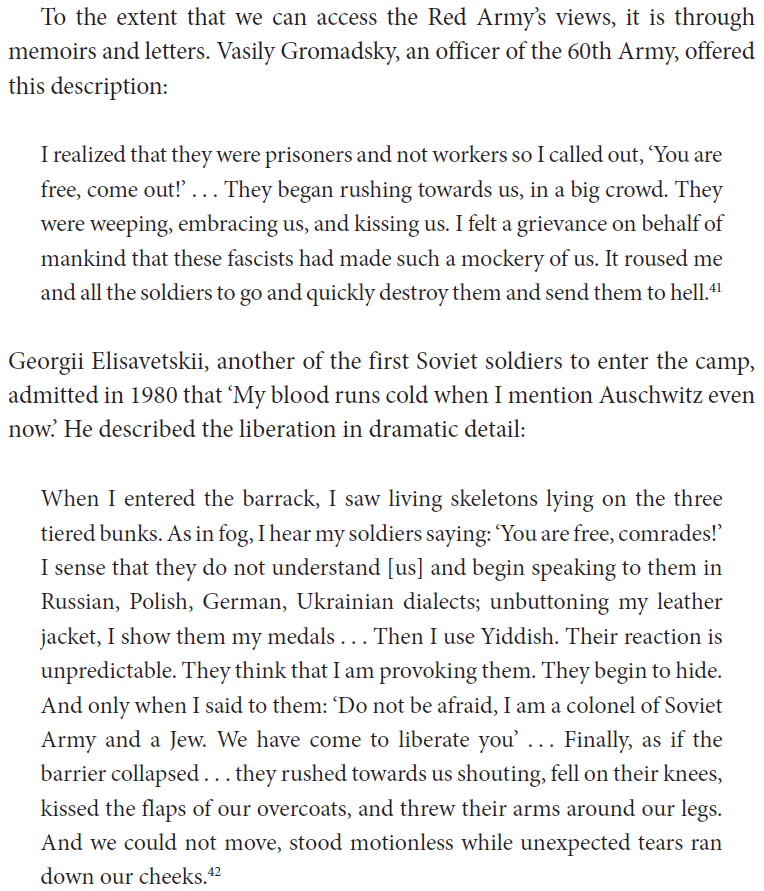
"Do not be afraid, I am a colonel of the Soviet army and a Jew. We have come to liberate you."
80 years ago today, the Red Army liberated Auschwitz. In the passage below, two Russian soldiers describe the heartwrenching moment in which the prisoners — "living skeletons" — greeted their arrival.
Over a million people were systematically destroyed in the camp. First their humanity was torn from them; then their lives. "[O]ur language," Auschwitz survivor Primo Levi wrote, "lacks words to express this offence, the demolition of a man... [N]o human condition is more miserable than this, nor could it conceivably be so."
This year, ahead of the anniversary, the EU parliament adopted a resolution banning Soviet symbols. Russia was barred from attending the commemorations, with the Holocaust museum saying that its "presence would be cynical". Meanwhile, the authors of our generation's holocaust in Gaza were not only invited, but offered immunity from arrest by the Polish government, despite the warrants issued by the International Criminal Court.
In this way, Europe rewrites its history. It weaponises Holocaust remembrance to provide cover for the same kind of colonial logic that produced Nazism. And it erases the legacy of those who most forcefully resisted it. The implication could not be clearer: until we dismantle the material basis of fascism and colonialism, "remembrance" will remain a pernicious rhetorical device.
To remember, I turn again to Primo Levi, who saw dignity in the Soviet resistance to German aggression, and in that dignity the reason for its ultimate victory:
"And yet, under their slovenly and anarchical appearance, it was easy to see in them, in each of those rough and open faces, the good soldiers of the Red Army, the valiant men of the old and new Russia, gentle in peace and fierce in war, strong from an inner discipline born from concord, from reciprocal love and from love of their country; a stronger discipline, because it came from the spirit, than the mechanical and servile discipline of the Germans. It was easy to understand, living among them, why this former discipline, and not the latter, had finally triumphed.”
These words could very well have been written about the Palestinian resistance today.