I’ve followed markets for years but never had a place to publicly document my thinking.
That is changing here.
I’m a finance student interested in investing, business, and how AI can make companies more efficient.
I’ll be sharing:
• Companies I’m researching
• Market and investing thoughts
• Finance + AI workflows
• What I learn while building something of my own
The goal is simple: become a better investor, operator, and builder while keeping a public record of the process.
U.S. retail sales just slowed from +0.8% to +0.2%.
But the headline is hiding something.
Take out autos and sales still grew 0.6%.
That’s why I think reacting to one economic headline is dangerous.
The first number tells you spending slowed.
The breakdown tells you WHERE.
Consumers pulled back on vehicles and other big-ticket purchases, while underlying spending held up better than the headline suggests.
And there’s another important detail:
Retail sales are reported in dollars, not adjusted for inflation.
So higher sales do not automatically mean consumers bought more stuff.
When economic data drops, I try to ask 3 questions:
What drove the headline?
What happens when you remove volatile categories?
And is the growth real, or partly higher prices?
The headline gets the attention.
The breakdown tells the story.
A company can spend BILLIONS buying back stock...
and barely reduce its share count.
This is something I think investors overlook all the time.
When management announces a huge buyback, the headline sounds bullish.
But the dollar amount alone tells you almost nothing.
What I actually want to know is:
Did shares outstanding go down?
Because a company can issue large amounts of stock-based compensation to employees while simultaneously buying shares back.
Imagine this:
A company spends $5B on buybacks.
Sounds great.
But it also issues $4B worth of stock compensation.
The economic benefit to existing shareholders is nowhere near what the $5B headline suggests.
Then there’s valuation.
Buying back undervalued shares can create significant value.
Buying back extremely expensive shares can destroy it.
So when I see a buyback announcement, I don’t stop at:
“How much are they spending?”
I ask:
Is the share count actually falling?
At what valuation are they repurchasing shares?
How much stock-based compensation is offsetting the buyback?
And could that cash earn a higher return somewhere else?
Buybacks aren’t automatically bullish.
Capital allocation is what matters.
Tyson guided revenue DOWN.
The stock jumped roughly 10%.
That sounds completely backwards until you understand how markets actually work.
$TSN expects fiscal 2027 revenue to decline 3.5% to 5.5%.
Analysts were expecting a much smaller decline.
Yet investors sent the stock higher.
Why?
Because the part of the business investors were most worried about may finally be improving.
Tyson’s beef segment lost $654M in fiscal 2026.
For 2027, management now expects somewhere between a $300M loss and $100M of profit.
That is a massive improvement in the trajectory of the business.
They also beat quarterly EPS expectations:
$0.61 actual
$0.58 expected
This is a perfect example of why investing is not as simple as:
Good news = stock goes up
Bad news = stock goes down
Markets care about expectations.
More specifically, they care about the CHANGE in expectations.
Revenue can fall while the stock rises if investors suddenly believe future profitability will be better than previously assumed.
Sometimes the most important number in an earnings report isn’t the headline growth rate.
It’s the number that changes the story.
Late night investing thought:
The market constantly makes you feel like you need to do something.
Buy.
Sell.
Rotate.
Take profits.
Buy the dip.
Chase what’s working.
But sometimes the highest-value decision is doing absolutely nothing.
If the business is still executing, the thesis is intact, valuation is reasonable, and your time horizon hasn’t changed, a red week probably shouldn’t change your strategy.
Activity feels productive.
Patience usually doesn’t.
But investing rewards being right over long periods much more than being busy every day.
A good portfolio shouldn’t need constant attention.
It should need constant understanding.
Anthropic’s IPO could be one of the best investing lessons of 2026.
The offering is reportedly massively oversubscribed.
That sounds bullish.
But here’s the question I care about:
Does huge demand for an IPO make the stock a good investment?
Not necessarily.
There are 3 separate things happening:
Anthropic can be an incredible company.
Investors can be incredibly excited to own it.
The stock can STILL be overpriced.
All three can be true at the same time.
At a valuation around $1T+, you’re not buying an unknown AI startup anymore.
You’re buying a company where the market is already expecting enormous future success.
That changes the question from:
“Will Anthropic grow?”
to:
“How much growth is already priced in?”
I’d want to understand:
• How quickly revenue can compound
• How much of that revenue eventually becomes FCF
• How durable Claude’s competitive advantage really is
• How much compute spending is required to maintain growth
• Whether AI models eventually become commoditized
• How much dilution shareholders could face
• What valuation makes sense under conservative assumptions
Anthropic could become one of the most important companies in the world.
But investing isn’t about identifying great companies.
It’s about identifying the gap between what a company becomes and what the market already expects it to become.
That gap matters more than the hype.
Fast growth can hide a terrible investment.
Revenue growth gets all the attention.
But growth only creates value if the economics underneath it are good.
A company can grow 40% and still be destroying shareholder value if:
• margins are collapsing
• free cash flow is weak
• dilution is excessive
• customer acquisition is too expensive
• returns on invested capital are poor
• growth requires constant outside funding
That’s why I don’t think “How fast is this company growing?” is enough.
A better question is:
“How valuable is each new dollar of growth?”
If a business can grow revenue while:
• expanding margins
• increasing FCF per share
• reinvesting at high returns
• maintaining a strong balance sheet
that growth is much more valuable.
Growth is not the goal.
Value creation is.
Sometimes the slower-growing company is actually the better investment.
A company can report AMAZING results and the stock can still get destroyed.
That confused me when I first started investing.
Then I realized:
Stocks don’t trade on whether the results were good.
They trade on whether the results were better or worse than what investors already expected.
Imagine a company reports:
• Revenue +30%
• EPS +35%
• Record free cash flow
• Higher margins
• Strong guidance
Sounds bullish.
But what if investors were expecting 40% growth?
The business performed incredibly well.
The stock can still fall.
Now flip it.
A struggling company reports:
• Revenue -5%
• Lower profits
• Weak margins
But investors expected revenue to fall 15%.
The stock might rally.
This is why one of the most important questions in investing is:
“What does the current price already assume?”
You’re not just trying to predict whether a company will perform well.
You’re trying to figure out whether it will perform BETTER than the expectations embedded in its valuation.
Great results ≠ great stock returns.
The gap between expectations and reality is what moves markets.
A stock can go up for a hundred different reasons in the short term.
Over the long term, I keep coming back to 3 things:
Free cash flow per share grows
Not just total FCF.
If a company grows cash flow 15% but dilutes shareholders 10%, the economics per share are much less impressive.
The business can reinvest at high returns
The best companies don’t just generate cash.
They have attractive places to put that cash back to work.
More customers.
New products.
Geographic expansion.
Higher capacity.
Better technology.
The longer they can reinvest at high returns, the longer compounding can continue.
You don’t massively overpay
A great business can still produce a bad return if the valuation already assumes years of perfection.
That’s why I think about investing as:
Business quality
FCF growth
reinvestment runway
valuation
The stock price will be noisy.
The underlying business is what I’m trying to follow.
If those four things keep improving, I’m usually much less concerned about what the stock did this week.
You can lose a TON of money buying one of the best companies in the world.
That sounds wrong.
But a great company and a great investment are NOT the same thing.
Imagine a business that:
• grows revenue 25% a year
• expands margins
• generates huge free cash flow
• dominates its industry
• has incredible management
Sounds like an obvious buy.
Not necessarily.
If the stock price already assumes all of that success, your future return can still be terrible.
This is why valuation matters.
When I look at a stock, I try to separate two questions:
Is this an incredible business?
What am I being asked to pay for it?
Then I think about what has to happen for today’s valuation to make sense.
How fast does revenue need to grow?
Where do margins need to go?
How much free cash flow could the business generate?
How long can that growth realistically continue?
And most importantly:
How much of that future success is already priced in?
Sometimes the best investment isn’t the company with the best story.
It’s the company where reality ends up being better than expectations.
That difference is where a lot of money gets made.
One valuation metric I think more investors should understand:
Free Cash Flow Yield.
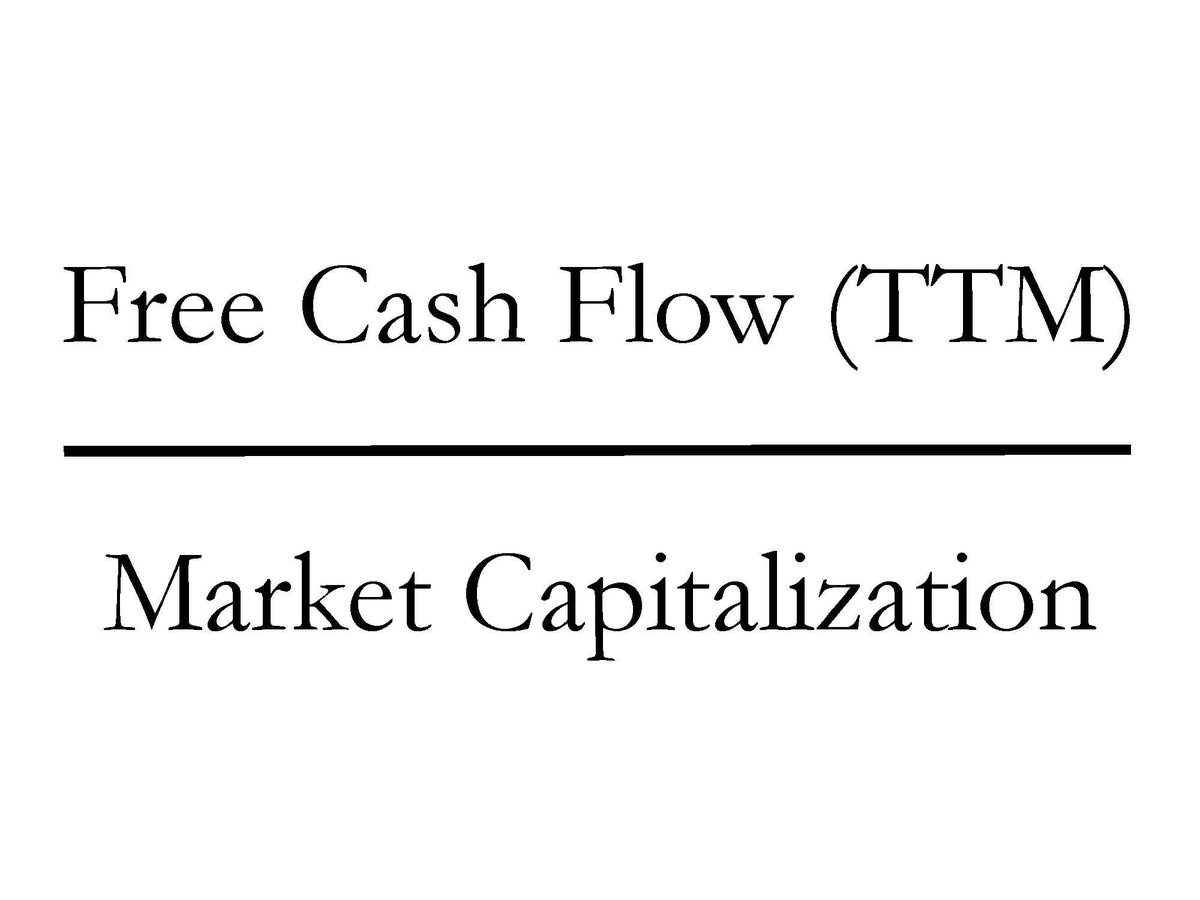
Formula:
FCF Yield = Free Cash Flow ÷ Market Cap
Example:
A company generates $10B in annual free cash flow and has a $200B market cap.
$10B ÷ $200B = 5% FCF yield.
Why does that matter?
It tells you how much cash the business is generating relative to what investors are paying for the entire company.
Think of it like this:
2% FCF yield = you’re paying a very high price for current cash flow.
5% FCF yield = more cash generation relative to valuation.
10% FCF yield = potentially cheap, but you need to understand why.
A low FCF yield is not automatically bad.
A company growing FCF 30% per year can deserve a much higher valuation than one with flat or declining cash flow.
And a high FCF yield is not automatically good.
Sometimes the market expects cash flow to collapse.
That’s why I like thinking about valuation as:
Current FCF yield + future FCF growth + business quality.
The goal isn’t just to find a low multiple.
It’s to figure out how much future cash flow you’re getting for the price you’re paying.